Protection of Inverter Based
Microgrids
EN 406 Seminar
Department of Energy Science and Engineering
IIT Bombay
Satya Sahoo
16D170026
System protection
Protection of the grid, and their constituents from abnormal conditions generated
artificially or naturally.
System Protection
● Under-frequency
● Out of step protection
● Islanding protection
● Rate of change of frequency
● Reverse Power Flow
● Voltage Surge
Apparatus Protection
● Transmission line
● Transformer
● Motor
● Busbar
● Generator
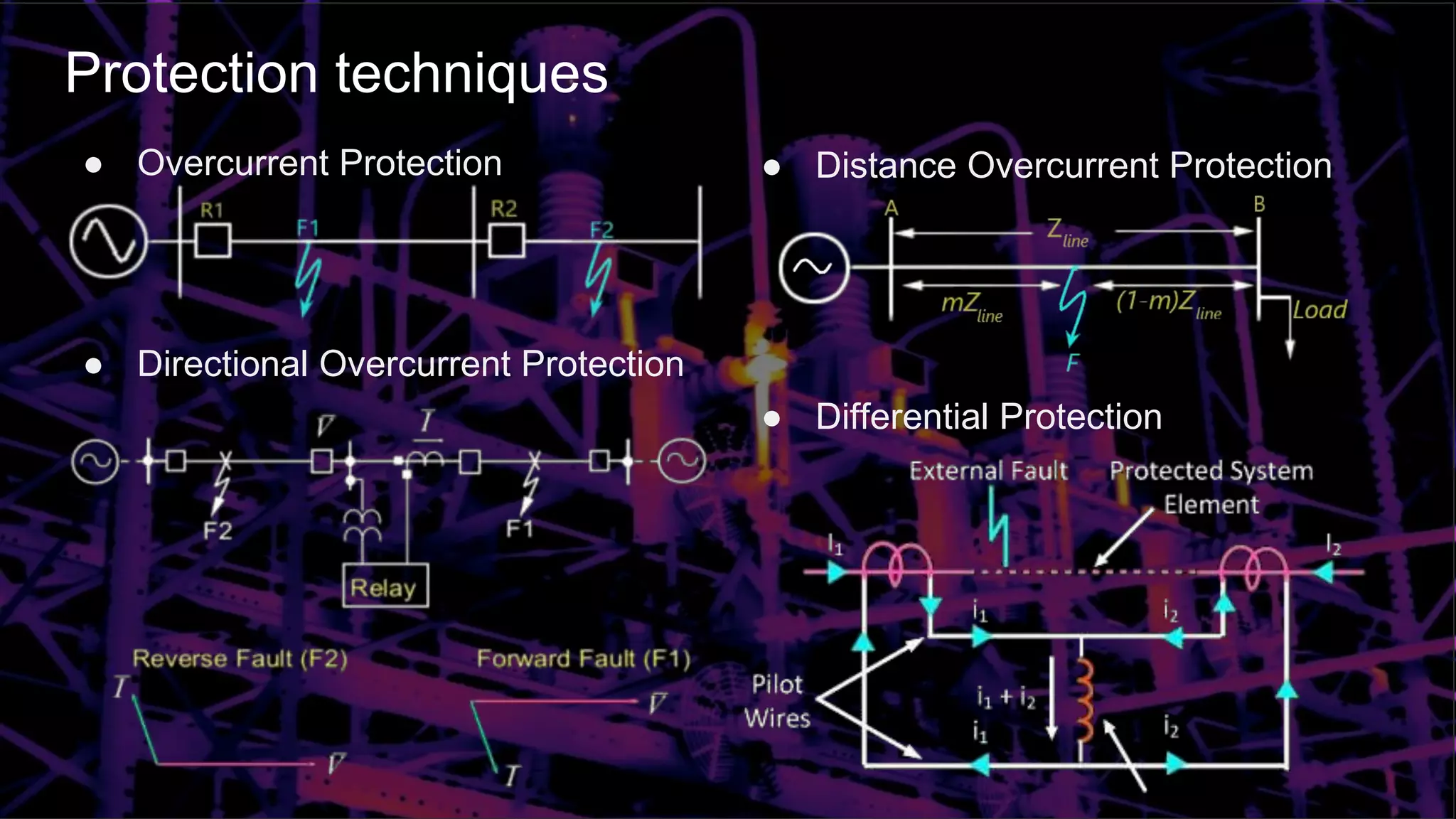
Protection techniques
● Overcurrent Protection
● Directional Overcurrent Protection
● Distance Overcurrent Protection
● Differential Protection
Microgrids
A microgrid consists of a group of interconnected loads and DERs with clearly
defined electrical boundaries which can be operated as a single standalone
controllable entity and can be operated either grid-interconnected or grid-isolated
● Decentralized generation
● Interconnected system
● Multiple operating modes
Operation
● Grid-connected
● Islanded
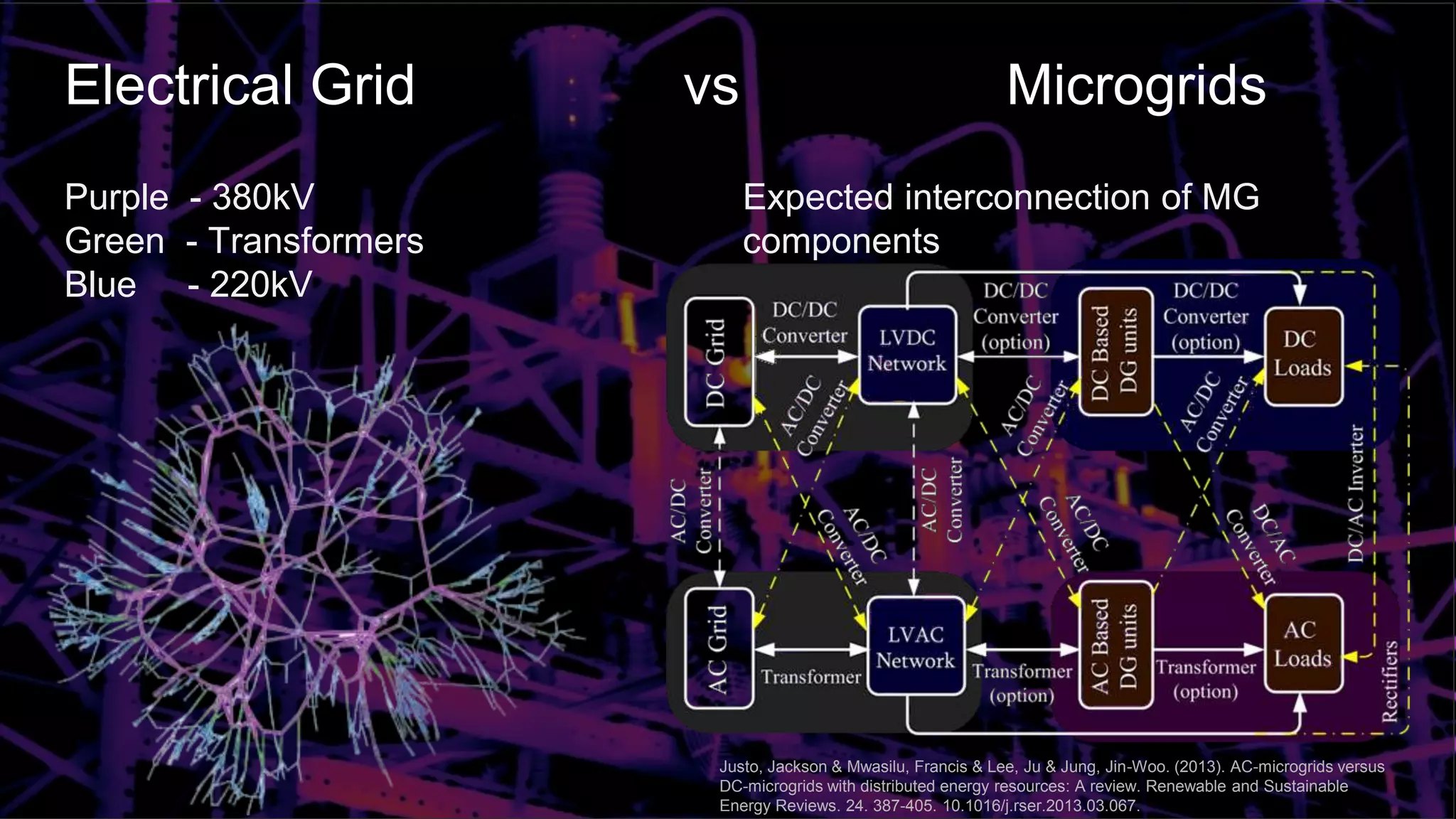
Purple - 380kV
Green - Transformers
Blue - 220kV
Electrical Grid vs Microgrids
Expected interconnection of MG
components
Justo, Jackson & Mwasilu, Francis & Lee, Ju & Jung, Jin-Woo. (2013). AC-microgrids versus
DC-microgrids with distributed energy resources: A review. Renewable and Sustainable
Energy Reviews. 24. 387-405. 10.1016/j.rser.2013.03.067.
Challenges in Microgrid Protection
● Bidirectional power flow
● Operating modes & corresponding behaviour
● Estimation of fault current levels
● Blinding of protection
● Sympathetic Tripping
● Dynamic nature of microgrids
● Grounding topologies
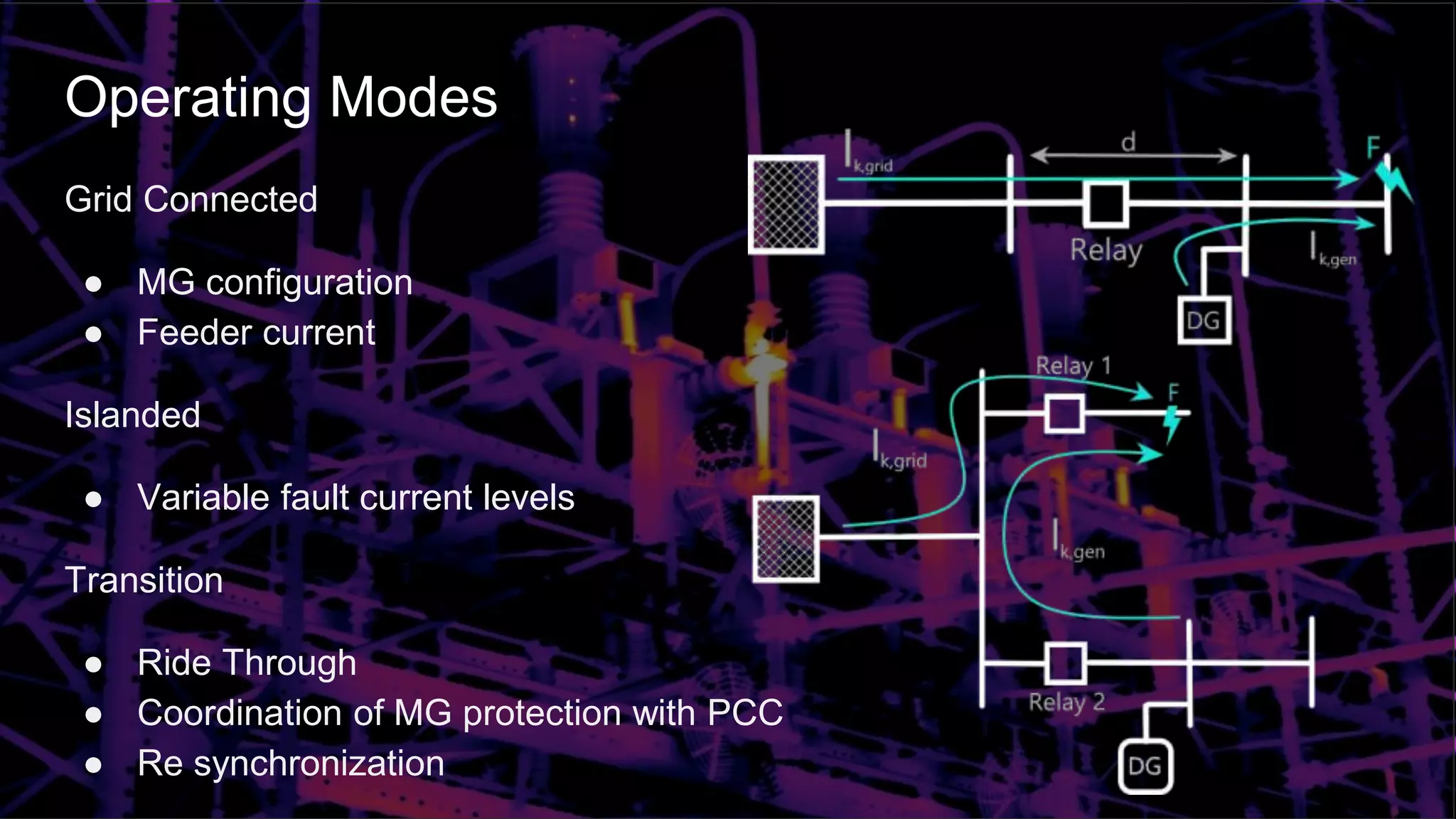
Operating Modes
Grid Connected
● MG configuration
● Feeder current
Islanded
● Variable fault current levels
Transition
● Ride Through
● Coordination of MG protection with PCC
● Re synchronization
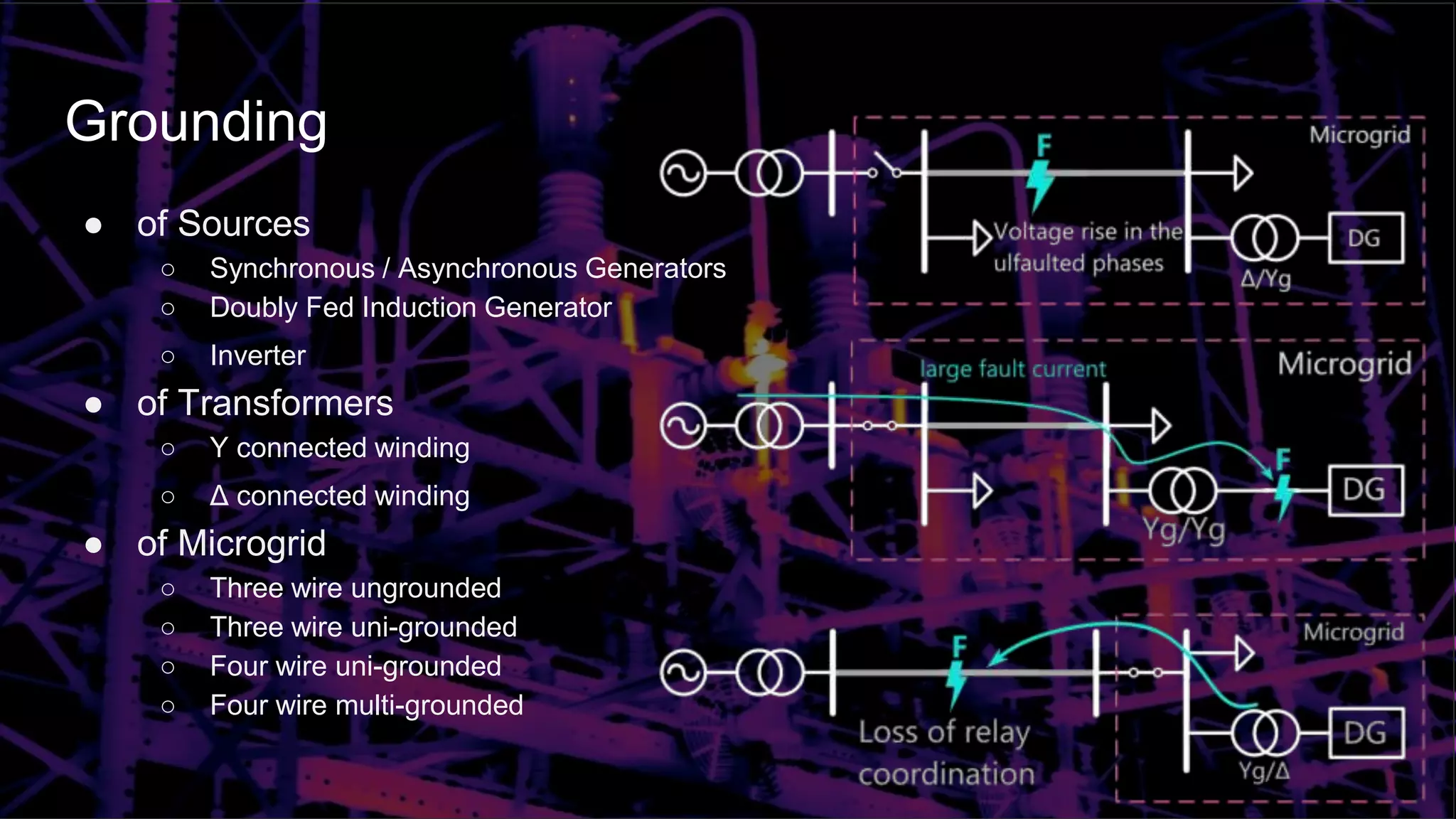
Grounding
● of Sources
○ Synchronous / Asynchronous Generators
○ Doubly Fed Induction Generator
○ Inverter
● of Transformers
○ Y connected winding
○ Δ connected winding
● of Microgrid
○ Three wire ungrounded
○ Three wire uni-grounded
○ Four wire uni-grounded
○ Four wire multi-grounded
Proposed Schemes
For Islanded Mode
● Harmonic content based protection scheme
○ THD and frequency measurement of converter voltages, communication link between relays
○ Difficult to assess THD threshold values
● Voltage based protection scheme
○ abc-dq0 transformation of DGs output voltages and communication link between relays
○ Single-pole tripping and high impedance faults are not considered
● Symmetrical component and residual current based scheme
○ OC relays, static switch at PCC, zoning principle
○ three phase and high impedance faults and single pole tripping not considered
● Adaptive protection scheme
○ IEDs (voltage, current, directional OC measurements with interlocking), high speed
communication link, zoning.
○ Complex
Proposed Schemes
For both islanded and grid connected mode
● Adaptive directional overcurrent protection
○ Numerical directional OC relays with directional interlocking capability
● Current travelling waves based scheme
○ Busbar voltages for faults detection and current travelling waves for fault location
● Multi-agent protection schemes
○ Network zoning, IEDs, communication link, wavelet coefficients of transient current for fault
location
● Inverse-time admittance- based protection scheme
○ Inverse–time admittance relay, directional element, zoning
● Pattern recognition based scheme
○ Time-frequency transform (S-transform), spectral energy contours, calculation of differential
energy
Future
By expectation, the protection systems of microgrid interfaced grids, which will
mostly be dominated by inverter based systems will most likely have one or more
of the below features:
● Communication b/w relays and other system elements
● ML based adaptive protection schemes
● Complex signal processing and analysis
● Fast response times
References
[1] IEEE recommended practice for grounding of industrial and commercial power systems. IEEE Std 142-2007 (Revision of IEEE Std
142-1991), pages 1–225, Nov 2007.
[2] H Al-Nasseri and MA Redfern. A new voltage based relay scheme to protect microgrids dominated by embedded generation using
solid state converters. In 19th International Conference Electricity Distribution, pages 1–4, 2007.
[3] Belwin J Brearley and R Raja Prabu. A review on issues and approaches for microgrid protection. Renewable and Sustainable
Energy Reviews, 67:988–997, 2017.
[4] G Buigues, A Dysko, V Valverde, I Zamora, and E Fern´andez. Microgrid protection: Technical challenges and existing techniques.
In International Conference on Renewable Energies and Power Quality, volume 1, pages 222–227, 2013.
[5] E. Casagrande, W. L. Woon, H. H. Zeineldin, and D. Svetinovic. A differential sequence component protection scheme for
microgrids with inverter-based distributed generators. IEEE Transactions on Smart Grid, 5(1):29–37, Jan 2014.
[6] E. A. A. Coelho, P. C. Cortizo, and P. F. D. Garcia. Small-signal stability for parallel-connected inverters in stand-alone ac supply
systems. IEEE Transactions on Industry Applications, 38(2):533–542, March 2002.
[7] Y. Han, X. Hu, and D. Zhang. Study of adaptive fault current algorithm for microgrid dominated by inverter based distributed
generators. In The 2nd International Symposium on Power Electronics for Distributed Generation Systems, pages 852– 854, June
2010.
[8] Seyed Amir Hosseini, Hossein Askarian Abyaneh, Seyed Hossein Hesamedin Sadeghi, Farzad Razavi, and Adel Nasiri. An
overview of microgrid protection methods and the factors involved. Renewable and Sustainable Energy Reviews, 64:174–186, 2016.
References (cotd.)
[9] Patrick Tendayi Manditereza and Ramesh Bansal. Renewable distributed generation: The hidden challenges–a review from the
protection perspective. Renewable and Sustainable Energy Reviews, 58:1457–1465, 2016.
[10] Aushiq Ali Memon and Kimmo Kauhaniemi. A critical review of ac microgrid protection issues and available solutions. Electric
Power Systems Research, 129:23–31, 2015. 22
[11] D. P. Mishra, S. R. Samantaray, and G. Joos. A combined wavelet and data-mining based intelligent protection scheme for
microgrid. IEEE Transactions on Smart Grid, 7(5):2295–2304, Sep. 2016.
[12] J. Mohammadi, F. Badrkhani Ajaei, and G. Stevens. Grounding the ac microgrid. IEEE Transactions on Industry Applications,
55(1):98–105, Jan 2019.
[13] H. Nikkhajoei and R. H. Lasseter. Microgrid protection. In 2007 IEEE Power Engineering Society General Meeting, pages 1–6,
June 2007.
[14] Nagaraju Pogaku, Milan Prodanovic, and Timothy C Green. Modeling, analysis and testing of autonomous operation of an inverter-
based microgrid. IEEE Transactions on power electronics, 22(2):613–625, 2007.
[15] Power System Relaying and Control Committee Subcommittee C Working Group C30. Microgrid Protection Systems. IEEE Power
Energy Society, July 2019.
[16] S.A. Soman. Digital protection of power systems. https://nptel.ac.in/courses/ 108101039/.

Protection of inverter based microgrids

  • 1.
    Protection of InverterBased Microgrids EN 406 Seminar Department of Energy Science and Engineering IIT Bombay Satya Sahoo 16D170026
  • 2.
    System protection Protection ofthe grid, and their constituents from abnormal conditions generated artificially or naturally. System Protection ● Under-frequency ● Out of step protection ● Islanding protection ● Rate of change of frequency ● Reverse Power Flow ● Voltage Surge Apparatus Protection ● Transmission line ● Transformer ● Motor ● Busbar ● Generator
  • 3.
    Protection techniques ● OvercurrentProtection ● Directional Overcurrent Protection ● Distance Overcurrent Protection ● Differential Protection
  • 4.
    Microgrids A microgrid consistsof a group of interconnected loads and DERs with clearly defined electrical boundaries which can be operated as a single standalone controllable entity and can be operated either grid-interconnected or grid-isolated ● Decentralized generation ● Interconnected system ● Multiple operating modes Operation ● Grid-connected ● Islanded
  • 5.
    Purple - 380kV Green- Transformers Blue - 220kV Electrical Grid vs Microgrids Expected interconnection of MG components Justo, Jackson & Mwasilu, Francis & Lee, Ju & Jung, Jin-Woo. (2013). AC-microgrids versus DC-microgrids with distributed energy resources: A review. Renewable and Sustainable Energy Reviews. 24. 387-405. 10.1016/j.rser.2013.03.067.
  • 6.
    Challenges in MicrogridProtection ● Bidirectional power flow ● Operating modes & corresponding behaviour ● Estimation of fault current levels ● Blinding of protection ● Sympathetic Tripping ● Dynamic nature of microgrids ● Grounding topologies
  • 7.
    Operating Modes Grid Connected ●MG configuration ● Feeder current Islanded ● Variable fault current levels Transition ● Ride Through ● Coordination of MG protection with PCC ● Re synchronization
  • 8.
    Grounding ● of Sources ○Synchronous / Asynchronous Generators ○ Doubly Fed Induction Generator ○ Inverter ● of Transformers ○ Y connected winding ○ Δ connected winding ● of Microgrid ○ Three wire ungrounded ○ Three wire uni-grounded ○ Four wire uni-grounded ○ Four wire multi-grounded
  • 9.
    Proposed Schemes For IslandedMode ● Harmonic content based protection scheme ○ THD and frequency measurement of converter voltages, communication link between relays ○ Difficult to assess THD threshold values ● Voltage based protection scheme ○ abc-dq0 transformation of DGs output voltages and communication link between relays ○ Single-pole tripping and high impedance faults are not considered ● Symmetrical component and residual current based scheme ○ OC relays, static switch at PCC, zoning principle ○ three phase and high impedance faults and single pole tripping not considered ● Adaptive protection scheme ○ IEDs (voltage, current, directional OC measurements with interlocking), high speed communication link, zoning. ○ Complex
  • 10.
    Proposed Schemes For bothislanded and grid connected mode ● Adaptive directional overcurrent protection ○ Numerical directional OC relays with directional interlocking capability ● Current travelling waves based scheme ○ Busbar voltages for faults detection and current travelling waves for fault location ● Multi-agent protection schemes ○ Network zoning, IEDs, communication link, wavelet coefficients of transient current for fault location ● Inverse-time admittance- based protection scheme ○ Inverse–time admittance relay, directional element, zoning ● Pattern recognition based scheme ○ Time-frequency transform (S-transform), spectral energy contours, calculation of differential energy
  • 11.
    Future By expectation, theprotection systems of microgrid interfaced grids, which will mostly be dominated by inverter based systems will most likely have one or more of the below features: ● Communication b/w relays and other system elements ● ML based adaptive protection schemes ● Complex signal processing and analysis ● Fast response times
  • 12.
    References [1] IEEE recommendedpractice for grounding of industrial and commercial power systems. IEEE Std 142-2007 (Revision of IEEE Std 142-1991), pages 1–225, Nov 2007. [2] H Al-Nasseri and MA Redfern. A new voltage based relay scheme to protect microgrids dominated by embedded generation using solid state converters. In 19th International Conference Electricity Distribution, pages 1–4, 2007. [3] Belwin J Brearley and R Raja Prabu. A review on issues and approaches for microgrid protection. Renewable and Sustainable Energy Reviews, 67:988–997, 2017. [4] G Buigues, A Dysko, V Valverde, I Zamora, and E Fern´andez. Microgrid protection: Technical challenges and existing techniques. In International Conference on Renewable Energies and Power Quality, volume 1, pages 222–227, 2013. [5] E. Casagrande, W. L. Woon, H. H. Zeineldin, and D. Svetinovic. A differential sequence component protection scheme for microgrids with inverter-based distributed generators. IEEE Transactions on Smart Grid, 5(1):29–37, Jan 2014. [6] E. A. A. Coelho, P. C. Cortizo, and P. F. D. Garcia. Small-signal stability for parallel-connected inverters in stand-alone ac supply systems. IEEE Transactions on Industry Applications, 38(2):533–542, March 2002. [7] Y. Han, X. Hu, and D. Zhang. Study of adaptive fault current algorithm for microgrid dominated by inverter based distributed generators. In The 2nd International Symposium on Power Electronics for Distributed Generation Systems, pages 852– 854, June 2010. [8] Seyed Amir Hosseini, Hossein Askarian Abyaneh, Seyed Hossein Hesamedin Sadeghi, Farzad Razavi, and Adel Nasiri. An overview of microgrid protection methods and the factors involved. Renewable and Sustainable Energy Reviews, 64:174–186, 2016.
  • 13.
    References (cotd.) [9] PatrickTendayi Manditereza and Ramesh Bansal. Renewable distributed generation: The hidden challenges–a review from the protection perspective. Renewable and Sustainable Energy Reviews, 58:1457–1465, 2016. [10] Aushiq Ali Memon and Kimmo Kauhaniemi. A critical review of ac microgrid protection issues and available solutions. Electric Power Systems Research, 129:23–31, 2015. 22 [11] D. P. Mishra, S. R. Samantaray, and G. Joos. A combined wavelet and data-mining based intelligent protection scheme for microgrid. IEEE Transactions on Smart Grid, 7(5):2295–2304, Sep. 2016. [12] J. Mohammadi, F. Badrkhani Ajaei, and G. Stevens. Grounding the ac microgrid. IEEE Transactions on Industry Applications, 55(1):98–105, Jan 2019. [13] H. Nikkhajoei and R. H. Lasseter. Microgrid protection. In 2007 IEEE Power Engineering Society General Meeting, pages 1–6, June 2007. [14] Nagaraju Pogaku, Milan Prodanovic, and Timothy C Green. Modeling, analysis and testing of autonomous operation of an inverter- based microgrid. IEEE Transactions on power electronics, 22(2):613–625, 2007. [15] Power System Relaying and Control Committee Subcommittee C Working Group C30. Microgrid Protection Systems. IEEE Power Energy Society, July 2019. [16] S.A. Soman. Digital protection of power systems. https://nptel.ac.in/courses/ 108101039/.