Distributed Control
Techniques in Micro-Grid
- Shivang Rana (14bee099)
CTPS Innovative Assignment
Guide : Prof. Sarika Kanojiya
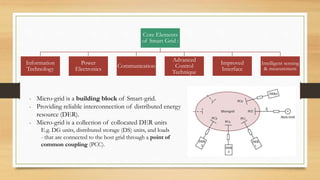
Core Elements
of Smart Grid :
Information
Technology
Power
Electronics
Communication
Advanced
Control
Technique
Improved
Interface
Intelligent sensing
& measurement
- Micro-grid is a building block of Smart-grid.
- Providing reliable interconnection of distributed energy
resource (DER).
- Micro-grid is a collection of collocated DER units
E.g. DG units, distributed storage (DS) units, and loads
- that are connected to the host grid through a point of
common coupling (PCC).
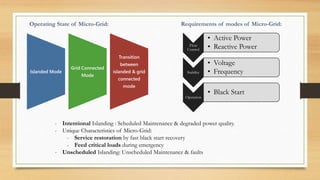
Islanded Mode
Grid Connected
Mode
Transition
between
islanded & grid
connected
mode
Flow
Control
• Active Power
• Reactive Power
Stability
• Voltage
• Frequency
Operation
• Black Start
- Intentional Islanding : Scheduled Maintenance & degraded power quality.
- Unique Characteristics of Micro-Grid:
- Service restoration by fast black start recovery
- Feed critical loads during emergency
- Unscheduled Islanding: Unscheduled Maintenance & faults
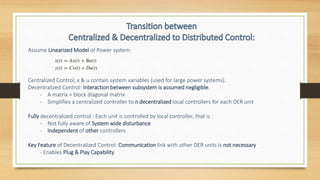
Assume Linearized Model of Power system:
Centralized Control, x & u contain system variables (used for large power systems).
Decentralized Control: Interaction between subsystem is assumed negligible.
- A matrix = block diagonal matrix
- Simplifies a centralized controller to n decentralized local controllers for each DER unit
Fully decentralized control : Each unit is controlled by local controller, that is :
- Not fully aware of System wide disturbance
- Independent of other controllers
Key Feature of Decentralized Control: Communication link with other DER units is not necessary
- Enables Plug & Play Capability
- Decentralized control of DER units based on droop characteristics is widely used.
- The droop method in DER units mimics the principle of power balance in synchronous generators in the
conventional grid.
- The droop method is artificially crafted for electronically interfaced DER units
- to adjust the frequency and voltage with respect to the output of DER units in islanded mode.
- The main advantage of droop control is elimination of the need for communication.
- Generally, small-scale renewable energy units such as micro wind generators and solar photovoltaic sources impact
the electromechanical stability of the grid because of
a) low inertia,
b) slow time response
c) stochastic nature.
- Furthermore, droop control scheme has several disadvantages, which limit its applicability for a modern power
system
- Proposed Modification:
a) Virtual output impedance method: to compensate voltage imbalance & decrease sensitivity to system parameters
b) Adaptive droop method : to improve transient performance, nonlinear load sharing autonomous load sharing to
achieve more rapid real power sharing without compromising frequency regulation.
- Ignoring, the interaction between subsystems may leads to significant performance deterioration.
- This necessitates using control strategies that do include the interaction between subsystems such
as distributed control.
- A distributed approach preserves the autonomy of each operator.
- Decomposing a large problem into a series of smaller problem  Using Computational
Techniques : Feasible
- Using Distributed Control Technique:
a) Cost of communication is truncated.
b) There is no need of whole shutdown for adding newer units or modifying Micro-Grid.
c) Tuning or readjustments is real easy.
Overview of Distributed Techniques
Distributed Model Predictive Control Based
Consensus Based
Agent Based
Decomposition based
Aim: To solve the optimization problem in a distributed manner with availability of communication
Different Techniques have different problem formulation & approaches.
Distributed Model Predictive Control Based
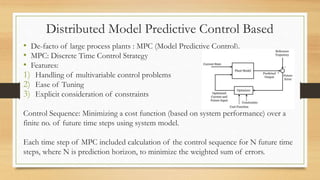
• De-facto of large process plants : MPC (Model Predictive Control).
• MPC: Discrete Time Control Strategy
• Features:
1) Handling of multivariable control problems
2) Ease of Tuning
3) Explicit consideration of constraints
Control Sequence: Minimizing a cost function (based on system performance) over a
finite no. of future time steps using system model.
Each time step of MPC included calculation of the control sequence for N future time
steps, where N is prediction horizon, to minimize the weighted sum of errors.
• Using this model in a MPC scheme, this method predicts the voltage profile in the next
time steps and adjusts the voltage and reactive power set points to achieve a smooth
voltage profile.
• Optimization problem for the control of the DG units of the Micro-grid is decomposed
into
1. Transient sub-problem
2. Steady-state sub-problem.
• This decomposition allows solving the steady-state sub-problem in a
 Slower time frame
 Reduces the computational burden.
Consensus-Based Technique
• Each unit is fully aware of the global objective function.
• Consensus is an approach for solving distributed optimization problems and offers a
flexible formulation that has promise for extend-ability and scalability.
• The goal of consensus is to have different DER units converge to a single value.
• A consensus-based approach achieves global optimality using limited, possibly time-
varying communication between neighbour units, without needing a dedicated unit.
• In this algorithm, each agent communicates with neighbour agents to discover global
information based on the average-consensus theorem.
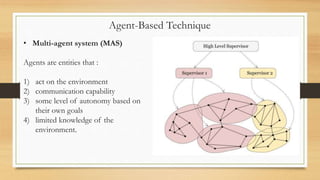
Agent-Based Technique
• Multi-agent system (MAS)
Agents are entities that :
1) act on the environment
2) communication capability
3) some level of autonomy based on
their own goals
4) limited knowledge of the
environment.
References
• G. W. Arnold:
“Challenges and opportunities in smart grid: A position article”
• Mehrdad Yazdanian, Graduate Student Member, IEEE, & Ali Mehrizi-Sani,
Member, IEEE
“Distributed Control Techniques in Micro-Grid”
THANK YOU !!!

Distributed control techniques in Micro-Grid

  • 1.
    Distributed Control Techniques inMicro-Grid - Shivang Rana (14bee099) CTPS Innovative Assignment Guide : Prof. Sarika Kanojiya
  • 2.
    Core Elements of SmartGrid : Information Technology Power Electronics Communication Advanced Control Technique Improved Interface Intelligent sensing & measurement - Micro-grid is a building block of Smart-grid. - Providing reliable interconnection of distributed energy resource (DER). - Micro-grid is a collection of collocated DER units E.g. DG units, distributed storage (DS) units, and loads - that are connected to the host grid through a point of common coupling (PCC).
  • 3.
    Islanded Mode Grid Connected Mode Transition between islanded& grid connected mode Flow Control • Active Power • Reactive Power Stability • Voltage • Frequency Operation • Black Start - Intentional Islanding : Scheduled Maintenance & degraded power quality. - Unique Characteristics of Micro-Grid: - Service restoration by fast black start recovery - Feed critical loads during emergency - Unscheduled Islanding: Unscheduled Maintenance & faults
  • 4.
    Assume Linearized Modelof Power system: Centralized Control, x & u contain system variables (used for large power systems). Decentralized Control: Interaction between subsystem is assumed negligible. - A matrix = block diagonal matrix - Simplifies a centralized controller to n decentralized local controllers for each DER unit Fully decentralized control : Each unit is controlled by local controller, that is : - Not fully aware of System wide disturbance - Independent of other controllers Key Feature of Decentralized Control: Communication link with other DER units is not necessary - Enables Plug & Play Capability
  • 5.
    - Decentralized controlof DER units based on droop characteristics is widely used. - The droop method in DER units mimics the principle of power balance in synchronous generators in the conventional grid. - The droop method is artificially crafted for electronically interfaced DER units - to adjust the frequency and voltage with respect to the output of DER units in islanded mode. - The main advantage of droop control is elimination of the need for communication. - Generally, small-scale renewable energy units such as micro wind generators and solar photovoltaic sources impact the electromechanical stability of the grid because of a) low inertia, b) slow time response c) stochastic nature. - Furthermore, droop control scheme has several disadvantages, which limit its applicability for a modern power system - Proposed Modification: a) Virtual output impedance method: to compensate voltage imbalance & decrease sensitivity to system parameters b) Adaptive droop method : to improve transient performance, nonlinear load sharing autonomous load sharing to achieve more rapid real power sharing without compromising frequency regulation.
  • 6.
    - Ignoring, theinteraction between subsystems may leads to significant performance deterioration. - This necessitates using control strategies that do include the interaction between subsystems such as distributed control. - A distributed approach preserves the autonomy of each operator. - Decomposing a large problem into a series of smaller problem  Using Computational Techniques : Feasible - Using Distributed Control Technique: a) Cost of communication is truncated. b) There is no need of whole shutdown for adding newer units or modifying Micro-Grid. c) Tuning or readjustments is real easy.
  • 7.
    Overview of DistributedTechniques Distributed Model Predictive Control Based Consensus Based Agent Based Decomposition based Aim: To solve the optimization problem in a distributed manner with availability of communication Different Techniques have different problem formulation & approaches.
  • 8.
    Distributed Model PredictiveControl Based • De-facto of large process plants : MPC (Model Predictive Control). • MPC: Discrete Time Control Strategy • Features: 1) Handling of multivariable control problems 2) Ease of Tuning 3) Explicit consideration of constraints Control Sequence: Minimizing a cost function (based on system performance) over a finite no. of future time steps using system model. Each time step of MPC included calculation of the control sequence for N future time steps, where N is prediction horizon, to minimize the weighted sum of errors.
  • 9.
    • Using thismodel in a MPC scheme, this method predicts the voltage profile in the next time steps and adjusts the voltage and reactive power set points to achieve a smooth voltage profile. • Optimization problem for the control of the DG units of the Micro-grid is decomposed into 1. Transient sub-problem 2. Steady-state sub-problem. • This decomposition allows solving the steady-state sub-problem in a  Slower time frame  Reduces the computational burden.
  • 10.
    Consensus-Based Technique • Eachunit is fully aware of the global objective function. • Consensus is an approach for solving distributed optimization problems and offers a flexible formulation that has promise for extend-ability and scalability. • The goal of consensus is to have different DER units converge to a single value. • A consensus-based approach achieves global optimality using limited, possibly time- varying communication between neighbour units, without needing a dedicated unit. • In this algorithm, each agent communicates with neighbour agents to discover global information based on the average-consensus theorem.
  • 11.
    Agent-Based Technique • Multi-agentsystem (MAS) Agents are entities that : 1) act on the environment 2) communication capability 3) some level of autonomy based on their own goals 4) limited knowledge of the environment.
  • 12.
    References • G. W.Arnold: “Challenges and opportunities in smart grid: A position article” • Mehrdad Yazdanian, Graduate Student Member, IEEE, & Ali Mehrizi-Sani, Member, IEEE “Distributed Control Techniques in Micro-Grid”
  • 13.