ORIENTAL UNIVERSITY ,
INDORE
FACULTY OF AGRICULTURE
TOPIC:GREEN HOUSE AND ITS
DIFFERENT TYPES OF STRUCTURES.
BY
AMIT LEDGAYA
OUI119BAG029
What is Green House
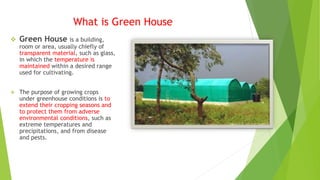
 Green House is a building,
room or area, usually chiefly of
transparent material, such as glass,
in which the temperature is
maintained within a desired range
used for cultivating.
 The purpose of growing crops
under greenhouse conditions is to
extend their cropping seasons and
to protect them from adverse
environmental conditions, such as
extreme temperatures and
precipitations, and from disease
and pests.
Types of Green House Structures
Styles of greenhouses vary widely. How they are built and what they are built
with is often the result of factors such as budget, material availability, area
of the country, crops to be grown and long term use. These are following:-
A) Based on shape
 Lean-to type greenhouse
 Even span type greenhouse
 Uneven span type greenhouse
 Ridge and furrow type greenhouse
 Saw tooth type Greenhouse
 Quonset greenhouse
C) Based on Construction
 Wooden framed structures
 Pipe framed structures
B) Based on Utility
 Greenhouses for active heating
 Greenhouses for active cooling
D) Based on Covering Material
 Glass greenhouses
 Rigid panel greenhouses
 Shading nets
 Plastic flim greenhouses
Based on shape
Lean-to type greenhouse
 A lean-to design is used when a
greenhouse is placed against the
side of an existing building.
 It is typically facing south side.
 The lean-to type greenhouse is
limited to single or double-row
plant benches with a total width of
7 to 12 feet.
Even span type greenhouse
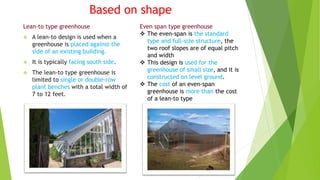
 The even-span is the standard
type and full-size structure, the
two roof slopes are of equal pitch
and width
 This design is used for the
greenhouse of small size, and it is
constructed on level ground.
 The cost of an even-span
greenhouse is more than the cost
of a lean-to type
Uneven span type greenhouse
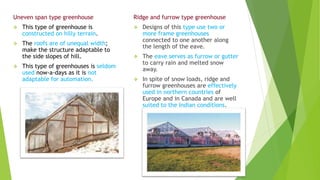
 This type of greenhouse is
constructed on hilly terrain.
 The roofs are of unequal width;
make the structure adaptable to
the side slopes of hill.
 This type of greenhouses is seldom
used now-a-days as it is not
adaptable for automation.
Ridge and furrow type greenhouse
 Designs of this type use two or
more frame greenhouses
connected to one another along
the length of the eave.
 The eave serves as furrow or gutter
to carry rain and melted snow
away.
 In spite of snow loads, ridge and
furrow greenhouses are effectively
used in northern countries of
Europe and in Canada and are well
suited to the Indian conditions.
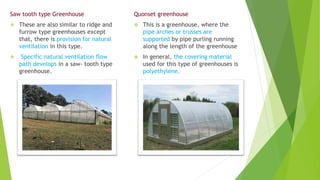
Saw tooth type Greenhouse
 These are also similar to ridge and
furrow type greenhouses except
that, there is provision for natural
ventilation in this type.
 Specific natural ventilation flow
path develops in a saw- tooth type
greenhouse.
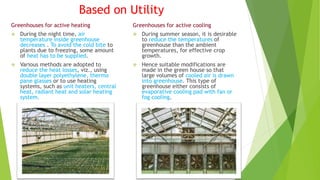
Quonset greenhouse
 This is a greenhouse, where the
pipe arches or trusses are
supported by pipe purling running
along the length of the greenhouse
 In general, the covering material
used for this type of greenhouses is
polyethylene.
Based on Utility
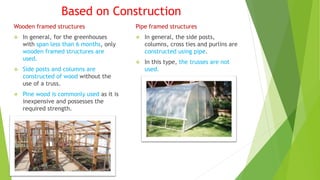
Greenhouses for active heating
 During the night time, air
temperature inside greenhouse
decreases . To avoid the cold bite to
plants due to freezing, some amount
of heat has to be supplied.
 Various methods are adopted to
reduce the heat losses, viz., using
double layer polyethylene, thermo
pane glasses or to use heating
systems, such as unit heaters, central
heat, radiant heat and solar heating
system.
Greenhouses for active cooling
 During summer season, it is desirable
to reduce the temperatures of
greenhouse than the ambient
temperatures, for effective crop
growth.
 Hence suitable modifications are
made in the green house so that
large volumes of cooled air is drawn
into greenhouse. This type of
greenhouse either consists of
evaporative cooling pad with fan or
fog cooling.
Based on Construction
Wooden framed structures
 In general, for the greenhouses
with span less than 6 months, only
wooden framed structures are
used.
 Side posts and columns are
constructed of wood without the
use of a truss.
 Pine wood is commonly used as it is
inexpensive and possesses the
required strength.
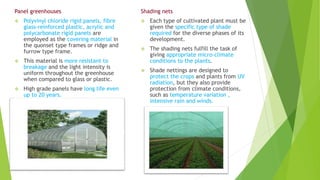
Pipe framed structures
 In general, the side posts,
columns, cross ties and purlins are
constructed using pipe.
 In this type, the trusses are not
used.
Based on Covering Material
Glass greenhouses
 Glass as covering material has the
advantage of greater interior light
intensity.
 These green houses have higher air
infiltration rate which leads to
lower interior humidity and better
disease prevention.
 Lean-to type, even span, ridge and
furrow type of designs are used for
construction of glass greenhouse.
Plastic film greenhouses
 Flexible plastic films including
polyethylene, polyester and
polyvinyl chloride are used as
covering material in this type of
greenhouses.
 Plastics as covering material for
greenhouses have become popular,
as they are cheap and the cost of
heating is less when compared to
glass greenhouses.
 The main disadvantage with plastic
films is its short life.
Panel greenhouses
 Polyvinyl chloride rigid panels, fibre
glass-reinforced plastic, acrylic and
polycarbonate rigid panels are
employed as the covering material in
the quonset type frames or ridge and
furrow type frame.
 This material is more resistant to
breakage and the light intensity is
uniform throughout the greenhouse
when compared to glass or plastic.
 High grade panels have long life even
up to 20 years.
Shading nets
 Each type of cultivated plant must be
given the specific type of shade
required for the diverse phases of its
development.
 The shading nets fulfill the task of
giving appropriate micro-climate
conditions to the plants.
 Shade nettings are designed to
protect the crops and plants from UV
radiation, but they also provide
protection from climate conditions,
such as temperature variation ,
intensive rain and winds.
GREENHOUSE

GREENHOUSE

  • 1.
    ORIENTAL UNIVERSITY , INDORE FACULTYOF AGRICULTURE TOPIC:GREEN HOUSE AND ITS DIFFERENT TYPES OF STRUCTURES. BY AMIT LEDGAYA OUI119BAG029
  • 2.
    What is GreenHouse  Green House is a building, room or area, usually chiefly of transparent material, such as glass, in which the temperature is maintained within a desired range used for cultivating.  The purpose of growing crops under greenhouse conditions is to extend their cropping seasons and to protect them from adverse environmental conditions, such as extreme temperatures and precipitations, and from disease and pests.
  • 3.
    Types of GreenHouse Structures Styles of greenhouses vary widely. How they are built and what they are built with is often the result of factors such as budget, material availability, area of the country, crops to be grown and long term use. These are following:- A) Based on shape  Lean-to type greenhouse  Even span type greenhouse  Uneven span type greenhouse  Ridge and furrow type greenhouse  Saw tooth type Greenhouse  Quonset greenhouse C) Based on Construction  Wooden framed structures  Pipe framed structures B) Based on Utility  Greenhouses for active heating  Greenhouses for active cooling D) Based on Covering Material  Glass greenhouses  Rigid panel greenhouses  Shading nets  Plastic flim greenhouses
  • 4.
    Based on shape Lean-totype greenhouse  A lean-to design is used when a greenhouse is placed against the side of an existing building.  It is typically facing south side.  The lean-to type greenhouse is limited to single or double-row plant benches with a total width of 7 to 12 feet. Even span type greenhouse  The even-span is the standard type and full-size structure, the two roof slopes are of equal pitch and width  This design is used for the greenhouse of small size, and it is constructed on level ground.  The cost of an even-span greenhouse is more than the cost of a lean-to type
  • 5.
    Uneven span typegreenhouse  This type of greenhouse is constructed on hilly terrain.  The roofs are of unequal width; make the structure adaptable to the side slopes of hill.  This type of greenhouses is seldom used now-a-days as it is not adaptable for automation. Ridge and furrow type greenhouse  Designs of this type use two or more frame greenhouses connected to one another along the length of the eave.  The eave serves as furrow or gutter to carry rain and melted snow away.  In spite of snow loads, ridge and furrow greenhouses are effectively used in northern countries of Europe and in Canada and are well suited to the Indian conditions.
  • 6.
    Saw tooth typeGreenhouse  These are also similar to ridge and furrow type greenhouses except that, there is provision for natural ventilation in this type.  Specific natural ventilation flow path develops in a saw- tooth type greenhouse. Quonset greenhouse  This is a greenhouse, where the pipe arches or trusses are supported by pipe purling running along the length of the greenhouse  In general, the covering material used for this type of greenhouses is polyethylene.
  • 7.
    Based on Utility Greenhousesfor active heating  During the night time, air temperature inside greenhouse decreases . To avoid the cold bite to plants due to freezing, some amount of heat has to be supplied.  Various methods are adopted to reduce the heat losses, viz., using double layer polyethylene, thermo pane glasses or to use heating systems, such as unit heaters, central heat, radiant heat and solar heating system. Greenhouses for active cooling  During summer season, it is desirable to reduce the temperatures of greenhouse than the ambient temperatures, for effective crop growth.  Hence suitable modifications are made in the green house so that large volumes of cooled air is drawn into greenhouse. This type of greenhouse either consists of evaporative cooling pad with fan or fog cooling.
  • 8.
    Based on Construction Woodenframed structures  In general, for the greenhouses with span less than 6 months, only wooden framed structures are used.  Side posts and columns are constructed of wood without the use of a truss.  Pine wood is commonly used as it is inexpensive and possesses the required strength. Pipe framed structures  In general, the side posts, columns, cross ties and purlins are constructed using pipe.  In this type, the trusses are not used.
  • 9.
    Based on CoveringMaterial Glass greenhouses  Glass as covering material has the advantage of greater interior light intensity.  These green houses have higher air infiltration rate which leads to lower interior humidity and better disease prevention.  Lean-to type, even span, ridge and furrow type of designs are used for construction of glass greenhouse. Plastic film greenhouses  Flexible plastic films including polyethylene, polyester and polyvinyl chloride are used as covering material in this type of greenhouses.  Plastics as covering material for greenhouses have become popular, as they are cheap and the cost of heating is less when compared to glass greenhouses.  The main disadvantage with plastic films is its short life.
  • 10.
    Panel greenhouses  Polyvinylchloride rigid panels, fibre glass-reinforced plastic, acrylic and polycarbonate rigid panels are employed as the covering material in the quonset type frames or ridge and furrow type frame.  This material is more resistant to breakage and the light intensity is uniform throughout the greenhouse when compared to glass or plastic.  High grade panels have long life even up to 20 years. Shading nets  Each type of cultivated plant must be given the specific type of shade required for the diverse phases of its development.  The shading nets fulfill the task of giving appropriate micro-climate conditions to the plants.  Shade nettings are designed to protect the crops and plants from UV radiation, but they also provide protection from climate conditions, such as temperature variation , intensive rain and winds.