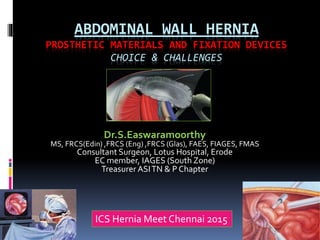

ABDOMINAL WALL HERNIA
PROSTHETIC MATERIALS AND FIXATION DEVICES
CHOICE & CHALLENGES
Dr.S.Easwaramoorthy
MS, FRCS(Edin) ,FRCS (Eng) ,FRCS (Glas), FAES, FIAGES, FMAS
Consultant Surgeon, Lotus Hospital, Erode
EC member, IAGES (South Zone)
Treasurer ASITN & P Chapter
ICS Hernia Meet Chennai 2015
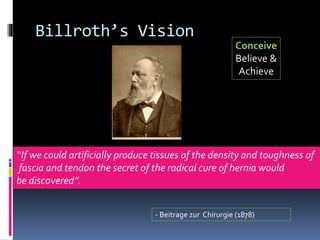
Billroth’s Vision
‘‘If we could artificially produce tissues of the density and toughness of
fascia and tendon the secret of the radical cure of hernia would
be discovered’’.
- Beitrage zur Chirurgie (1878)
Conceive
Believe &
Achieve
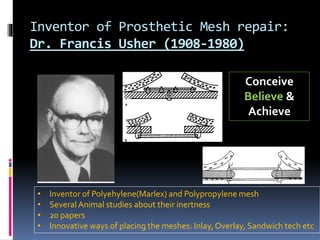
Inventor of Prosthetic Mesh repair:
Dr. Francis Usher (1908-1980)
• Inventor of Polyehylene(Marlex) and Polypropylene mesh
• Several Animal studies about their inertness
• 20 papers
• Innovative ways of placing the meshes: Inlay,Overlay, Sandwich tech etc
Conceive
Believe &
Achieve
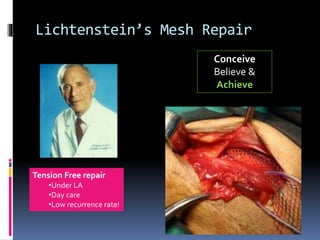
Lichtenstein’s Mesh Repair
Tension Free repair
•Under LA
•Day care
•Low recurrence rate!
Conceive
Believe &
Achieve
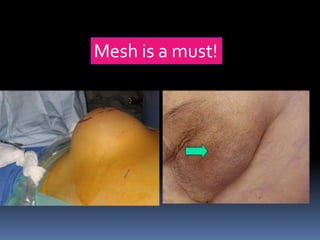
Mesh is a must!
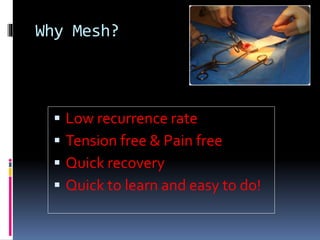
Why Mesh?
 Low recurrence rate
 Tension free & Pain free
 Quick recovery
 Quick to learn and easy to do!
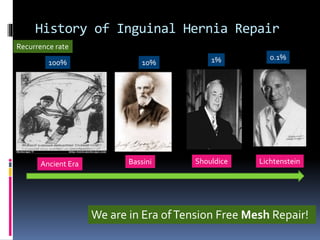
History of Inguinal Hernia Repair
We are in Era ofTension Free Mesh Repair!
10% 1% 0.1%
100%
Recurrence rate
Bassini Shouldice LichtensteinAncient Era
Why Mesh?
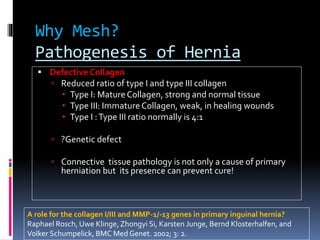
Pathogenesis of Hernia
 Defective Collagen
 Reduced ratio of type I and type III collagen
 Type I: MatureCollagen, strong and normal tissue
 Type III: ImmatureCollagen, weak, in healing wounds
 Type I :Type III ratio normally is 4:1
 ?Genetic defect
 Connective tissue pathology is not only a cause of primary
herniation but its presence can prevent cure!
A role for the collagen I/III and MMP-1/-13 genes in primary inguinal hernia?
Raphael Rosch, Uwe Klinge, Zhongyi Si, Karsten Junge, Bernd Klosterhalfen, and
Volker Schumpelick, BMC Med Genet. 2002; 3: 2.
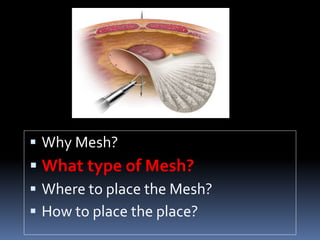
 Why Mesh?
 What type of Mesh?
 Where to place the Mesh?
 How to place the place?
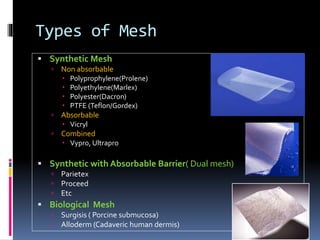
Types of Mesh
 Synthetic Mesh
 Non absorbable
 Polyprophylene(Prolene)
 Polyethylene(Marlex)
 Polyester(Dacron)
 PTFE (Teflon/Gordex)
 Absorbable
 Vicryl
 Combined
 Vypro, Ultrapro
 Synthetic with Absorbable Barrier( Dual mesh)
 Parietex
 Proceed
 Etc
 Biological Mesh
 Surgisis ( Porcine submucosa)
 Alloderm (Cadaveric human dermis)
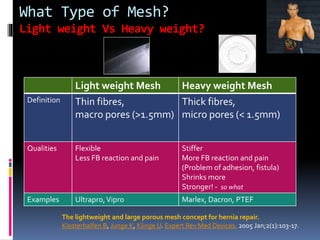
What Type of Mesh?
Light weight Vs Heavy weight?
Light weight Mesh Heavy weight Mesh
Definition Thin fibres,
macro pores (>1.5mm)
Thick fibres,
micro pores (< 1.5mm)
Qualities Flexible
Less FB reaction and pain
Stiffer
More FB reaction and pain
(Problem of adhesion, fistula)
Shrinks more
Stronger! - so what
Examples Ultrapro,Vipro Marlex, Dacron, PTEF
The lightweight and large porous mesh concept for hernia repair.
Klosterhalfen B, Junge K, Klinge U. Expert Rev Med Devices. 2005 Jan;2(1):103-17.
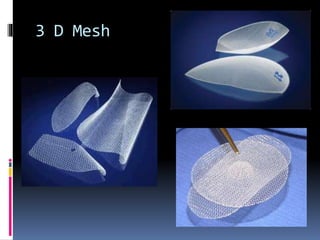
3 D Mesh
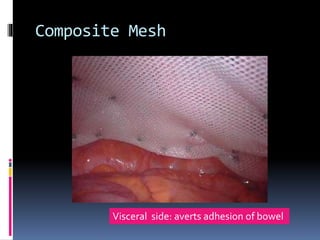
Composite Mesh
Visceral side: averts adhesion of bowel
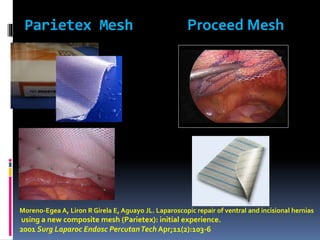
Parietex Mesh
Moreno-Egea A, Liron R Girela E, Aguayo JL. Laparoscopic repair of ventral and incisional hernias
using a new composite mesh (Parietex): initial experience.
2001 Surg Laparoc Endosc PercutanTech Apr;11(2):103-6
Proceed Mesh
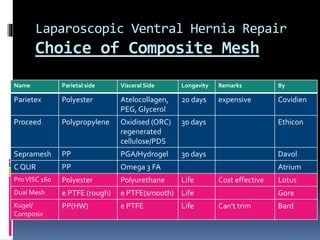
Laparoscopic Ventral Hernia Repair
Choice of Composite Mesh
Name Parietal side Visceral Side Longevity Remarks By
Parietex Polyester Atelocollagen,
PEG, Glycerol
20 days expensive Covidien
Proceed Polypropylene Oxidised (ORC)
regenerated
cellulose/PDS
30 days Ethicon
Sepramesh PP PGA/Hydrogel 30 days Davol
C QUR PP Omega 3 FA Atrium
ProVISC 160 Polyester Polyurethane Life Cost effective Lotus
Dual Mesh e PTFE (rough) e PTFE(smooth) Life Gore
Kugel/
Composix
PP(HW) e PTFE Life Can't trim Bard
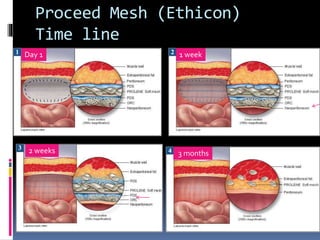
Proceed Mesh (Ethicon)
Time line
1 week
2 weeks
Day 1
3 months
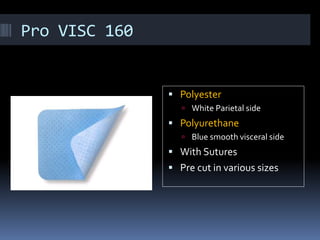
Pro VISC 160
 Polyester
 White Parietal side
 Polyurethane
 Blue smooth visceral side
 With Sutures
 Pre cut in various sizes
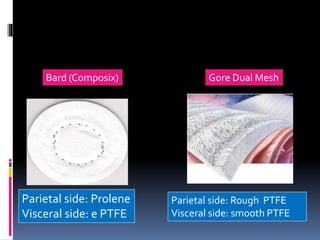
Parietal side: Prolene
Visceral side: e PTFE
Bard (Composix) Gore Dual Mesh
Parietal side: Rough PTFE
Visceral side: smooth PTFE
Frequently Asked Questions!
 Why Mesh?
 What type of Mesh?
 Where to place the Mesh?
 How to fix the mesh?
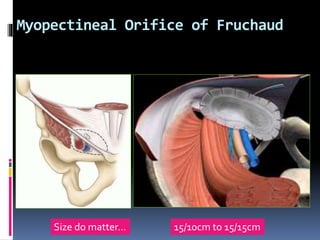
Myopectineal Orifice of Fruchaud
15/10cm to 15/15cmSize do matter…
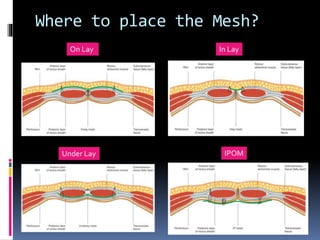
Where to place the Mesh?
On Lay In Lay
Under Lay IPOM
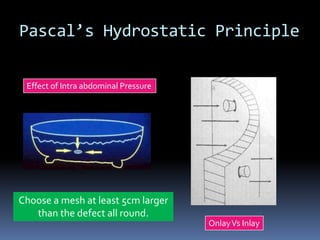
Pascal’s Hydrostatic Principle
OnlayVs Inlay
Effect of Intra abdominal Pressure
Choose a mesh at least 5cm larger
than the defect all round.
 Why Mesh?
 What type of Mesh?
 Where to place the Mesh?
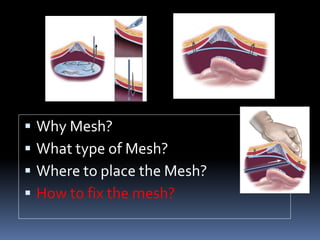
 How to fix the mesh?
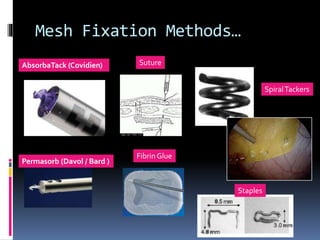
Mesh Fixation Methods…
AbsorbaTack (Covidien)
Permasorb (Davol / Bard )
Fibrin sealant
SpiralTackers
Staples
Fibrin Glue
Suture
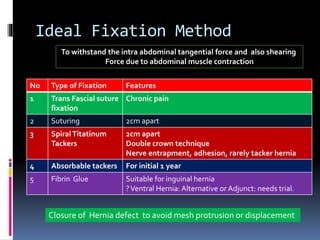
Ideal Fixation Method
No Type of Fixation Features
1 Trans Fascial suture
fixation
Chronic pain
2 Suturing 2cm apart
3 SpiralTitatinum
Tackers
2cm apart
Double crown technique
Nerve entrapment, adhesion, rarely tacker hernia
4 Absorbable tackers For initial 1 year
5 Fibrin Glue Suitable for inguinal hernia
?Ventral Hernia: Alternative or Adjunct: needs trial.
Closure of Hernia defect to avoid mesh protrusion or displacement
To withstand the intra abdominal tangential force and also shearing
Force due to abdominal muscle contraction
Conclusion
 Mesh repair is the Standard of Care.
 Use Composite mesh for ventral hernia
 Secure the mesh to prevent recurrence
Forthcoming Courses /Erode ASI
Contact Us: 9843328928/9790028328
 3rd ASI Endoscopic course
 On 5 days/all Sundays from 8am to 5pm
 8th November 2015 : 1st session starting
 FIAGES Laparoscopic Fellowship course
 Venue: Lotus hospital, at Erode
 7th to 9th January 2016

Prosthesis and fixation device

  • 2.
    ABDOMINAL WALL HERNIA PROSTHETICMATERIALS AND FIXATION DEVICES CHOICE & CHALLENGES Dr.S.Easwaramoorthy MS, FRCS(Edin) ,FRCS (Eng) ,FRCS (Glas), FAES, FIAGES, FMAS Consultant Surgeon, Lotus Hospital, Erode EC member, IAGES (South Zone) Treasurer ASITN & P Chapter ICS Hernia Meet Chennai 2015
  • 3.
    Billroth’s Vision ‘‘If wecould artificially produce tissues of the density and toughness of fascia and tendon the secret of the radical cure of hernia would be discovered’’. - Beitrage zur Chirurgie (1878) Conceive Believe & Achieve
  • 4.
    Inventor of ProstheticMesh repair: Dr. Francis Usher (1908-1980) • Inventor of Polyehylene(Marlex) and Polypropylene mesh • Several Animal studies about their inertness • 20 papers • Innovative ways of placing the meshes: Inlay,Overlay, Sandwich tech etc Conceive Believe & Achieve
  • 5.
    Lichtenstein’s Mesh Repair TensionFree repair •Under LA •Day care •Low recurrence rate! Conceive Believe & Achieve
  • 6.
    Mesh is amust!
  • 7.
    Why Mesh?  Lowrecurrence rate  Tension free & Pain free  Quick recovery  Quick to learn and easy to do!
  • 8.
    History of InguinalHernia Repair We are in Era ofTension Free Mesh Repair! 10% 1% 0.1% 100% Recurrence rate Bassini Shouldice LichtensteinAncient Era
  • 9.
    Why Mesh? Pathogenesis ofHernia  Defective Collagen  Reduced ratio of type I and type III collagen  Type I: MatureCollagen, strong and normal tissue  Type III: ImmatureCollagen, weak, in healing wounds  Type I :Type III ratio normally is 4:1  ?Genetic defect  Connective tissue pathology is not only a cause of primary herniation but its presence can prevent cure! A role for the collagen I/III and MMP-1/-13 genes in primary inguinal hernia? Raphael Rosch, Uwe Klinge, Zhongyi Si, Karsten Junge, Bernd Klosterhalfen, and Volker Schumpelick, BMC Med Genet. 2002; 3: 2.
  • 10.
     Why Mesh? What type of Mesh?  Where to place the Mesh?  How to place the place?
  • 11.
    Types of Mesh Synthetic Mesh  Non absorbable  Polyprophylene(Prolene)  Polyethylene(Marlex)  Polyester(Dacron)  PTFE (Teflon/Gordex)  Absorbable  Vicryl  Combined  Vypro, Ultrapro  Synthetic with Absorbable Barrier( Dual mesh)  Parietex  Proceed  Etc  Biological Mesh  Surgisis ( Porcine submucosa)  Alloderm (Cadaveric human dermis)
  • 12.
    What Type ofMesh? Light weight Vs Heavy weight? Light weight Mesh Heavy weight Mesh Definition Thin fibres, macro pores (>1.5mm) Thick fibres, micro pores (< 1.5mm) Qualities Flexible Less FB reaction and pain Stiffer More FB reaction and pain (Problem of adhesion, fistula) Shrinks more Stronger! - so what Examples Ultrapro,Vipro Marlex, Dacron, PTEF The lightweight and large porous mesh concept for hernia repair. Klosterhalfen B, Junge K, Klinge U. Expert Rev Med Devices. 2005 Jan;2(1):103-17.
  • 13.
  • 14.
    Composite Mesh Visceral side:averts adhesion of bowel
  • 15.
    Parietex Mesh Moreno-Egea A,Liron R Girela E, Aguayo JL. Laparoscopic repair of ventral and incisional hernias using a new composite mesh (Parietex): initial experience. 2001 Surg Laparoc Endosc PercutanTech Apr;11(2):103-6 Proceed Mesh
  • 16.
    Laparoscopic Ventral HerniaRepair Choice of Composite Mesh Name Parietal side Visceral Side Longevity Remarks By Parietex Polyester Atelocollagen, PEG, Glycerol 20 days expensive Covidien Proceed Polypropylene Oxidised (ORC) regenerated cellulose/PDS 30 days Ethicon Sepramesh PP PGA/Hydrogel 30 days Davol C QUR PP Omega 3 FA Atrium ProVISC 160 Polyester Polyurethane Life Cost effective Lotus Dual Mesh e PTFE (rough) e PTFE(smooth) Life Gore Kugel/ Composix PP(HW) e PTFE Life Can't trim Bard
  • 17.
    Proceed Mesh (Ethicon) Timeline 1 week 2 weeks Day 1 3 months
  • 18.
    Pro VISC 160 Polyester  White Parietal side  Polyurethane  Blue smooth visceral side  With Sutures  Pre cut in various sizes
  • 19.
    Parietal side: Prolene Visceralside: e PTFE Bard (Composix) Gore Dual Mesh Parietal side: Rough PTFE Visceral side: smooth PTFE
  • 20.
    Frequently Asked Questions! Why Mesh?  What type of Mesh?  Where to place the Mesh?  How to fix the mesh?
  • 21.
    Myopectineal Orifice ofFruchaud 15/10cm to 15/15cmSize do matter…
  • 22.
    Where to placethe Mesh? On Lay In Lay Under Lay IPOM
  • 23.
    Pascal’s Hydrostatic Principle OnlayVsInlay Effect of Intra abdominal Pressure Choose a mesh at least 5cm larger than the defect all round.
  • 24.
     Why Mesh? What type of Mesh?  Where to place the Mesh?  How to fix the mesh?
  • 25.
    Mesh Fixation Methods… AbsorbaTack(Covidien) Permasorb (Davol / Bard ) Fibrin sealant SpiralTackers Staples Fibrin Glue Suture
  • 26.
    Ideal Fixation Method NoType of Fixation Features 1 Trans Fascial suture fixation Chronic pain 2 Suturing 2cm apart 3 SpiralTitatinum Tackers 2cm apart Double crown technique Nerve entrapment, adhesion, rarely tacker hernia 4 Absorbable tackers For initial 1 year 5 Fibrin Glue Suitable for inguinal hernia ?Ventral Hernia: Alternative or Adjunct: needs trial. Closure of Hernia defect to avoid mesh protrusion or displacement To withstand the intra abdominal tangential force and also shearing Force due to abdominal muscle contraction
  • 27.
    Conclusion  Mesh repairis the Standard of Care.  Use Composite mesh for ventral hernia  Secure the mesh to prevent recurrence
  • 29.
    Forthcoming Courses /ErodeASI Contact Us: 9843328928/9790028328  3rd ASI Endoscopic course  On 5 days/all Sundays from 8am to 5pm  8th November 2015 : 1st session starting  FIAGES Laparoscopic Fellowship course  Venue: Lotus hospital, at Erode  7th to 9th January 2016