Laparoscopic
Tissue approximation
Dr.S.Easwaramoorthy
MS FRCS(England) FRCS (Glasgow) FRCS (Edinburgh)
Head of Dept of Minimal Access Surgery
Examiner, RCS of Edinburgh
Executive Member, South Zone IAGES
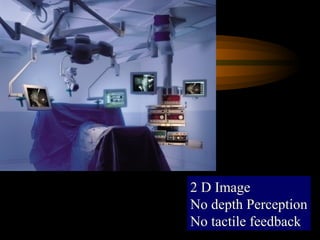
2 D Image
No depth Perception
No tactile feedback
It is both humiliating and frustrating
to be observed by every one in OR
when you take more than 15 min
just to do a one square knot!
Dr. Nathaneil Soper
Surgical Clinics of North America
Oct - 92
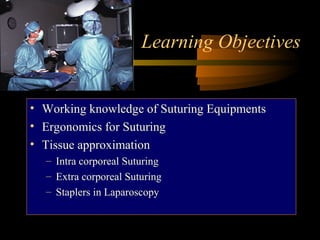
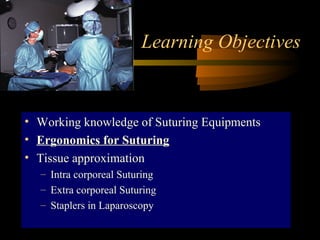
Learning Objectives
• Working knowledge of Suturing Equipments
• Ergonomics for Suturing
• Tissue approximation
– Intra corporeal Suturing
– Extra corporeal Suturing
– Staplers in Laparoscopy
Laparoscopic Suturing
Equipments
• Needle Holders
• Knot pushers
• Suture Materials
HD Camera
30 degree telescope Good Assistants
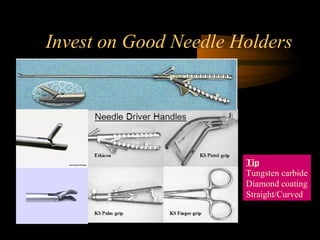
Invest on Good Needle Holders
Tip
Tungsten carbide
Diamond coating
Straight/Curved
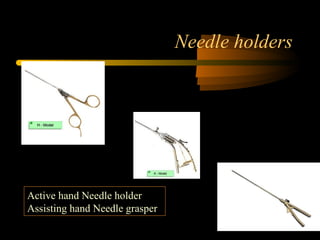
Needle holders
Active hand Needle holder
Assisting hand Needle grasper
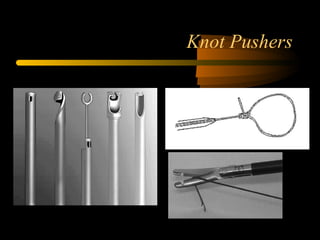
Knot Pushers
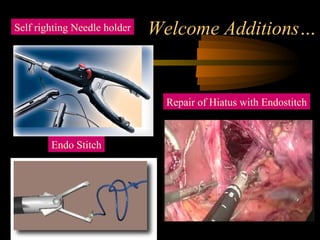
Welcome Additions…
Endo Stitch
Self righting Needle holder
Repair of Hiatus with Endostitch
Suture Material
• Before selecting, Consider following qualities
– Absorbability/ Strength/tissue reaction
– Handling characteristics and visibility
• Favoured suture materials
– Absorbable
• Vicryl, Catgut, PDS
– Non absorbable
• Ethibond,Prolene
• Length of Suture Material
– Intra corporeal suture: 10-12cm
– Extra corporeal suture: 70cm
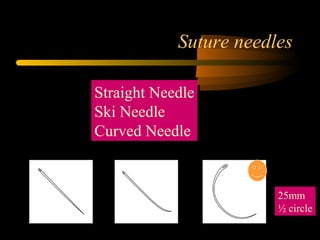
Suture needles
Straight Needle
Ski Needle
Curved Needle
25mm
½ circle
Learning Objectives
• Working knowledge of Suturing Equipments
• Ergonomics for Suturing
• Tissue approximation
– Intra corporeal Suturing
– Extra corporeal Suturing
– Staplers in Laparoscopy
Different Ball Game!
Open Surgery suturing
 Fast
 Ergonomics: Optional
Laparoscopic Suturing
 Slow and steady
 Magnification effect
 Choreographic
movements
 Ergonomics: Vital
 Triangulation
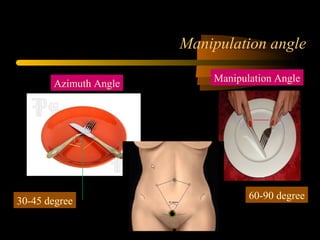
 Manipulation angle
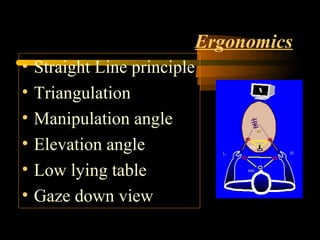
Ergonomics
• Straight Line principle
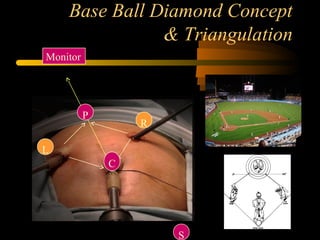
• Triangulation
• Manipulation angle
• Elevation angle
• Low lying table
• Gaze down view
Base Ball Diamond Concept
& Triangulation
Monitor
S
C
R
L
P
Manipulation angle
Azimuth Angle
Manipulation Angle
30-45 degree
60-90 degree
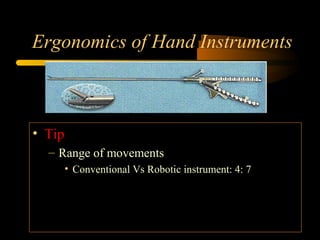
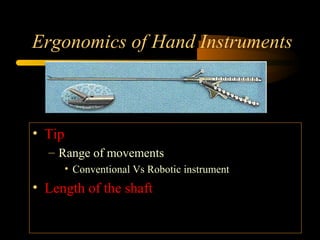
Ergonomics of Hand Instruments
• Tip
– Range of movements
• Conventional Vs Robotic instrument: 4: 7
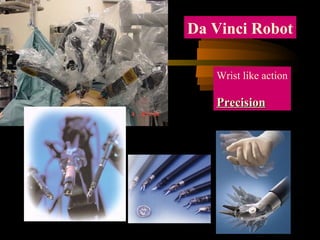
Da Vinci Robot
Wrist like action
PrecisionPrecision
Ergonomics of Hand Instruments
• Tip
– Range of movements
• Conventional Vs Robotic instrument
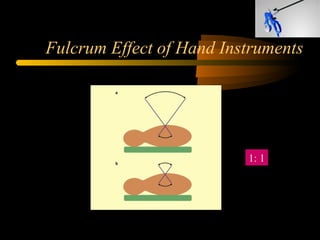
• Length of the shaft
Fulcrum Effect of Hand Instruments
1: 1
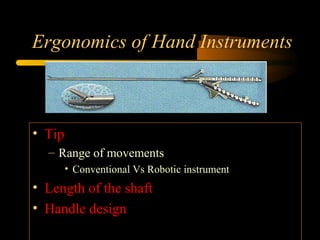
Ergonomics of Hand Instruments
• Tip
– Range of movements
• Conventional Vs Robotic instrument
• Length of the shaft
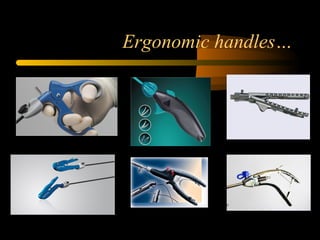
• Handle design
Ergonomic handles…
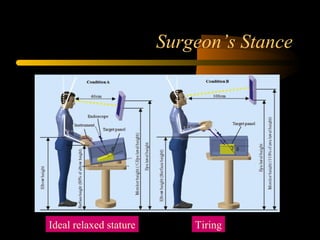
Surgeon’s Stance
Ideal relaxed stature Tiring
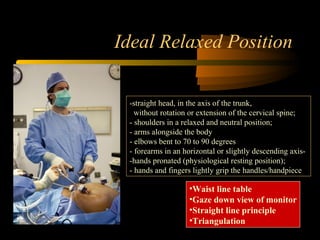
Ideal Relaxed Position
-straight head, in the axis of the trunk,
without rotation or extension of the cervical spine;
- shoulders in a relaxed and neutral position;
- arms alongside the body
- elbows bent to 70 to 90 degrees
- forearms in an horizontal or slightly descending axis-
-hands pronated (physiological resting position);
- hands and fingers lightly grip the handles/handpiece
•Waist line table
•Gaze down view of monitor
•Straight line principle
•Triangulation
Learning Objectives
• Working knowledge of Suturing Equipments
• Ergonomics for Suturing
• Tissue approximation
– Intra corporeal Suturing
– Extra corporeal Suturing
– Staplers in Laparoscopy
I can recognize a good surgeon ,
not from how he cuts,
but
from how he sews!
Johan Mikulicz Radecki
1850-1905
Critical Steps of Suturing
1. Introduction of Needle
2. Grasping the Needle
3. Tissue Penetration
4. Knotting
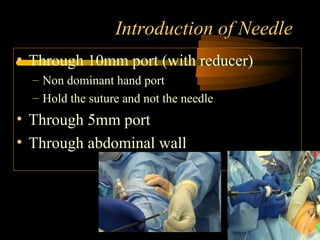
Introduction of Needle
• Through 10mm port (with reducer)
– Non dominant hand port
– Hold the suture and not the needle
• Through 5mm port
• Through abdominal wall
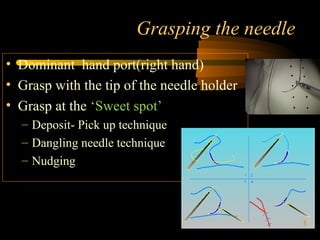
Grasping the needle
• Dominant hand port(right hand)
• Grasp with the tip of the needle holder
• Grasp at the ‘Sweet spot’
– Deposit- Pick up technique
– Dangling needle technique
– Nudging
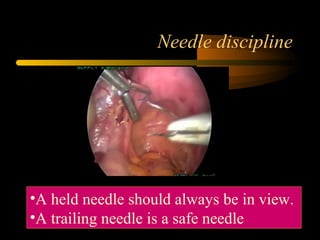
Needle discipline
•A held needle should always be in view.
•A trailing needle is a safe needle
Types of Knots
• Granny knot
• Square knot
• Slip knot to square knot
• Surgeon’s Knot
• Aberdeen knot
• Dundee Jamming Slip Knot
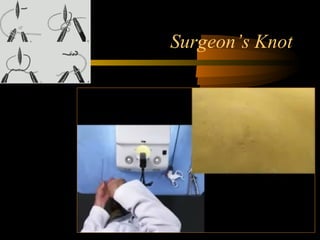
Surgeon’s Knot
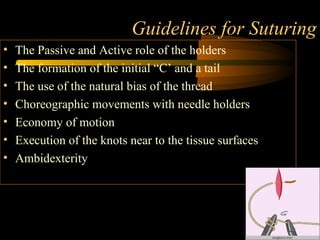
Guidelines for Suturing
• The Passive and Active role of the holders
• The formation of the initial “C’ and a tail
• The use of the natural bias of the thread
• Choreographic movements with needle holders
• Economy of motion
• Execution of the knots near to the tissue surfaces
• Ambidexterity
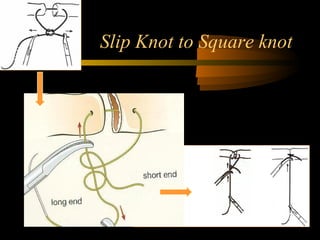
Slip Knot to Square knot
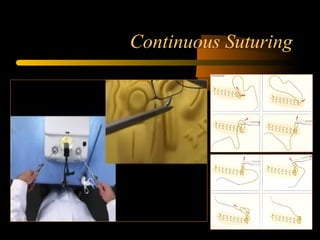
Continuous Suturing
Laparoscopic Bowel Anastomosis
Key points
• Port positioning
• Good communications with your assistant
• Positioning of sutures, especially at the
corners
• Spacing the sutures (remember the
magnification)
• Tensioning of sutures
Learning Objectives
• Working knowledge of Suturing Equipments
• Ergonomics for Suturing
• Tissue approximation
– Intra corporeal Suturing
– Extra corporeal Suturing
– Staplers in Laparoscopy
Extra corporeal knots
• Roeder Knot
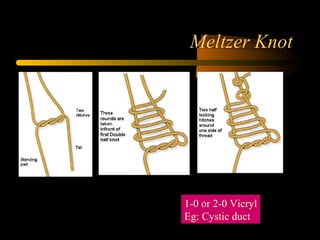
• Meltzer Knot
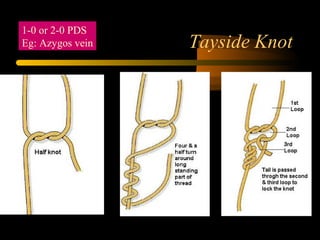
• Tayside knot
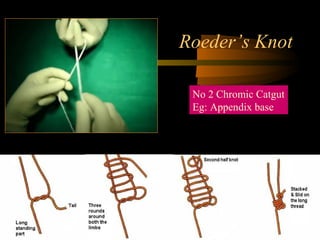
Roeder’s Knot
No 2 Chromic Catgut
Eg: Appendix base
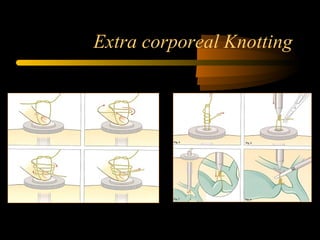
Extra corporeal Knotting
Meltzer Knot
1-0 or 2-0 Vicryl
Eg: Cystic duct
Tayside Knot
1-0 or 2-0 PDS
Eg: Azygos vein
Learning Objectives
• Working knowledge of Suturing Equipments
• Ergonomics for Suturing
• Tissue approximation
– Intra corporeal Suturing
– Extra corporeal Suturing
– Staplers in Laparoscopy
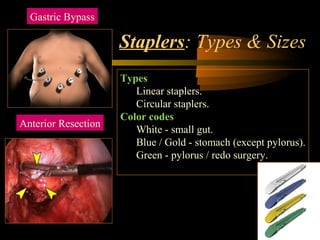
Staplers: Types & Sizes
Gastric Bypass
Anterior Resection
Types
Linear staplers.
Circular staplers.
Color codes
White - small gut.
Blue / Gold - stomach (except pylorus).
Green - pylorus / redo surgery.
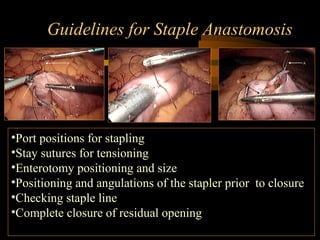
Guidelines for Staple Anastomosis
•Port positions for stapling
•Stay sutures for tensioning
•Enterotomy positioning and size
•Positioning and angulations of the stapler prior to closure
•Checking staple line
•Complete closure of residual opening
It is not practice that makes perfect
It’s perfect practice that makes perfect!
- Vince Lombardi,
American Foot ball Coach, Green Bay, Wisconsin
laparoscopic suturing

laparoscopic suturing

  • 1.
    Laparoscopic Tissue approximation Dr.S.Easwaramoorthy MS FRCS(England)FRCS (Glasgow) FRCS (Edinburgh) Head of Dept of Minimal Access Surgery Examiner, RCS of Edinburgh Executive Member, South Zone IAGES
  • 2.
    2 D Image Nodepth Perception No tactile feedback
  • 3.
    It is bothhumiliating and frustrating to be observed by every one in OR when you take more than 15 min just to do a one square knot! Dr. Nathaneil Soper Surgical Clinics of North America Oct - 92
  • 4.
    Learning Objectives • Workingknowledge of Suturing Equipments • Ergonomics for Suturing • Tissue approximation – Intra corporeal Suturing – Extra corporeal Suturing – Staplers in Laparoscopy
  • 6.
    Laparoscopic Suturing Equipments • NeedleHolders • Knot pushers • Suture Materials HD Camera 30 degree telescope Good Assistants
  • 7.
    Invest on GoodNeedle Holders Tip Tungsten carbide Diamond coating Straight/Curved
  • 8.
    Needle holders Active handNeedle holder Assisting hand Needle grasper
  • 9.
  • 10.
    Welcome Additions… Endo Stitch Selfrighting Needle holder Repair of Hiatus with Endostitch
  • 11.
    Suture Material • Beforeselecting, Consider following qualities – Absorbability/ Strength/tissue reaction – Handling characteristics and visibility • Favoured suture materials – Absorbable • Vicryl, Catgut, PDS – Non absorbable • Ethibond,Prolene • Length of Suture Material – Intra corporeal suture: 10-12cm – Extra corporeal suture: 70cm
  • 12.
    Suture needles Straight Needle SkiNeedle Curved Needle 25mm ½ circle
  • 13.
    Learning Objectives • Workingknowledge of Suturing Equipments • Ergonomics for Suturing • Tissue approximation – Intra corporeal Suturing – Extra corporeal Suturing – Staplers in Laparoscopy
  • 14.
    Different Ball Game! OpenSurgery suturing  Fast  Ergonomics: Optional Laparoscopic Suturing  Slow and steady  Magnification effect  Choreographic movements  Ergonomics: Vital  Triangulation  Manipulation angle
  • 15.
    Ergonomics • Straight Lineprinciple • Triangulation • Manipulation angle • Elevation angle • Low lying table • Gaze down view
  • 16.
    Base Ball DiamondConcept & Triangulation Monitor S C R L P
  • 17.
    Manipulation angle Azimuth Angle ManipulationAngle 30-45 degree 60-90 degree
  • 18.
    Ergonomics of HandInstruments • Tip – Range of movements • Conventional Vs Robotic instrument: 4: 7
  • 19.
    Da Vinci Robot Wristlike action PrecisionPrecision
  • 20.
    Ergonomics of HandInstruments • Tip – Range of movements • Conventional Vs Robotic instrument • Length of the shaft
  • 21.
    Fulcrum Effect ofHand Instruments 1: 1
  • 22.
    Ergonomics of HandInstruments • Tip – Range of movements • Conventional Vs Robotic instrument • Length of the shaft • Handle design
  • 23.
  • 24.
  • 25.
    Ideal Relaxed Position -straighthead, in the axis of the trunk, without rotation or extension of the cervical spine; - shoulders in a relaxed and neutral position; - arms alongside the body - elbows bent to 70 to 90 degrees - forearms in an horizontal or slightly descending axis- -hands pronated (physiological resting position); - hands and fingers lightly grip the handles/handpiece •Waist line table •Gaze down view of monitor •Straight line principle •Triangulation
  • 26.
    Learning Objectives • Workingknowledge of Suturing Equipments • Ergonomics for Suturing • Tissue approximation – Intra corporeal Suturing – Extra corporeal Suturing – Staplers in Laparoscopy
  • 27.
    I can recognizea good surgeon , not from how he cuts, but from how he sews! Johan Mikulicz Radecki 1850-1905
  • 28.
    Critical Steps ofSuturing 1. Introduction of Needle 2. Grasping the Needle 3. Tissue Penetration 4. Knotting
  • 29.
    Introduction of Needle •Through 10mm port (with reducer) – Non dominant hand port – Hold the suture and not the needle • Through 5mm port • Through abdominal wall
  • 30.
    Grasping the needle •Dominant hand port(right hand) • Grasp with the tip of the needle holder • Grasp at the ‘Sweet spot’ – Deposit- Pick up technique – Dangling needle technique – Nudging
  • 31.
    Needle discipline •A heldneedle should always be in view. •A trailing needle is a safe needle
  • 32.
    Types of Knots •Granny knot • Square knot • Slip knot to square knot • Surgeon’s Knot • Aberdeen knot • Dundee Jamming Slip Knot
  • 33.
  • 34.
    Guidelines for Suturing •The Passive and Active role of the holders • The formation of the initial “C’ and a tail • The use of the natural bias of the thread • Choreographic movements with needle holders • Economy of motion • Execution of the knots near to the tissue surfaces • Ambidexterity
  • 35.
    Slip Knot toSquare knot
  • 36.
  • 37.
    Laparoscopic Bowel Anastomosis Keypoints • Port positioning • Good communications with your assistant • Positioning of sutures, especially at the corners • Spacing the sutures (remember the magnification) • Tensioning of sutures
  • 38.
    Learning Objectives • Workingknowledge of Suturing Equipments • Ergonomics for Suturing • Tissue approximation – Intra corporeal Suturing – Extra corporeal Suturing – Staplers in Laparoscopy
  • 39.
    Extra corporeal knots •Roeder Knot • Meltzer Knot • Tayside knot
  • 40.
    Roeder’s Knot No 2Chromic Catgut Eg: Appendix base
  • 41.
  • 42.
    Meltzer Knot 1-0 or2-0 Vicryl Eg: Cystic duct
  • 43.
    Tayside Knot 1-0 or2-0 PDS Eg: Azygos vein
  • 44.
    Learning Objectives • Workingknowledge of Suturing Equipments • Ergonomics for Suturing • Tissue approximation – Intra corporeal Suturing – Extra corporeal Suturing – Staplers in Laparoscopy
  • 45.
    Staplers: Types &Sizes Gastric Bypass Anterior Resection Types Linear staplers. Circular staplers. Color codes White - small gut. Blue / Gold - stomach (except pylorus). Green - pylorus / redo surgery.
  • 46.
    Guidelines for StapleAnastomosis •Port positions for stapling •Stay sutures for tensioning •Enterotomy positioning and size •Positioning and angulations of the stapler prior to closure •Checking staple line •Complete closure of residual opening
  • 47.
    It is notpractice that makes perfect It’s perfect practice that makes perfect! - Vince Lombardi, American Foot ball Coach, Green Bay, Wisconsin