VENTRAL
INCISIONAL
HERNIA REPAIR
Evaluatation of the Sublay
retromuscular technique using light-
weight "Vypro"mesh versus prolene
mesh
THESIS
Submitted for partial fulfillment of the M.D degree in general
surgery
By
Dr.MOUSTAFA MOHAMED HEGAZY
Supervised by
PROF. Dr. AHMED MOHAMED LOTFY
Professor of General Surgery
Faculty of Medicine - Ain-Shams University
PROF. Dr. OSAMA FOUAD MOHAMED
ABD ELGAWAD
Professor of General Surgery
Faculty of Medicine - Ain-Shams University
Dr. MOHAMED ALI MOHAMED NADA
Lecture of General Surgery
Faculty of Medicine - Ain-Shams University
2010
Incisional hernias remain one of the mostIncisional hernias remain one of the most
common surgical complications with a long-termcommon surgical complications with a long-term
incidence of 10-20%incidence of 10-20% (Schumpelick, et al., 2006).(Schumpelick, et al., 2006).
Primary suture repair of incisional hernia resultsPrimary suture repair of incisional hernia results
in 31-58% recurrencein 31-58% recurrence (Clark et al., 2006).(Clark et al., 2006).
With a move to the tension-free repair following
the introduction of the meshes, results improved,
with a dramatic decrease in the rate of recurrence
to approximately 10% (Millikan, 2003).
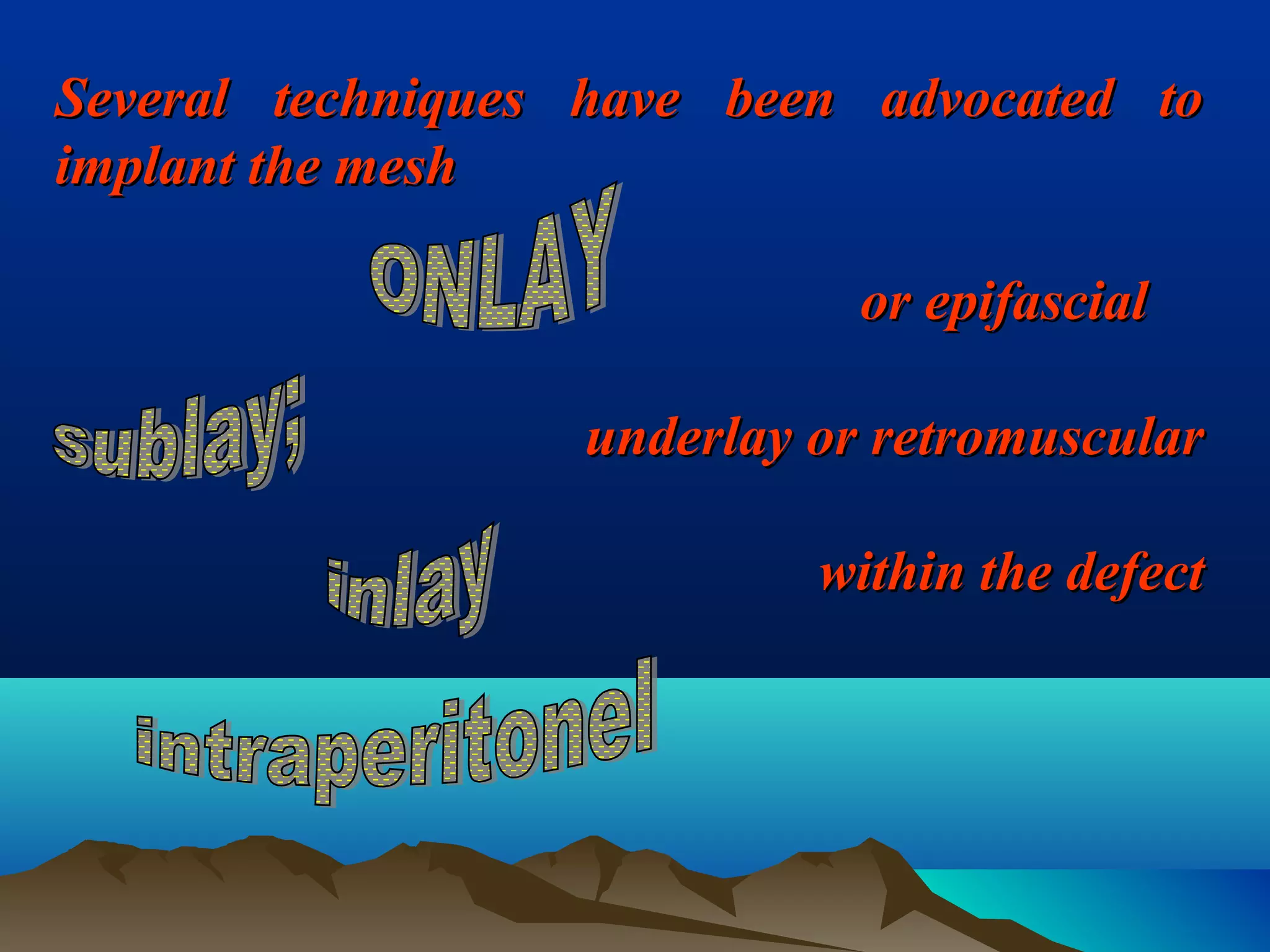
Several techniques have been advocated toSeveral techniques have been advocated to
implant the meshimplant the mesh
or epifascialor epifascial
underlay or retromuscularunderlay or retromuscular
within the defectwithin the defect
The onlay method may be complicated by:The onlay method may be complicated by:
seroma and wound infections, whileseroma and wound infections, while
intraperitoneal mesh leaves the potentialintraperitoneal mesh leaves the potential
for development of enteric fistula or smallfor development of enteric fistula or small
bowel obstructionsbowel obstructions (Hamilton et al.,(Hamilton et al.,
20052005)
Within recent decades, the sublay prostheticWithin recent decades, the sublay prosthetic
herniorrhaphy, which was introduced in the 1970herniorrhaphy, which was introduced in the 1970
by the French surgeons Stoppa and Rives, becameby the French surgeons Stoppa and Rives, became
one of the widely accepted procedures forone of the widely accepted procedures for
incisional hernia repair.This technique isincisional hernia repair.This technique is
characterized by mesh implantation in thecharacterized by mesh implantation in the
"sublay"position below the rectus muscle"sublay"position below the rectus muscle
(Petresen et al., 2004 )(Petresen et al., 2004 )
Increasing evidence of impaired wound healingIncreasing evidence of impaired wound healing
in incisional hernia patients supports routine usein incisional hernia patients supports routine use
of an open prefascial, retromuscular mesh repair.of an open prefascial, retromuscular mesh repair.
Basic pathophysiologic principles dictate that forBasic pathophysiologic principles dictate that for
a successful long-term outcome and prevention ofa successful long-term outcome and prevention of
recurrence, a wide overlap underneath healthyrecurrence, a wide overlap underneath healthy
tissue is required ,only retromuscular placementtissue is required ,only retromuscular placement
allows sufficient subduction of the mesh byallows sufficient subduction of the mesh by
healthy tissuehealthy tissue (schumpelick, et al; 2007)(schumpelick, et al; 2007).
Polypropylene is the material widely used forPolypropylene is the material widely used for
open mesh repair. New developments have led toopen mesh repair. New developments have led to
light-weight meshe e.g`Vypro and Ultrapro``meshes,light-weight meshe e.g`Vypro and Ultrapro``meshes,
which are adjusted to the physiological requirementswhich are adjusted to the physiological requirements
of the abdominal wall and permit proper tissueof the abdominal wall and permit proper tissue
integration. These meshes provide the possibility ofintegration. These meshes provide the possibility of
forming a scar net instead of a stiff scar plate ,forming a scar net instead of a stiff scar plate ,
therefore help to avoid the former knowntherefore help to avoid the former known
complicationscomplications (schumpelick, et al; 2009).
In our study we try to evaluate the:In our study we try to evaluate the:
*challenge of the sublay retromuscular*challenge of the sublay retromuscular
technique of ventral incisional hernia repair, withtechnique of ventral incisional hernia repair, with
the advent of some new technical points in a trialthe advent of some new technical points in a trial
to reduce recurrence.to reduce recurrence.
**compare results of using light-weight**compare results of using light-weight
``Vypro``mesh versus the standard heavy-weight``Vypro``mesh versus the standard heavy-weight
prolene mesh in respect of post-operativeprolene mesh in respect of post-operative
complications, chronic pain and recurrence.complications, chronic pain and recurrence.
REVIEW
OF
HERNIA
No disease of the human body, belongingNo disease of the human body, belonging
to the province of the surgeon, requires in itsto the province of the surgeon, requires in its
treatment a better combination of accuratetreatment a better combination of accurate
anatomical knowledge with surgical skillanatomical knowledge with surgical skill
than hernia in all its varietiesthan hernia in all its varieties(Sir Astley(Sir Astley
Paston copoer, 1804)Paston copoer, 1804)
Incidence of Incisional Hernia:
The frequency for incisional hernias (IH)
after laparotomy is 2-11% Incisional hernias
make up about 80% of the ventral hernias that
surgeons encounter (Voeller, 2007).
Factors affecting incisional hernia incidencFactors affecting incisional hernia incidenc
A- Patient factors:A- Patient factors: including obesity, smoking,including obesity, smoking,
aneurismal disease, chronic obstructiveaneurismal disease, chronic obstructive
pulmonary disease, male gender,pulmonary disease, male gender,
malnourishment, corticosteroid dependency,malnourishment, corticosteroid dependency,
renal failure, malignancy, and prostatismrenal failure, malignancy, and prostatism
(Millikan, 2003).
B- Surgical factors:B- Surgical factors: Like emergency surgery,Like emergency surgery,
bowel surgery, suture type and technique,bowel surgery, suture type and technique,
chest infection, abdominal distension andchest infection, abdominal distension and
wound infection. There is evidence that inwound infection. There is evidence that in
many cases wound failure after abdominalmany cases wound failure after abdominal
wall closure is dependent on the surgeonwall closure is dependent on the surgeon
(Yahchouchy-Chouillard et al., 2003).(Yahchouchy-Chouillard et al., 2003).
Recently, molecular biologic investigationsRecently, molecular biologic investigations
have proven the theory of disturbedhave proven the theory of disturbed
composition of the extracellular matrix incomposition of the extracellular matrix in
patients with recurrent hernia. In particular,patients with recurrent hernia. In particular,
there is a decreased ratio of collagen types Ithere is a decreased ratio of collagen types I
and IIIand III (Jansen et al., 2004 ).(Jansen et al., 2004 ).
.…
Treatment of Incisional HerniaTreatment of Incisional Hernia
Once an IH occurs, the natural history ofOnce an IH occurs, the natural history of
it is to grow. Delay in repair complicatesit is to grow. Delay in repair complicates
every single aspect of the surgery and leadsevery single aspect of the surgery and leads
to increased morbidity; so repair should beto increased morbidity; so repair should be
done as soon as possibledone as soon as possible
Suture RepairSuture Repair
Many suture techniques have been described,Many suture techniques have been described,
but none has proven to be superior to the other.but none has proven to be superior to the other.
HoweverHowever (Jenkin's rule):(Jenkin's rule): mass closure with amass closure with a
non-absorbable or slowly absorbablenon-absorbable or slowly absorbable
monofilament suture (e.g. PDS) good bitesmonofilament suture (e.g. PDS) good bites
(>1cm), using a suture length : wound length(>1cm), using a suture length : wound length
ratio of 4:1, can be used in small sized herniaratio of 4:1, can be used in small sized hernia
less than 4 cm.less than 4 cm.
Inlay Repair:Inlay Repair:
In this repair, the mesh is sutured to the fascialIn this repair, the mesh is sutured to the fascial
edges without initially closing the defect. Theedges without initially closing the defect. The
mesh lies in contact with the viscera. Thismesh lies in contact with the viscera. This
technique has a high recurrence rate and maytechnique has a high recurrence rate and may
lead to bowel adhesions and development oflead to bowel adhesions and development of
enterocutaneous fistulas, so it is notenterocutaneous fistulas, so it is not
recommended unless the substantial defectrecommended unless the substantial defect
cannot be closed with other technique .cannot be closed with other technique .
Onlay Repair :Onlay Repair :
After dissection of the hernial sac, theAfter dissection of the hernial sac, the
fascial edges are brought together and thefascial edges are brought together and the
mesh is placed over the suture line makingmesh is placed over the suture line making
an overlap of 5 cm.and fixed with stiches toan overlap of 5 cm.and fixed with stiches to
the anterior fascia The skin is closed overthe anterior fascia The skin is closed over
the mesh.the mesh.
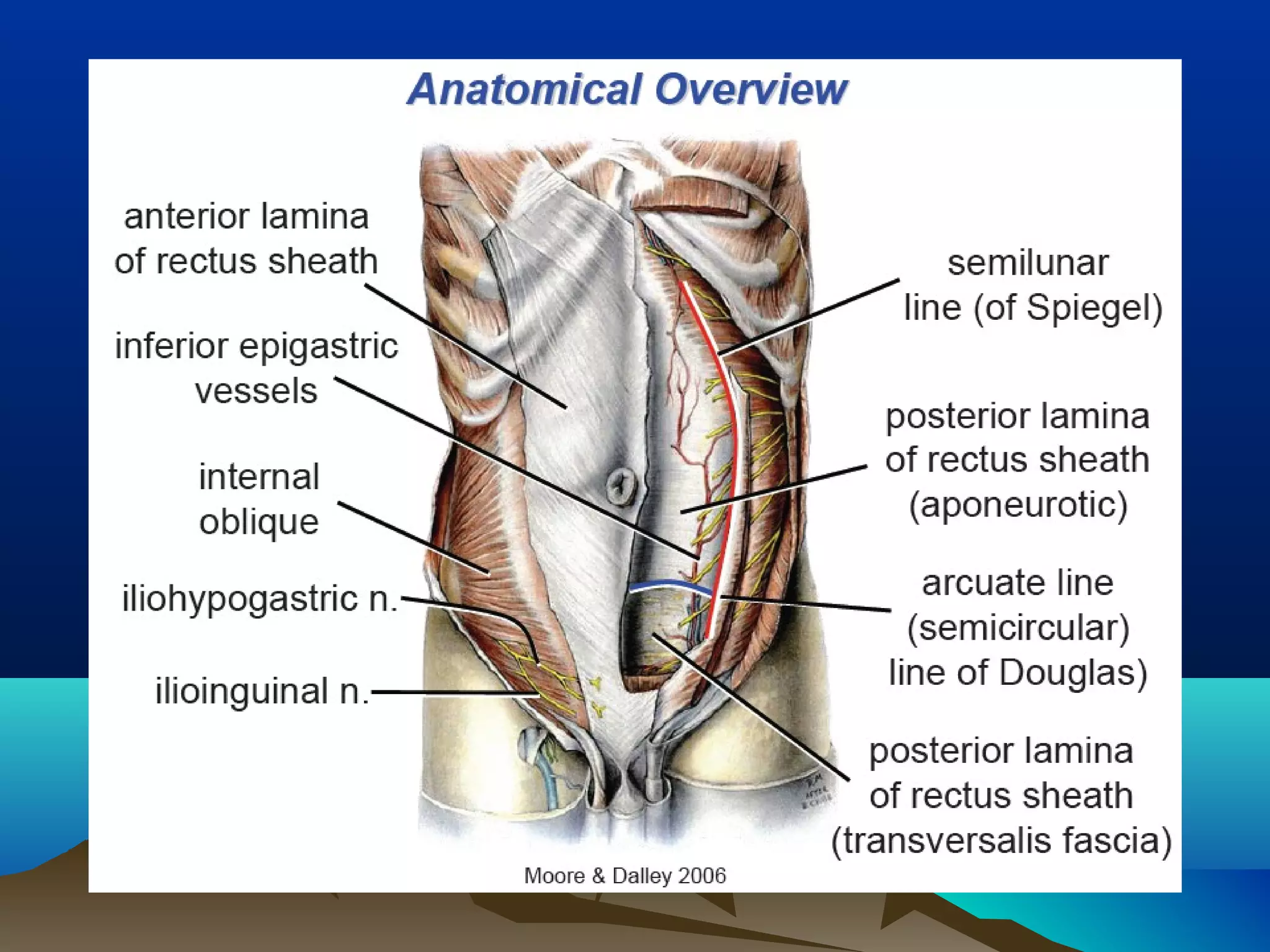
Sublay RepairSublay Repair ((Rives-Stoppa-Retrorectus Repair)Rives-Stoppa-Retrorectus Repair)
The mesh is placed beneath the rectus muscle inThe mesh is placed beneath the rectus muscle in
front of the closed posterior rectus sheath andfront of the closed posterior rectus sheath and
peritoneum. The anterior rectus sheath is closed.peritoneum. The anterior rectus sheath is closed.
The advantage of this technique is that intra-The advantage of this technique is that intra-
abdominal forces hold the prosthesis against theabdominal forces hold the prosthesis against the
muscles,i.e the forces that created the herniamuscles,i.e the forces that created the hernia
now are used to prevent its recurrence.now are used to prevent its recurrence.
In contrast to a mesh in front of the fasciaIn contrast to a mesh in front of the fascia
in onlay position, the sublay mesh positionin onlay position, the sublay mesh position
facilitates a sufficient subduction of intactfacilitates a sufficient subduction of intact
linea alba. It is the retromuscular mesh with alinea alba. It is the retromuscular mesh with a
fascia closure in front, which is kept infascia closure in front, which is kept in
position just by tissue ingrowth and intra-position just by tissue ingrowth and intra-
abdominal pressure,abdominal pressure,
whereas the onlay mesh has to be fixedwhereas the onlay mesh has to be fixed
additionally by permanent sutures. The spaceadditionally by permanent sutures. The space
behind the rectus muscle can be easilybehind the rectus muscle can be easily
dissected, whereas the extended preparation ofdissected, whereas the extended preparation of
the subcutaneous space in the case of the onlaythe subcutaneous space in the case of the onlay
position is frequently accompanied byposition is frequently accompanied by
hematoma, seroma, or wound infection.hematoma, seroma, or wound infection.
(Schumpelick et al., 2007).(Schumpelick et al., 2007).
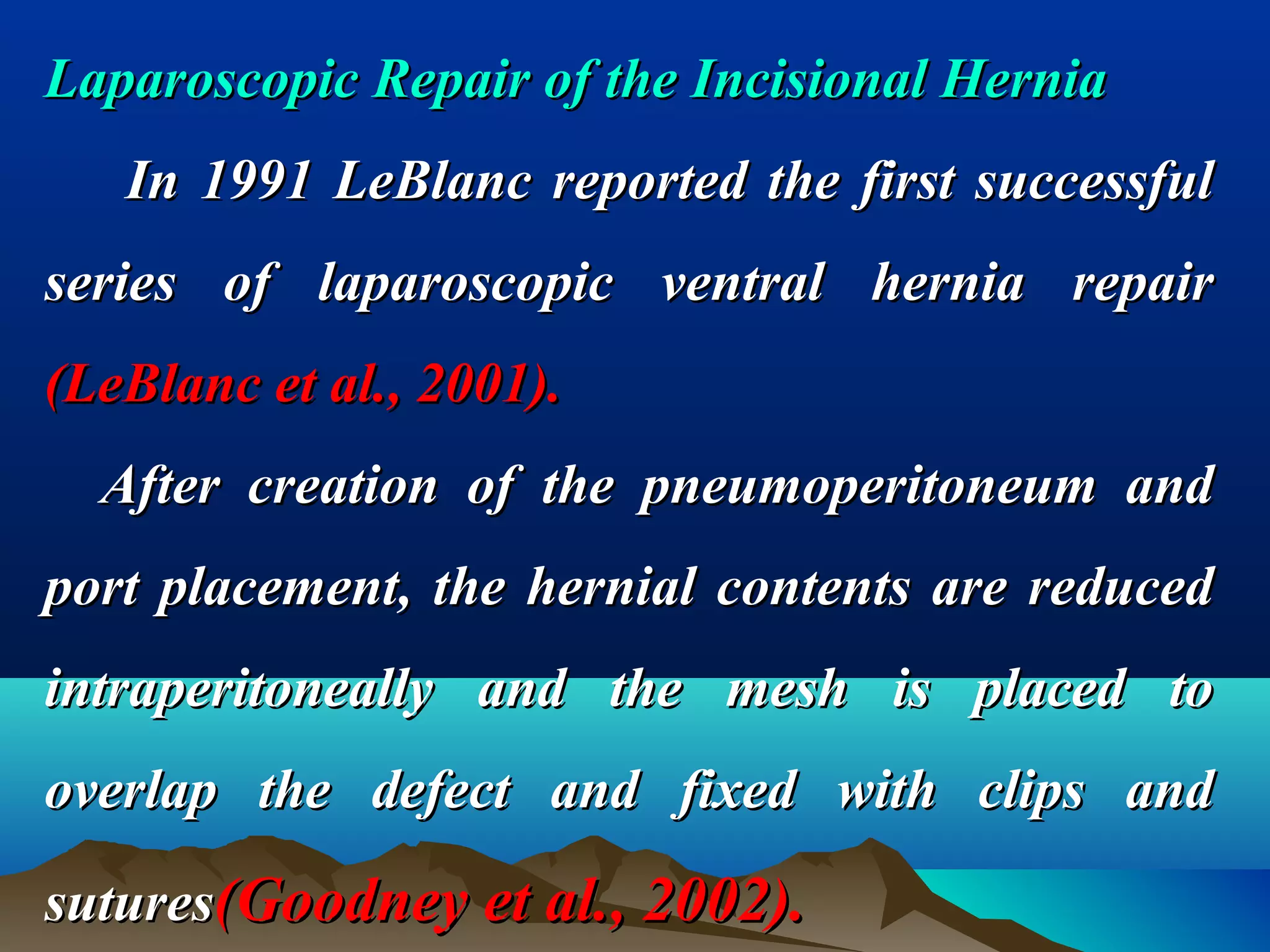
Laparoscopic Repair of the Incisional HerniaLaparoscopic Repair of the Incisional Hernia
In 1991 LeBlanc reported the first successfulIn 1991 LeBlanc reported the first successful
series of laparoscopic ventral hernia repairseries of laparoscopic ventral hernia repair
(LeBlanc et al., 2001).(LeBlanc et al., 2001).
After creation of the pneumoperitoneum andAfter creation of the pneumoperitoneum and
port placement, the hernial contents are reducedport placement, the hernial contents are reduced
intraperitoneally and the mesh is placed tointraperitoneally and the mesh is placed to
overlap the defect and fixed with clips andoverlap the defect and fixed with clips and
suturessutures(Goodney et al., 2002).(Goodney et al., 2002).
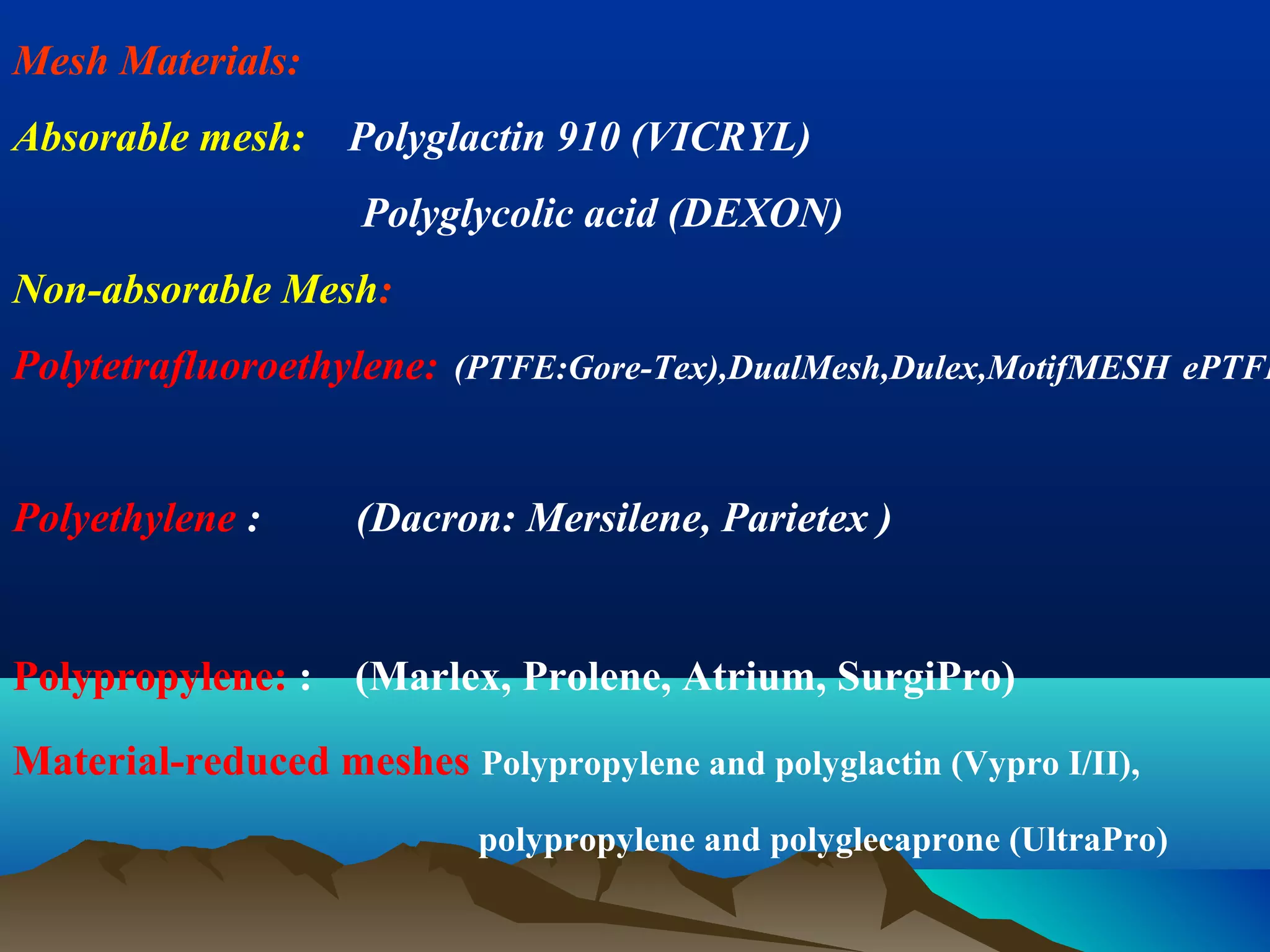
Mesh Materials:
Absorable mesh: Polyglactin 910 (VICRYL)
Polyglycolic acid (DEXON)
Non-absorable Mesh:
Polytetrafluoroethylene: (PTFE:Gore-Tex),DualMesh,Dulex,MotifMESH ePTFE
Polyethylene : (Dacron: Mersilene, Parietex )
Polypropylene: : (Marlex, Prolene, Atrium, SurgiPro)
Material-reduced meshes Polypropylene and polyglactin (Vypro I/II),
polypropylene and polyglecaprone (UltraPro)
The Ideal MeshThe Ideal Mesh
There is no ideal mesh or ‘‘best’’ mesh, soThere is no ideal mesh or ‘‘best’’ mesh, so
the decision of which mesh to use is based onthe decision of which mesh to use is based on
several factors: the type of procedure beingseveral factors: the type of procedure being
done, the clinical situation, the desireddone, the clinical situation, the desired
handling characteristics, and the productshandling characteristics, and the products
available to the surgeon based upon hospitalavailable to the surgeon based upon hospital
materials contracts and costs.materials contracts and costs.
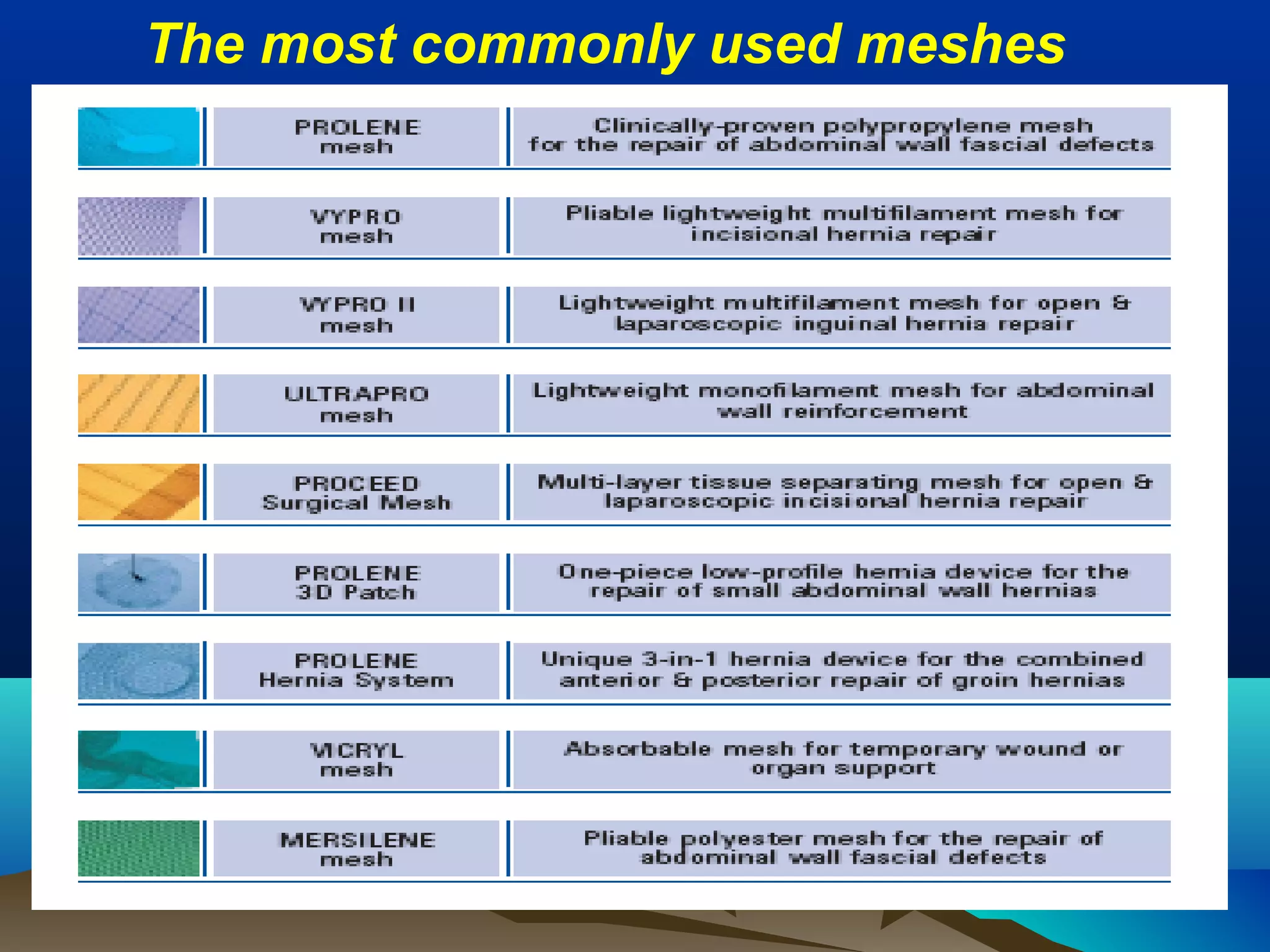
The most commonly used meshes
l
Biological Meshes
Recently, a number of biological meshes haveRecently, a number of biological meshes have
become available. These are Surgisis?, which isbecome available. These are Surgisis?, which is
made from porcine gut submucosa, Alloderm?,made from porcine gut submucosa, Alloderm?,
which is made from cadaver dermis andwhich is made from cadaver dermis and
Permacol? made from porcine dermis. They arePermacol? made from porcine dermis. They are
expensive and can be used in contaminatedexpensive and can be used in contaminated
situations. Long-term evaluation issituations. Long-term evaluation is
neededneeded(Voeller 2007).(Voeller 2007).
Postoperative complications of mesh repair
**seroma formation,seroma formation,
**superficial and deep wound infection,superficial and deep wound infection,
**mesh rejectionmesh rejection
**Abdominal discomfort (stiff abdomen),Abdominal discomfort (stiff abdomen),
**recurrence.recurrence.
SUBLAYSUBLAY
RETROMUSCULRRETROMUSCULR
MESH REPAIRMESH REPAIR
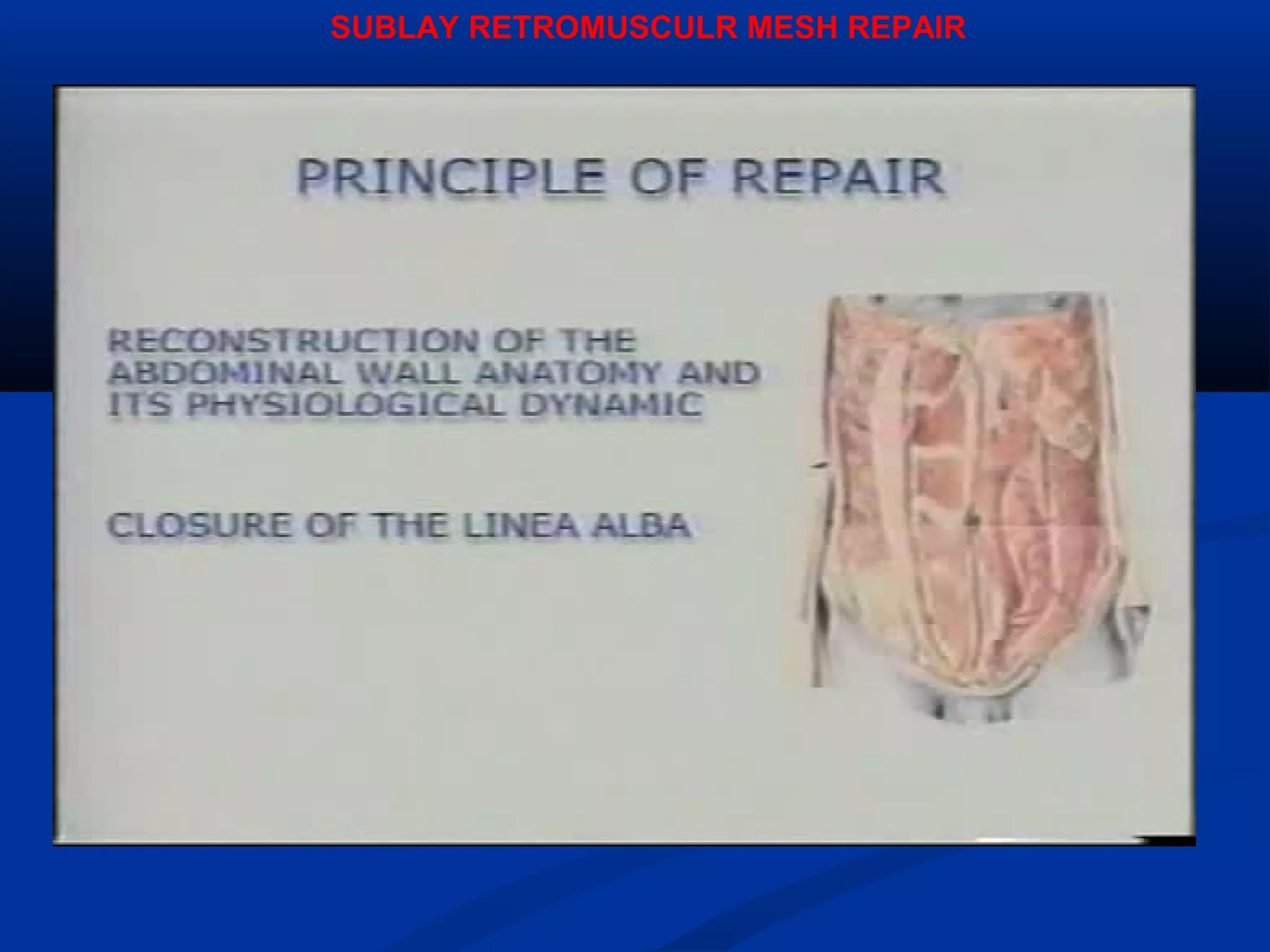
SUBLAY RETROMUSCULR MESH REPAIR
PatientsPatients::
*30 patients complaining of moderate*30 patients complaining of moderate
sized ventral incisional hernia (5-11cm).sized ventral incisional hernia (5-11cm).
*Larg and huge sized hernias are*Larg and huge sized hernias are
excluded as they requrie additionalexcluded as they requrie additional
methods of repair.methods of repair.
The patients classified into two
groups:
Group A: 15 patients treated by the
Heavy-weight prolene mesh in the
sublay position.
Group B: 15 patients treated by the
Light-weight`` vypro`` mesh in the
sublay position.
Operative detai
METHODES OF REPAIR
Sublay "mesh repair; retromuscularSublay "mesh repair; retromuscular
techniquetechnique
The steps of operation sublay retromuscular
mesh repair published by Schumpelick et al.,
(2007),stressing on the following technical
points:
*The different layers of the abdominal wall
were reconstructed with mesh placed behind
the rectus muscle.
*The mesh was sized to give a wide overlap of
the implanted mesh at least 5cm in all directions
surrounding the hernia defect.
*The posterior rectus sheath and the peritoneum
were closed to prevent direct contact between
mesh and intestine.
*The anterior fascia of the rectus sheath was
closed i.e. reconstruction of the linea alba by
closure of anterior rectus sheath over the
mesh was mandatory.
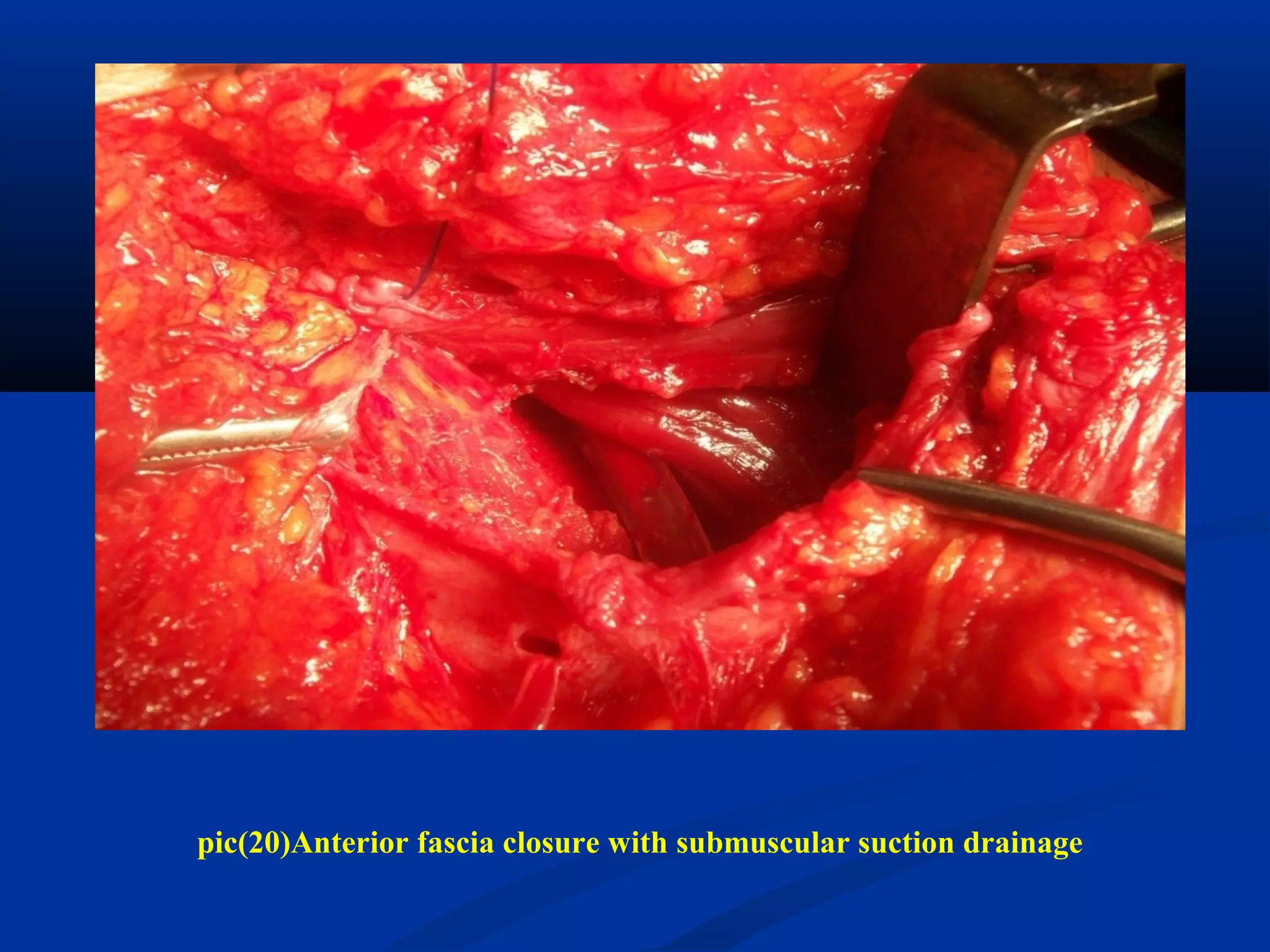
*Suction drain left in the retromuscular plane
before wound closure .
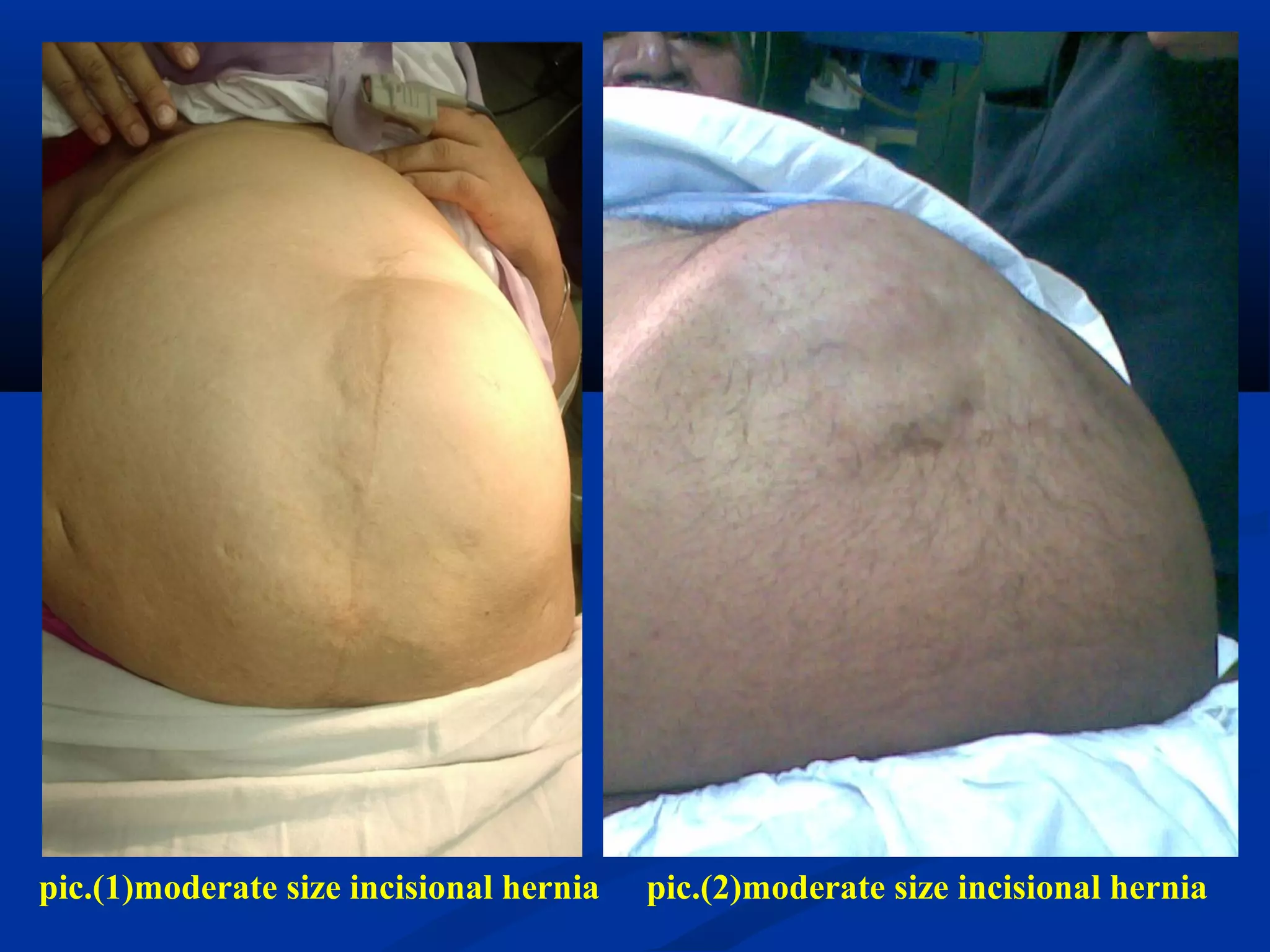
pic.(2)moderate size incisional herniapic.(1)moderate size incisional hernia
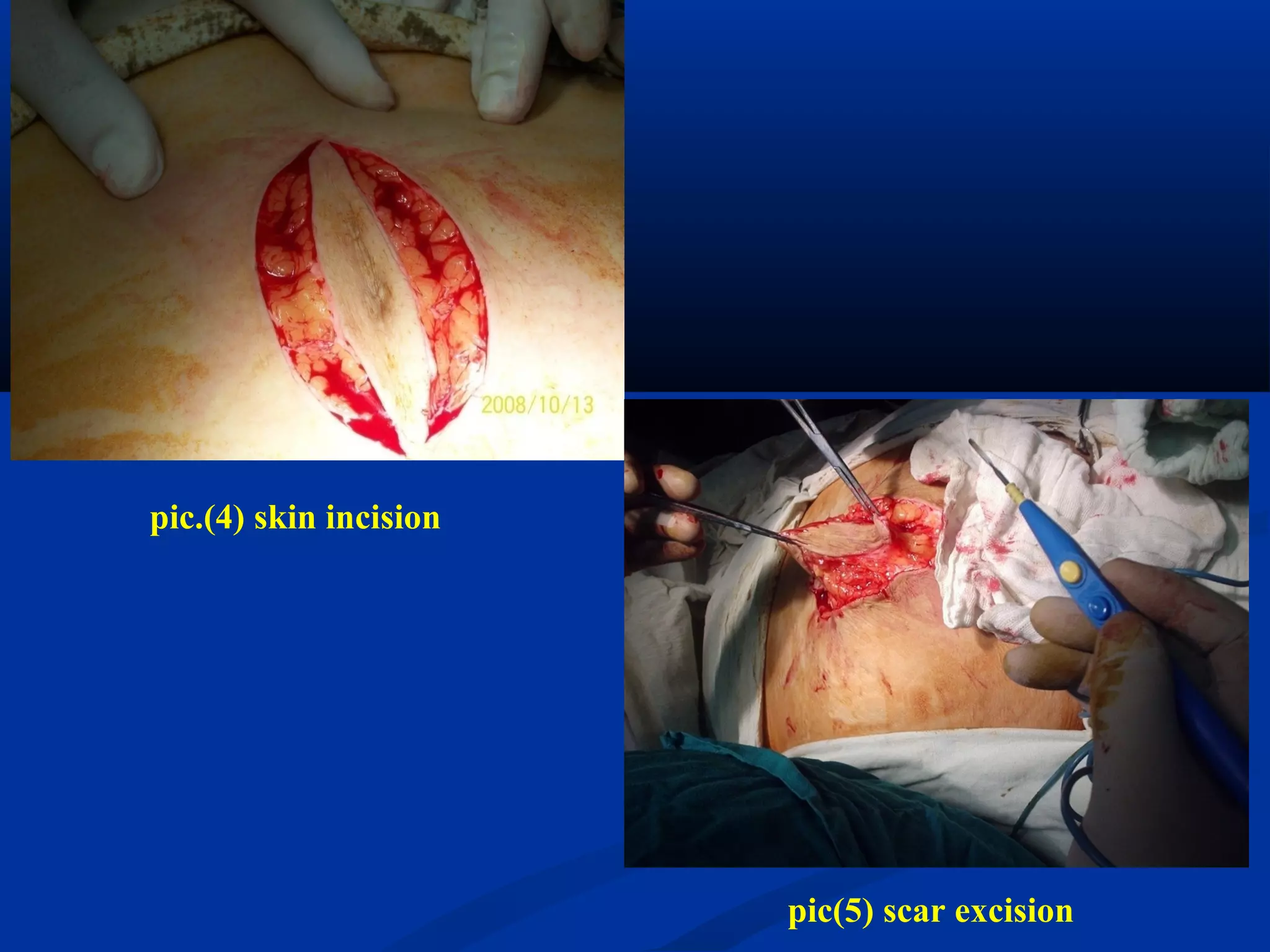
pic.(4) skin incision
pic(5) scar excision
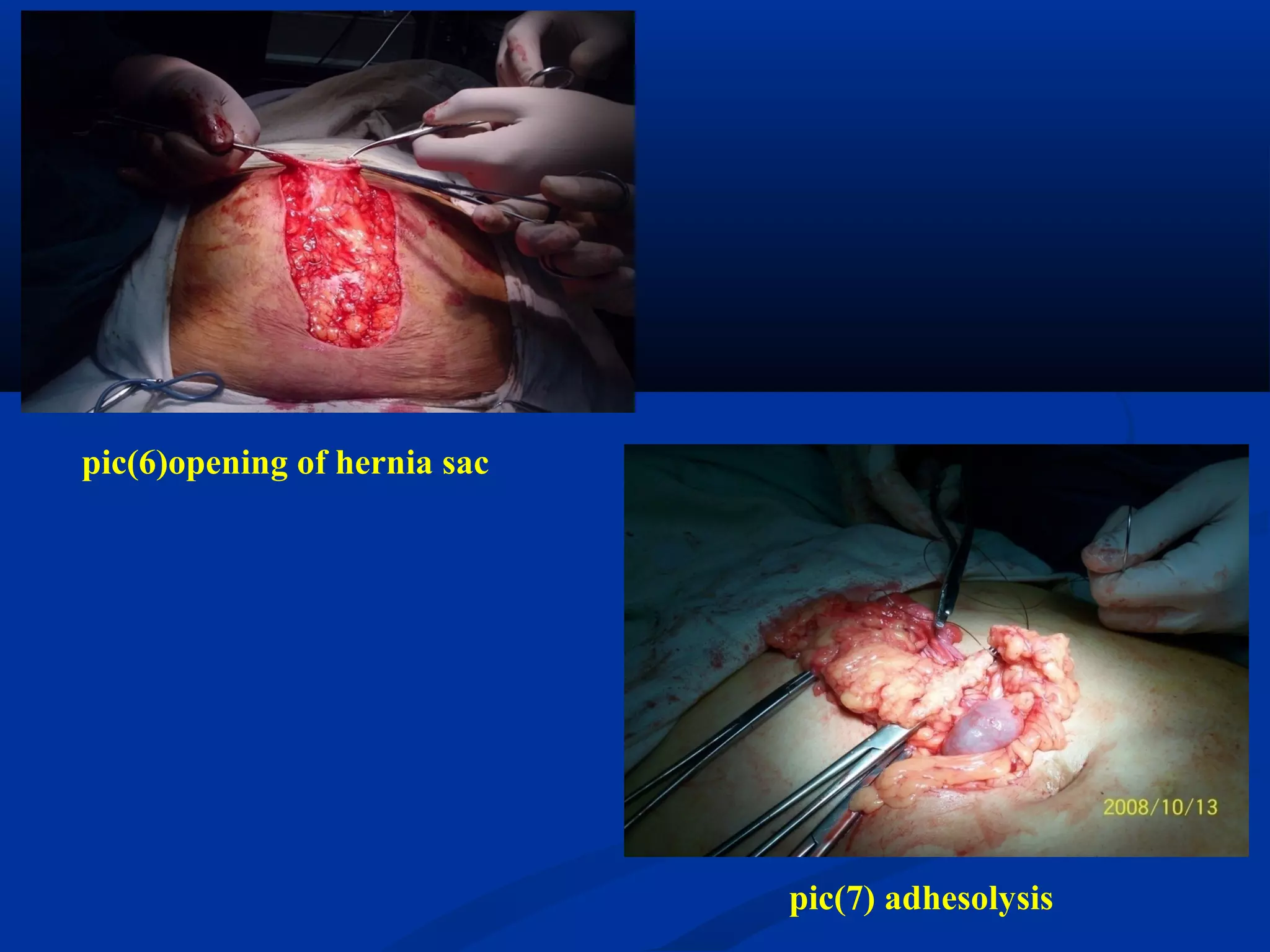
pic(6)opening of hernia sac
pic(7) adhesolysis
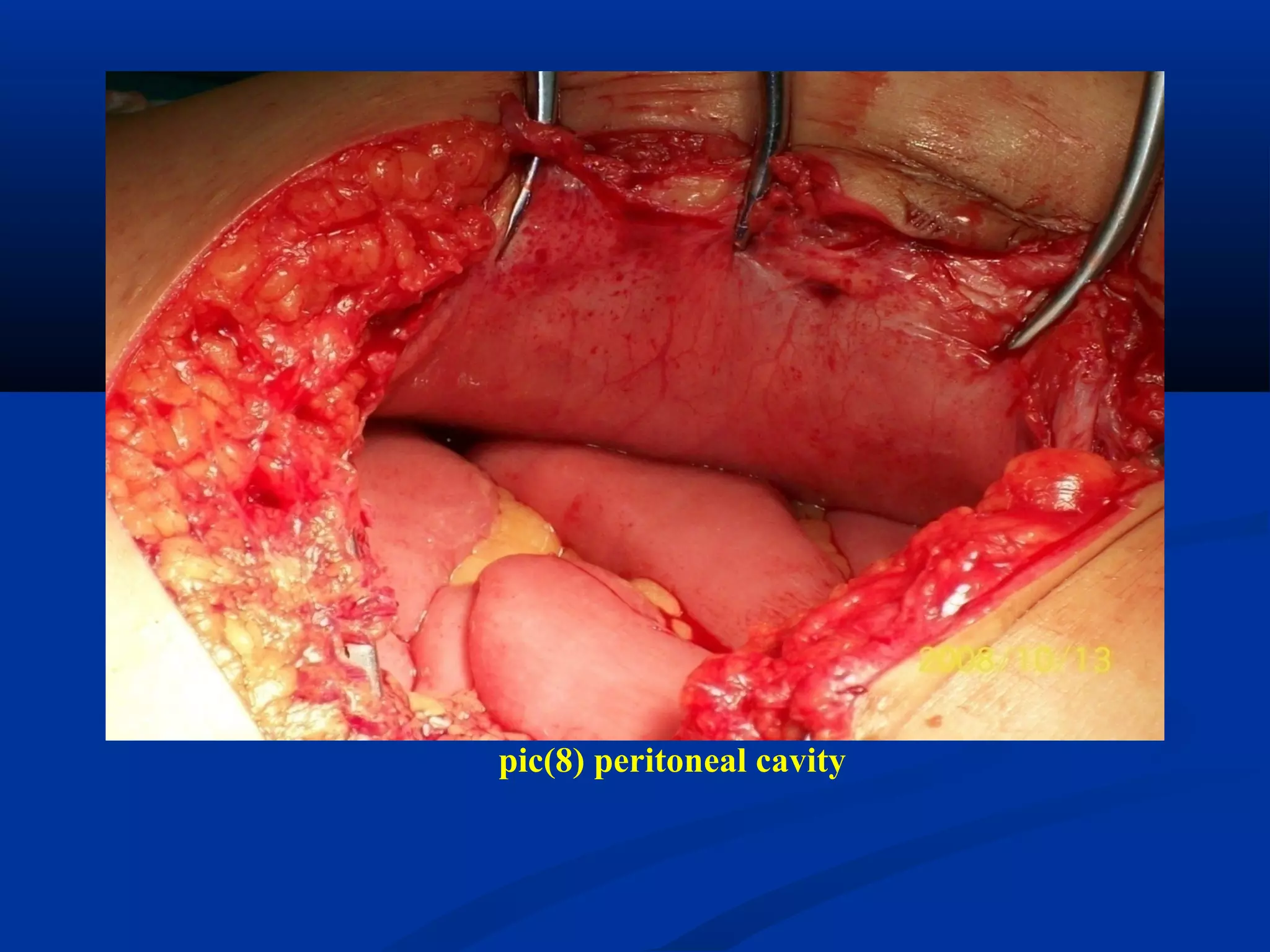
pic(8) peritoneal cavity
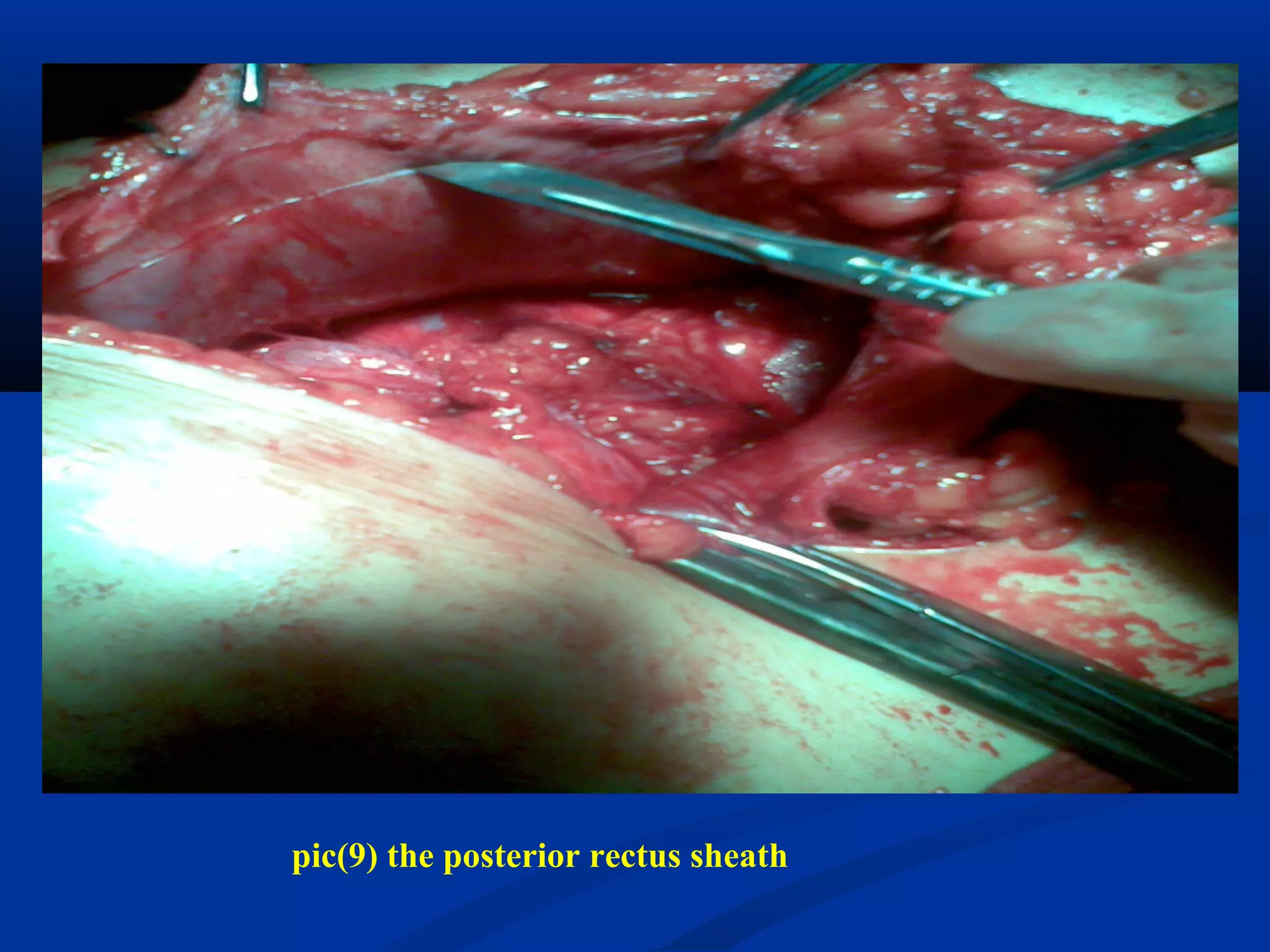
pic(9) the posterior rectus sheath
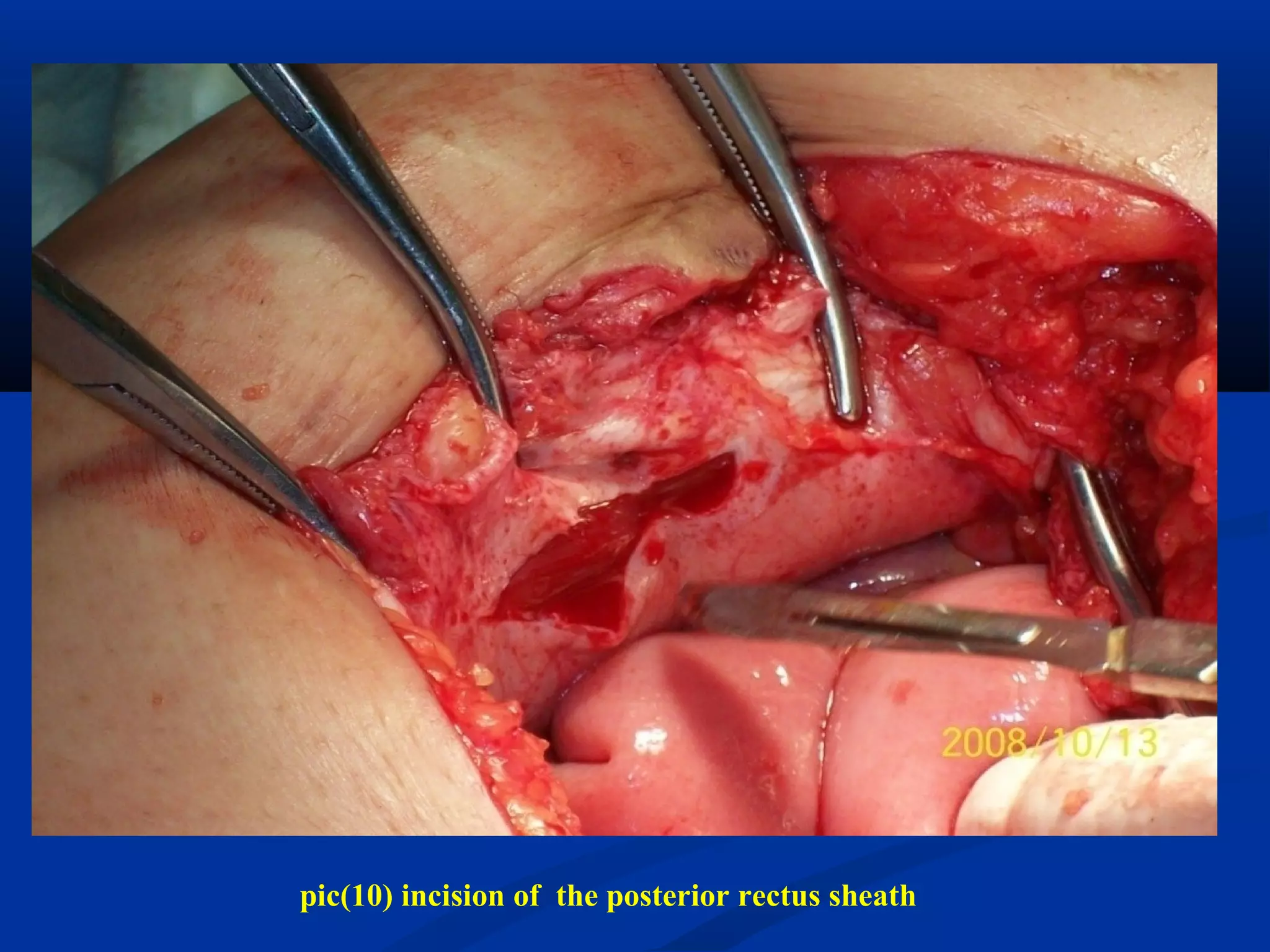
pic(10) incision of the posterior rectus sheath
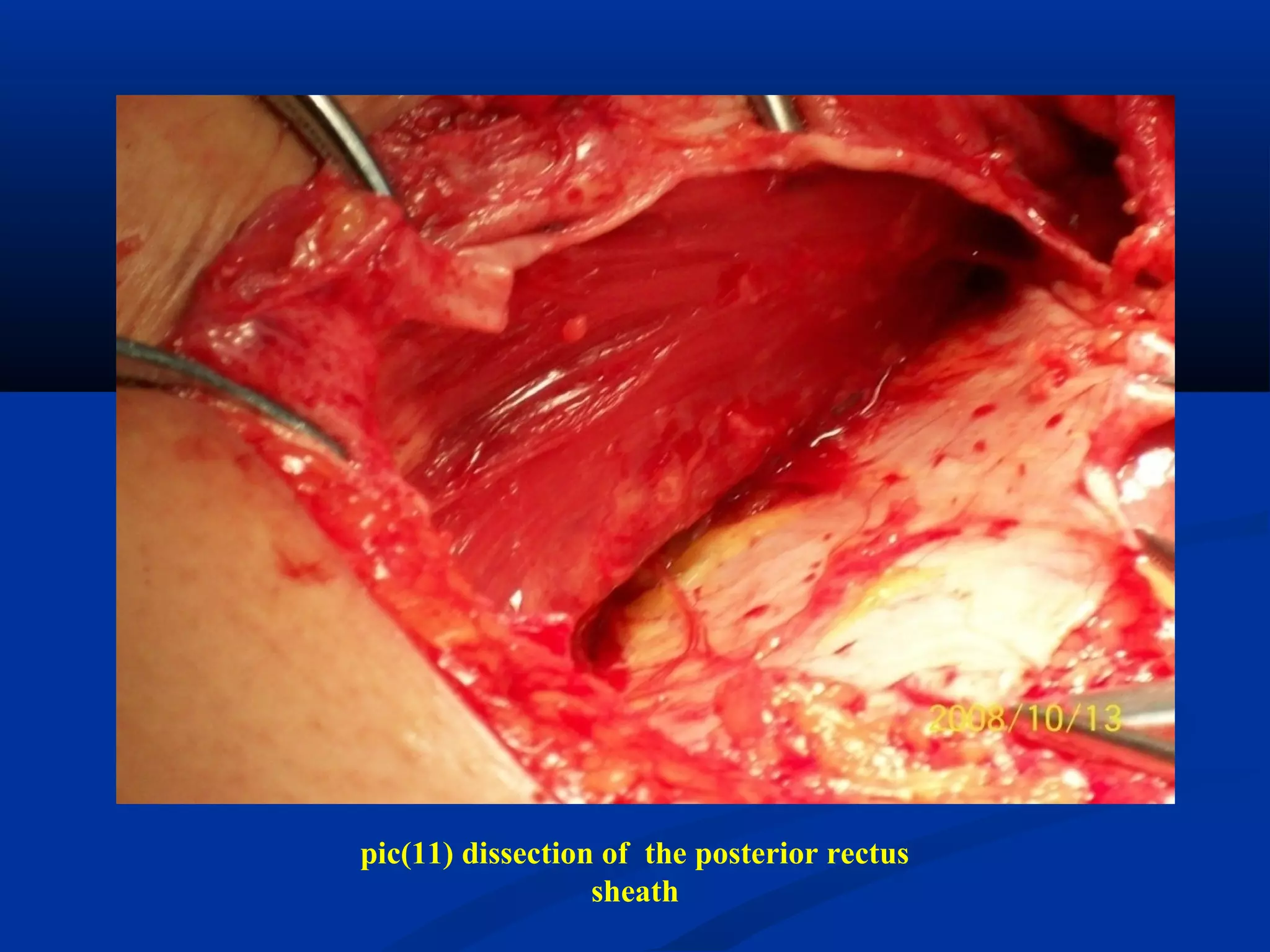
pic(11) dissection of the posterior rectus
sheath
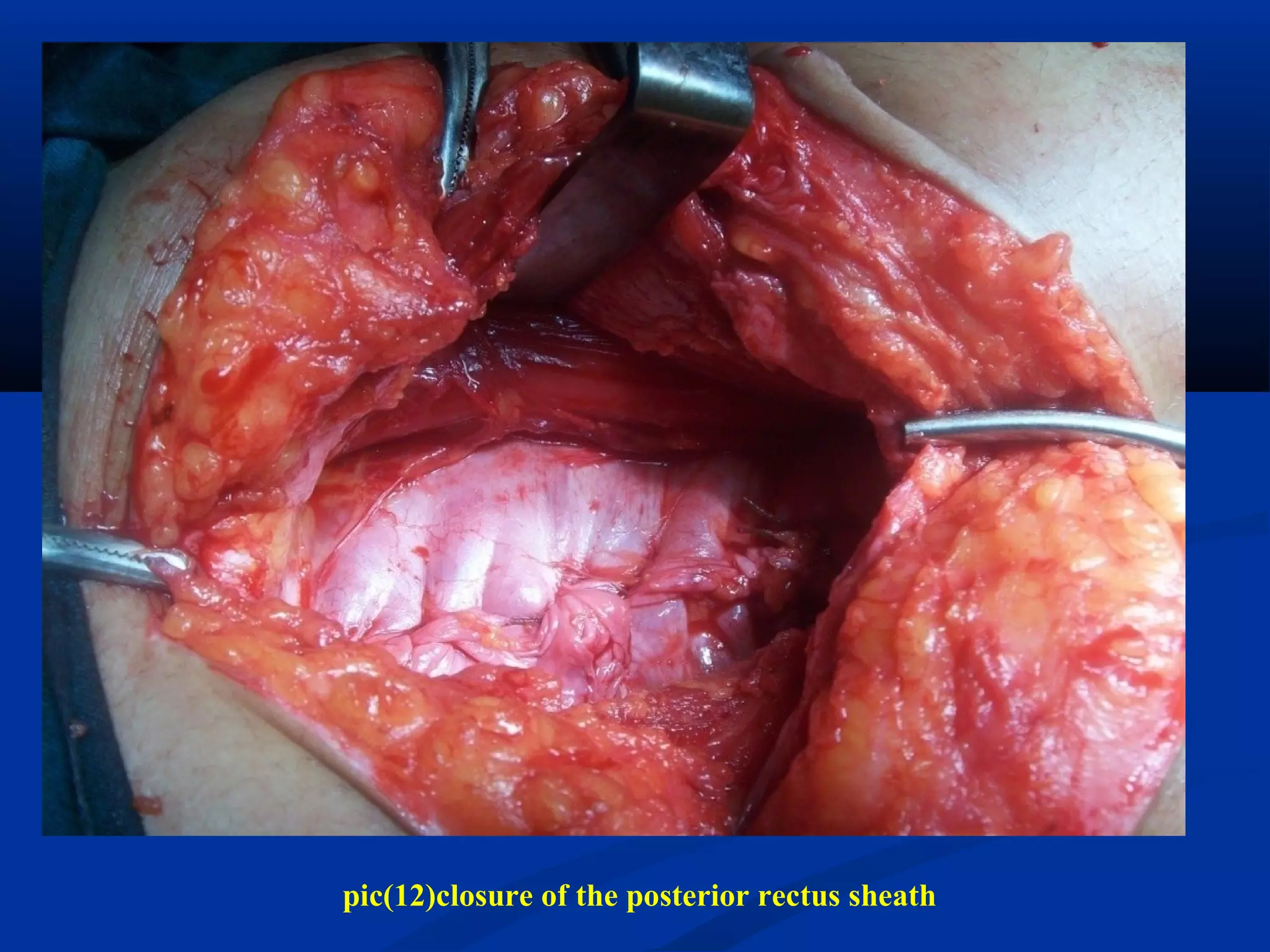
pic(12)closure of the posterior rectus sheath
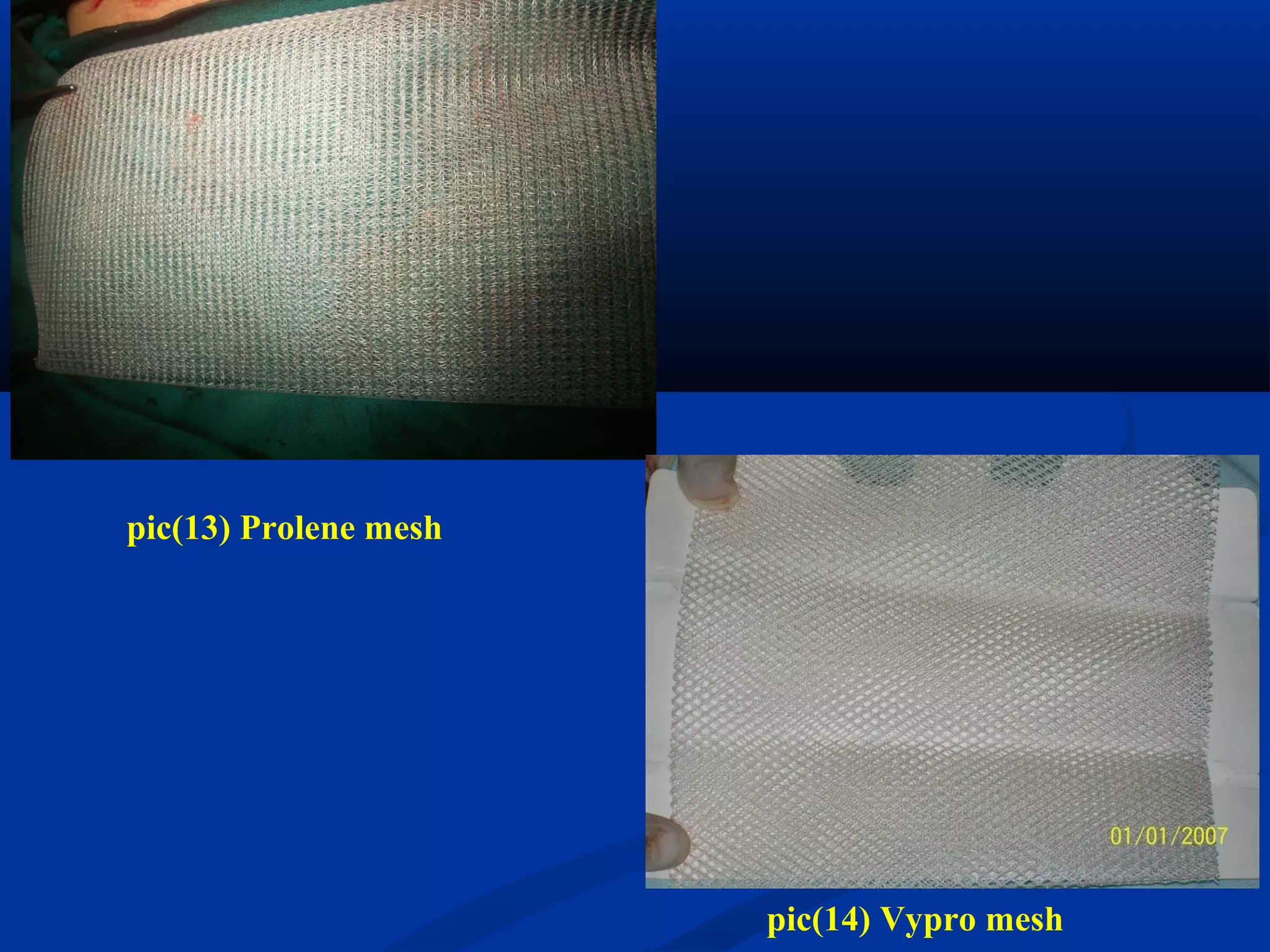
pic(13) Prolene mesh
pic(14) Vypro mesh
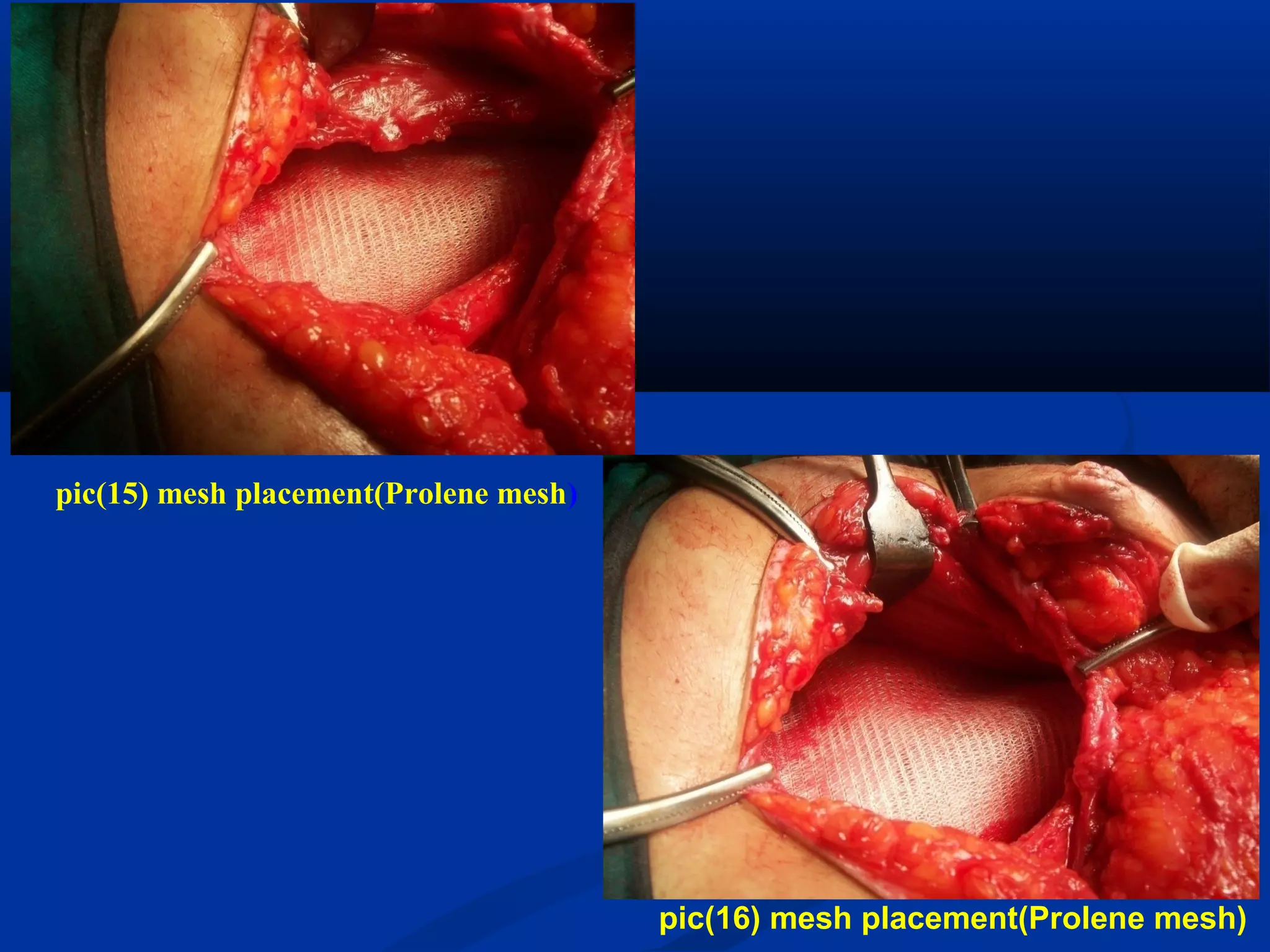
pic(15) mesh placement(Prolene mesh)
pic(16) mesh placement(Prolene mesh)
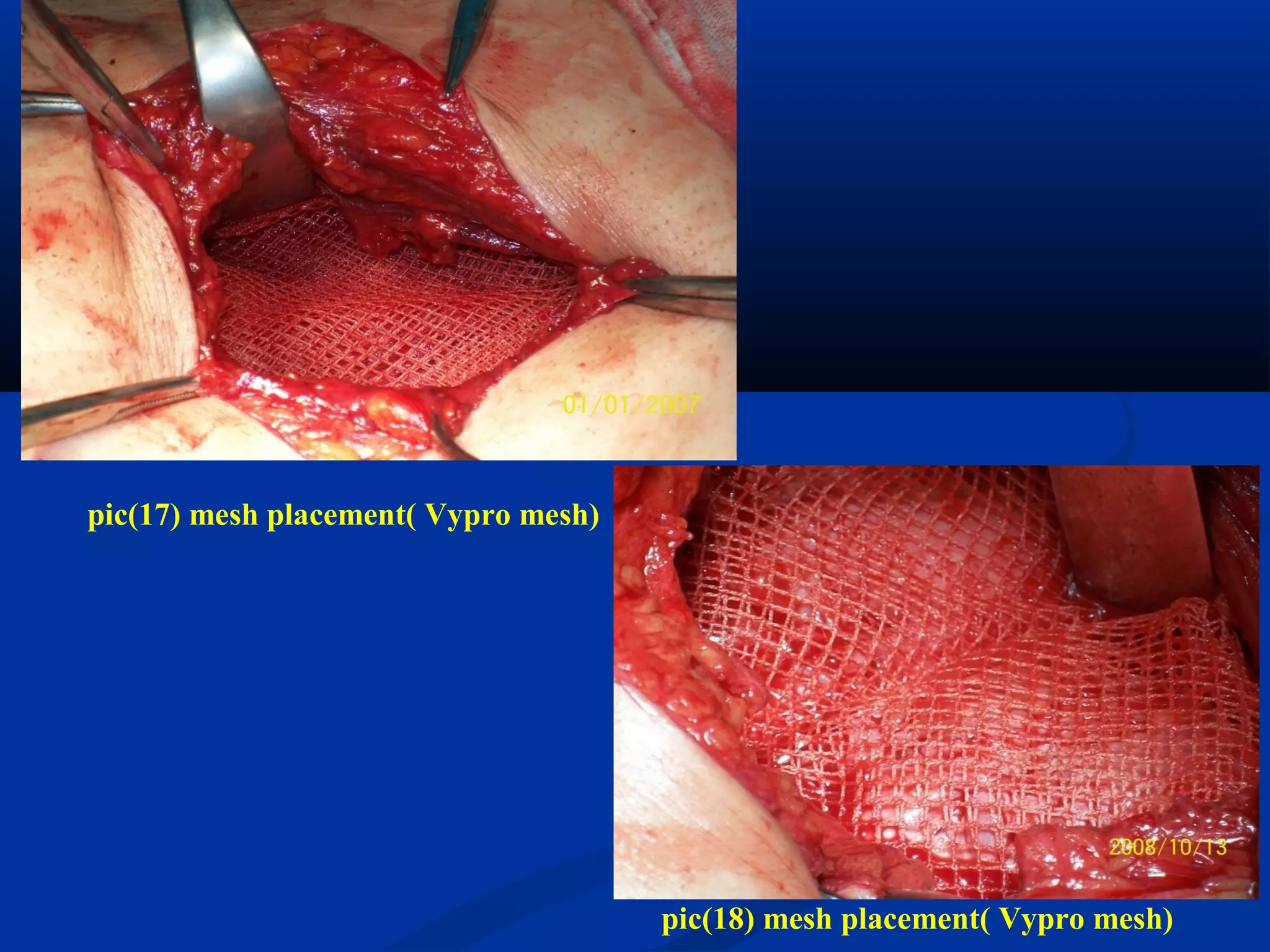
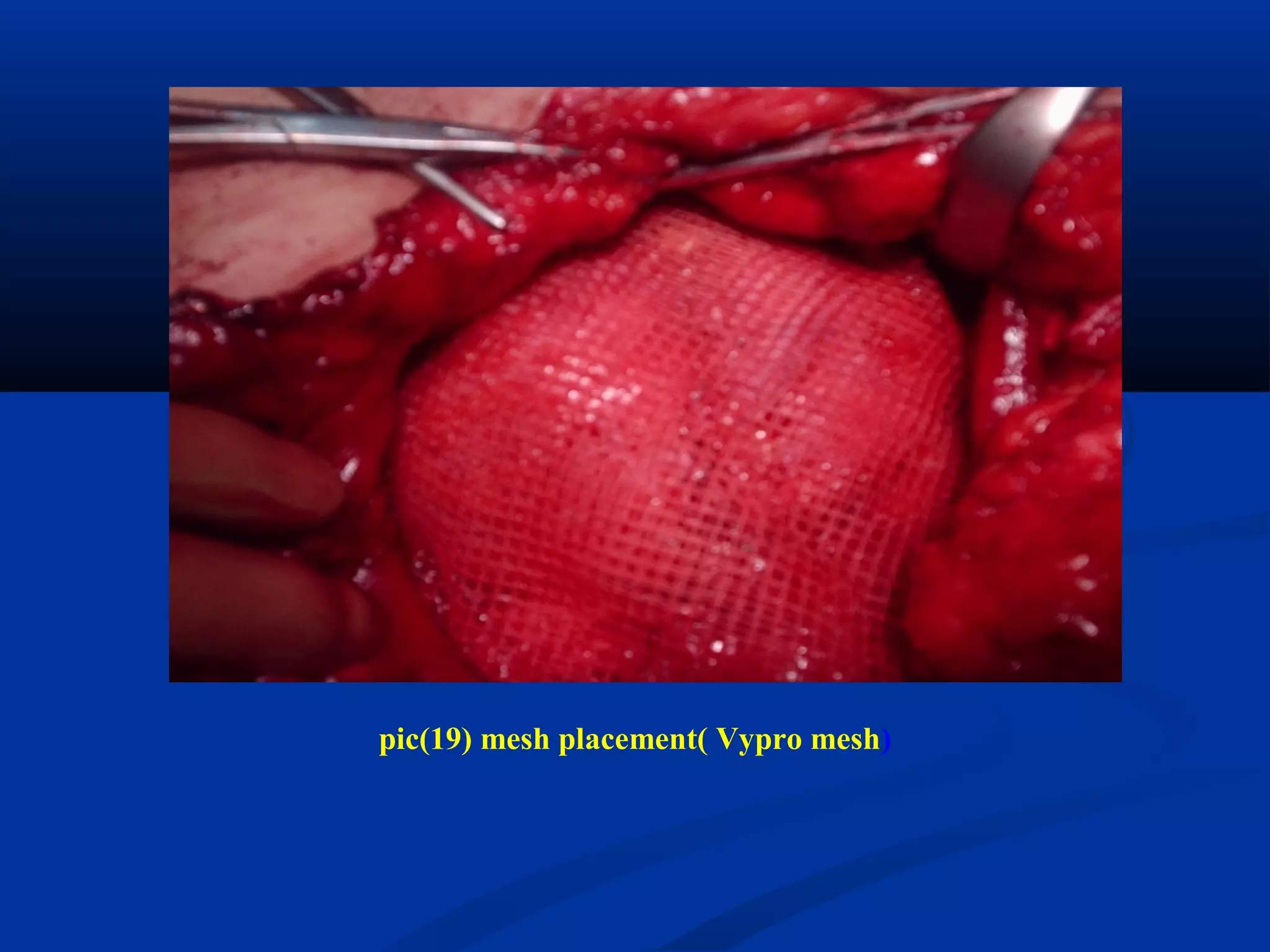
pic(17) mesh placement( Vypro mesh)
pic(18) mesh placement( Vypro mesh)
pic(19) mesh placement( Vypro mesh)
pic(20)Anterior fascia closure with submuscular suction drainage
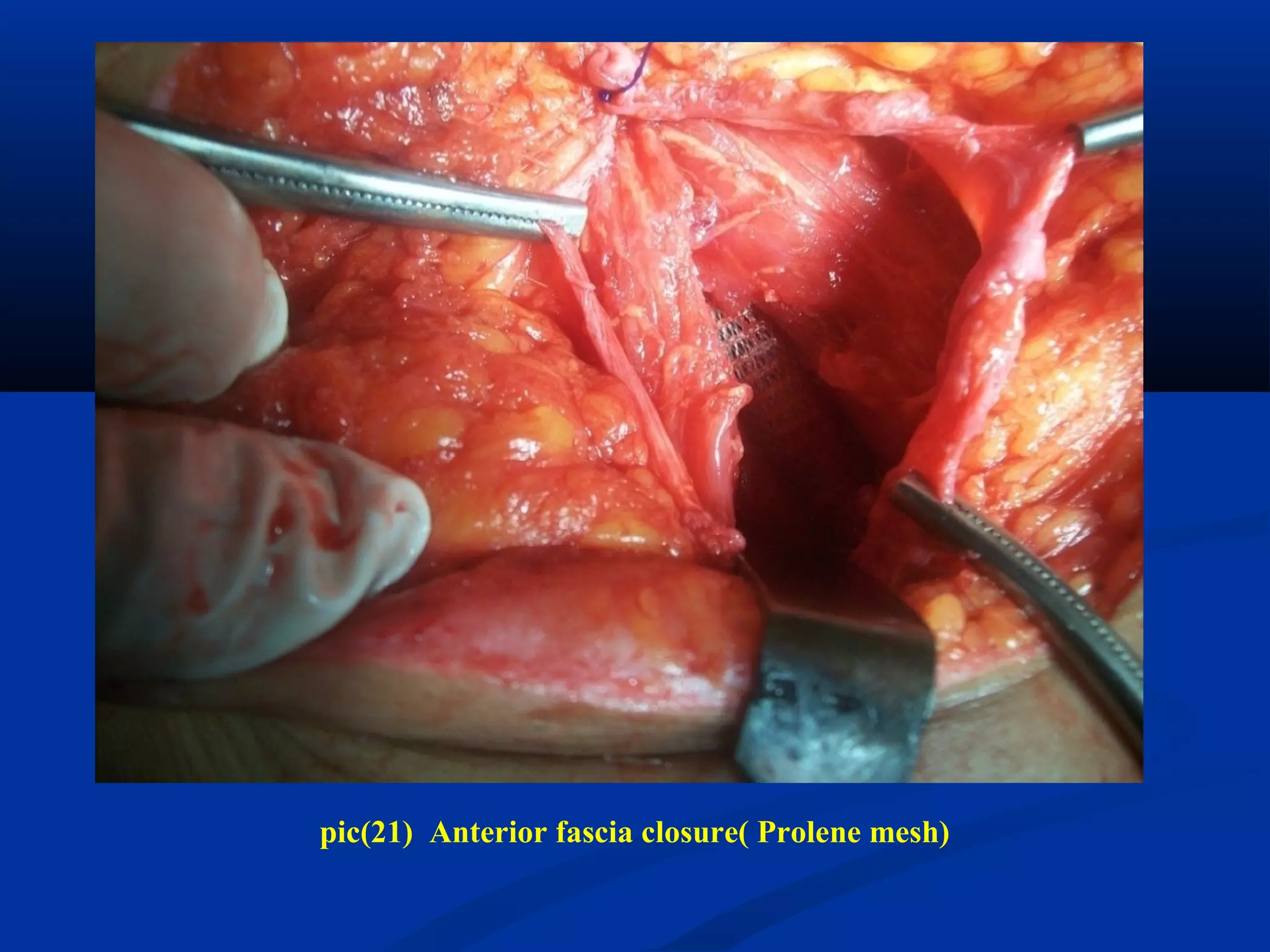
pic(21) Anterior fascia closure( Prolene mesh)
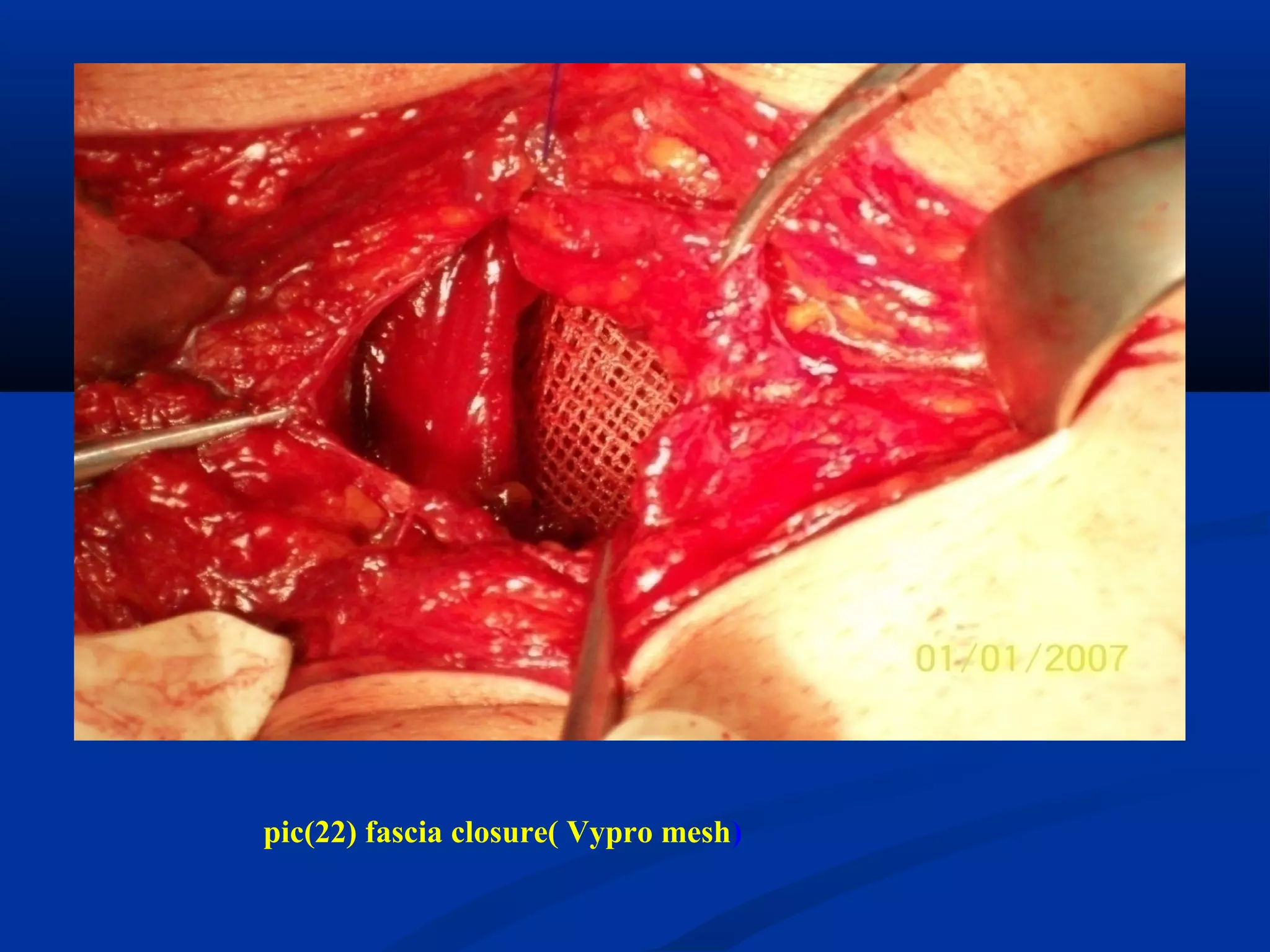
pic(22) fascia closure( Vypro mesh)
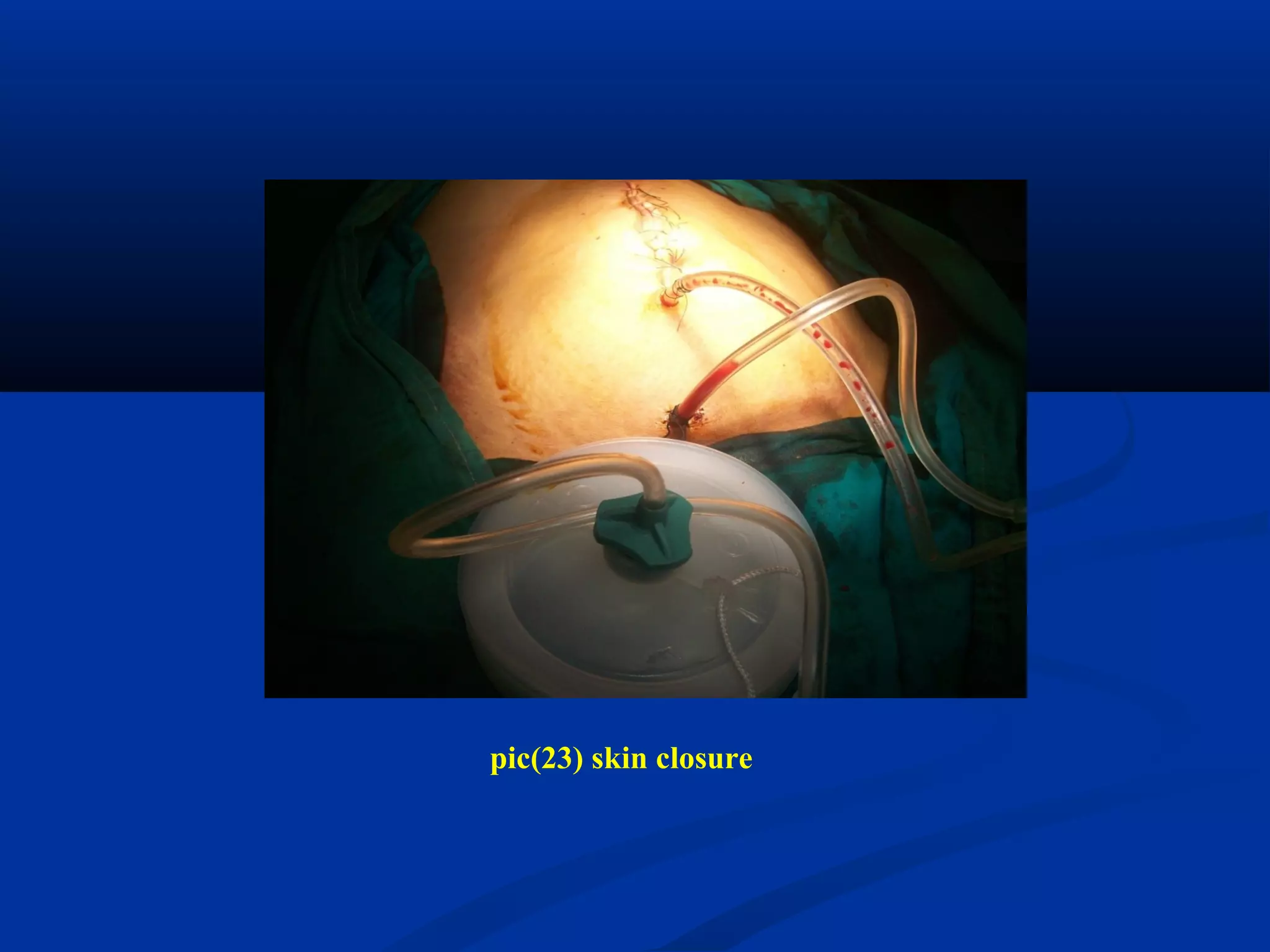
pic(23) skin closure
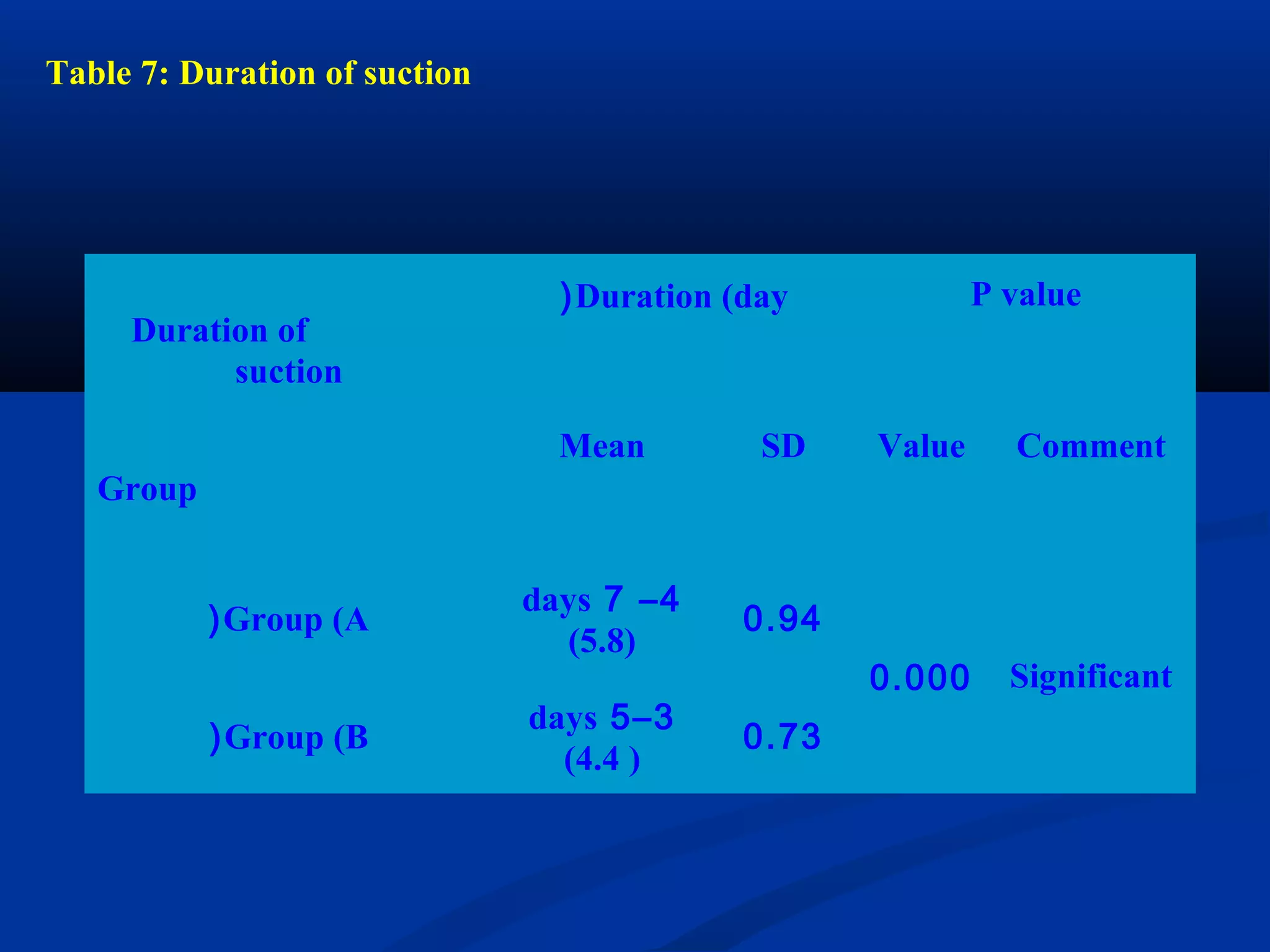
Duration of
suction
Group
Duration (day( P value
Mean SD Value Comment
Group (A(
4–7days
(5.8)
0.94
0.000 Significant
Group (B(
3–5days
(4.4 )
0.73
Table 7: Duration of suction
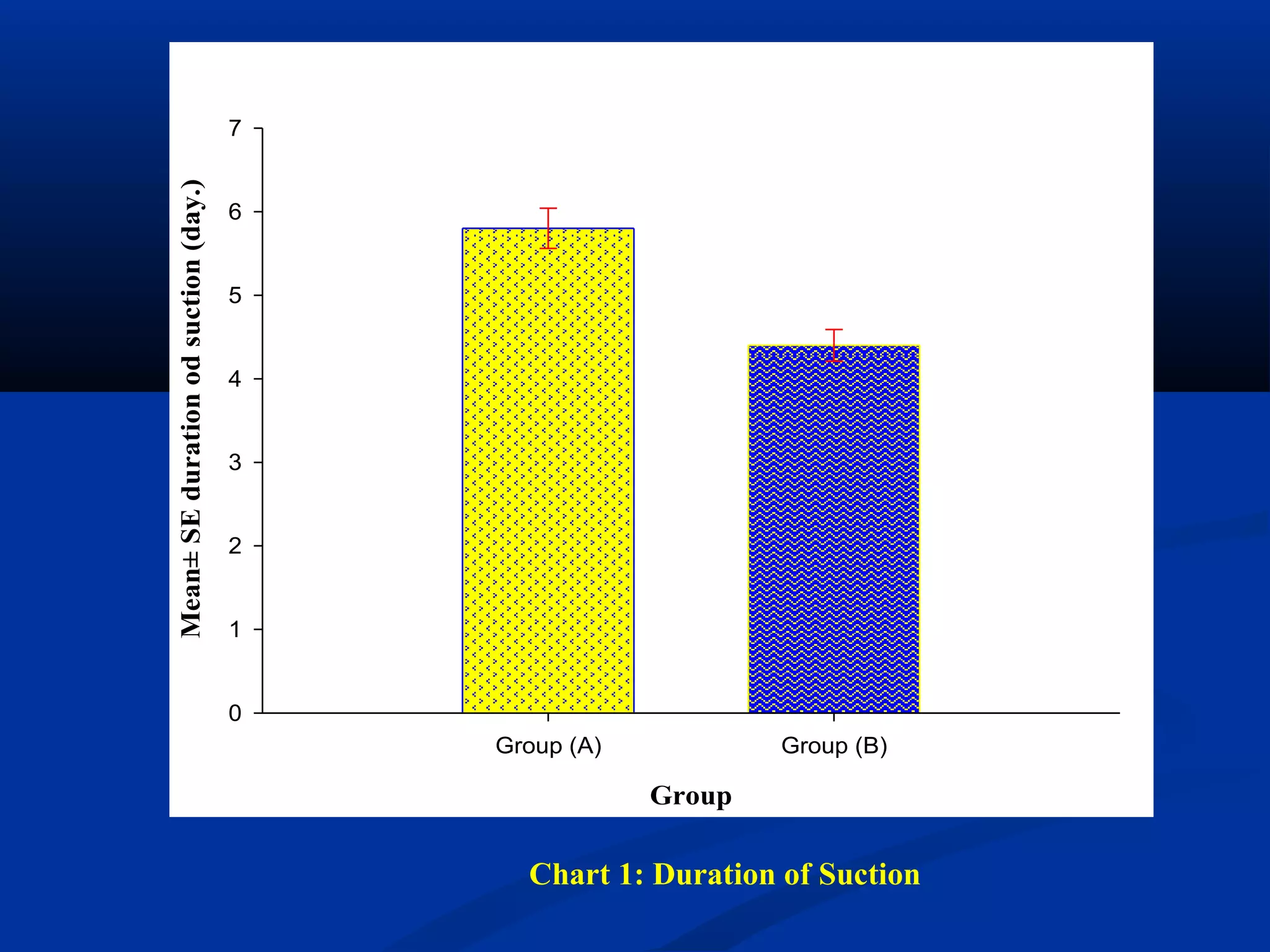
Group
Group (A) Group (B)
Mean±SEdurationodsuction(day.)
0
1
2
3
4
5
6
7
Chart 1: Duration of Suction
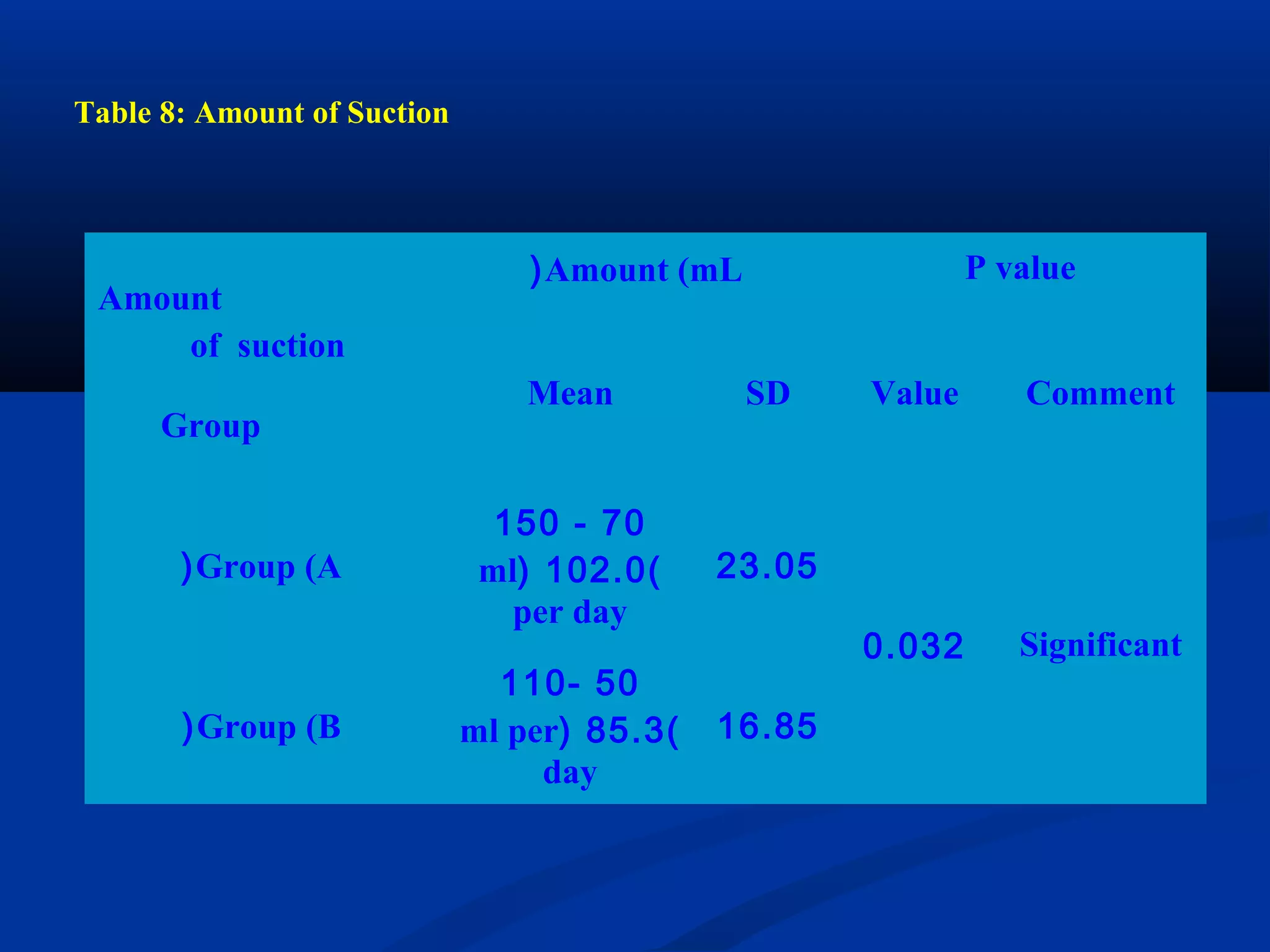
Table 8: Amount of Suction
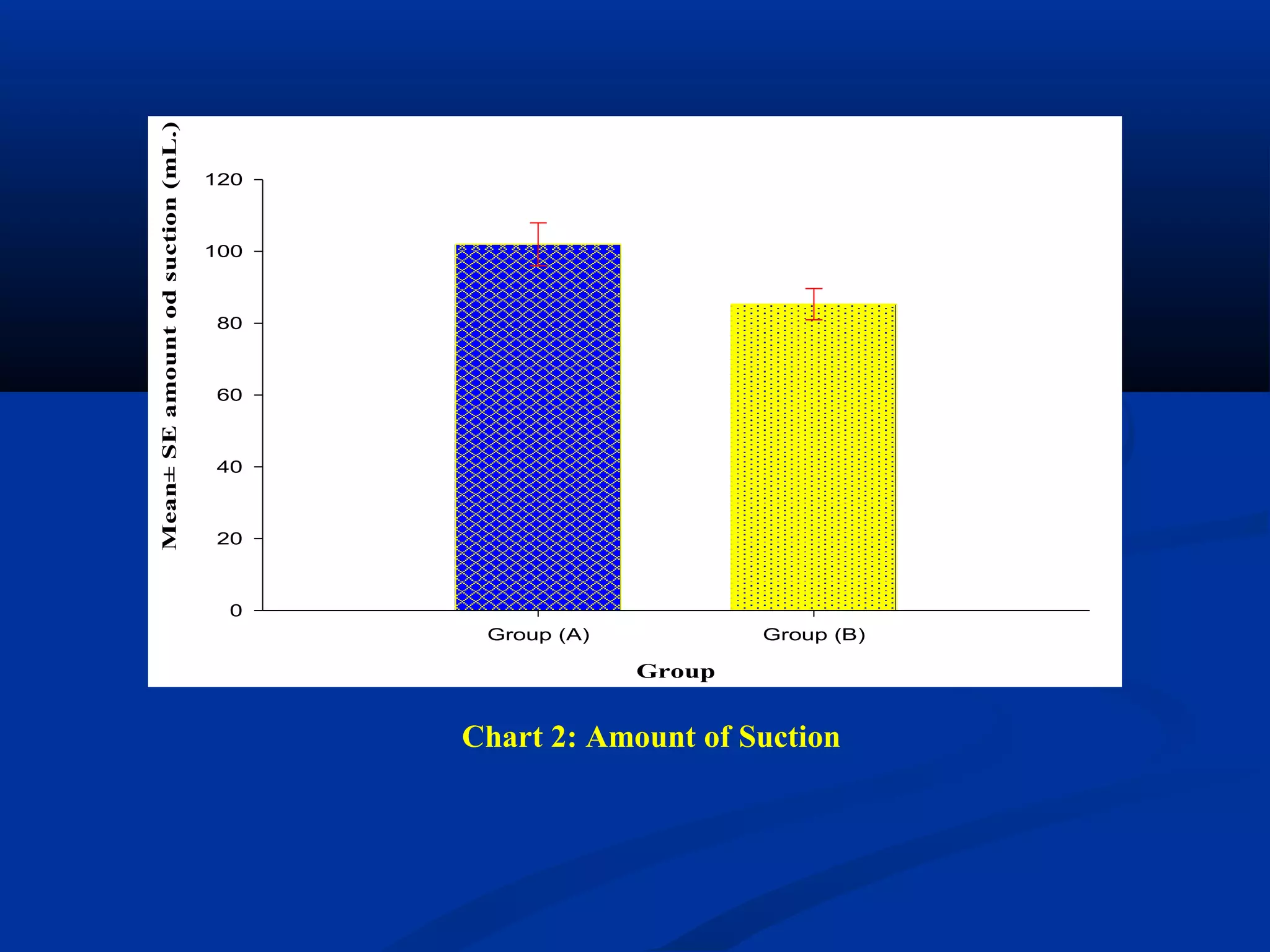
Amount
of suction
Group
Amount (mL( P value
Mean SD Value Comment
Group (A(
70-150
)102.0(ml
per day
23.05
0.032 Significant
Group (B(
50-110
)85.3(ml per
day
16.85
Group
Group (A) Group (B)
Mean±SEamountodsuction(mL.)
0
20
40
60
80
100
120
Chart 2: Amount of Suction
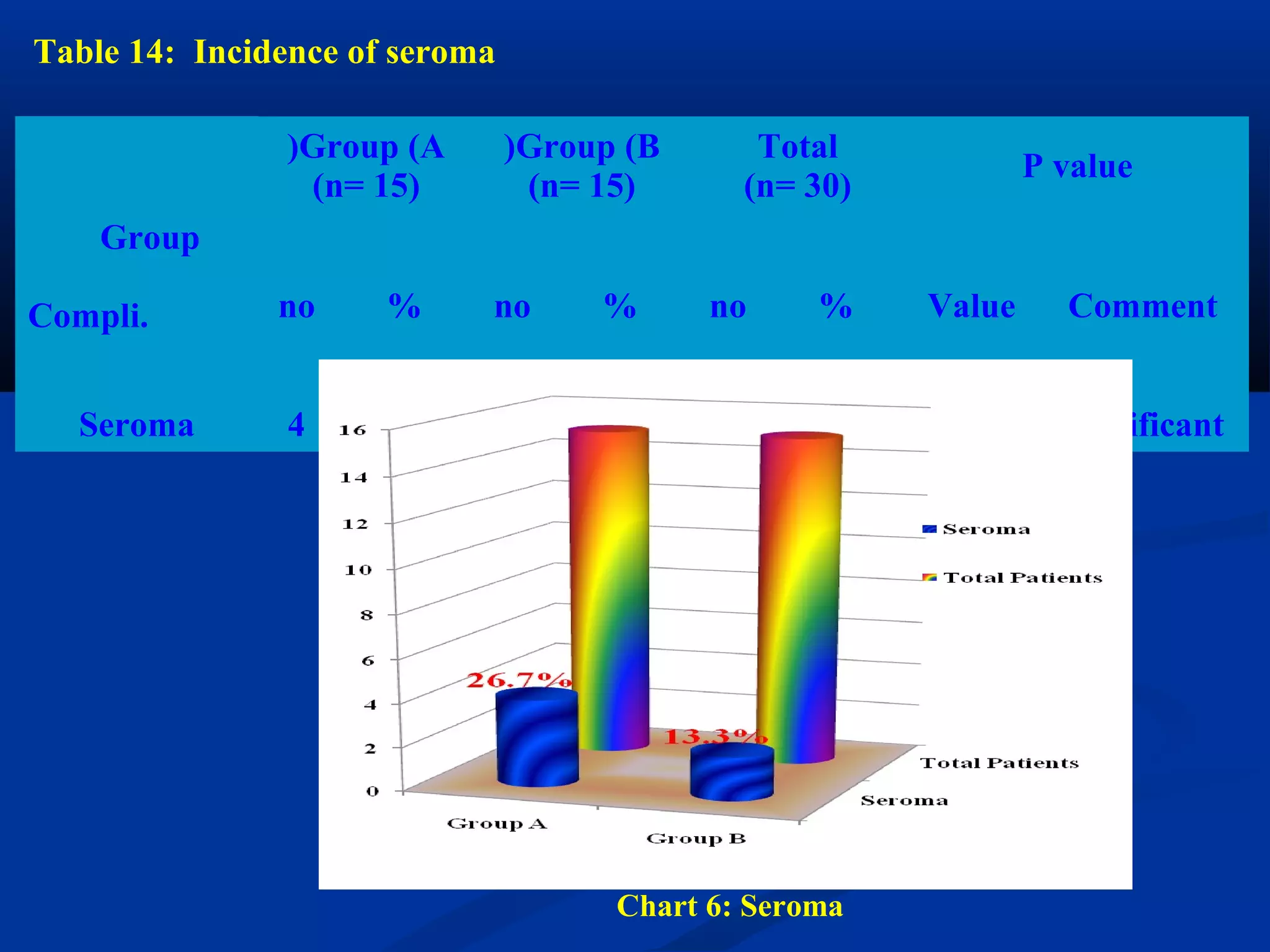
Table 14: Incidence of seroma
Group
Compli.
Group (A)
(n= 15)
Group (B)
(n= 15)
Total
(n= 30)
P value
no % no % no % Value Comment
Seroma 4 26.7% 2 13.3% 6 20.0% 0.013 Significant
Chart 6: Seroma
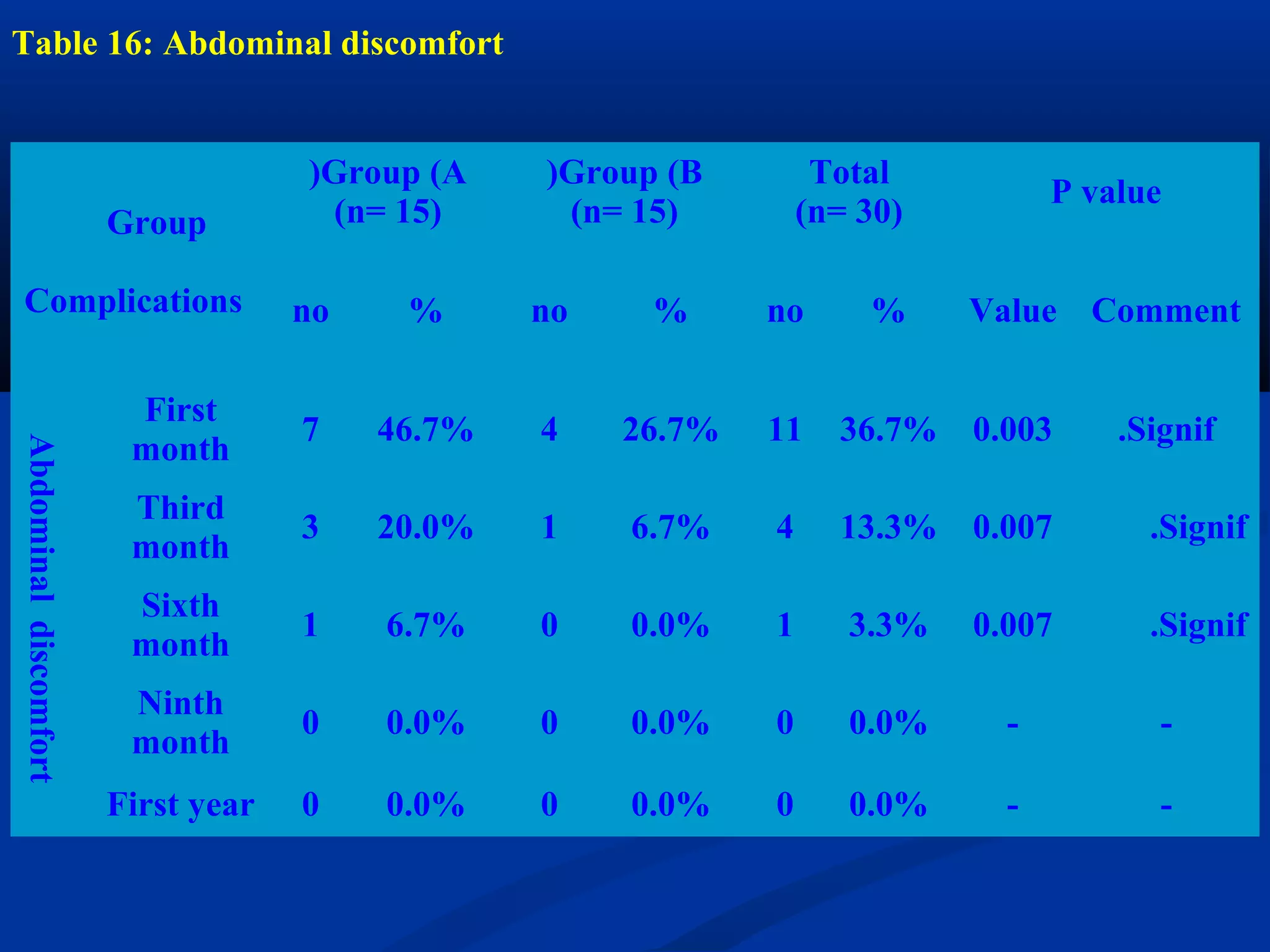
Table 16: Abdominal discomfort
Group
Complications
Group (A)
(n= 15)
Group (B)
(n= 15)
Total
(n= 30)
P value
no % no % no % Value Comment
Abdominaldiscomfort
First
month
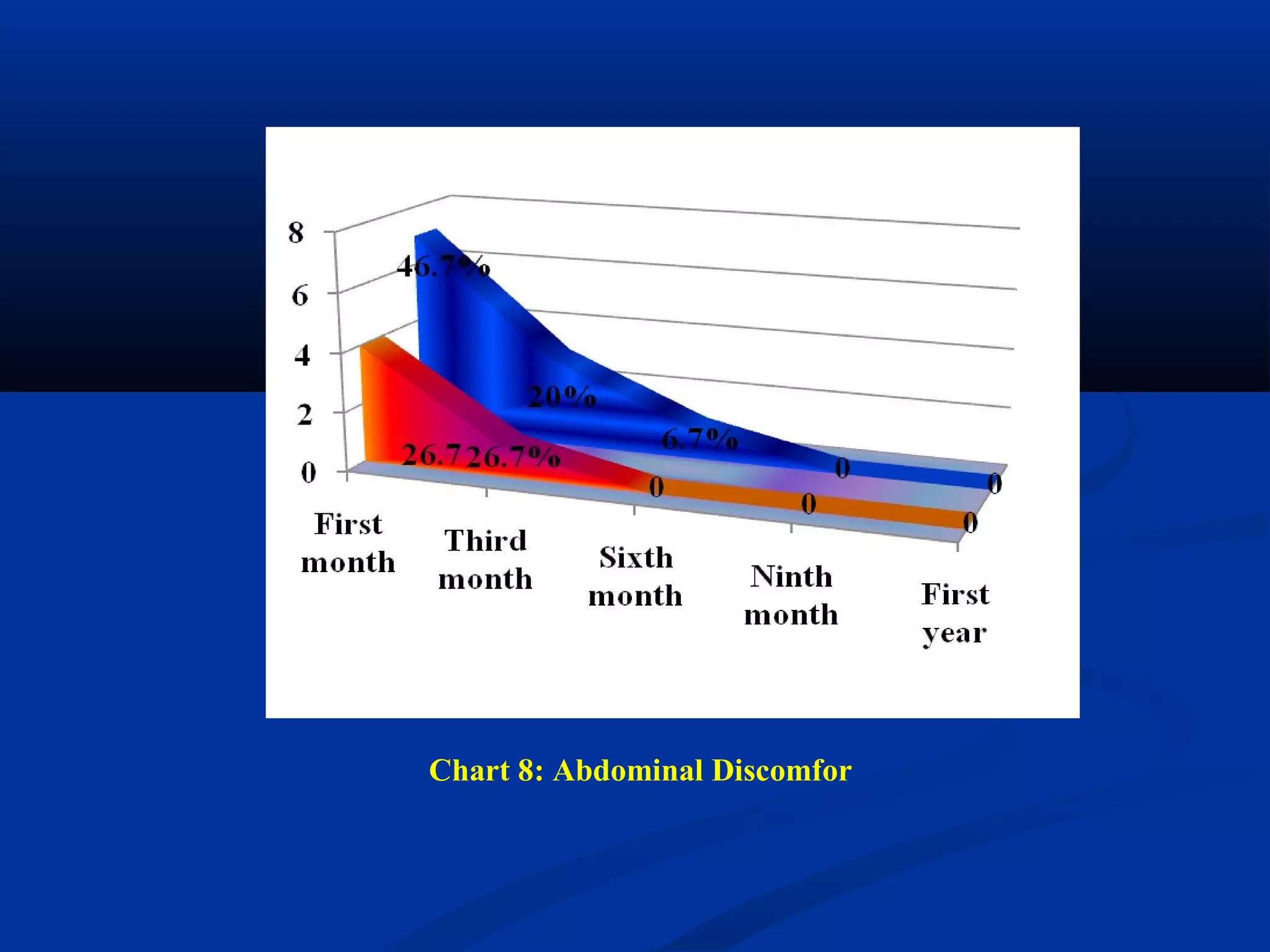
7 46.7% 4 26.7% 11 36.7% 0.003 Signif.
Third
month
3 20.0% 1 6.7% 4 13.3% 0.007 Signif.
Sixth
month
1 6.7% 0 0.0% 1 3.3% 0.007 Signif.
Ninth
month
0 0.0% 0 0.0% 0 0.0% - -
First year 0 0.0% 0 0.0% 0 0.0% - -
Chart 8: Abdominal Discomfor
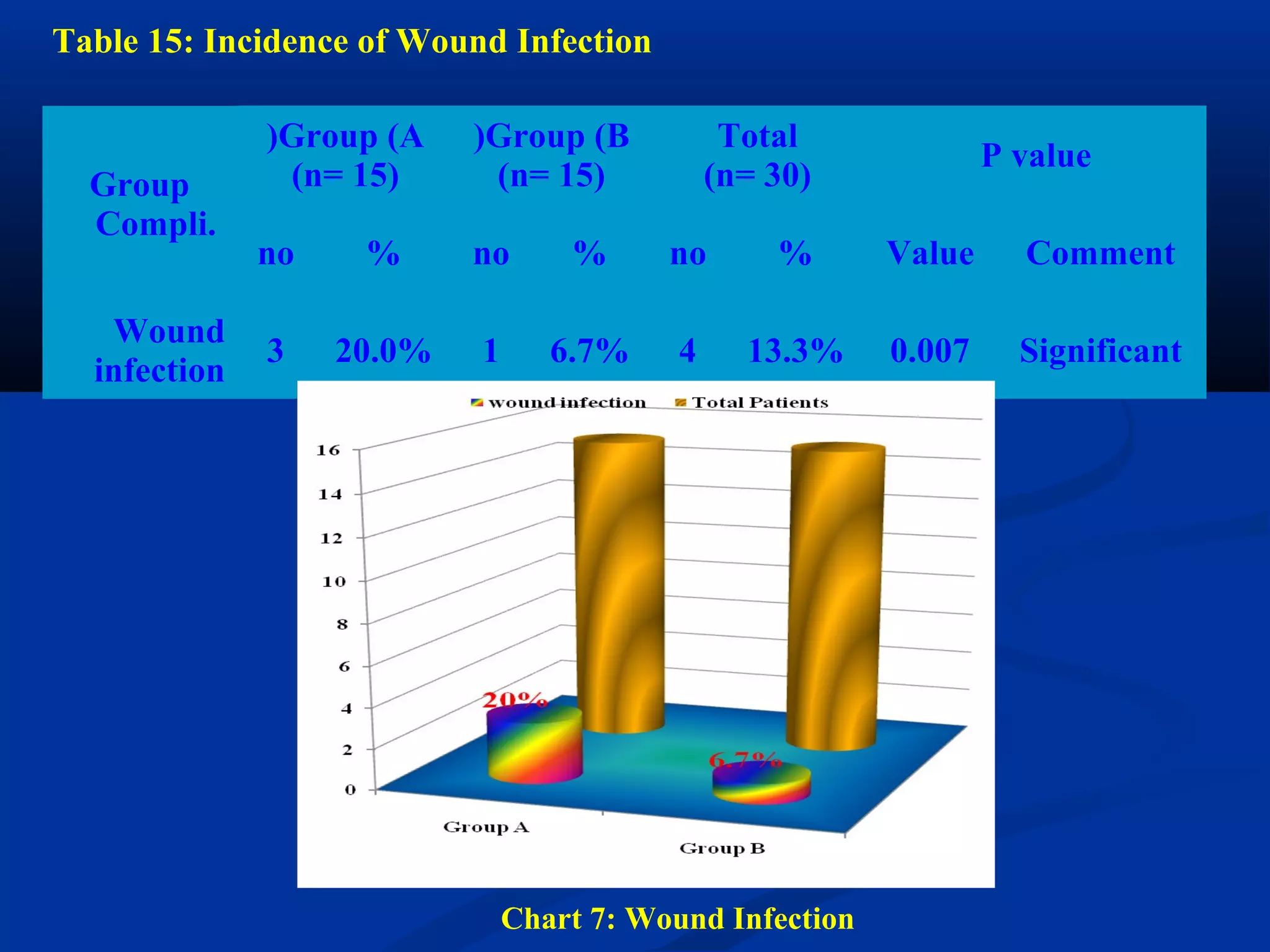
Table 15: Incidence of Wound Infection
Group
Compli.
Group (A)
(n= 15)
Group (B)
(n= 15)
Total
(n= 30)
P value
no % no % no % Value Comment
Wound
infection
3 20.0% 1 6.7% 4 13.3% 0.007 Significant
Chart 7: Wound Infection
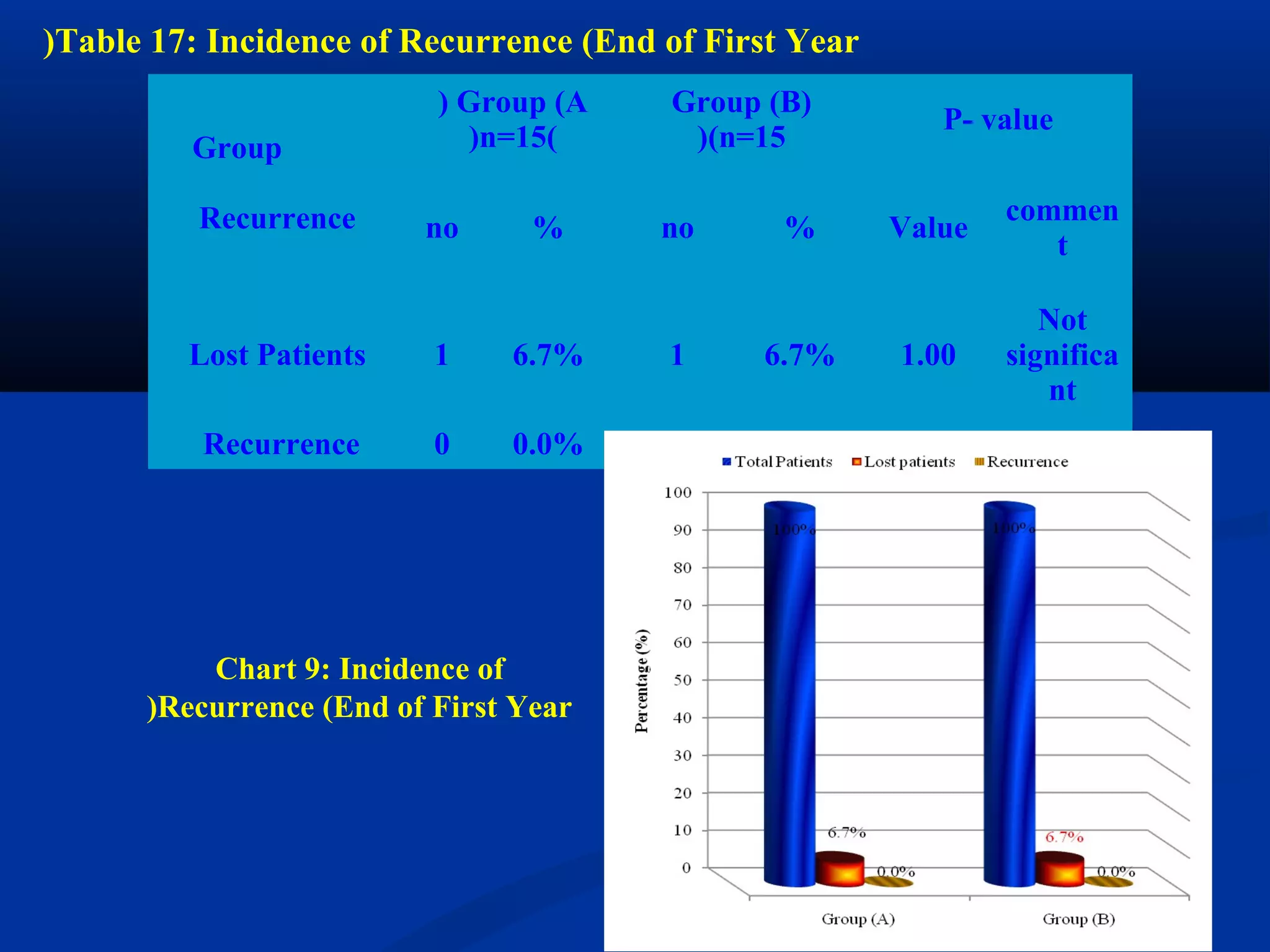
Table 17: Incidence of Recurrence (End of First Year)
Group
Recurrence
Group (A)
(n=15)
Group (B)
(n=15)
P- value
no % no % Value
commen
t
Lost Patients 1 6.7% 1 6.7% 1.00
Not
significa
nt
Recurrence 0 0.0% 0 0.0% - -
Chart 9: Incidence of
Recurrence (End of First Year)
Between Aug. 2007 and March 2010, 30
Patients were randomized to receive lightweight
composite (Vypro) mesh, or standard
polypropylene (Prolene) mesh. The clinical
course of all patients was registered during the
hospital stay as well as 3 ,6,9, and 12 months
after surgery. The follow up of all patients was
regular for at least one year after surgery and we
observed that :
*No significant differences concerning age,
gender,operative time.
*Duratin and amount of suction, length of
hospital stay were lower in the low-weight
(Vypro)mesh.
*Minor complications; seroma and wound
infection appeared frequently more in the heavy-
weight (Prolene)mesh group
.
*Patients of the heavy-weight mesh
complained significantly and more frequently
about chronic pain and abdominal wall
discomfort than those of the low-weight (Vypro)
mesh group,but non of both groups complain of
"stiff abdomen“.
* No hernia recurrences observed in both
groups ,this may be due to short follow up also
the hernias were selected of moderate size (5-
To conclude:
Open mesh repair using modern lowweightOpen mesh repair using modern lowweight
polypropylene (Vypro,Ultrapro) meshespolypropylene (Vypro,Ultrapro) meshes
with the retromuscular sublay techniquewith the retromuscular sublay technique
offers excellent results for treatment ofoffers excellent results for treatment of
incisional hernias even in long-term follow-incisional hernias even in long-term follow-
up.This technique is very simple can beup.This technique is very simple can be
easly done and easly learned.easly done and easly learned.
Thank you
‫ننننننن‬
‫ننن‬ ‫نننننن‬ ‫نننن‬ ‫ننن‬ ‫نننن‬ ‫نن‬
‫نننننننننننننننننن‬ ‫ننننننن‬
‫نن‬ ‫نننن‬ ‫ننن‬
‫ننننن‬ ‫نننن‬ ‫ننننن‬ /‫نننننن‬
‫نننننن‬ ‫ننننننن‬ ‫ننننننن‬
‫ننننننننن‬ ‫نننن‬ ‫ننن‬ ‫نننننن‬ ‫ننننن‬
‫نننننن‬ ‫ننننننن‬ ‫نن‬
‫ننننن‬ ‫ننن‬
‫نننن‬ ‫نننن‬ ‫نننن‬ /‫ننننننن‬ ‫ننننننن‬
‫نننننن‬ ‫ننننننن‬ ‫ننننن‬
‫ننن‬ ‫ننن‬ – ‫نن‬ ‫نننن‬
‫ننننن‬ / ‫ننننننن‬ ‫ننننننن‬
‫نننننن‬ ‫ننن‬ ‫نننننننن‬
‫نننننن‬ ‫ننننننن‬ ‫ننننن‬
‫ننن‬ ‫ننن‬ -‫نن‬ ‫نننن‬
‫ننن‬ ‫نننن‬ ‫ننن‬ ‫/نننن‬ ‫ننننننن‬

Vypro mesh presentation today1

  • 2.
  • 3.
    Evaluatation of theSublay retromuscular technique using light- weight "Vypro"mesh versus prolene mesh THESIS Submitted for partial fulfillment of the M.D degree in general surgery By Dr.MOUSTAFA MOHAMED HEGAZY
  • 4.
    Supervised by PROF. Dr.AHMED MOHAMED LOTFY Professor of General Surgery Faculty of Medicine - Ain-Shams University PROF. Dr. OSAMA FOUAD MOHAMED ABD ELGAWAD Professor of General Surgery Faculty of Medicine - Ain-Shams University Dr. MOHAMED ALI MOHAMED NADA Lecture of General Surgery Faculty of Medicine - Ain-Shams University 2010
  • 6.
    Incisional hernias remainone of the mostIncisional hernias remain one of the most common surgical complications with a long-termcommon surgical complications with a long-term incidence of 10-20%incidence of 10-20% (Schumpelick, et al., 2006).(Schumpelick, et al., 2006). Primary suture repair of incisional hernia resultsPrimary suture repair of incisional hernia results in 31-58% recurrencein 31-58% recurrence (Clark et al., 2006).(Clark et al., 2006). With a move to the tension-free repair following the introduction of the meshes, results improved, with a dramatic decrease in the rate of recurrence to approximately 10% (Millikan, 2003).
  • 7.
    Several techniques havebeen advocated toSeveral techniques have been advocated to implant the meshimplant the mesh or epifascialor epifascial underlay or retromuscularunderlay or retromuscular within the defectwithin the defect
  • 8.
    The onlay methodmay be complicated by:The onlay method may be complicated by: seroma and wound infections, whileseroma and wound infections, while intraperitoneal mesh leaves the potentialintraperitoneal mesh leaves the potential for development of enteric fistula or smallfor development of enteric fistula or small bowel obstructionsbowel obstructions (Hamilton et al.,(Hamilton et al., 20052005)
  • 9.
    Within recent decades,the sublay prostheticWithin recent decades, the sublay prosthetic herniorrhaphy, which was introduced in the 1970herniorrhaphy, which was introduced in the 1970 by the French surgeons Stoppa and Rives, becameby the French surgeons Stoppa and Rives, became one of the widely accepted procedures forone of the widely accepted procedures for incisional hernia repair.This technique isincisional hernia repair.This technique is characterized by mesh implantation in thecharacterized by mesh implantation in the "sublay"position below the rectus muscle"sublay"position below the rectus muscle (Petresen et al., 2004 )(Petresen et al., 2004 )
  • 10.
    Increasing evidence ofimpaired wound healingIncreasing evidence of impaired wound healing in incisional hernia patients supports routine usein incisional hernia patients supports routine use of an open prefascial, retromuscular mesh repair.of an open prefascial, retromuscular mesh repair. Basic pathophysiologic principles dictate that forBasic pathophysiologic principles dictate that for a successful long-term outcome and prevention ofa successful long-term outcome and prevention of recurrence, a wide overlap underneath healthyrecurrence, a wide overlap underneath healthy tissue is required ,only retromuscular placementtissue is required ,only retromuscular placement allows sufficient subduction of the mesh byallows sufficient subduction of the mesh by healthy tissuehealthy tissue (schumpelick, et al; 2007)(schumpelick, et al; 2007).
  • 11.
    Polypropylene is thematerial widely used forPolypropylene is the material widely used for open mesh repair. New developments have led toopen mesh repair. New developments have led to light-weight meshe e.g`Vypro and Ultrapro``meshes,light-weight meshe e.g`Vypro and Ultrapro``meshes, which are adjusted to the physiological requirementswhich are adjusted to the physiological requirements of the abdominal wall and permit proper tissueof the abdominal wall and permit proper tissue integration. These meshes provide the possibility ofintegration. These meshes provide the possibility of forming a scar net instead of a stiff scar plate ,forming a scar net instead of a stiff scar plate , therefore help to avoid the former knowntherefore help to avoid the former known complicationscomplications (schumpelick, et al; 2009).
  • 13.
    In our studywe try to evaluate the:In our study we try to evaluate the: *challenge of the sublay retromuscular*challenge of the sublay retromuscular technique of ventral incisional hernia repair, withtechnique of ventral incisional hernia repair, with the advent of some new technical points in a trialthe advent of some new technical points in a trial to reduce recurrence.to reduce recurrence. **compare results of using light-weight**compare results of using light-weight ``Vypro``mesh versus the standard heavy-weight``Vypro``mesh versus the standard heavy-weight prolene mesh in respect of post-operativeprolene mesh in respect of post-operative complications, chronic pain and recurrence.complications, chronic pain and recurrence.
  • 14.
  • 15.
    No disease ofthe human body, belongingNo disease of the human body, belonging to the province of the surgeon, requires in itsto the province of the surgeon, requires in its treatment a better combination of accuratetreatment a better combination of accurate anatomical knowledge with surgical skillanatomical knowledge with surgical skill than hernia in all its varietiesthan hernia in all its varieties(Sir Astley(Sir Astley Paston copoer, 1804)Paston copoer, 1804)
  • 17.
    Incidence of IncisionalHernia: The frequency for incisional hernias (IH) after laparotomy is 2-11% Incisional hernias make up about 80% of the ventral hernias that surgeons encounter (Voeller, 2007).
  • 18.
    Factors affecting incisionalhernia incidencFactors affecting incisional hernia incidenc A- Patient factors:A- Patient factors: including obesity, smoking,including obesity, smoking, aneurismal disease, chronic obstructiveaneurismal disease, chronic obstructive pulmonary disease, male gender,pulmonary disease, male gender, malnourishment, corticosteroid dependency,malnourishment, corticosteroid dependency, renal failure, malignancy, and prostatismrenal failure, malignancy, and prostatism (Millikan, 2003).
  • 19.
    B- Surgical factors:B-Surgical factors: Like emergency surgery,Like emergency surgery, bowel surgery, suture type and technique,bowel surgery, suture type and technique, chest infection, abdominal distension andchest infection, abdominal distension and wound infection. There is evidence that inwound infection. There is evidence that in many cases wound failure after abdominalmany cases wound failure after abdominal wall closure is dependent on the surgeonwall closure is dependent on the surgeon (Yahchouchy-Chouillard et al., 2003).(Yahchouchy-Chouillard et al., 2003).
  • 20.
    Recently, molecular biologicinvestigationsRecently, molecular biologic investigations have proven the theory of disturbedhave proven the theory of disturbed composition of the extracellular matrix incomposition of the extracellular matrix in patients with recurrent hernia. In particular,patients with recurrent hernia. In particular, there is a decreased ratio of collagen types Ithere is a decreased ratio of collagen types I and IIIand III (Jansen et al., 2004 ).(Jansen et al., 2004 ). .…
  • 21.
    Treatment of IncisionalHerniaTreatment of Incisional Hernia Once an IH occurs, the natural history ofOnce an IH occurs, the natural history of it is to grow. Delay in repair complicatesit is to grow. Delay in repair complicates every single aspect of the surgery and leadsevery single aspect of the surgery and leads to increased morbidity; so repair should beto increased morbidity; so repair should be done as soon as possibledone as soon as possible
  • 22.
    Suture RepairSuture Repair Manysuture techniques have been described,Many suture techniques have been described, but none has proven to be superior to the other.but none has proven to be superior to the other. HoweverHowever (Jenkin's rule):(Jenkin's rule): mass closure with amass closure with a non-absorbable or slowly absorbablenon-absorbable or slowly absorbable monofilament suture (e.g. PDS) good bitesmonofilament suture (e.g. PDS) good bites (>1cm), using a suture length : wound length(>1cm), using a suture length : wound length ratio of 4:1, can be used in small sized herniaratio of 4:1, can be used in small sized hernia less than 4 cm.less than 4 cm.
  • 23.
    Inlay Repair:Inlay Repair: Inthis repair, the mesh is sutured to the fascialIn this repair, the mesh is sutured to the fascial edges without initially closing the defect. Theedges without initially closing the defect. The mesh lies in contact with the viscera. Thismesh lies in contact with the viscera. This technique has a high recurrence rate and maytechnique has a high recurrence rate and may lead to bowel adhesions and development oflead to bowel adhesions and development of enterocutaneous fistulas, so it is notenterocutaneous fistulas, so it is not recommended unless the substantial defectrecommended unless the substantial defect cannot be closed with other technique .cannot be closed with other technique .
  • 24.
    Onlay Repair :OnlayRepair : After dissection of the hernial sac, theAfter dissection of the hernial sac, the fascial edges are brought together and thefascial edges are brought together and the mesh is placed over the suture line makingmesh is placed over the suture line making an overlap of 5 cm.and fixed with stiches toan overlap of 5 cm.and fixed with stiches to the anterior fascia The skin is closed overthe anterior fascia The skin is closed over the mesh.the mesh.
  • 25.
    Sublay RepairSublay Repair((Rives-Stoppa-Retrorectus Repair)Rives-Stoppa-Retrorectus Repair) The mesh is placed beneath the rectus muscle inThe mesh is placed beneath the rectus muscle in front of the closed posterior rectus sheath andfront of the closed posterior rectus sheath and peritoneum. The anterior rectus sheath is closed.peritoneum. The anterior rectus sheath is closed. The advantage of this technique is that intra-The advantage of this technique is that intra- abdominal forces hold the prosthesis against theabdominal forces hold the prosthesis against the muscles,i.e the forces that created the herniamuscles,i.e the forces that created the hernia now are used to prevent its recurrence.now are used to prevent its recurrence.
  • 26.
    In contrast toa mesh in front of the fasciaIn contrast to a mesh in front of the fascia in onlay position, the sublay mesh positionin onlay position, the sublay mesh position facilitates a sufficient subduction of intactfacilitates a sufficient subduction of intact linea alba. It is the retromuscular mesh with alinea alba. It is the retromuscular mesh with a fascia closure in front, which is kept infascia closure in front, which is kept in position just by tissue ingrowth and intra-position just by tissue ingrowth and intra- abdominal pressure,abdominal pressure,
  • 27.
    whereas the onlaymesh has to be fixedwhereas the onlay mesh has to be fixed additionally by permanent sutures. The spaceadditionally by permanent sutures. The space behind the rectus muscle can be easilybehind the rectus muscle can be easily dissected, whereas the extended preparation ofdissected, whereas the extended preparation of the subcutaneous space in the case of the onlaythe subcutaneous space in the case of the onlay position is frequently accompanied byposition is frequently accompanied by hematoma, seroma, or wound infection.hematoma, seroma, or wound infection. (Schumpelick et al., 2007).(Schumpelick et al., 2007).
  • 28.
    Laparoscopic Repair ofthe Incisional HerniaLaparoscopic Repair of the Incisional Hernia In 1991 LeBlanc reported the first successfulIn 1991 LeBlanc reported the first successful series of laparoscopic ventral hernia repairseries of laparoscopic ventral hernia repair (LeBlanc et al., 2001).(LeBlanc et al., 2001). After creation of the pneumoperitoneum andAfter creation of the pneumoperitoneum and port placement, the hernial contents are reducedport placement, the hernial contents are reduced intraperitoneally and the mesh is placed tointraperitoneally and the mesh is placed to overlap the defect and fixed with clips andoverlap the defect and fixed with clips and suturessutures(Goodney et al., 2002).(Goodney et al., 2002).
  • 29.
    Mesh Materials: Absorable mesh:Polyglactin 910 (VICRYL) Polyglycolic acid (DEXON) Non-absorable Mesh: Polytetrafluoroethylene: (PTFE:Gore-Tex),DualMesh,Dulex,MotifMESH ePTFE Polyethylene : (Dacron: Mersilene, Parietex ) Polypropylene: : (Marlex, Prolene, Atrium, SurgiPro) Material-reduced meshes Polypropylene and polyglactin (Vypro I/II), polypropylene and polyglecaprone (UltraPro)
  • 30.
    The Ideal MeshTheIdeal Mesh There is no ideal mesh or ‘‘best’’ mesh, soThere is no ideal mesh or ‘‘best’’ mesh, so the decision of which mesh to use is based onthe decision of which mesh to use is based on several factors: the type of procedure beingseveral factors: the type of procedure being done, the clinical situation, the desireddone, the clinical situation, the desired handling characteristics, and the productshandling characteristics, and the products available to the surgeon based upon hospitalavailable to the surgeon based upon hospital materials contracts and costs.materials contracts and costs.
  • 31.
    The most commonlyused meshes
  • 32.
    l Biological Meshes Recently, anumber of biological meshes haveRecently, a number of biological meshes have become available. These are Surgisis?, which isbecome available. These are Surgisis?, which is made from porcine gut submucosa, Alloderm?,made from porcine gut submucosa, Alloderm?, which is made from cadaver dermis andwhich is made from cadaver dermis and Permacol? made from porcine dermis. They arePermacol? made from porcine dermis. They are expensive and can be used in contaminatedexpensive and can be used in contaminated situations. Long-term evaluation issituations. Long-term evaluation is neededneeded(Voeller 2007).(Voeller 2007).
  • 33.
    Postoperative complications ofmesh repair **seroma formation,seroma formation, **superficial and deep wound infection,superficial and deep wound infection, **mesh rejectionmesh rejection **Abdominal discomfort (stiff abdomen),Abdominal discomfort (stiff abdomen), **recurrence.recurrence.
  • 34.
  • 35.
  • 37.
    PatientsPatients:: *30 patients complainingof moderate*30 patients complaining of moderate sized ventral incisional hernia (5-11cm).sized ventral incisional hernia (5-11cm). *Larg and huge sized hernias are*Larg and huge sized hernias are excluded as they requrie additionalexcluded as they requrie additional methods of repair.methods of repair.
  • 38.
    The patients classifiedinto two groups: Group A: 15 patients treated by the Heavy-weight prolene mesh in the sublay position. Group B: 15 patients treated by the Light-weight`` vypro`` mesh in the sublay position.
  • 39.
    Operative detai METHODES OFREPAIR Sublay "mesh repair; retromuscularSublay "mesh repair; retromuscular techniquetechnique The steps of operation sublay retromuscular mesh repair published by Schumpelick et al., (2007),stressing on the following technical points: *The different layers of the abdominal wall were reconstructed with mesh placed behind the rectus muscle.
  • 40.
    *The mesh wassized to give a wide overlap of the implanted mesh at least 5cm in all directions surrounding the hernia defect. *The posterior rectus sheath and the peritoneum were closed to prevent direct contact between mesh and intestine.
  • 41.
    *The anterior fasciaof the rectus sheath was closed i.e. reconstruction of the linea alba by closure of anterior rectus sheath over the mesh was mandatory. *Suction drain left in the retromuscular plane before wound closure .
  • 42.
    pic.(2)moderate size incisionalherniapic.(1)moderate size incisional hernia
  • 43.
  • 44.
    pic(6)opening of herniasac pic(7) adhesolysis
  • 45.
  • 46.
    pic(9) the posteriorrectus sheath
  • 47.
    pic(10) incision ofthe posterior rectus sheath
  • 48.
    pic(11) dissection ofthe posterior rectus sheath
  • 49.
    pic(12)closure of theposterior rectus sheath
  • 50.
  • 51.
    pic(15) mesh placement(Prolenemesh) pic(16) mesh placement(Prolene mesh)
  • 52.
    pic(17) mesh placement(Vypro mesh) pic(18) mesh placement( Vypro mesh)
  • 53.
  • 54.
    pic(20)Anterior fascia closurewith submuscular suction drainage
  • 55.
    pic(21) Anterior fasciaclosure( Prolene mesh)
  • 56.
  • 57.
  • 59.
    Duration of suction Group Duration (day(P value Mean SD Value Comment Group (A( 4–7days (5.8) 0.94 0.000 Significant Group (B( 3–5days (4.4 ) 0.73 Table 7: Duration of suction
  • 60.
    Group Group (A) Group(B) Mean±SEdurationodsuction(day.) 0 1 2 3 4 5 6 7 Chart 1: Duration of Suction
  • 61.
    Table 8: Amountof Suction Amount of suction Group Amount (mL( P value Mean SD Value Comment Group (A( 70-150 )102.0(ml per day 23.05 0.032 Significant Group (B( 50-110 )85.3(ml per day 16.85
  • 62.
    Group Group (A) Group(B) Mean±SEamountodsuction(mL.) 0 20 40 60 80 100 120 Chart 2: Amount of Suction
  • 63.
    Table 14: Incidenceof seroma Group Compli. Group (A) (n= 15) Group (B) (n= 15) Total (n= 30) P value no % no % no % Value Comment Seroma 4 26.7% 2 13.3% 6 20.0% 0.013 Significant Chart 6: Seroma
  • 64.
    Table 16: Abdominaldiscomfort Group Complications Group (A) (n= 15) Group (B) (n= 15) Total (n= 30) P value no % no % no % Value Comment Abdominaldiscomfort First month 7 46.7% 4 26.7% 11 36.7% 0.003 Signif. Third month 3 20.0% 1 6.7% 4 13.3% 0.007 Signif. Sixth month 1 6.7% 0 0.0% 1 3.3% 0.007 Signif. Ninth month 0 0.0% 0 0.0% 0 0.0% - - First year 0 0.0% 0 0.0% 0 0.0% - -
  • 65.
  • 66.
    Table 15: Incidenceof Wound Infection Group Compli. Group (A) (n= 15) Group (B) (n= 15) Total (n= 30) P value no % no % no % Value Comment Wound infection 3 20.0% 1 6.7% 4 13.3% 0.007 Significant Chart 7: Wound Infection
  • 67.
    Table 17: Incidenceof Recurrence (End of First Year) Group Recurrence Group (A) (n=15) Group (B) (n=15) P- value no % no % Value commen t Lost Patients 1 6.7% 1 6.7% 1.00 Not significa nt Recurrence 0 0.0% 0 0.0% - - Chart 9: Incidence of Recurrence (End of First Year)
  • 69.
    Between Aug. 2007and March 2010, 30 Patients were randomized to receive lightweight composite (Vypro) mesh, or standard polypropylene (Prolene) mesh. The clinical course of all patients was registered during the hospital stay as well as 3 ,6,9, and 12 months after surgery. The follow up of all patients was regular for at least one year after surgery and we observed that :
  • 70.
    *No significant differencesconcerning age, gender,operative time. *Duratin and amount of suction, length of hospital stay were lower in the low-weight (Vypro)mesh. *Minor complications; seroma and wound infection appeared frequently more in the heavy- weight (Prolene)mesh group .
  • 71.
    *Patients of theheavy-weight mesh complained significantly and more frequently about chronic pain and abdominal wall discomfort than those of the low-weight (Vypro) mesh group,but non of both groups complain of "stiff abdomen“. * No hernia recurrences observed in both groups ,this may be due to short follow up also the hernias were selected of moderate size (5-
  • 73.
    To conclude: Open meshrepair using modern lowweightOpen mesh repair using modern lowweight polypropylene (Vypro,Ultrapro) meshespolypropylene (Vypro,Ultrapro) meshes with the retromuscular sublay techniquewith the retromuscular sublay technique offers excellent results for treatment ofoffers excellent results for treatment of incisional hernias even in long-term follow-incisional hernias even in long-term follow- up.This technique is very simple can beup.This technique is very simple can be easly done and easly learned.easly done and easly learned.
  • 74.
  • 75.
    ‫ننننننن‬ ‫ننن‬ ‫نننننن‬ ‫نننن‬‫ننن‬ ‫نننن‬ ‫نن‬ ‫نننننننننننننننننن‬ ‫ننننننن‬ ‫نن‬ ‫نننن‬ ‫ننن‬ ‫ننننن‬ ‫نننن‬ ‫ننننن‬ /‫نننننن‬ ‫نننننن‬ ‫ننننننن‬ ‫ننننننن‬ ‫ننننننننن‬ ‫نننن‬ ‫ننن‬ ‫نننننن‬ ‫ننننن‬ ‫نننننن‬ ‫ننننننن‬ ‫نن‬ ‫ننننن‬ ‫ننن‬ ‫نننن‬ ‫نننن‬ ‫نننن‬ /‫ننننننن‬ ‫ننننننن‬ ‫نننننن‬ ‫ننننننن‬ ‫ننننن‬ ‫ننن‬ ‫ننن‬ – ‫نن‬ ‫نننن‬ ‫ننننن‬ / ‫ننننننن‬ ‫ننننننن‬ ‫نننننن‬ ‫ننن‬ ‫نننننننن‬ ‫نننننن‬ ‫ننننننن‬ ‫ننننن‬ ‫ننن‬ ‫ننن‬ -‫نن‬ ‫نننن‬ ‫ننن‬ ‫نننن‬ ‫ننن‬ ‫/نننن‬ ‫ننننننن‬