Complete Mesocolic Excision –
CME
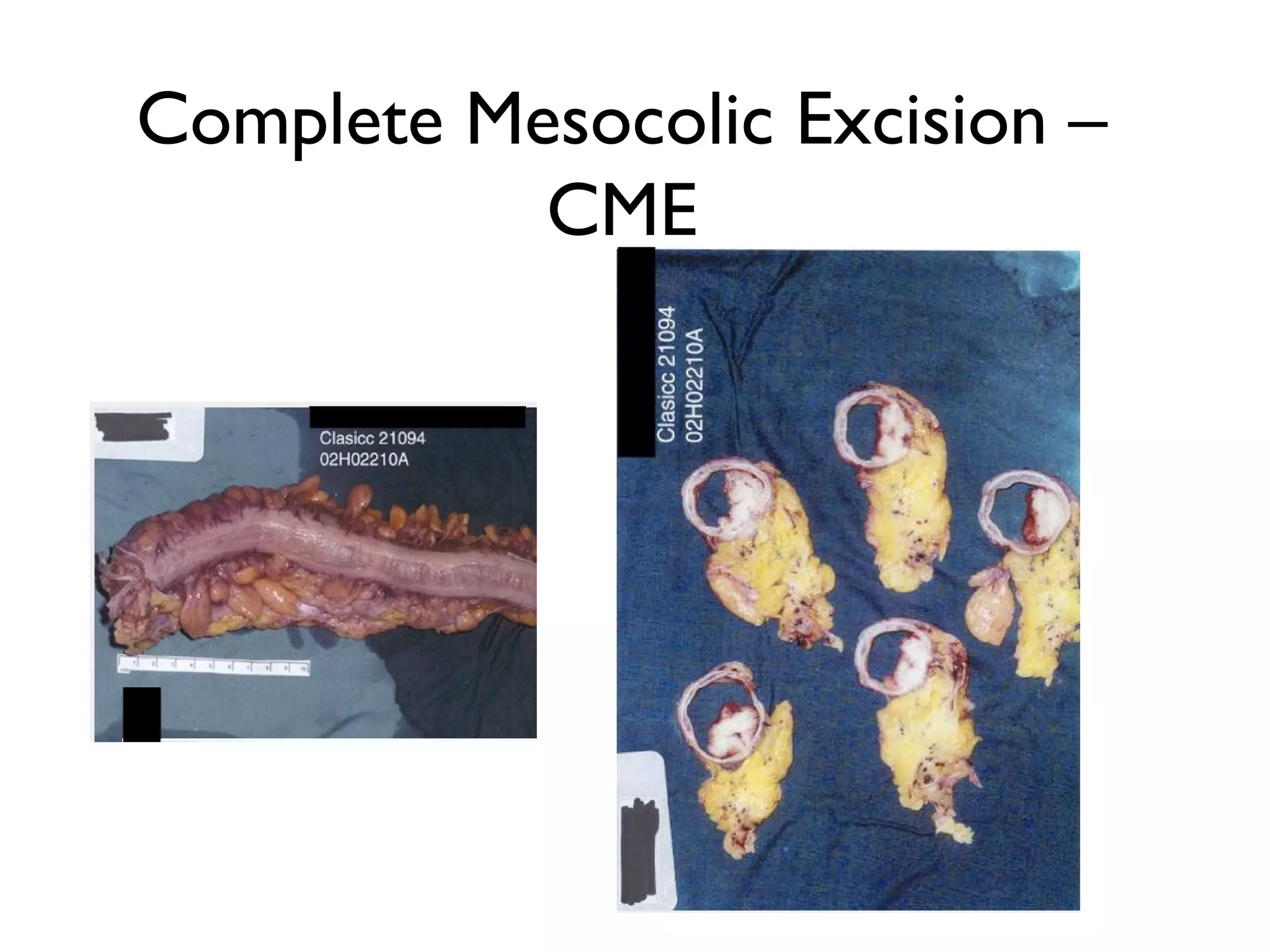
Complete Mesocolic Excision –
CME
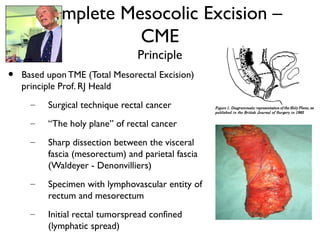
Principle
• Based upon TME (Total Mesorectal Excision)
principle Prof. RJ Heald
– Surgical technique rectal cancer
– “The holy plane” of rectal cancer
– Sharp dissection between the visceral
fascia (mesorectum) and parietal fascia
(Waldeyer - Denonvilliers)
– Specimen with lymphovascular entity of
rectum and mesorectum
– Initial rectal tumorspread confined
(lymphatic spread)
Complete Mesocolic excision -
CME
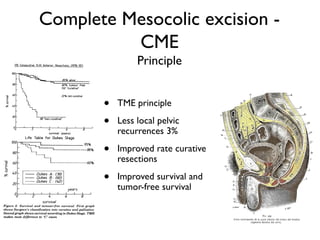
Principle
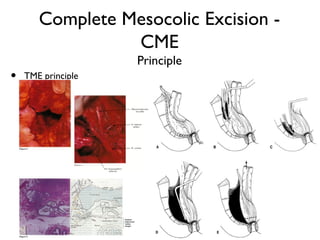
• TME principle
• Less local pelvic
recurrences 3%
• Improved rate curative
resections
• Improved survival and
tumor-free survival
Complete Mesocolic Excision -
CME
Principle
• TME principle
Complete Mesocolic Excision -
CME
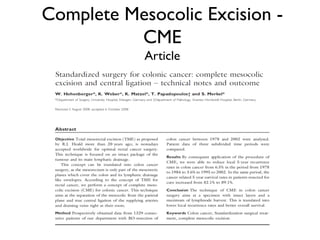
Article
Complete Mesocolic Excision
Colonic cancer
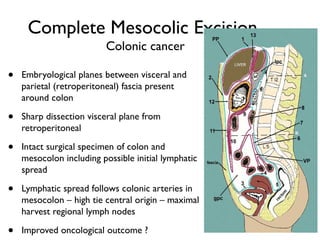
• Embryological planes between visceral and
parietal (retroperitoneal) fascia present
around colon
• Sharp dissection visceral plane from
retroperitoneal
• Intact surgical specimen of colon and
mesocolon including possible initial lymphatic
spread
• Lymphatic spread follows colonic arteries in
mesocolon – high tie central origin – maximal
harvest regional lymph nodes
• Improved oncological outcome ?
Complete Mesocolic Excision -
CME
Method
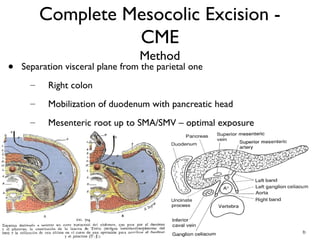
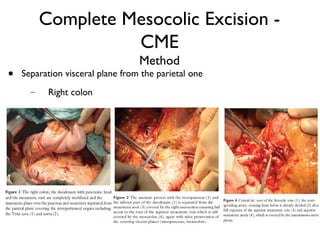
• Separation visceral plane from the parietal one
– Right colon
– Mobilization of duodenum with pancreatic head
– Mesenteric root up to SMA/SMV – optimal exposure
Complete Mesocolic Excision -
CME
Method
• Separation visceral plane from the parietal one
– Right colon
Complete Mesocolic Excision -
CME
Method
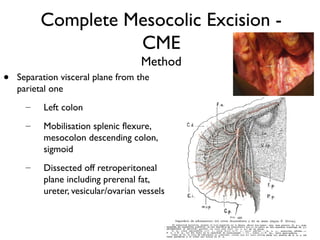
• Separation visceral plane from the
parietal one
– Left colon
– Mobilisation splenic flexure,
mesocolon descending colon,
sigmoid
– Dissected off retroperitoneal
plane including prerenal fat,
ureter, vesicular/ovarian vessels
Complete Mesocolic Excision -
CME
Method
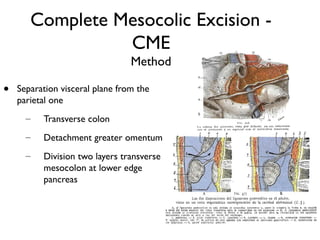
• Separation visceral plane from the
parietal one
– Transverse colon
– Detachment greater omentum
– Division two layers transverse
mesocolon at lower edge
pancreas
Complete Mesocolic Excision -
CME
Method
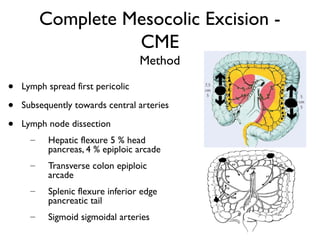
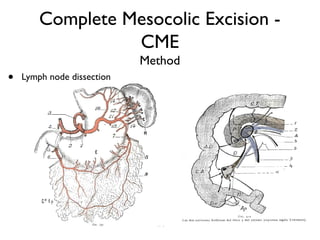
• Lymph spread first pericolic
• Subsequently towards central arteries
• Lymph node dissection
– Hepatic flexure 5 % head
pancreas, 4 % epiploic arcade
– Transverse colon epiploic
arcade
– Splenic flexure inferior edge
pancreatic tail
– Sigmoid sigmoidal arteries
Complete Mesocolic Excision -
CME
Method
• Lymph node dissection
Complete Mesocolic Excision -
CME
Method
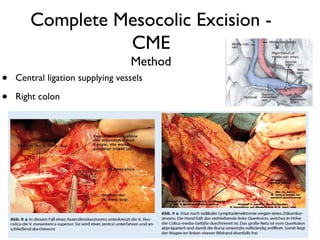
• Central ligation supplying vessels
• Right colon
Complete Mesocolic Excision -
CME
Method
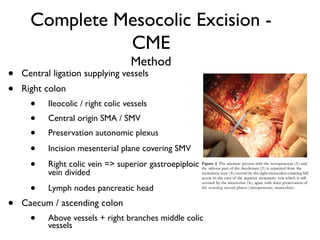
• Central ligation supplying vessels
• Right colon
• Ileocolic / right colic vessels
• Central origin SMA / SMV
• Preservation autonomic plexus
• Incision mesenterial plane covering SMV
• Right colic vein => superior gastroepiploic
vein divided
• Lymph nodes pancreatic head
• Caecum / ascending colon
• Above vessels + right branches middle colic
vessels
Complete Mesocolic Excision -
CME
Method
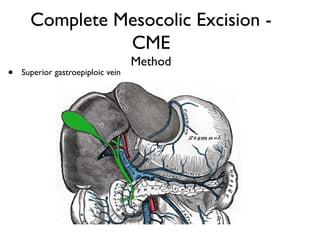
• Superior gastroepiploic vein
Complete Mesocolic Excision -
CME
Method
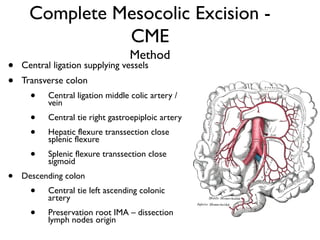
• Central ligation supplying vessels
• Transverse colon
• Central ligation middle colic artery /
vein
• Central tie right gastroepiploic artery
• Hepatic flexure transsection close
splenic flexure
• Splenic flexure transsection close
sigmoid
• Descending colon
• Central tie left ascending colonic
artery
• Preservation root IMA – dissection
lymph nodes origin
Complete Mesocolic Excision -
CME
Method
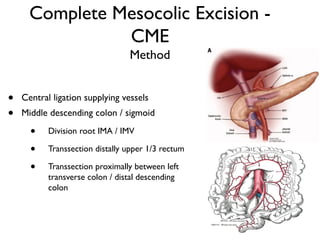
• Central ligation supplying vessels
• Middle descending colon / sigmoid
• Division root IMA / IMV
• Transsection distally upper 1/3 rectum
• Transsection proximally between left
transverse colon / distal descending
colon
Complete Mesocolic excision -
CME
Patients
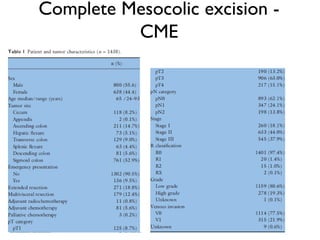
• Prospective study
• University Hospital Erlangen, Germany
• 1438 patients between 1978 and 2002
• Inclusion criteria
– Solitary invasive (at least submucosa) colon
carcinoma (>16 cm from anal verge)
– No other history of previous or synchronous
malignancies
– No carcinoma because of FAP, UC or Crohn's
– No neo-adjuvant treatment; Stage I-III
Complete Mesocolic excision -
CME
Patients
• Exclusion criteria
– 109 patients (7,6 %)
– 37 patients no R0-resection (2,6 %)
– 42 patients surgical mortality (2,9 %)
– 30 patients tumour status unknown to
recurrence (2,1 %)
• 1329 patients analysed
• Median follow-up 103 months (1-335)
• WHO tumour classification / 6th
TNM classification
Complete Mesocolic excision -
CME
Patients
• Outcome assessment
– Cancer-related survival
• Death with locoregional or distant
metastases
– Rate locoregional recurrence
– Amount lymph node harvest
– Postoperative complications and mortality
• Comparison three time periods 1978-1984 /
1985-1994 / 1995-2002
Complete Mesocolic excision -
CME
Complete Mesocolic excision -
CME
Results
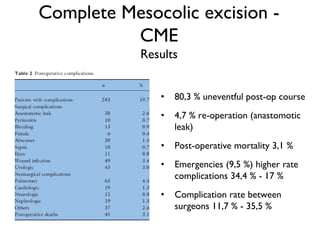
• 80,3 % uneventful post-op course
• 4,7 % re-operation (anastomotic
leak)
• Post-operative mortality 3,1 %
• Emergencies (9,5 %) higher rate
complications 34,4 % - 17 %
• Complication rate between
surgeons 11,7 % - 35,5 %
Complete Mesocolic excision -
CME
Results
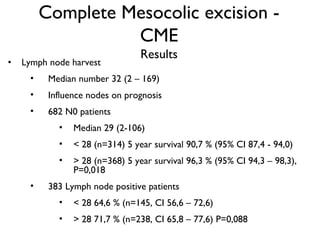
• Lymph node harvest
• Median number 32 (2 – 169)
• Influence nodes on prognosis
• 682 N0 patients
• Median 29 (2-106)
• < 28 (n=314) 5 year survival 90,7 % (95% CI 87,4 - 94,0)
• > 28 (n=368) 5 year survival 96,3 % (95% CI 94,3 – 98,3),
P=0,018
• 383 Lymph node positive patients
• < 28 64,6 % (n=145, CI 56,6 – 72,6)
• > 28 71,7 % (n=238, CI 65,8 – 77,6) P=0,088
Complete Mesocolic excision -
CME
Results
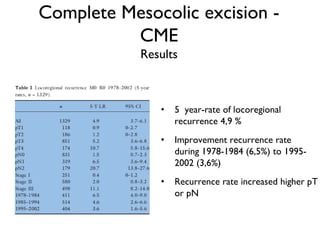
• 5 year-rate of locoregional
recurrence 4,9 %
• Improvement recurrence rate
during 1978-1984 (6,5%) to 1995-
2002 (3,6%)
• Recurrence rate increased higher pT
or pN
Complete Mesocolic excision -
CME
Results
Complete Mesocolic excision -
CME
Results
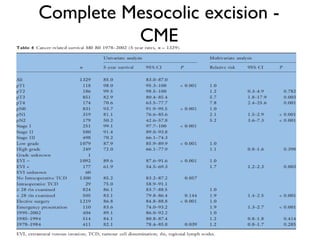
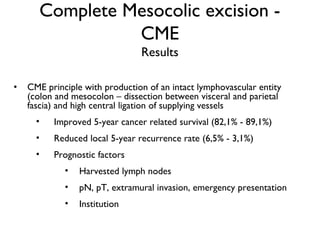
• CME principle with production of an intact lymphovascular entity
(colon and mesocolon – dissection between visceral and parietal
fascia) and high central ligation of supplying vessels
• Improved 5-year cancer related survival (82,1% - 89,1%)
• Reduced local 5-year recurrence rate (6,5% - 3,1%)
• Prognostic factors
• Harvested lymph nodes
• pN, pT, extramural invasion, emergency presentation
• Institution
Complete Mesocolic excision -
CME
Discussion
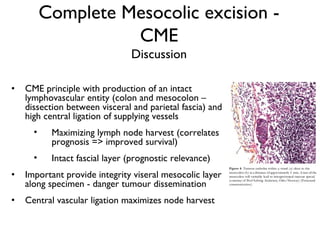
• CME principle with production of an intact
lymphovascular entity (colon and mesocolon –
dissection between visceral and parietal fascia) and
high central ligation of supplying vessels
• Maximizing lymph node harvest (correlates
prognosis => improved survival)
• Intact fascial layer (prognostic relevance)
• Important provide integrity viseral mesocolic layer
along specimen - danger tumour dissemination
• Central vascular ligation maximizes node harvest
Complete Mesocolic excision -
CME
Discussion
• CME principle with production of an intact lymphovascular entity
(colon and mesocolon – dissection between visceral and parietal
fascia) and high central ligation of supplying vessels
• Right colon mobilisation mesenteric root and duodenum
with pancreatic head
• Right colonic flexure pancreatic head metastases
• Transverse colon and splenic flexure mobilisation
gastroepiploic arcade and dissection inferior edge pancreas
Thank you

Complete mesocolic excision

  • 1.
  • 2.
    Complete Mesocolic Excision– CME Principle • Based upon TME (Total Mesorectal Excision) principle Prof. RJ Heald – Surgical technique rectal cancer – “The holy plane” of rectal cancer – Sharp dissection between the visceral fascia (mesorectum) and parietal fascia (Waldeyer - Denonvilliers) – Specimen with lymphovascular entity of rectum and mesorectum – Initial rectal tumorspread confined (lymphatic spread)
  • 3.
    Complete Mesocolic excision- CME Principle • TME principle • Less local pelvic recurrences 3% • Improved rate curative resections • Improved survival and tumor-free survival
  • 4.
    Complete Mesocolic Excision- CME Principle • TME principle
  • 5.
  • 6.
    Complete Mesocolic Excision Coloniccancer • Embryological planes between visceral and parietal (retroperitoneal) fascia present around colon • Sharp dissection visceral plane from retroperitoneal • Intact surgical specimen of colon and mesocolon including possible initial lymphatic spread • Lymphatic spread follows colonic arteries in mesocolon – high tie central origin – maximal harvest regional lymph nodes • Improved oncological outcome ?
  • 7.
    Complete Mesocolic Excision- CME Method • Separation visceral plane from the parietal one – Right colon – Mobilization of duodenum with pancreatic head – Mesenteric root up to SMA/SMV – optimal exposure
  • 8.
    Complete Mesocolic Excision- CME Method • Separation visceral plane from the parietal one – Right colon
  • 9.
    Complete Mesocolic Excision- CME Method • Separation visceral plane from the parietal one – Left colon – Mobilisation splenic flexure, mesocolon descending colon, sigmoid – Dissected off retroperitoneal plane including prerenal fat, ureter, vesicular/ovarian vessels
  • 10.
    Complete Mesocolic Excision- CME Method • Separation visceral plane from the parietal one – Transverse colon – Detachment greater omentum – Division two layers transverse mesocolon at lower edge pancreas
  • 11.
    Complete Mesocolic Excision- CME Method • Lymph spread first pericolic • Subsequently towards central arteries • Lymph node dissection – Hepatic flexure 5 % head pancreas, 4 % epiploic arcade – Transverse colon epiploic arcade – Splenic flexure inferior edge pancreatic tail – Sigmoid sigmoidal arteries
  • 12.
    Complete Mesocolic Excision- CME Method • Lymph node dissection
  • 13.
    Complete Mesocolic Excision- CME Method • Central ligation supplying vessels • Right colon
  • 14.
    Complete Mesocolic Excision- CME Method • Central ligation supplying vessels • Right colon • Ileocolic / right colic vessels • Central origin SMA / SMV • Preservation autonomic plexus • Incision mesenterial plane covering SMV • Right colic vein => superior gastroepiploic vein divided • Lymph nodes pancreatic head • Caecum / ascending colon • Above vessels + right branches middle colic vessels
  • 15.
    Complete Mesocolic Excision- CME Method • Superior gastroepiploic vein
  • 16.
    Complete Mesocolic Excision- CME Method • Central ligation supplying vessels • Transverse colon • Central ligation middle colic artery / vein • Central tie right gastroepiploic artery • Hepatic flexure transsection close splenic flexure • Splenic flexure transsection close sigmoid • Descending colon • Central tie left ascending colonic artery • Preservation root IMA – dissection lymph nodes origin
  • 17.
    Complete Mesocolic Excision- CME Method • Central ligation supplying vessels • Middle descending colon / sigmoid • Division root IMA / IMV • Transsection distally upper 1/3 rectum • Transsection proximally between left transverse colon / distal descending colon
  • 18.
    Complete Mesocolic excision- CME Patients • Prospective study • University Hospital Erlangen, Germany • 1438 patients between 1978 and 2002 • Inclusion criteria – Solitary invasive (at least submucosa) colon carcinoma (>16 cm from anal verge) – No other history of previous or synchronous malignancies – No carcinoma because of FAP, UC or Crohn's – No neo-adjuvant treatment; Stage I-III
  • 19.
    Complete Mesocolic excision- CME Patients • Exclusion criteria – 109 patients (7,6 %) – 37 patients no R0-resection (2,6 %) – 42 patients surgical mortality (2,9 %) – 30 patients tumour status unknown to recurrence (2,1 %) • 1329 patients analysed • Median follow-up 103 months (1-335) • WHO tumour classification / 6th TNM classification
  • 20.
    Complete Mesocolic excision- CME Patients • Outcome assessment – Cancer-related survival • Death with locoregional or distant metastases – Rate locoregional recurrence – Amount lymph node harvest – Postoperative complications and mortality • Comparison three time periods 1978-1984 / 1985-1994 / 1995-2002
  • 21.
  • 22.
    Complete Mesocolic excision- CME Results • 80,3 % uneventful post-op course • 4,7 % re-operation (anastomotic leak) • Post-operative mortality 3,1 % • Emergencies (9,5 %) higher rate complications 34,4 % - 17 % • Complication rate between surgeons 11,7 % - 35,5 %
  • 23.
    Complete Mesocolic excision- CME Results • Lymph node harvest • Median number 32 (2 – 169) • Influence nodes on prognosis • 682 N0 patients • Median 29 (2-106) • < 28 (n=314) 5 year survival 90,7 % (95% CI 87,4 - 94,0) • > 28 (n=368) 5 year survival 96,3 % (95% CI 94,3 – 98,3), P=0,018 • 383 Lymph node positive patients • < 28 64,6 % (n=145, CI 56,6 – 72,6) • > 28 71,7 % (n=238, CI 65,8 – 77,6) P=0,088
  • 24.
    Complete Mesocolic excision- CME Results • 5 year-rate of locoregional recurrence 4,9 % • Improvement recurrence rate during 1978-1984 (6,5%) to 1995- 2002 (3,6%) • Recurrence rate increased higher pT or pN
  • 25.
  • 26.
    Complete Mesocolic excision- CME Results • CME principle with production of an intact lymphovascular entity (colon and mesocolon – dissection between visceral and parietal fascia) and high central ligation of supplying vessels • Improved 5-year cancer related survival (82,1% - 89,1%) • Reduced local 5-year recurrence rate (6,5% - 3,1%) • Prognostic factors • Harvested lymph nodes • pN, pT, extramural invasion, emergency presentation • Institution
  • 27.
    Complete Mesocolic excision- CME Discussion • CME principle with production of an intact lymphovascular entity (colon and mesocolon – dissection between visceral and parietal fascia) and high central ligation of supplying vessels • Maximizing lymph node harvest (correlates prognosis => improved survival) • Intact fascial layer (prognostic relevance) • Important provide integrity viseral mesocolic layer along specimen - danger tumour dissemination • Central vascular ligation maximizes node harvest
  • 28.
    Complete Mesocolic excision- CME Discussion • CME principle with production of an intact lymphovascular entity (colon and mesocolon – dissection between visceral and parietal fascia) and high central ligation of supplying vessels • Right colon mobilisation mesenteric root and duodenum with pancreatic head • Right colonic flexure pancreatic head metastases • Transverse colon and splenic flexure mobilisation gastroepiploic arcade and dissection inferior edge pancreas
  • 29.