
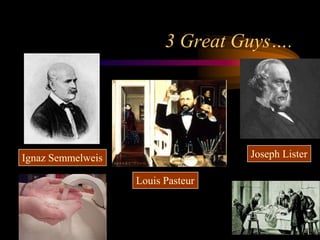

3 Great Guys….
Ignaz Semmelweis
Louis Pasteur
Joseph Lister
Sterilization & Disinfection in Laparoscopic Surgery
Practical Guidelines
Dr.S.Easwaramoorthy
MS FRCS (Eng) FRCS (Glas) Hon FRCS (Edin)
Consultant surgeon, Lotus hospital, Erode, TN
MRCS Examiner, RCS of Edinburgh
EC Member, ASI TN & P Chapter & IAGES South Zone
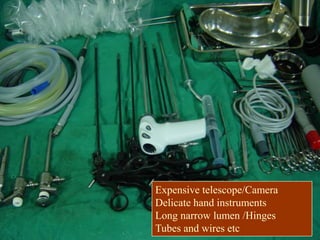
Expensive telescope/Camera
Delicate hand instruments
Long narrow lumen /Hinges
Tubes and wires etc
Laparoscopic equipments are considered
As ‘Critical’ equipments
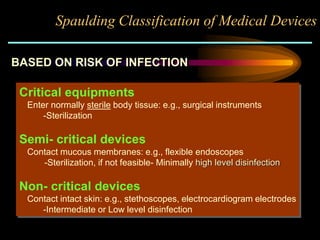
Spaulding Classification of Medical Devices
BASED ON RISK OF INFECTION
Critical equipments
Enter normally sterile body tissue: e.g., surgical instruments
-Sterilization
Semi- critical devices
Contact mucous membranes: e.g., flexible endoscopes
-Sterilization, if not feasible- Minimally high level disinfection
Non- critical devices
Contact intact skin: e.g., stethoscopes, electrocardiogram electrodes
-Intermediate or Low level disinfection
Guidelines for prevention of surgical site infection, 1999
‘Critical’ equipments
require
Sterilization/High level disinfection
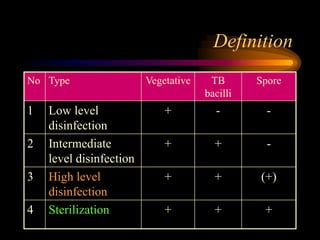
Definition
No Type Vegetative TB
bacilli
Spore
1 Low level
disinfection
+ - -
2 Intermediate
level disinfection
+ + -
3 High level
disinfection
+ + (+)
4 Sterilization + + +
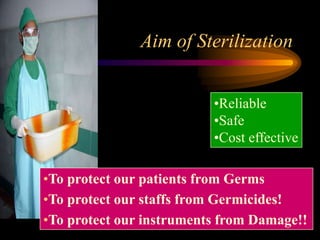
Aim of Sterilization
•Reliable
•Safe
•Cost effective
•To protect our patients from Germs
•To protect our staffs from Germicides!
•To protect our instruments from Damage!!
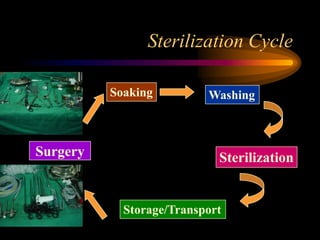
Sterilization Cycle
Surgery
Storage/Transport
Soaking Washing
Sterilization
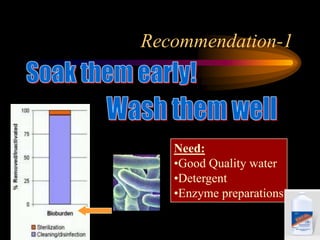
Recommendation-1
Need:
•Good Quality water
•Detergent
•Enzyme preparations
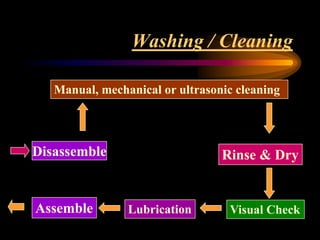
Washing / Cleaning
Disassemble
Visual Check
Manual, mechanical or ultrasonic cleaning
Rinse & Dry
Lubrication
Assemble
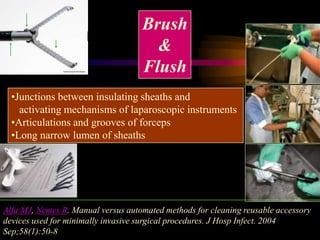
Alfa MJ, Nemes R. Manual versus automated methods for cleaning reusable accessory
devices used for minimally invasive surgical procedures. J Hosp Infect. 2004
Sep;58(1):50-8
Brush
&
Flush
•Junctions between insulating sheaths and
activating mechanisms of laparoscopic instruments
•Articulations and grooves of forceps
•Long narrow lumen of sheaths
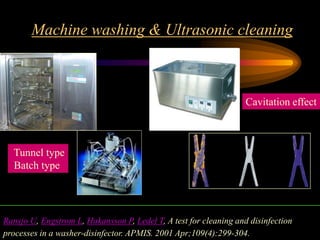
Machine washing & Ultrasonic cleaning
Ransjo U, Engstrom L, Hakansson P, Ledel T, A test for cleaning and disinfection
processes in a washer-disinfector. APMIS. 2001 Apr;109(4):299-304.
Tunnel type
Batch type
Cavitation effect
Recommendation 2
Sterilization of Laparoscopic Instruments
• Steam sterilization
• Ethylene Oxide
• Chemical Disinfection
• Formaldehyde Cabinets?
• Newer methods…..
Marshburn PB, Rutala WA, Wannamaker NS, Hulka JF. Gas and steam sterilization of
assembled versus disassembled laparoscopic equipment. Microbiologic studies.
J Reprod Med. 1991 Jul;36(7):483-7
Ayliffe G; Minimal Access Therapy Decontamination Working Group.
Decontamination of minimally invasive surgical endoscopes and accessories.
J Hosp Infect. 2000 Aug;45(4):263-77.
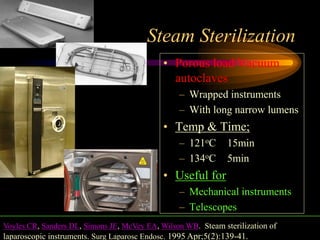
Steam Sterilization
• Porous load Vacuum
autoclaves
– Wrapped instruments
– With long narrow lumens
• Temp & Time;
– 121oC 15min
– 134oC 5min
• Useful for
– Mechanical instruments
– Telescopes
Voyles CR, Sanders DL, Simons JE, McVey EA, Wilson WB. Steam sterilization of
laparoscopic instruments. Surg Laparosc Endosc. 1995 Apr;5(2):139-41.
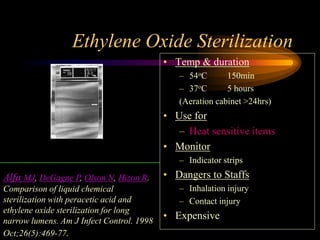
Ethylene Oxide Sterilization
• Temp & duration
– 54oC 150min
– 37oC 5 hours
(Aeration cabinet >24hrs)
• Use for
– Heat sensitive items
• Monitor
– Indicator strips
• Dangers to Staffs
– Inhalation injury
– Contact injury
• Expensive
Alfa MJ, DeGagne P, Olson N, Hizon R.
Comparison of liquid chemical
sterilization with peracetic acid and
ethylene oxide sterilization for long
narrow lumens. Am J Infect Control. 1998
Oct;26(5):469-77.
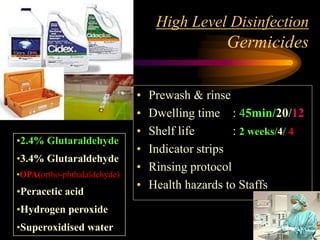
High Level Disinfection
Germicides
• Prewash & rinse
• Dwelling time : 45min/20/12
• Shelf life : 2 weeks/4/ 4
• Indicator strips
• Rinsing protocol
• Health hazards to Staffs
•2.4% Glutaraldehyde
•3.4% Glutaraldehyde
•OPA(ortho-phthalaldehyde)
•Peracetic acid
•Hydrogen peroxide
•Superoxidised water
Factors affecting Sterilization
• Number of organisms ( Bio burden)
• Types of organisms
• Concentration of disinfecting agent
• Presence of organic material (e.g., serum, blood)
• Contact time
• pH
• Biofilms
• Temperature
Recommendation 3
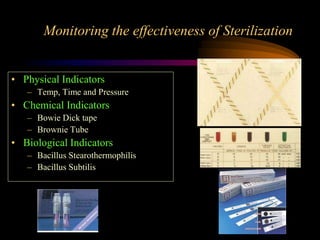
Monitoring the effectiveness of Sterilization
• Physical Indicators
– Temp, Time and Pressure
• Chemical Indicators
– Bowie Dick tape
– Brownie Tube
• Biological Indicators
– Bacillus Stearothermophilis
– Bacillus Subtilis
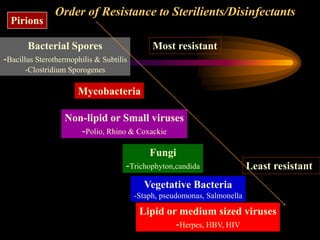
Order of Resistance to Sterilients/Disinfectants
Bacterial Spores
-Bacillus Sterothermophilis & Subtilis
-Clostridium Sporogenes
Mycobacteria
Non-lipid or Small viruses
-Polio, Rhino & Coxackie
Fungi
-Trichophyton,candida
Vegetative Bacteria
-Staph, pseudomonas, Salmonella
Lipid or medium sized viruses
-Herpes, HBV, HIV
Most resistant
Least resistant
Pirions
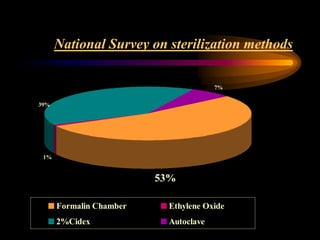
National Survey on sterilization methods
1%
7%
53%
39%
Formalin Chamber Ethylene Oxide
2%Cidex Autoclave
53%
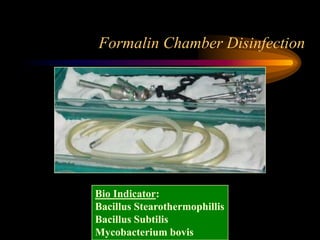
Formalin Chamber Disinfection
Bio Indicator:
Bacillus Stearothermophillis
Bacillus Subtilis
Mycobacterium bovis
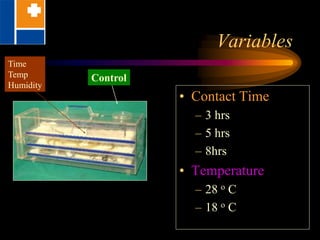
Variables
• Contact Time
– 3 hrs
– 5 hrs
– 8hrs
• Temperature
– 28 o C
– 18 o C
Control
Time
Temp
Humidity
Using formalin Chamber
• Use tight fitting formalin cabinet
• Pre washing and drying is essential
• Disassembled trocars and Instruments
• Total of 45 gm HCHO
• Contact time : 5 hours & >
• Temperature : 280 C & >
Guidelines:
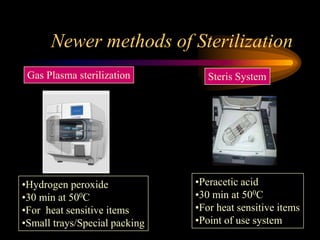
Newer methods of Sterilization
Gas Plasma sterilization Steris System
•Hydrogen peroxide
•30 min at 500C
•For heat sensitive items
•Small trays/Special packing
•Peracetic acid
•30 min at 500C
•For heat sensitive items
•Point of use system
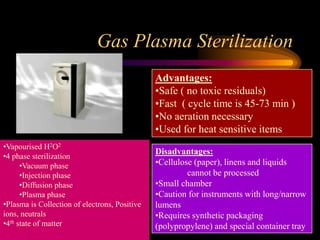
Gas Plasma Sterilization
Advantages:
•Safe ( no toxic residuals)
•Fast ( cycle time is 45-73 min )
•No aeration necessary
•Used for heat sensitive items
Disadvantages:
•Cellulose (paper), linens and liquids
cannot be processed
•Small chamber
•Caution for instruments with long/narrow
lumens
•Requires synthetic packaging
(polypropylene) and special container tray
•Vapourised H2O2
•4 phase sterilization
•Vacuum phase
•Injection phase
•Diffusion phase
•Plasma phase
•Plasma is Collection of electrons, Positive
ions, neutrals
•4th state of matter
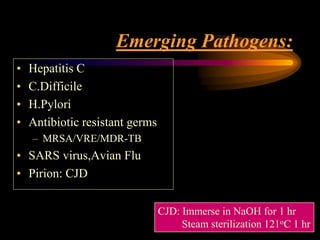
Emerging Pathogens:
• Hepatitis C
• C.Difficile
• H.Pylori
• Antibiotic resistant germs
– MRSA/VRE/MDR-TB
• SARS virus,Avian Flu
• Pirion: CJD
CJD: Immerse in NaOH for 1 hr
Steam sterilization 121oC 1 hr
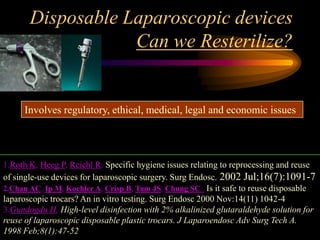
Disposable Laparoscopic devices
Can we Resterilize?
1.Roth K, Heeg P, Reichl R. Specific hygiene issues relating to reprocessing and reuse
of single-use devices for laparoscopic surgery. Surg Endosc. 2002 Jul;16(7):1091-7
2.Chan AC, Ip M, Koehler A, Crisp B, Tam JS, Chung SC . Is it safe to reuse disposable
laparoscopic trocars? An in vitro testing. Surg Endosc 2000 Nov:14(11) 1042-4
3.Gundogdu H, High-level disinfection with 2% alkalinized glutaraldehyde solution for
reuse of laparoscopic disposable plastic trocars. J Laparoendosc Adv Surg Tech A.
1998 Feb;8(1):47-52
Involves regulatory, ethical, medical, legal and economic issues
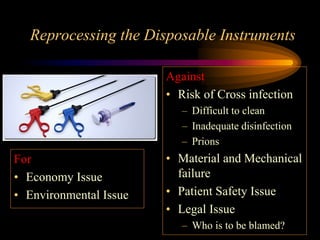
Reprocessing the Disposable Instruments
For
• Economy Issue
• Environmental Issue
Against
• Risk of Cross infection
– Difficult to clean
– Inadequate disinfection
– Prions
• Material and Mechanical
failure
• Patient Safety Issue
• Legal Issue
– Who is to be blamed?
© 2006 Kaiser Permanente Health Plan, Inc.
*Reprinted with permission from: Muscarella LF,
“Automatic Flexible Endoscope Reprocessors,”
Gastrointestinal Endoscopy Clinic of North America,
2000 April;10(2):245-257
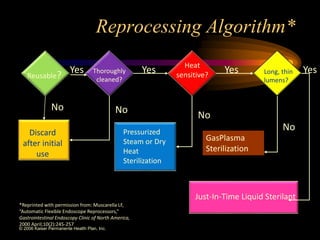
Reprocessing Algorithm*
Reusable?
Discard
after initial
use
Thoroughly
cleaned?
Heat
sensitive?
Pressurized
Steam or Dry
Heat
Sterilization
GasPlasma
Sterilization
Long, thin
lumens?
Just-In-Time Liquid Sterilant
No
No
No
No
Yes Yes Yes Yes
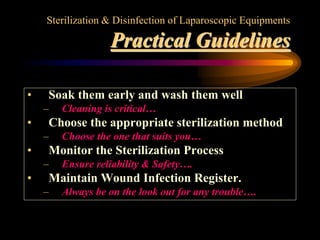
Sterilization & Disinfection of Laparoscopic Equipments
Practical Guidelines
• Soak them early and wash them well
– Cleaning is critical…
• Choose the appropriate sterilization method
– Choose the one that suits you…
• Monitor the Sterilization Process
– Ensure reliability & Safety….
• Maintain Wound Infection Register.
– Always be on the look out for any trouble….
Sterilization for gynacologisgt

Sterilization for gynacologisgt

  • 2.
    3 Great Guys…. IgnazSemmelweis Louis Pasteur Joseph Lister
  • 3.
    Sterilization & Disinfectionin Laparoscopic Surgery Practical Guidelines Dr.S.Easwaramoorthy MS FRCS (Eng) FRCS (Glas) Hon FRCS (Edin) Consultant surgeon, Lotus hospital, Erode, TN MRCS Examiner, RCS of Edinburgh EC Member, ASI TN & P Chapter & IAGES South Zone
  • 4.
    Expensive telescope/Camera Delicate handinstruments Long narrow lumen /Hinges Tubes and wires etc
  • 5.
    Laparoscopic equipments areconsidered As ‘Critical’ equipments
  • 6.
    Spaulding Classification ofMedical Devices BASED ON RISK OF INFECTION Critical equipments Enter normally sterile body tissue: e.g., surgical instruments -Sterilization Semi- critical devices Contact mucous membranes: e.g., flexible endoscopes -Sterilization, if not feasible- Minimally high level disinfection Non- critical devices Contact intact skin: e.g., stethoscopes, electrocardiogram electrodes -Intermediate or Low level disinfection
  • 7.
    Guidelines for preventionof surgical site infection, 1999 ‘Critical’ equipments require Sterilization/High level disinfection
  • 8.
    Definition No Type VegetativeTB bacilli Spore 1 Low level disinfection + - - 2 Intermediate level disinfection + + - 3 High level disinfection + + (+) 4 Sterilization + + +
  • 9.
    Aim of Sterilization •Reliable •Safe •Costeffective •To protect our patients from Germs •To protect our staffs from Germicides! •To protect our instruments from Damage!!
  • 10.
  • 11.
  • 12.
    Washing / Cleaning Disassemble VisualCheck Manual, mechanical or ultrasonic cleaning Rinse & Dry Lubrication Assemble
  • 13.
    Alfa MJ, NemesR. Manual versus automated methods for cleaning reusable accessory devices used for minimally invasive surgical procedures. J Hosp Infect. 2004 Sep;58(1):50-8 Brush & Flush •Junctions between insulating sheaths and activating mechanisms of laparoscopic instruments •Articulations and grooves of forceps •Long narrow lumen of sheaths
  • 14.
    Machine washing &Ultrasonic cleaning Ransjo U, Engstrom L, Hakansson P, Ledel T, A test for cleaning and disinfection processes in a washer-disinfector. APMIS. 2001 Apr;109(4):299-304. Tunnel type Batch type Cavitation effect
  • 15.
  • 16.
    Sterilization of LaparoscopicInstruments • Steam sterilization • Ethylene Oxide • Chemical Disinfection • Formaldehyde Cabinets? • Newer methods….. Marshburn PB, Rutala WA, Wannamaker NS, Hulka JF. Gas and steam sterilization of assembled versus disassembled laparoscopic equipment. Microbiologic studies. J Reprod Med. 1991 Jul;36(7):483-7 Ayliffe G; Minimal Access Therapy Decontamination Working Group. Decontamination of minimally invasive surgical endoscopes and accessories. J Hosp Infect. 2000 Aug;45(4):263-77.
  • 17.
    Steam Sterilization • Porousload Vacuum autoclaves – Wrapped instruments – With long narrow lumens • Temp & Time; – 121oC 15min – 134oC 5min • Useful for – Mechanical instruments – Telescopes Voyles CR, Sanders DL, Simons JE, McVey EA, Wilson WB. Steam sterilization of laparoscopic instruments. Surg Laparosc Endosc. 1995 Apr;5(2):139-41.
  • 18.
    Ethylene Oxide Sterilization •Temp & duration – 54oC 150min – 37oC 5 hours (Aeration cabinet >24hrs) • Use for – Heat sensitive items • Monitor – Indicator strips • Dangers to Staffs – Inhalation injury – Contact injury • Expensive Alfa MJ, DeGagne P, Olson N, Hizon R. Comparison of liquid chemical sterilization with peracetic acid and ethylene oxide sterilization for long narrow lumens. Am J Infect Control. 1998 Oct;26(5):469-77.
  • 19.
    High Level Disinfection Germicides •Prewash & rinse • Dwelling time : 45min/20/12 • Shelf life : 2 weeks/4/ 4 • Indicator strips • Rinsing protocol • Health hazards to Staffs •2.4% Glutaraldehyde •3.4% Glutaraldehyde •OPA(ortho-phthalaldehyde) •Peracetic acid •Hydrogen peroxide •Superoxidised water
  • 20.
    Factors affecting Sterilization •Number of organisms ( Bio burden) • Types of organisms • Concentration of disinfecting agent • Presence of organic material (e.g., serum, blood) • Contact time • pH • Biofilms • Temperature
  • 21.
  • 22.
    Monitoring the effectivenessof Sterilization • Physical Indicators – Temp, Time and Pressure • Chemical Indicators – Bowie Dick tape – Brownie Tube • Biological Indicators – Bacillus Stearothermophilis – Bacillus Subtilis
  • 23.
    Order of Resistanceto Sterilients/Disinfectants Bacterial Spores -Bacillus Sterothermophilis & Subtilis -Clostridium Sporogenes Mycobacteria Non-lipid or Small viruses -Polio, Rhino & Coxackie Fungi -Trichophyton,candida Vegetative Bacteria -Staph, pseudomonas, Salmonella Lipid or medium sized viruses -Herpes, HBV, HIV Most resistant Least resistant Pirions
  • 24.
    National Survey onsterilization methods 1% 7% 53% 39% Formalin Chamber Ethylene Oxide 2%Cidex Autoclave 53%
  • 25.
    Formalin Chamber Disinfection BioIndicator: Bacillus Stearothermophillis Bacillus Subtilis Mycobacterium bovis
  • 26.
    Variables • Contact Time –3 hrs – 5 hrs – 8hrs • Temperature – 28 o C – 18 o C Control Time Temp Humidity
  • 27.
    Using formalin Chamber •Use tight fitting formalin cabinet • Pre washing and drying is essential • Disassembled trocars and Instruments • Total of 45 gm HCHO • Contact time : 5 hours & > • Temperature : 280 C & > Guidelines:
  • 28.
    Newer methods ofSterilization Gas Plasma sterilization Steris System •Hydrogen peroxide •30 min at 500C •For heat sensitive items •Small trays/Special packing •Peracetic acid •30 min at 500C •For heat sensitive items •Point of use system
  • 29.
    Gas Plasma Sterilization Advantages: •Safe( no toxic residuals) •Fast ( cycle time is 45-73 min ) •No aeration necessary •Used for heat sensitive items Disadvantages: •Cellulose (paper), linens and liquids cannot be processed •Small chamber •Caution for instruments with long/narrow lumens •Requires synthetic packaging (polypropylene) and special container tray •Vapourised H2O2 •4 phase sterilization •Vacuum phase •Injection phase •Diffusion phase •Plasma phase •Plasma is Collection of electrons, Positive ions, neutrals •4th state of matter
  • 30.
    Emerging Pathogens: • HepatitisC • C.Difficile • H.Pylori • Antibiotic resistant germs – MRSA/VRE/MDR-TB • SARS virus,Avian Flu • Pirion: CJD CJD: Immerse in NaOH for 1 hr Steam sterilization 121oC 1 hr
  • 31.
    Disposable Laparoscopic devices Canwe Resterilize? 1.Roth K, Heeg P, Reichl R. Specific hygiene issues relating to reprocessing and reuse of single-use devices for laparoscopic surgery. Surg Endosc. 2002 Jul;16(7):1091-7 2.Chan AC, Ip M, Koehler A, Crisp B, Tam JS, Chung SC . Is it safe to reuse disposable laparoscopic trocars? An in vitro testing. Surg Endosc 2000 Nov:14(11) 1042-4 3.Gundogdu H, High-level disinfection with 2% alkalinized glutaraldehyde solution for reuse of laparoscopic disposable plastic trocars. J Laparoendosc Adv Surg Tech A. 1998 Feb;8(1):47-52 Involves regulatory, ethical, medical, legal and economic issues
  • 32.
    Reprocessing the DisposableInstruments For • Economy Issue • Environmental Issue Against • Risk of Cross infection – Difficult to clean – Inadequate disinfection – Prions • Material and Mechanical failure • Patient Safety Issue • Legal Issue – Who is to be blamed?
  • 33.
    © 2006 KaiserPermanente Health Plan, Inc. *Reprinted with permission from: Muscarella LF, “Automatic Flexible Endoscope Reprocessors,” Gastrointestinal Endoscopy Clinic of North America, 2000 April;10(2):245-257 Reprocessing Algorithm* Reusable? Discard after initial use Thoroughly cleaned? Heat sensitive? Pressurized Steam or Dry Heat Sterilization GasPlasma Sterilization Long, thin lumens? Just-In-Time Liquid Sterilant No No No No Yes Yes Yes Yes
  • 34.
    Sterilization & Disinfectionof Laparoscopic Equipments Practical Guidelines • Soak them early and wash them well – Cleaning is critical… • Choose the appropriate sterilization method – Choose the one that suits you… • Monitor the Sterilization Process – Ensure reliability & Safety…. • Maintain Wound Infection Register. – Always be on the look out for any trouble….