

Cancer or Not Cancer ? Dr Ho Siew Hong Consultant Urologist S H Ho Urology and Laparoscopy Centre Gleneagles Hospital
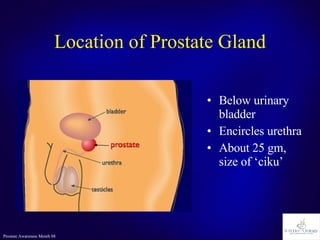
Location of Prostate Gland Below urinary bladder Encircles urethra About 25 gm,  size of ‘ciku’
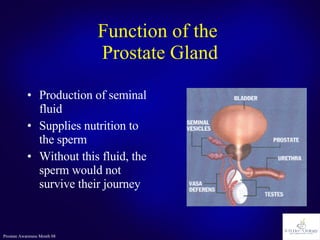
Function of the  Prostate Gland Production of seminal fluid Supplies nutrition to the sperm Without this fluid, the sperm would not survive their journey
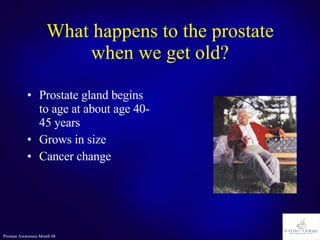
What happens to the prostate when we get old? Prostate gland begins to age at about age 40-45 years Grows in size Cancer change
How common are Prostate problems? ‘ There is an old saying that if you are a man and live long enough, you will eventually have problems with your prostate’ ‘ Prostate enlargement is the commonest growth in the elderly men’ ’ In men above 50 years of age, up to half may have prostate enlargement’
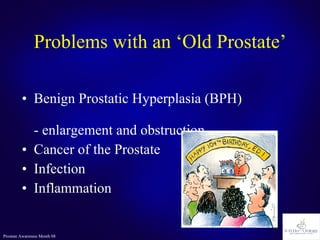
Problems with an ‘Old Prostate’ Benign Prostatic Hyperplasia (BPH)  - enlargement and obstruction Cancer of the Prostate Infection Inflammation
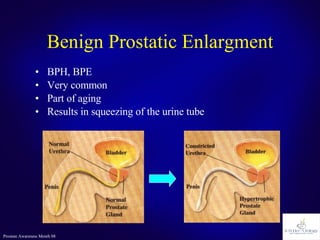
Benign Prostatic Enlargment BPH, BPE Very common Part of aging Results in squeezing of the urine tube
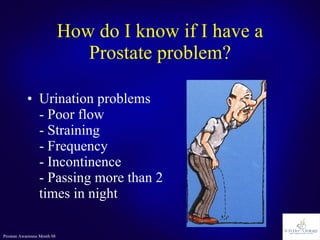
How do I know if I have a Prostate problem? Urination problems  - Poor flow - Straining - Frequency - Incontinence - Passing more than 2 times in night
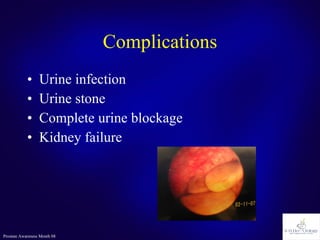
Complications Urine infection Urine stone Complete urine blockage Kidney failure
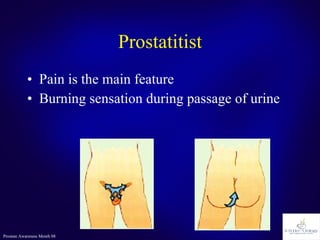
Prostatitist Pain is the main feature Burning sensation during passage of urine
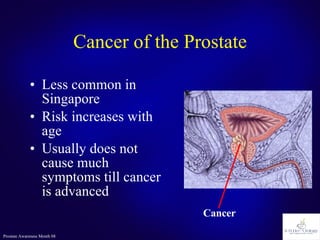
Cancer of the Prostate Less common in Singapore Risk increases with age Usually does not cause much symptoms till cancer is advanced Cancer
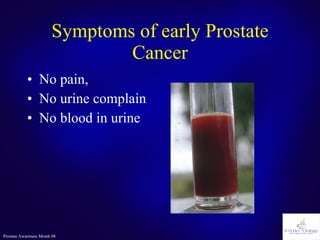
Symptoms of early Prostate Cancer No pain,  No urine complain No blood in urine
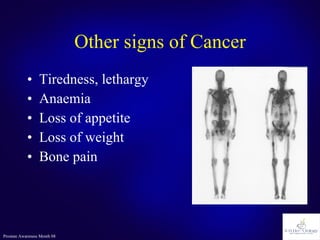
Other signs of Cancer Tiredness, lethargy Anaemia Loss of appetite Loss of weight Bone pain
Risk of cancer Family history of prostate cancer Smoking ? Western diet Not related to prostate enlargement, infection, sexual activities
What should I do ? Awareness Early action No self examination method No lump to be felt Consult a doctor
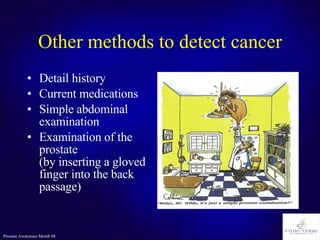
Other methods to detect cancer Detail history Current medications Simple abdominal examination Examination of the prostate (by inserting a gloved finger into the back passage)
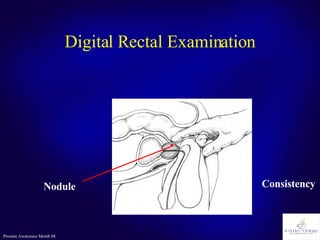
Digital Rectal Examination Nodule Consistency
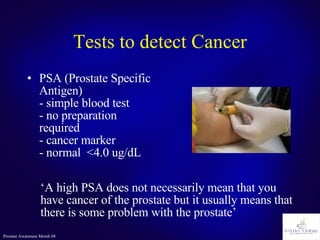
Tests to detect Cancer PSA (Prostate Specific Antigen) - simple blood test - no preparation required - cancer marker - normal  <4.0 ug/dL ‘ A high PSA does not necessarily mean that you have cancer of the prostate but it usually means that there is some problem with the prostate’
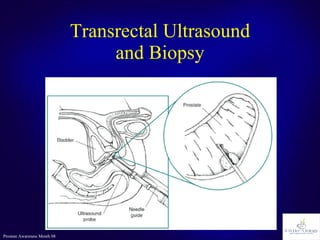
Transrectal Ultrasound and Biopsy
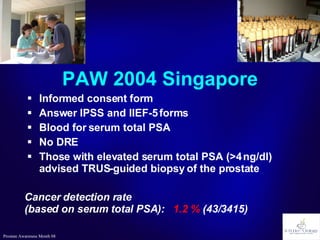
PAW 2004 Singapore Informed consent form  Answer IPSS and IIEF-5 forms Blood for serum total PSA  No DRE  Those with elevated serum total PSA (>4 ng/dl) advised TRUS-guided biopsy of the prostate Cancer detection rate  (based on serum total PSA):  1.2 %  (43/3415)
Why detect prostate cancer early? Early cancer is potentially curable Cure by surgery or radiation 15 year survival (expected to be a live)  - 65% (cancer specific survival 90%) If not treated, 15 year survival - 35% (cancer specific survival 80%)
Strategy Awareness Do not deny symptoms Do not accept symptoms as part of aging Routine medical check up - 2 to 3 yearly if between 40 - 50 years old - annual if above 50 years old - annual PSA test if family history of prostate cancer
Thank you

Prostate Cancer or Not

  • 1.
    Cancer or NotCancer ? Dr Ho Siew Hong Consultant Urologist S H Ho Urology and Laparoscopy Centre Gleneagles Hospital
  • 2.
    Location of ProstateGland Below urinary bladder Encircles urethra About 25 gm, size of ‘ciku’
  • 3.
    Function of the Prostate Gland Production of seminal fluid Supplies nutrition to the sperm Without this fluid, the sperm would not survive their journey
  • 4.
    What happens tothe prostate when we get old? Prostate gland begins to age at about age 40-45 years Grows in size Cancer change
  • 5.
    How common areProstate problems? ‘ There is an old saying that if you are a man and live long enough, you will eventually have problems with your prostate’ ‘ Prostate enlargement is the commonest growth in the elderly men’ ’ In men above 50 years of age, up to half may have prostate enlargement’
  • 6.
    Problems with an‘Old Prostate’ Benign Prostatic Hyperplasia (BPH) - enlargement and obstruction Cancer of the Prostate Infection Inflammation
  • 7.
    Benign Prostatic EnlargmentBPH, BPE Very common Part of aging Results in squeezing of the urine tube
  • 8.
    How do Iknow if I have a Prostate problem? Urination problems - Poor flow - Straining - Frequency - Incontinence - Passing more than 2 times in night
  • 9.
    Complications Urine infectionUrine stone Complete urine blockage Kidney failure
  • 10.
    Prostatitist Pain isthe main feature Burning sensation during passage of urine
  • 11.
    Cancer of theProstate Less common in Singapore Risk increases with age Usually does not cause much symptoms till cancer is advanced Cancer
  • 12.
    Symptoms of earlyProstate Cancer No pain, No urine complain No blood in urine
  • 13.
    Other signs ofCancer Tiredness, lethargy Anaemia Loss of appetite Loss of weight Bone pain
  • 14.
    Risk of cancerFamily history of prostate cancer Smoking ? Western diet Not related to prostate enlargement, infection, sexual activities
  • 15.
    What should Ido ? Awareness Early action No self examination method No lump to be felt Consult a doctor
  • 16.
    Other methods todetect cancer Detail history Current medications Simple abdominal examination Examination of the prostate (by inserting a gloved finger into the back passage)
  • 17.
    Digital Rectal ExaminationNodule Consistency
  • 18.
    Tests to detectCancer PSA (Prostate Specific Antigen) - simple blood test - no preparation required - cancer marker - normal <4.0 ug/dL ‘ A high PSA does not necessarily mean that you have cancer of the prostate but it usually means that there is some problem with the prostate’
  • 19.
  • 20.
  • 21.
    PAW 2004 SingaporeInformed consent form Answer IPSS and IIEF-5 forms Blood for serum total PSA No DRE Those with elevated serum total PSA (>4 ng/dl) advised TRUS-guided biopsy of the prostate Cancer detection rate (based on serum total PSA): 1.2 % (43/3415)
  • 22.
    Why detect prostatecancer early? Early cancer is potentially curable Cure by surgery or radiation 15 year survival (expected to be a live) - 65% (cancer specific survival 90%) If not treated, 15 year survival - 35% (cancer specific survival 80%)
  • 23.
    Strategy Awareness Donot deny symptoms Do not accept symptoms as part of aging Routine medical check up - 2 to 3 yearly if between 40 - 50 years old - annual if above 50 years old - annual PSA test if family history of prostate cancer
  • 24.