Wake-up man…
Hey, Smart Guy! 
Can you guess who can get 
prostate cancer? 
Not you? 
Well, guess again… any 
male can get prostate 
cancer
THIS PRESENTATION 
IS SPONSORED BY: 
US TOO! INTERNATIONAL, INC
Prostate Cancer 
Facts That Every Man Over 40 
Should Know
WHAT IS 
THE PROSTATE GLAND?
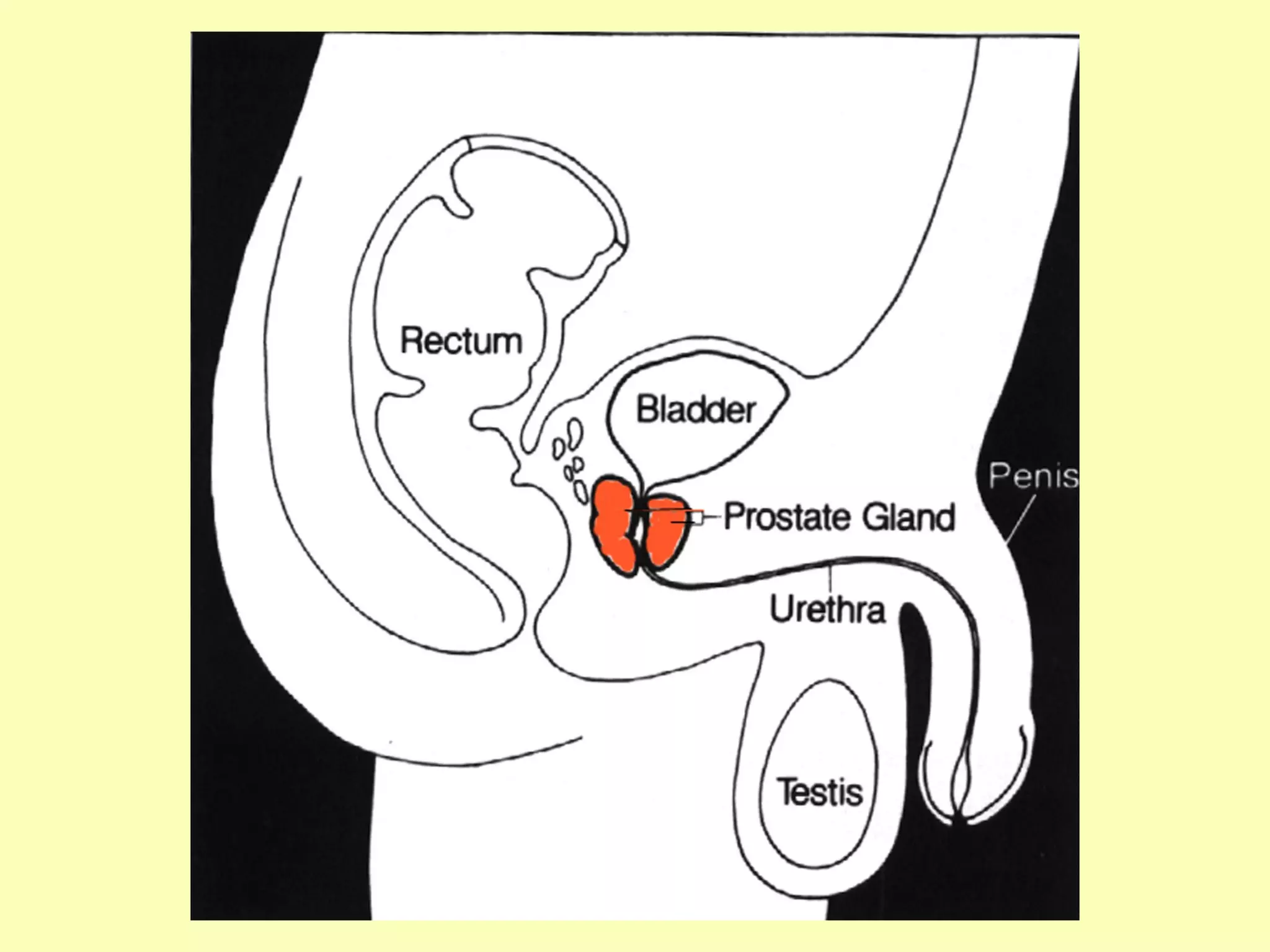
 The prostate is part of the male reproductive system 
 Its major function is to secrete a fluid to nourish 
semen during intercourse 
 The prostate is about the size of a walnut but it can 
grow with age 
 It is located below the urinary bladder, in front of the 
rectum surrounding the urethra (the canal for the 
discharge of urine that extends from the urinary 
bladder to the outside)
What Is Prostate Cancer? 
Not 
Much! 
What do you 
know about 
prostate cancer?
What is Cancer 
anyway?
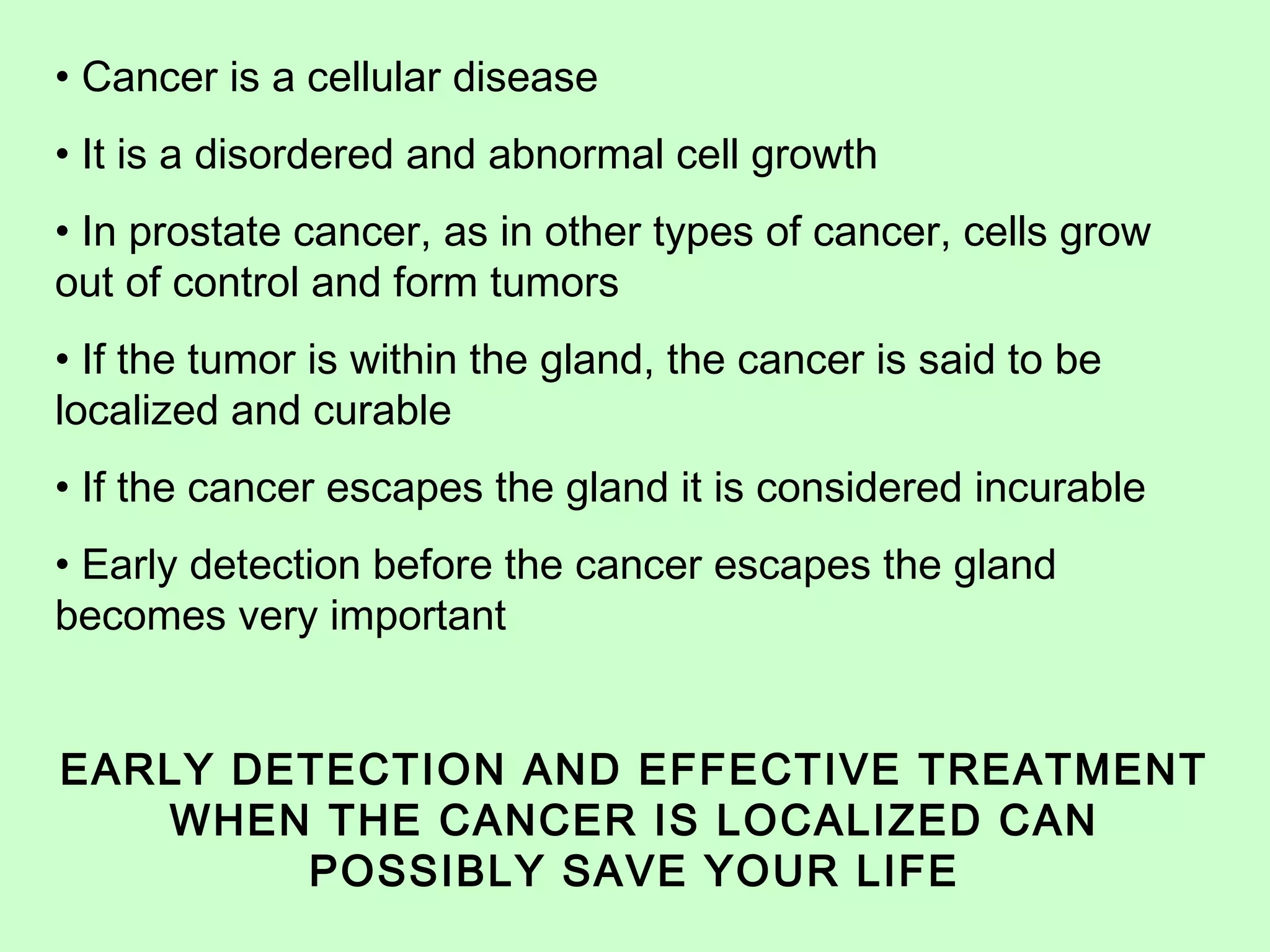
• Cancer is a cellular disease 
• It is a disordered and abnormal cell growth 
• In prostate cancer, as in other types of cancer, cells grow 
out of control and form tumors 
• If the tumor is within the gland, the cancer is said to be 
localized and curable 
• If the cancer escapes the gland it is considered incurable 
• Early detection before the cancer escapes the gland 
becomes very important 
EARLY DETECTION AND EFFECTIVE TREATMENT 
WHEN THE CANCER IS LOCALIZED CAN 
POSSIBLY SAVE YOUR LIFE
Possible Levels of Prostate Cancer At Diagnosis 
Local-Regional Disease Spread 
Tumor 
Tumor 
CAPSULE 
GLAND 
PROSTATE 
Systemic Spread 
Lymph 
Node 
Other Organs 
Bone
What are the symptoms of prostate cancer? 
 You might not have any at all! 
 Often there are none, or they are not recognized 
 Major symptoms: 
 Urinary frequency 
 Slow urinary flow 
 Painful urination 
 Blood in urine or semen 
 Impotence 
 Lower back or thigh pain
How Significant Is Prostate 
Cancer? 
 In the USA, 230,110 men will be diagnosed 
with prostate cancer. That is one man 
diagnosed every 3 minutes 
 Prostate cancer deaths are estimated at 
29,900 That is one death every 18 minutes 
 In Texas, an estimated 11,600 new cases 
were reported in 2002. 
Source: Cancer Facts and Figures –2004- American Cancer Society and Texas 
Department of Health
How much of a threat? 
 Prostate cancer 
is the most 
diagnosed non-skin 
cancer in 
American men 
and the second 
leading cause of 
cancer death .
Who Is at Most Risk? 
 Prostate cancer is 
almost twice as 
common in African- 
American men than in 
Caucasian men 
 African Americans are 
more than twice as 
likely to die when 
diagnosed than 
Caucasian men
Prostate cancer risk factors: 
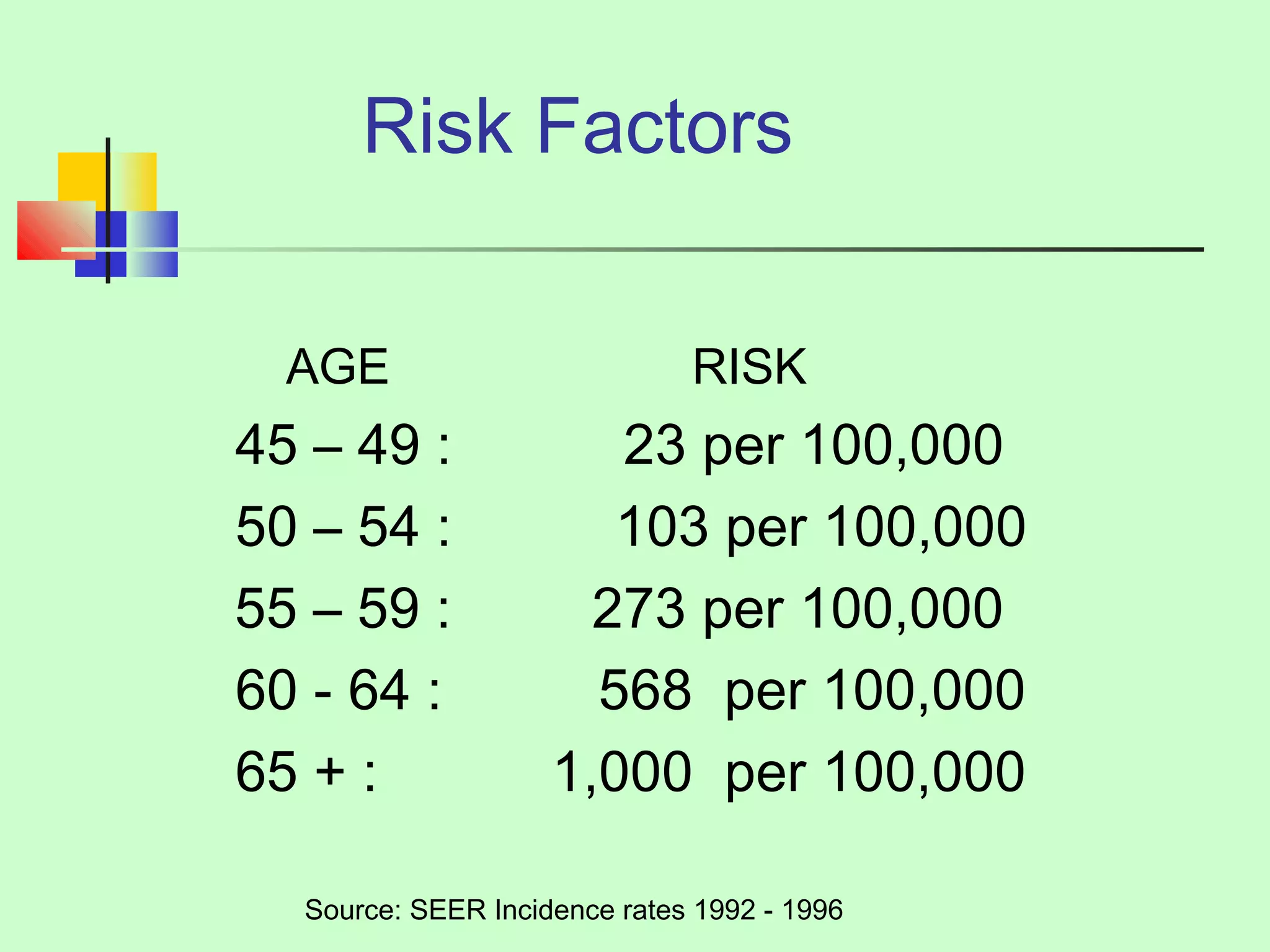
 Age: The risk increases with age, but 25% of 
diagnoses are made under age 65. 
 Race: African-Americans have a rate of incidence 
double that of Caucasian men 
 Family history of prostate cancer: Men with a 
family history have two- to three-fold increase in the 
risk of prostate cancer 
 Diet: A diet high in saturated animal fat can double 
the risk of developing prostate cancer.
Risk Factors 
AGE RISK 
45 – 49 : 23 per 100,000 
50 – 54 : 103 per 100,000 
55 – 59 : 273 per 100,000 
60 - 64 : 568 per 100,000 
65 + : 1,000 per 100,000 
Source: SEER Incidence rates 1992 - 1996
Risk Factors 
RACE 
Incidence Death 
Afr.-Am. 230.3 55.0 
Cauc. 153.5 24.1 
Hisp. 106.7 16.8 
Asian 91.3 11.1 
Source: 
Rates per 100,000 and age-adjusted. SEER incidence and U.S. cancer death rates, 1990-95, 
in Cancer 82: 1197-207, 1998 (SEER = NCI Surveillance, Epidemiology, and End-Results 
Program
Risk Factors 
FAMILY HISTORY 
2.4 times increased risk for men with a first-degree 
relative 
(Spitz, et al, “Familial patterns of prostate cancer: A case-control analysis”, J Urol, 
1991, 146:1305-1307)
Risk Factors 
DIET 
 Eating red meat increases the risk of developing prostate 
cancer 2.64 times 
 Red meat and dairy products are high in saturated fat rich 
in arachidonic acid (a fatty acid) 
 Vegetable oil is rich in alpha linolenic acid (a fatty acid) 
 By-products of these fats promote the growth and 
seriousness of prostate cancer 
 Eating a diet high in fats also lowers the body’s defenses
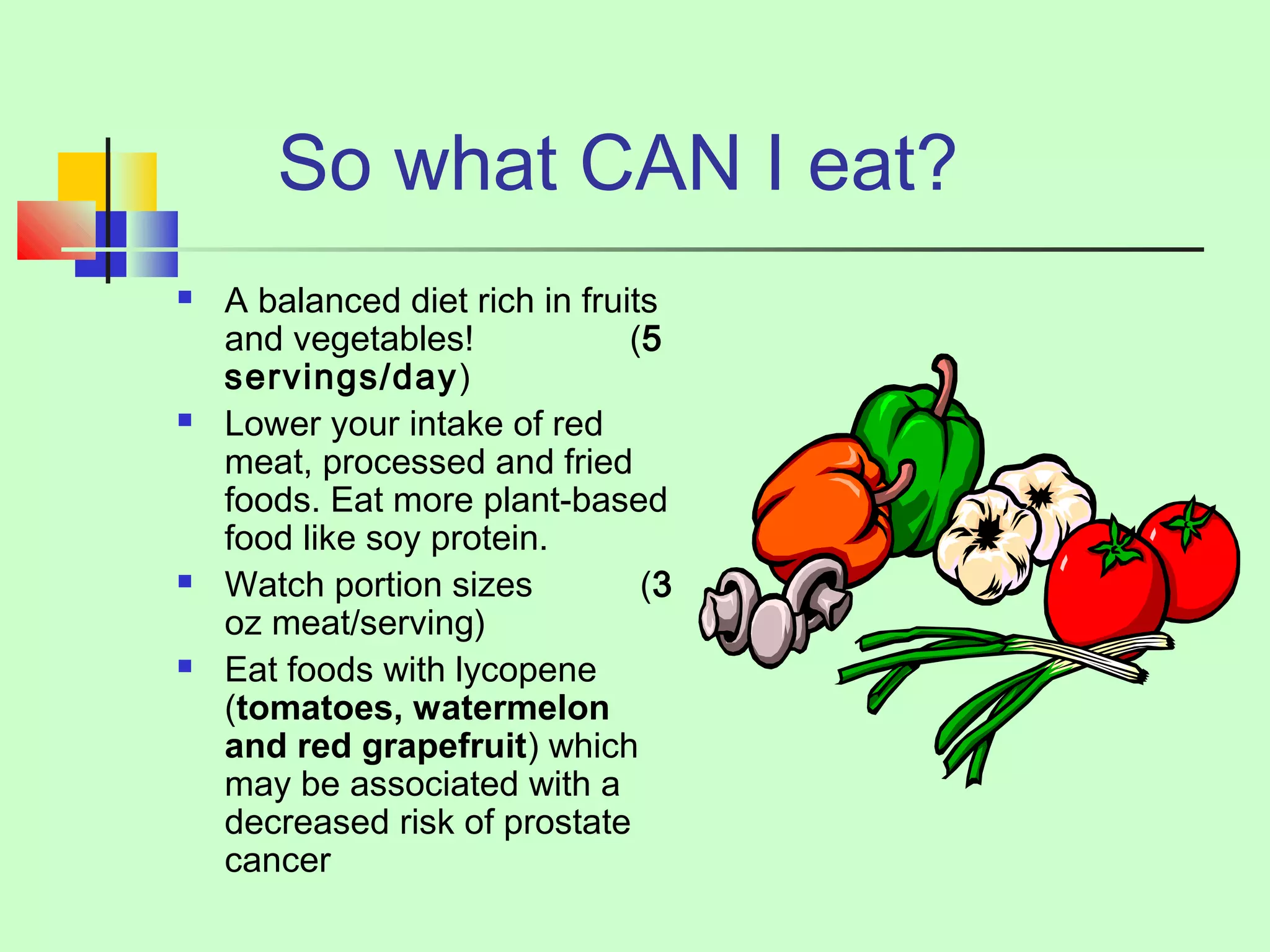
So what CAN I eat? 
 A balanced diet rich in fruits 
and vegetables! (5 
servings/day) 
 Lower your intake of red 
meat, processed and fried 
foods. Eat more plant-based 
food like soy protein. 
 Watch portion sizes (3 
oz meat/serving) 
 Eat foods with lycopene 
(tomatoes, watermelon 
and red grapefruit) which 
may be associated with a 
decreased risk of prostate 
cancer
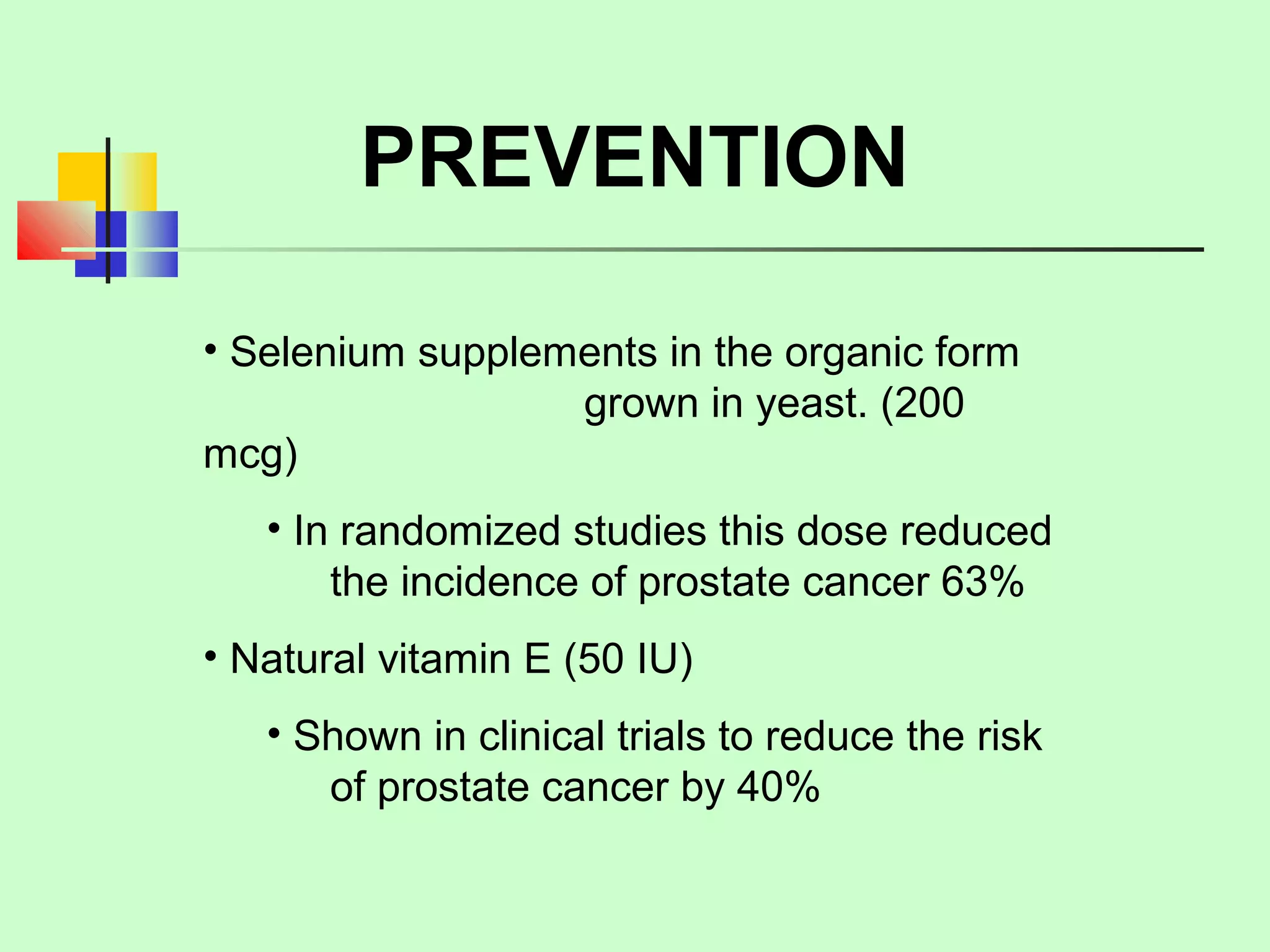
PREVENTION 
• Selenium supplements in the organic form 
grown in yeast. (200 
mcg) 
• In randomized studies this dose reduced 
the incidence of prostate cancer 63% 
• Natural vitamin E (50 IU) 
• Shown in clinical trials to reduce the risk 
of prostate cancer by 40%
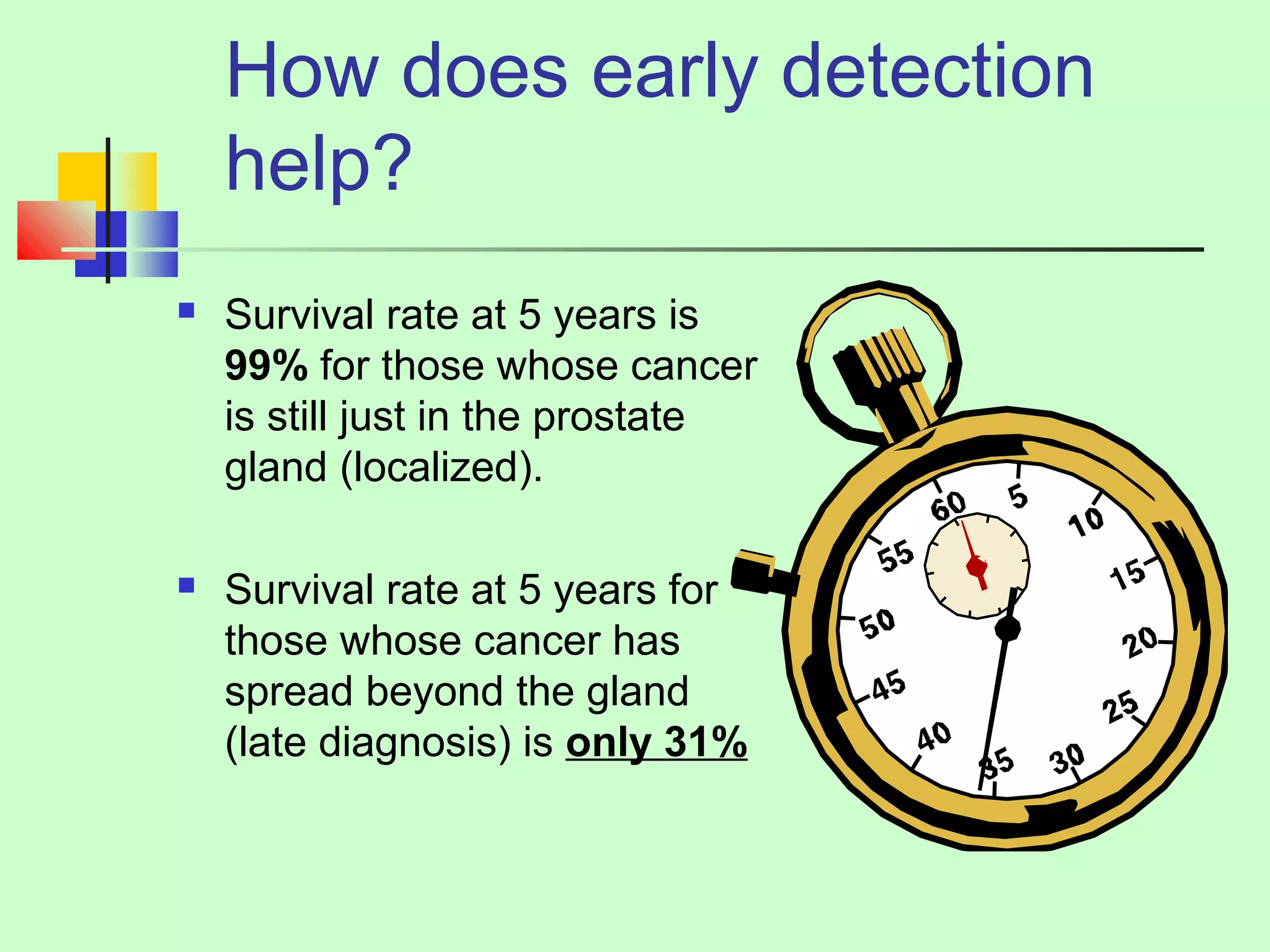
How does early detection 
help? 
 Survival rate at 5 years is 
99% for those whose cancer 
is still just in the prostate 
gland (localized). 
 Survival rate at 5 years for 
those whose cancer has 
spread beyond the gland 
(late diagnosis) is only 31%
How to Avoid an Advanced 
Stage Diagnosis: 
Early Detection is the Answer 
Men Assuming Responsibility 
for Their Health 
PSA 
DRE
No Warning! 
 Since symptoms can be 
caused by other conditions 
annual testing is KEY! 
 Prostate Specific Antigen 
(PSA), a blood test 
 Digital Rectal Examination 
(DRE), a physical exam 
 Basic tools to find Prostate 
Cancer EARLY!
What You Should Know About the PSA Test 
 PSA is checked by a blood test 
 The real value of the PSA test is in 
testing year to year and observing 
the rate of change 
 Medical opinion is divided about 
the usefulness of a single PSA 
 One test out of range could be 
caused by other problems 
 PSA is not prostate cancer specific
Why do I have to have a DRE? 
 In the DRE the doctor 
examines you by feeling 
the prostate gland through 
the rectum with his finger 
(digit) 
 DRE improves the value 
of PSA testing in early 
disease detection 
 DRE and PSA together are 
often able to detect 
prostate cancer better and 
sooner than either test 
alone
When do I need to start getting tested? 
 DRE: 40 years and older every year 
(American Cancer Society guidelines) 
 PSA: 50 years and older every year 
(American Cancer Society guidelines) 
 If family history of prostate cancer and/or 
African-American: 45 years and older every 
year (American Cancer Society guidelines)
What if the doctor doesn’t offer 
PSA and DRE? 
 Some doctors do not offer 
these tests to men at risk 
 These men have the right 
to request to be tested 
annually if so desired 
 You may have to insist on 
being tested
Be a man! 
 Take responsibility for 
your health! 
 Ask your doctor for a copy of 
your results. The normal 
range for PSA is 0.0 to 4.0 
ng/ml. (This is just a guideline 
range) 
 Knowing your “PSA number” 
lets you help track your own 
health. 
 Do not accept “your PSA is 
fine” from your doctor 
without getting a copy of the 
real number.
What if my PSA is high? 
 Infection needs to be ruled out 
 Antibiotics are prescribed to rule out infection 
 Free-PSA ratio test - Ordered if PSA remains high after antibiotics. 
It helps detect the presence of prostate cancer. A free-PSA ratio of 
15% or less indicates a high probability of prostate cancer 
 Ultrasound and biopsy examination may be ordered if the Free- 
PSA ratio indicates possible cancer
In Case of a Diagnosis With a 
Positive Biopsy… 
 Do not panic, learn your treatment options by 
contacting your local US TOO prostate cancer 
support group chapter. 
To locate a local chapter call: 1-800-80-US TOO or 
access their website at: http://www.ustoo.com 
 Get a second opinion on the biopsy sample by a 
pathologist specializing in prostate cancer . 
Your treatment decision depends on a good 
assessment of the biopsy material 
 Get a second opinion about your diagnosis and 
treatment options from an unbiased specialist in 
prostate cancer treatment

Us2aware

  • 1.
  • 2.
    Hey, Smart Guy! Can you guess who can get prostate cancer? Not you? Well, guess again… any male can get prostate cancer
  • 3.
    THIS PRESENTATION ISSPONSORED BY: US TOO! INTERNATIONAL, INC
  • 4.
    Prostate Cancer FactsThat Every Man Over 40 Should Know
  • 5.
    WHAT IS THEPROSTATE GLAND?
  • 6.
     The prostateis part of the male reproductive system  Its major function is to secrete a fluid to nourish semen during intercourse  The prostate is about the size of a walnut but it can grow with age  It is located below the urinary bladder, in front of the rectum surrounding the urethra (the canal for the discharge of urine that extends from the urinary bladder to the outside)
  • 8.
    What Is ProstateCancer? Not Much! What do you know about prostate cancer?
  • 9.
  • 10.
    • Cancer isa cellular disease • It is a disordered and abnormal cell growth • In prostate cancer, as in other types of cancer, cells grow out of control and form tumors • If the tumor is within the gland, the cancer is said to be localized and curable • If the cancer escapes the gland it is considered incurable • Early detection before the cancer escapes the gland becomes very important EARLY DETECTION AND EFFECTIVE TREATMENT WHEN THE CANCER IS LOCALIZED CAN POSSIBLY SAVE YOUR LIFE
  • 11.
    Possible Levels ofProstate Cancer At Diagnosis Local-Regional Disease Spread Tumor Tumor CAPSULE GLAND PROSTATE Systemic Spread Lymph Node Other Organs Bone
  • 12.
    What are thesymptoms of prostate cancer?  You might not have any at all!  Often there are none, or they are not recognized  Major symptoms:  Urinary frequency  Slow urinary flow  Painful urination  Blood in urine or semen  Impotence  Lower back or thigh pain
  • 13.
    How Significant IsProstate Cancer?  In the USA, 230,110 men will be diagnosed with prostate cancer. That is one man diagnosed every 3 minutes  Prostate cancer deaths are estimated at 29,900 That is one death every 18 minutes  In Texas, an estimated 11,600 new cases were reported in 2002. Source: Cancer Facts and Figures –2004- American Cancer Society and Texas Department of Health
  • 14.
    How much ofa threat?  Prostate cancer is the most diagnosed non-skin cancer in American men and the second leading cause of cancer death .
  • 15.
    Who Is atMost Risk?  Prostate cancer is almost twice as common in African- American men than in Caucasian men  African Americans are more than twice as likely to die when diagnosed than Caucasian men
  • 16.
    Prostate cancer riskfactors:  Age: The risk increases with age, but 25% of diagnoses are made under age 65.  Race: African-Americans have a rate of incidence double that of Caucasian men  Family history of prostate cancer: Men with a family history have two- to three-fold increase in the risk of prostate cancer  Diet: A diet high in saturated animal fat can double the risk of developing prostate cancer.
  • 17.
    Risk Factors AGERISK 45 – 49 : 23 per 100,000 50 – 54 : 103 per 100,000 55 – 59 : 273 per 100,000 60 - 64 : 568 per 100,000 65 + : 1,000 per 100,000 Source: SEER Incidence rates 1992 - 1996
  • 18.
    Risk Factors RACE Incidence Death Afr.-Am. 230.3 55.0 Cauc. 153.5 24.1 Hisp. 106.7 16.8 Asian 91.3 11.1 Source: Rates per 100,000 and age-adjusted. SEER incidence and U.S. cancer death rates, 1990-95, in Cancer 82: 1197-207, 1998 (SEER = NCI Surveillance, Epidemiology, and End-Results Program
  • 19.
    Risk Factors FAMILYHISTORY 2.4 times increased risk for men with a first-degree relative (Spitz, et al, “Familial patterns of prostate cancer: A case-control analysis”, J Urol, 1991, 146:1305-1307)
  • 20.
    Risk Factors DIET  Eating red meat increases the risk of developing prostate cancer 2.64 times  Red meat and dairy products are high in saturated fat rich in arachidonic acid (a fatty acid)  Vegetable oil is rich in alpha linolenic acid (a fatty acid)  By-products of these fats promote the growth and seriousness of prostate cancer  Eating a diet high in fats also lowers the body’s defenses
  • 21.
    So what CANI eat?  A balanced diet rich in fruits and vegetables! (5 servings/day)  Lower your intake of red meat, processed and fried foods. Eat more plant-based food like soy protein.  Watch portion sizes (3 oz meat/serving)  Eat foods with lycopene (tomatoes, watermelon and red grapefruit) which may be associated with a decreased risk of prostate cancer
  • 22.
    PREVENTION • Seleniumsupplements in the organic form grown in yeast. (200 mcg) • In randomized studies this dose reduced the incidence of prostate cancer 63% • Natural vitamin E (50 IU) • Shown in clinical trials to reduce the risk of prostate cancer by 40%
  • 23.
    How does earlydetection help?  Survival rate at 5 years is 99% for those whose cancer is still just in the prostate gland (localized).  Survival rate at 5 years for those whose cancer has spread beyond the gland (late diagnosis) is only 31%
  • 24.
    How to Avoidan Advanced Stage Diagnosis: Early Detection is the Answer Men Assuming Responsibility for Their Health PSA DRE
  • 25.
    No Warning! Since symptoms can be caused by other conditions annual testing is KEY!  Prostate Specific Antigen (PSA), a blood test  Digital Rectal Examination (DRE), a physical exam  Basic tools to find Prostate Cancer EARLY!
  • 26.
    What You ShouldKnow About the PSA Test  PSA is checked by a blood test  The real value of the PSA test is in testing year to year and observing the rate of change  Medical opinion is divided about the usefulness of a single PSA  One test out of range could be caused by other problems  PSA is not prostate cancer specific
  • 27.
    Why do Ihave to have a DRE?  In the DRE the doctor examines you by feeling the prostate gland through the rectum with his finger (digit)  DRE improves the value of PSA testing in early disease detection  DRE and PSA together are often able to detect prostate cancer better and sooner than either test alone
  • 28.
    When do Ineed to start getting tested?  DRE: 40 years and older every year (American Cancer Society guidelines)  PSA: 50 years and older every year (American Cancer Society guidelines)  If family history of prostate cancer and/or African-American: 45 years and older every year (American Cancer Society guidelines)
  • 29.
    What if thedoctor doesn’t offer PSA and DRE?  Some doctors do not offer these tests to men at risk  These men have the right to request to be tested annually if so desired  You may have to insist on being tested
  • 30.
    Be a man!  Take responsibility for your health!  Ask your doctor for a copy of your results. The normal range for PSA is 0.0 to 4.0 ng/ml. (This is just a guideline range)  Knowing your “PSA number” lets you help track your own health.  Do not accept “your PSA is fine” from your doctor without getting a copy of the real number.
  • 31.
    What if myPSA is high?  Infection needs to be ruled out  Antibiotics are prescribed to rule out infection  Free-PSA ratio test - Ordered if PSA remains high after antibiotics. It helps detect the presence of prostate cancer. A free-PSA ratio of 15% or less indicates a high probability of prostate cancer  Ultrasound and biopsy examination may be ordered if the Free- PSA ratio indicates possible cancer
  • 32.
    In Case ofa Diagnosis With a Positive Biopsy…  Do not panic, learn your treatment options by contacting your local US TOO prostate cancer support group chapter. To locate a local chapter call: 1-800-80-US TOO or access their website at: http://www.ustoo.com  Get a second opinion on the biopsy sample by a pathologist specializing in prostate cancer . Your treatment decision depends on a good assessment of the biopsy material  Get a second opinion about your diagnosis and treatment options from an unbiased specialist in prostate cancer treatment

Editor's Notes

  • #8 The prostate is part of the male reproductive system Its major function is to secrete a fluid to nourish semen during reproduction The prostate is about the size of a walnut but it can grow with age It is located below the urinary bladder, in front of the rectum surrounding the urethra (the canal for the discharge of urine that extends from the urinary bladder to the outside)
  • #10 Cancer is a cellular disease It is a disordered and abnormal cell growth In prostate cancer cells grow out of control and form tumors If the tumor is within the gland, the cancer is said to be localized and curable If the cancer escapes the gland it is considered incurable Early detection before the cancer escapes the gland becomes very important
  • #12 Left graphic representation: Prostate cancer can be localized within the gland as represented by the tumor on the lower part of the prostate gland or it can break through the capsule and invade nearby tissues. Right graphic representation: Prostate cancer cells can escape the prostate and invade the lymph nodes that drain the prostate. From there these cells can invade other organs. Prostate cancer cells preferentially invade bones.