

Gender Development
Yukti Mehta
Anish Gautham
Disha Chaudhry
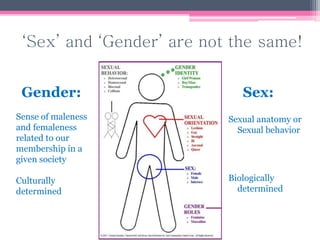
‘Sex’ and ‘Gender’ are not the same!
Gender:
Sense of maleness
and femaleness
related to our
membership in a
given society
Culturally
determined
Sex:
Sexual anatomy or
Sexual behavior
Biologically
determined
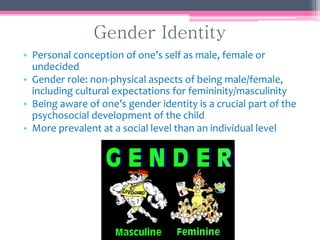
Gender Identity
• Personal conception of one’s self as male, female or
undecided
• Gender role: non-physical aspects of being male/female,
including cultural expectations for femininity/masculinity
• Being aware of one’s gender identity is a crucial part of the
psychosocial development of the child
• More prevalent at a social level than an individual level
Gender Roles
• Automatically assigned to the child at birth, expected
to play out the role simultaneously
• Gender Typing: Process in which people learn their
cultural appropriate gender roles through the process of
socialization
• This produces a gender schema, a framework that
organizes and guides a child’s understanding of information
relevant to gender (Sandra Bem, 1981)
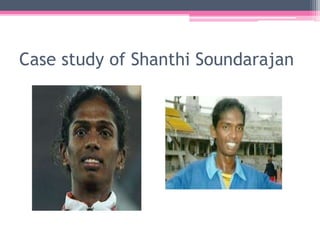
Case study of Shanthi Soundarajan
Gender Differences
|birth - to – early childhood|
• Freud’s Psychosexual Development Stages:
Formation of the personality at the age of 5
onward through the identification theory
“The basic feminine sense of self is
connected to the world. The basic
masculine sense of self is separate
(Chodorow, 1978)”
Kohlberg, 1966
Gender Cognitive Theory
• Ages 0 – 2, the child is neutral to his gender
• By the age of 2 and 3 - Gender identity
• At the age of 4 – Gender stability
• By the age of 7 – Gender constancy
• Sandra Bem’s Sex-Role Inventory
(BSRI) – classified sex into 4 groups:
1) Feminine 2) Masculine 3) Androgynous
4)Undifferentiated
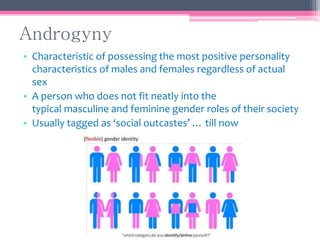
Androgyny
• Characteristic of possessing the most positive personality
characteristics of males and females regardless of actual
sex
• A person who does not fit neatly into the
typical masculine and feminine gender roles of their society
• Usually tagged as ‘social outcastes’ … till now
Changing perspectives:
Androgyny Fashion
Ehrhardt, 1985
• Exposure to different levels of androgen during
gestation and its effects
• Both males and females have androgens,
estrogens and progestin; only their levels differ
– leading to formation of Hermaphrodite babies
Psychological Outcome and
Gender-related development in
CAIS victims
• Complete Androgen Insensitivity Syndrome
• An extensive study by Mellissa Hines, Faizal Ahmed and A.
Hughes
• 22 women with CAIS, inter-sex cases
and AIS interviewed
• 47 males and females interviewed
with no sexual diseases
Caucasian,
average age of 27
Outcome measures
• Quality of life
• Gender-related psychological characteristics
• Marital status
• Personality traits
Result
• 22 matches were found between the two groups
• NO substantial difference for any psychological
outcome
Klinefelter syndrome, 1942
• Klinefelter discovered that some men have
enlarged breasts, small testes and inability to
produce sperms
• Later, identified as an extra ‘X’ chromosome
• Transgender - of, relating to, or being a person
(as a tran-sexual or transvestite) who identifies
with or expresses a gender identity that differs
from the one which corresponds to the person’s
sex at birth.- Merriam Webster
Gender Stereotypes
• Behavioral
• Appearance
• Society
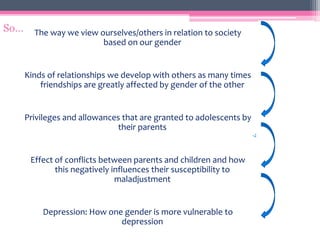
The way we view ourselves/others in relation to society
based on our gender
Kinds of relationships we develop with others as many times
friendships are greatly affected by gender of the other
Privileges and allowances that are granted to adolescents by
their parents
Effect of conflicts between parents and children and how
this negatively influences their susceptibility to
maladjustment
Depression: How one gender is more vulnerable to
depression
So…
Bibliography
• http://en.wikipedia.org/wiki/Gender_schema_theory
• http://en.wikipedia.org/wiki/Sandra_Bem
• https://www.google.co.in/search?q=androgyny+fashion&newwindow=1
&tbm=isch&tbo=u&source=univ&sa=X&ei=Nvz_UZTtBYXKrAe3yoHwD
A&ved=0CCsQsAQ&biw=1241&bih=567&sei=6AIAUqz8JInNrQeVk4DYC
Q
• http://www.premiercollegeadvisor.com/newsletter/Educational%20Psyc
hology%20-%20Gender%20Roles.pdf
• http://link.springer.com/article/10.1023/A:1022492106974#page-1
• "Understanding Klinefelter Syndrome: A Guide for XXY Males and
TheirFamilies. N.p., n.d. Web. 05 Aug. 2013.
<http://www.clevelandclinic.org/health/health-
info/docs/0800/0852.asp>
• Thank you!

Gender Development

  • 1.
  • 2.
    ‘Sex’ and ‘Gender’are not the same! Gender: Sense of maleness and femaleness related to our membership in a given society Culturally determined Sex: Sexual anatomy or Sexual behavior Biologically determined
  • 3.
    Gender Identity • Personalconception of one’s self as male, female or undecided • Gender role: non-physical aspects of being male/female, including cultural expectations for femininity/masculinity • Being aware of one’s gender identity is a crucial part of the psychosocial development of the child • More prevalent at a social level than an individual level
  • 4.
    Gender Roles • Automaticallyassigned to the child at birth, expected to play out the role simultaneously • Gender Typing: Process in which people learn their cultural appropriate gender roles through the process of socialization • This produces a gender schema, a framework that organizes and guides a child’s understanding of information relevant to gender (Sandra Bem, 1981)
  • 5.
    Case study ofShanthi Soundarajan
  • 6.
    Gender Differences |birth -to – early childhood| • Freud’s Psychosexual Development Stages: Formation of the personality at the age of 5 onward through the identification theory “The basic feminine sense of self is connected to the world. The basic masculine sense of self is separate (Chodorow, 1978)”
  • 7.
    Kohlberg, 1966 Gender CognitiveTheory • Ages 0 – 2, the child is neutral to his gender • By the age of 2 and 3 - Gender identity • At the age of 4 – Gender stability • By the age of 7 – Gender constancy
  • 8.
    • Sandra Bem’sSex-Role Inventory (BSRI) – classified sex into 4 groups: 1) Feminine 2) Masculine 3) Androgynous 4)Undifferentiated
  • 9.
    Androgyny • Characteristic ofpossessing the most positive personality characteristics of males and females regardless of actual sex • A person who does not fit neatly into the typical masculine and feminine gender roles of their society • Usually tagged as ‘social outcastes’ … till now
  • 11.
  • 12.
    Ehrhardt, 1985 • Exposureto different levels of androgen during gestation and its effects • Both males and females have androgens, estrogens and progestin; only their levels differ – leading to formation of Hermaphrodite babies
  • 13.
    Psychological Outcome and Gender-relateddevelopment in CAIS victims • Complete Androgen Insensitivity Syndrome • An extensive study by Mellissa Hines, Faizal Ahmed and A. Hughes • 22 women with CAIS, inter-sex cases and AIS interviewed • 47 males and females interviewed with no sexual diseases Caucasian, average age of 27
  • 14.
    Outcome measures • Qualityof life • Gender-related psychological characteristics • Marital status • Personality traits
  • 15.
    Result • 22 matcheswere found between the two groups • NO substantial difference for any psychological outcome
  • 16.
    Klinefelter syndrome, 1942 •Klinefelter discovered that some men have enlarged breasts, small testes and inability to produce sperms • Later, identified as an extra ‘X’ chromosome • Transgender - of, relating to, or being a person (as a tran-sexual or transvestite) who identifies with or expresses a gender identity that differs from the one which corresponds to the person’s sex at birth.- Merriam Webster
  • 17.
  • 18.
    The way weview ourselves/others in relation to society based on our gender Kinds of relationships we develop with others as many times friendships are greatly affected by gender of the other Privileges and allowances that are granted to adolescents by their parents Effect of conflicts between parents and children and how this negatively influences their susceptibility to maladjustment Depression: How one gender is more vulnerable to depression So…
  • 19.
    Bibliography • http://en.wikipedia.org/wiki/Gender_schema_theory • http://en.wikipedia.org/wiki/Sandra_Bem •https://www.google.co.in/search?q=androgyny+fashion&newwindow=1 &tbm=isch&tbo=u&source=univ&sa=X&ei=Nvz_UZTtBYXKrAe3yoHwD A&ved=0CCsQsAQ&biw=1241&bih=567&sei=6AIAUqz8JInNrQeVk4DYC Q • http://www.premiercollegeadvisor.com/newsletter/Educational%20Psyc hology%20-%20Gender%20Roles.pdf • http://link.springer.com/article/10.1023/A:1022492106974#page-1 • "Understanding Klinefelter Syndrome: A Guide for XXY Males and TheirFamilies. N.p., n.d. Web. 05 Aug. 2013. <http://www.clevelandclinic.org/health/health- info/docs/0800/0852.asp>
  • 20.