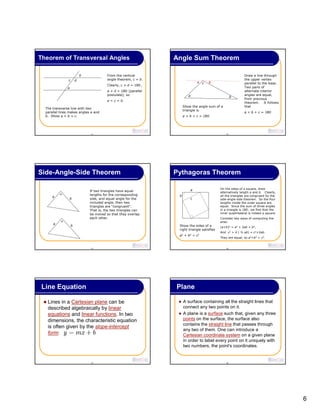
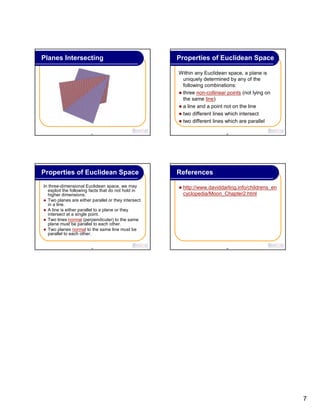
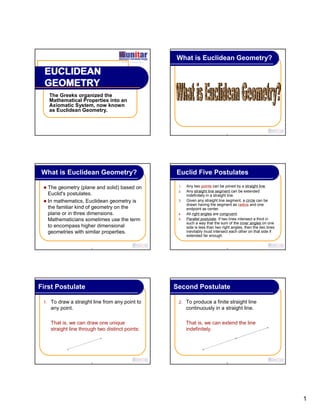
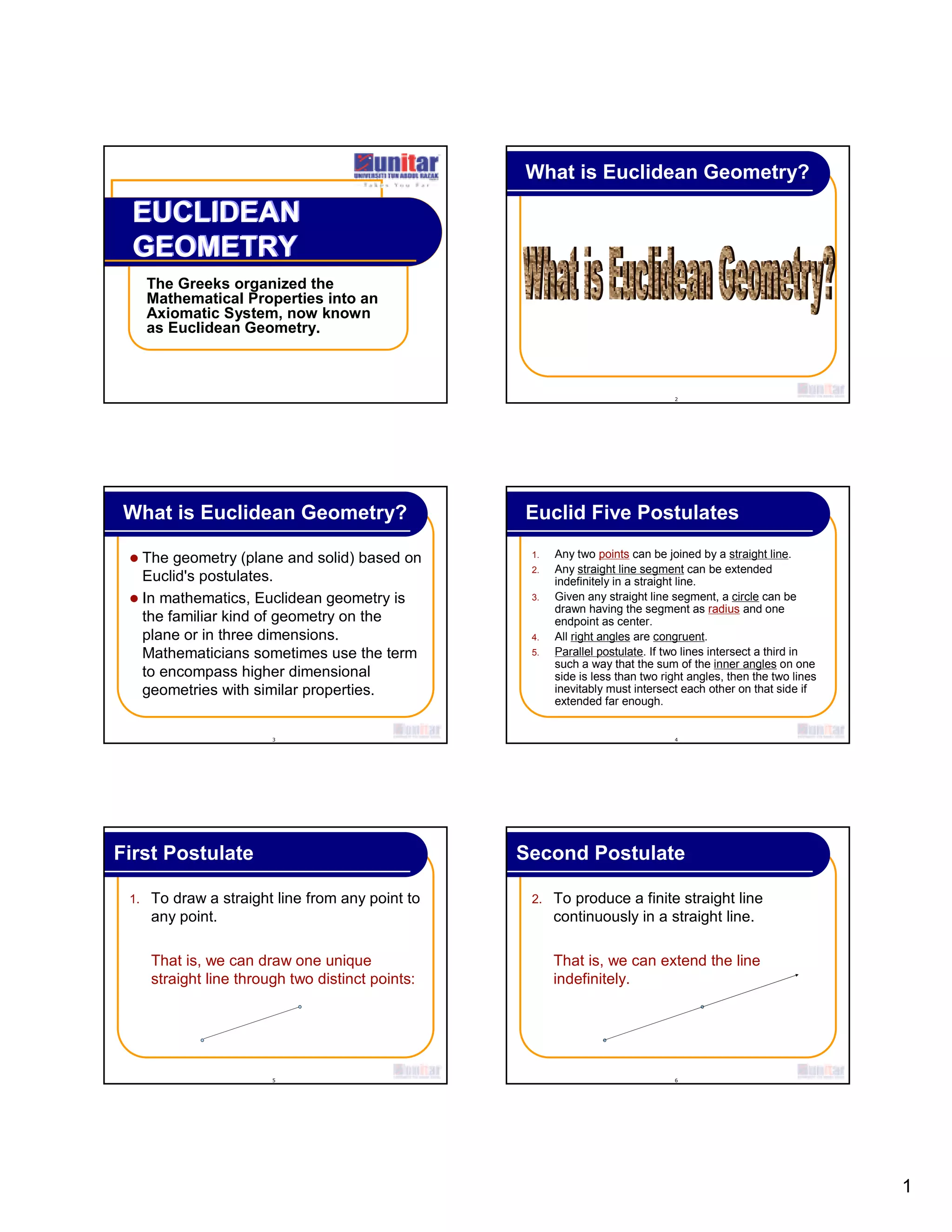
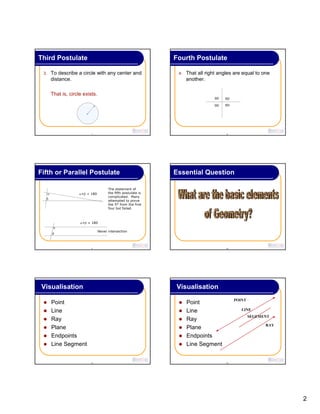
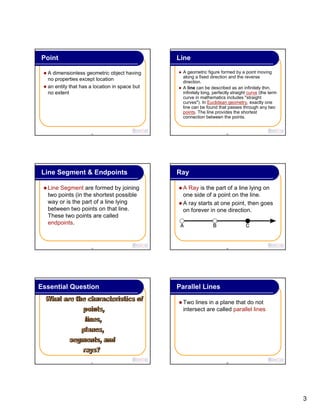
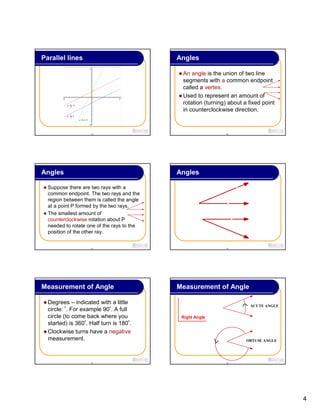
Euclidean geometry is based on Euclid's postulates and describes geometry in two or three dimensions. It includes concepts like points, lines, planes, angles and their properties. Some key principles are: parallel lines never intersect; the internal angles of a triangle sum to 180 degrees; and the Pythagorean theorem relating the sides of a right triangle. Euclidean geometry provides an axiomatic framework to define and prove theorems about geometric shapes and their relationships using logic and definitions. It has applications in fields like engineering and remains important in mathematics.
![5
25
Perpendicular Lines
Right Angle – If the angle formed by
the two rays is 90º.
When two lines in a plane meet,
they form four angles.
When all four of these angles made
by two intersecting lines are 90º, the
lines are called perpendicular lines.
26
Normal Line
Normal Line at a point on surface is a
line that passes through that point and is
perpendicular to the surface at that point.
Physical Principle of reflection –
Incoming light and reflected light make
the same angle with the normal line at
the point where the incoming light ray
hits the surface
27
Reflection
Normal Light ray lies in the
same plane as the normal line
and the incoming light ray.
The reflected ray and incoming
light ray coincide only when
incoming light ray lines up with
the normal line
28
Reflection
60 degrees
60 degrees
reflected light ray'Incomming light ray
Reflective Surface
Normal Line
29
Common Notions (Axioms)
1. Things which are equal to the same thing are
also equal to one another. [a=c, b=c => a =
b]
2. If equals be added to equals, the wholes are
equal. [a=b => a+c = b+c]
3. If equals be subtracted from equals, the
remainders are equal. [a=b => a-c = b-c]
4. Things which coincide with one another are
equal to one another.
5. The whole is greater than the part.
30
Thales’ theorem of “vertical
angles are equal”
a b
c
Straight line spans an angle
of 180◦, so
a + c = 180◦, c + b = 180◦
By common notation 1, we
have
a + c = c + b
By common notion 3, we
subtract c from above,
getting
a = b.
Pair of non-adjacent
angles a and b are
called vertical angles,
prove a = b.](https://image.slidesharecdn.com/012euclideangeometry1-181201153749/85/012-euclidean-geometry-1-5-320.jpg)