Mathematical System in
Geometry
Mathematics 8 – Quarter 3: Module 1 (MELC Based)
Learning Competencies
Illustrates the need for an axiomatic structure of a
mathematical system in general, and in Geometry in
particular: (a) defined terms; (b) undefined terms;(c)
postulates; and (d) theorems (M8GE-IIIa-c-1).
Objectives
At the end of the lesson, you are expected to:
 identify and illustrate the points, lines and planes;
identify and illustrate collinear points and coplanar
points/lines and
determine the postulates that are related to points,
lines and planes.
LESSON 1: Undefined Terms
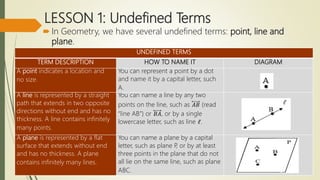
 In Geometry, we have several undefined terms: point, line and
plane.
UNDEFINED TERMS
TERM DESCRIPTION HOW TO NAME IT DIAGRAM
A point indicates a location and
no size.
You can represent a point by a dot
and name it by a capital letter, such
A.
A line is represented by a straight
path that extends in two opposite
directions without end and has no
thickness. A line contains infinitely
many points.
You can name a line by any two
points on the line, such as 𝐴𝐵 (read
“line AB”) or 𝐵𝐴, or by a single
lowercase letter, such as line 𝓁.
A plane is represented by a flat
surface that extends without end
and has no thickness. A plane
contains infinitely many lines.
You can name a plane by a capital
letter, such as plane P
, or by at least
three points in the plane that do not
all lie on the same line, such as plane
ABC.
LESSON 1: Exercise
Tell whether each of the following represents a point, a
line, or a plane.
Example: top of a box; plane
1. four corners of a room
2. cover of a book
3. side of a blackboard
4. tip of a pen
LESSON 2: Collinear and Coplanar
LESSON 2: Exercise
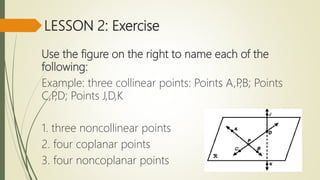
Use the figure on the right to name each of the
following:
Example: three collinear points: Points A,P
,B; Points
C,P
,D; Points J,D,K
1. three noncollinear points
2. four coplanar points
3. four noncoplanar points
LESSON 3: Postulates about Points, Lines
and Planes
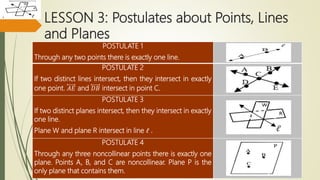
POSTULATE 1
Through any two points there is exactly one line.
POSTULATE 2
If two distinct lines intersect, then they intersect in exactly
one point. 𝐴𝐸 and 𝐷𝐵 intersect in point C.
POSTULATE 3
If two distinct planes intersect, then they intersect in exactly
one line.
Plane W and plane R intersect in line 𝓁 .
POSTULATE 4
Through any three noncollinear points there is exactly one
plane. Points A, B, and C are noncollinear. Plane P is the
only plane that contains them.
LESSON 3: Exercise
Determine what postulate is to be used to justify each of the
following statements.

Math8Q3Module1 .pptx

  • 1.
    Mathematical System in Geometry Mathematics8 – Quarter 3: Module 1 (MELC Based)
  • 2.
    Learning Competencies Illustrates theneed for an axiomatic structure of a mathematical system in general, and in Geometry in particular: (a) defined terms; (b) undefined terms;(c) postulates; and (d) theorems (M8GE-IIIa-c-1).
  • 3.
    Objectives At the endof the lesson, you are expected to:  identify and illustrate the points, lines and planes; identify and illustrate collinear points and coplanar points/lines and determine the postulates that are related to points, lines and planes.
  • 4.
    LESSON 1: UndefinedTerms  In Geometry, we have several undefined terms: point, line and plane. UNDEFINED TERMS TERM DESCRIPTION HOW TO NAME IT DIAGRAM A point indicates a location and no size. You can represent a point by a dot and name it by a capital letter, such A. A line is represented by a straight path that extends in two opposite directions without end and has no thickness. A line contains infinitely many points. You can name a line by any two points on the line, such as 𝐴𝐵 (read “line AB”) or 𝐵𝐴, or by a single lowercase letter, such as line 𝓁. A plane is represented by a flat surface that extends without end and has no thickness. A plane contains infinitely many lines. You can name a plane by a capital letter, such as plane P , or by at least three points in the plane that do not all lie on the same line, such as plane ABC.
  • 5.
    LESSON 1: Exercise Tellwhether each of the following represents a point, a line, or a plane. Example: top of a box; plane 1. four corners of a room 2. cover of a book 3. side of a blackboard 4. tip of a pen
  • 6.
    LESSON 2: Collinearand Coplanar
  • 7.
    LESSON 2: Exercise Usethe figure on the right to name each of the following: Example: three collinear points: Points A,P ,B; Points C,P ,D; Points J,D,K 1. three noncollinear points 2. four coplanar points 3. four noncoplanar points
  • 8.
    LESSON 3: Postulatesabout Points, Lines and Planes POSTULATE 1 Through any two points there is exactly one line. POSTULATE 2 If two distinct lines intersect, then they intersect in exactly one point. 𝐴𝐸 and 𝐷𝐵 intersect in point C. POSTULATE 3 If two distinct planes intersect, then they intersect in exactly one line. Plane W and plane R intersect in line 𝓁 . POSTULATE 4 Through any three noncollinear points there is exactly one plane. Points A, B, and C are noncollinear. Plane P is the only plane that contains them.
  • 9.
    LESSON 3: Exercise Determinewhat postulate is to be used to justify each of the following statements.