Downloaded 363 times
![Euclid`s Geometry
"To draw a straight line from any point to any
point."
"To produce [extend] a finite straight line
continuously in a straight line."
"To describe a circle with any centre and distance
[radius]."
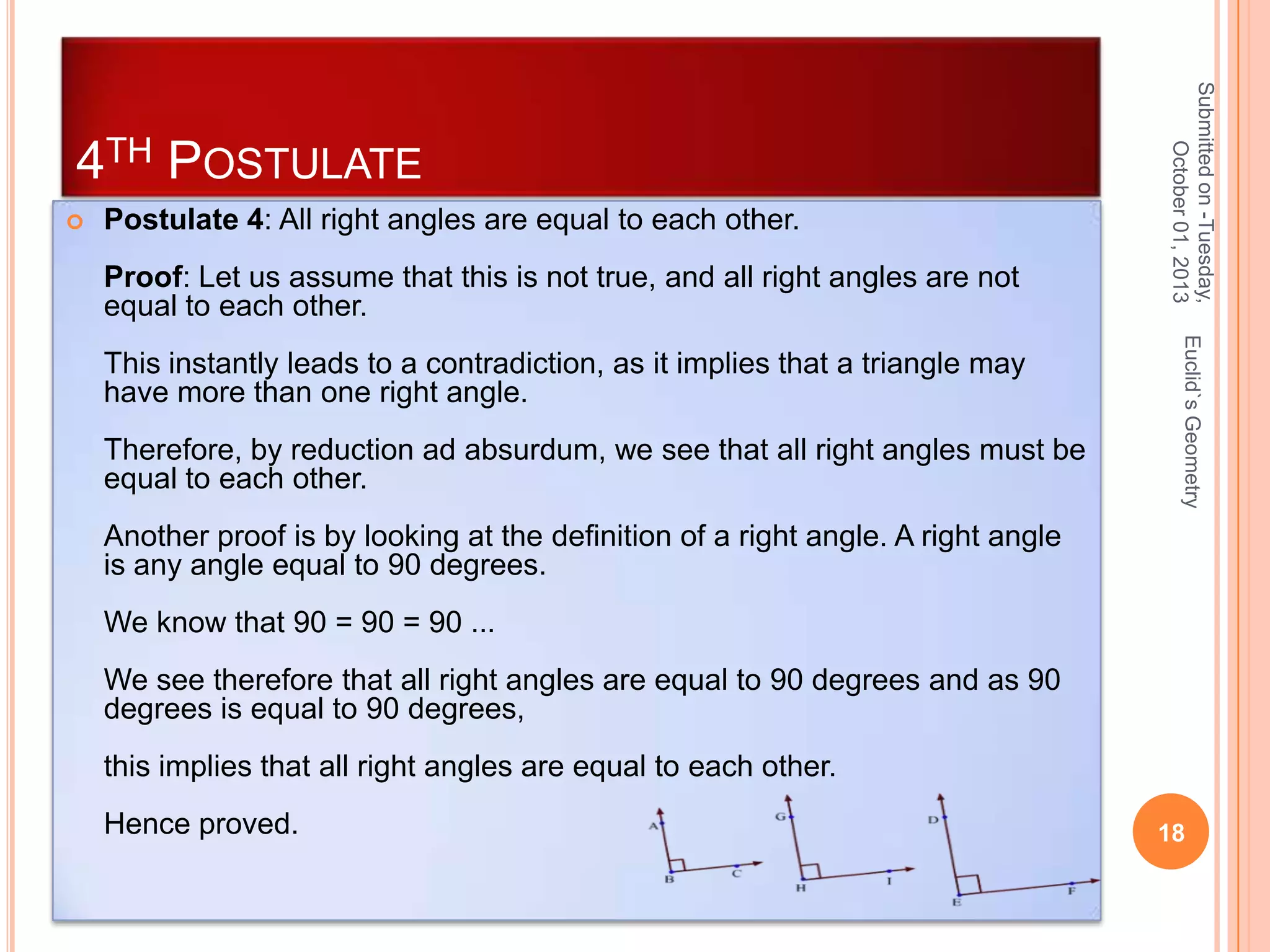
"That all right angles are equal to one another."
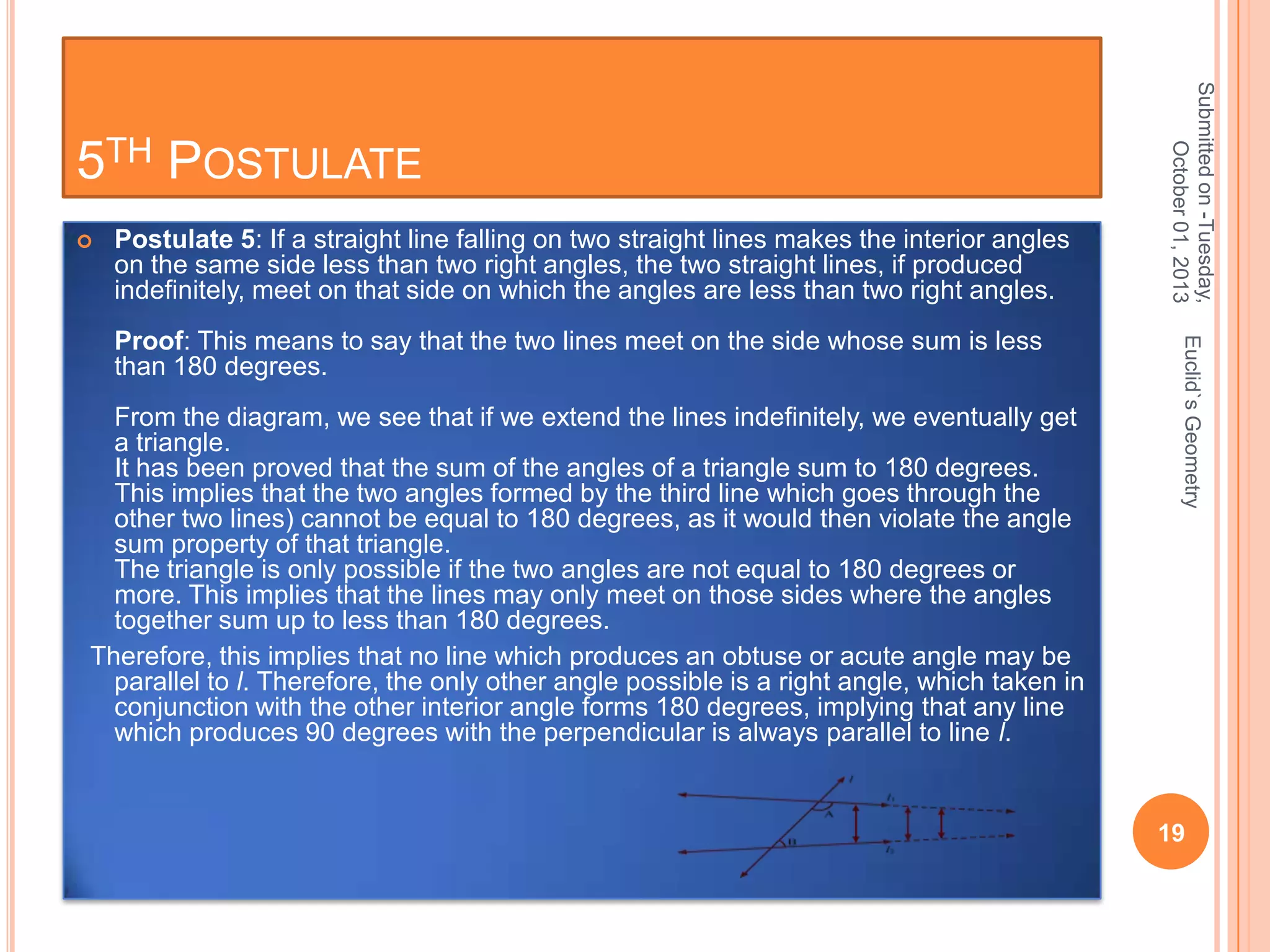
The parallel postulates : "That, if a straight line
falling on two straight lines make the interior
angles on the same side less than two right
angles, the two straight lines, if produced
indefinitely, meet on that side on which are the
angles less than the two right angles."
Submitted on -Tuesday,
October 01, 2013
POSTULATES
14](https://image.slidesharecdn.com/introductiontoeuclidsgeometryby-131215081330-phpapp02/75/Introduction-to-euclid-s-geometry-by-Al-Muktadir-hussain-14-2048.jpg)
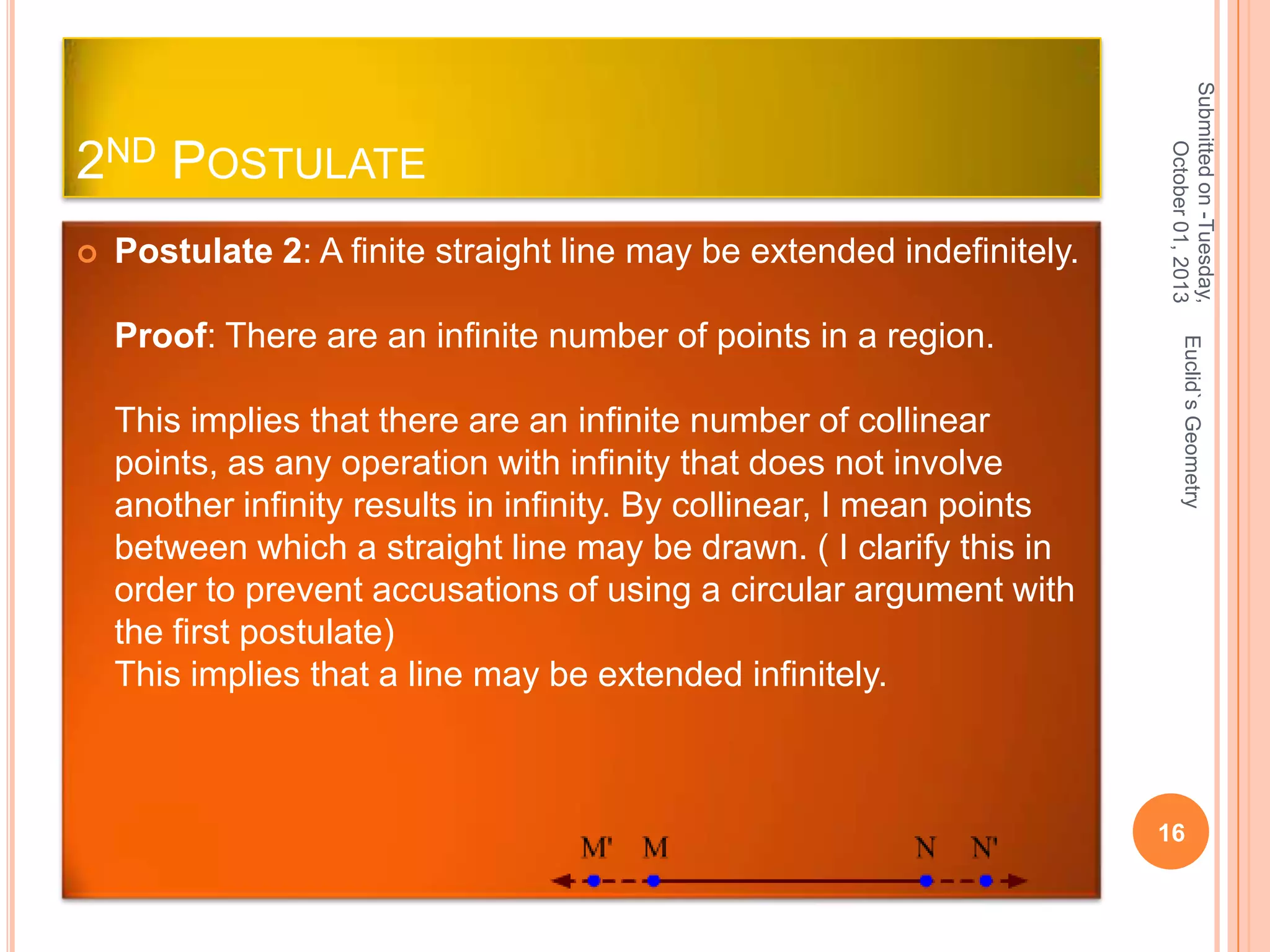
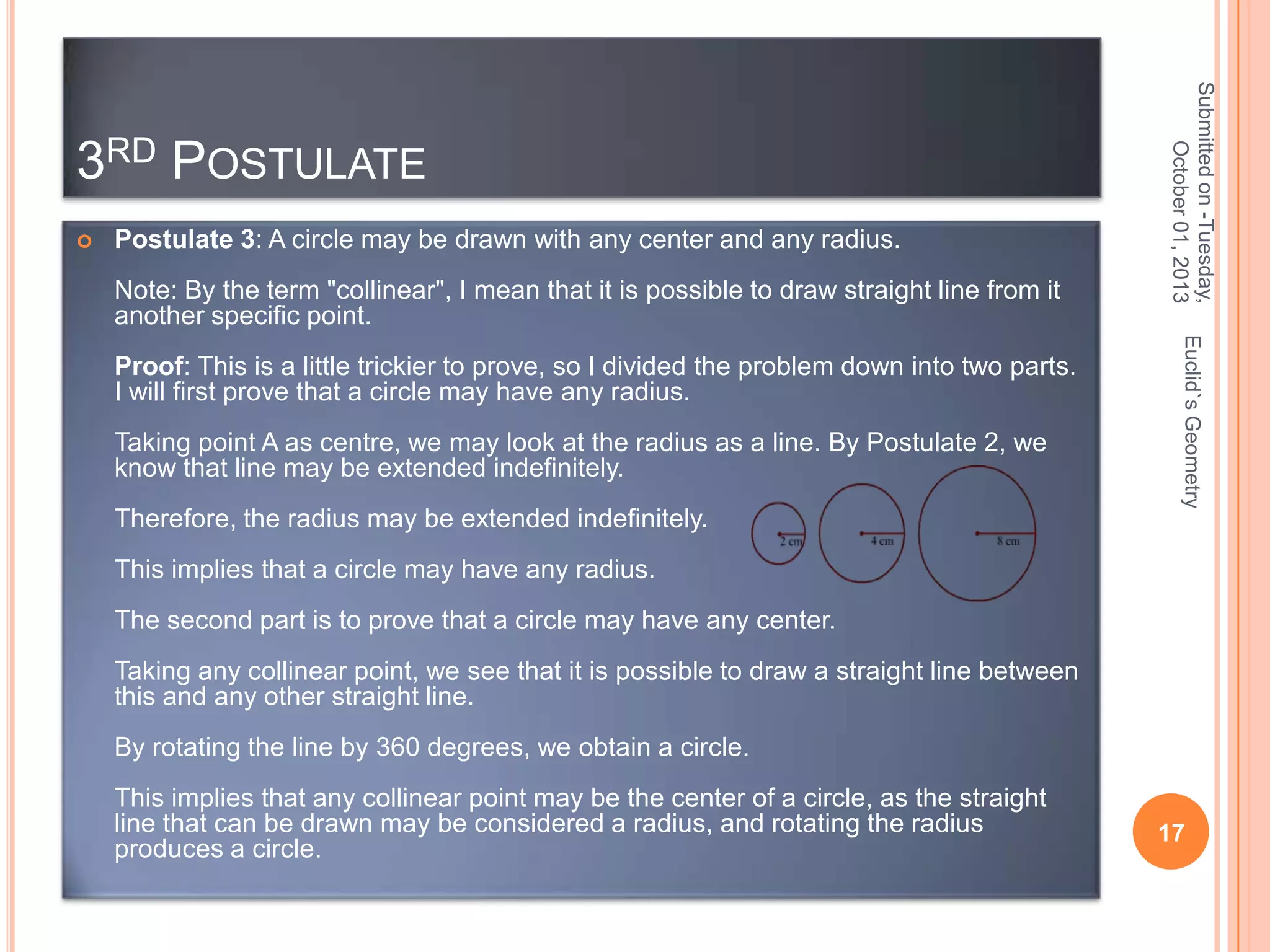

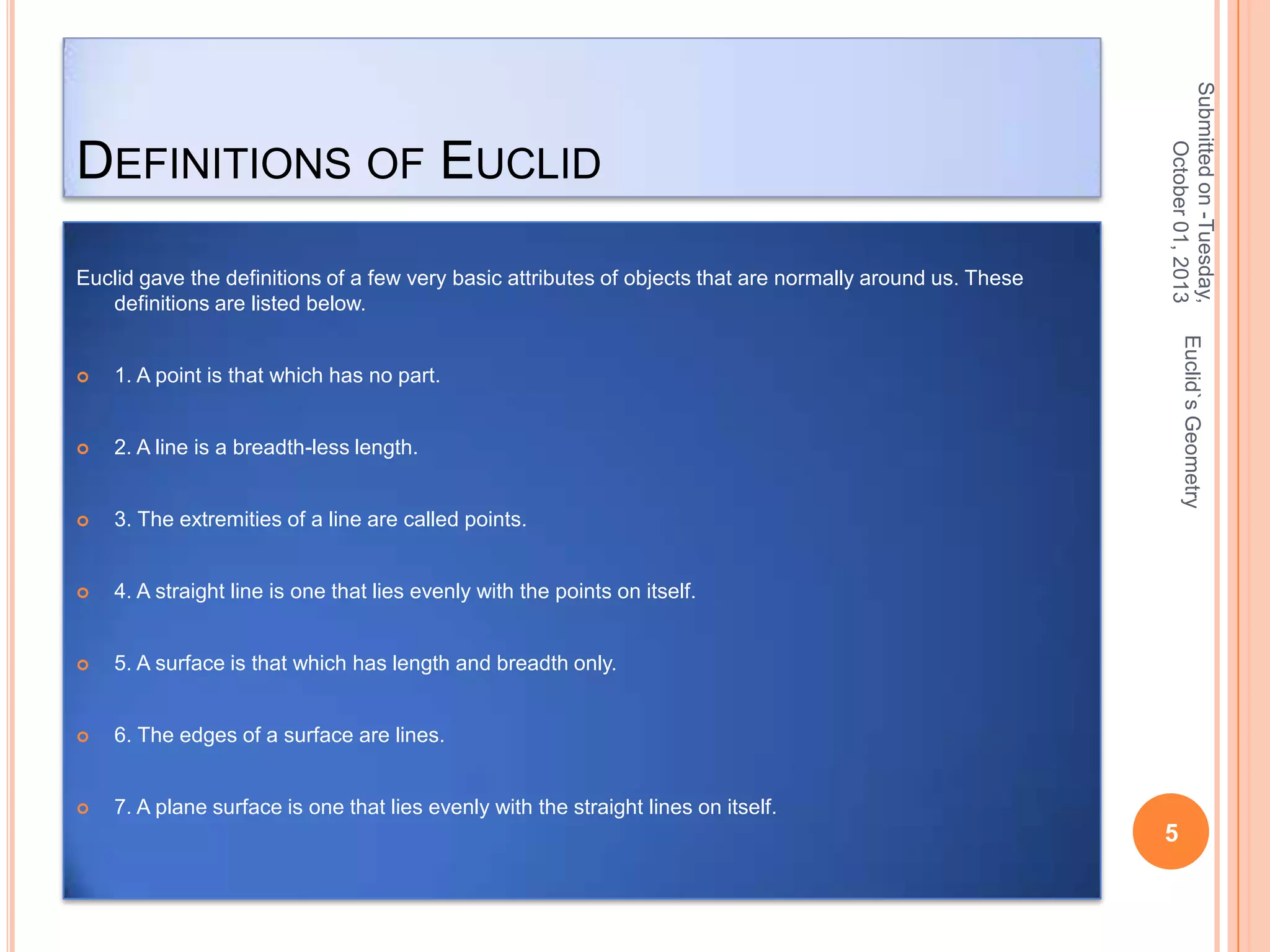
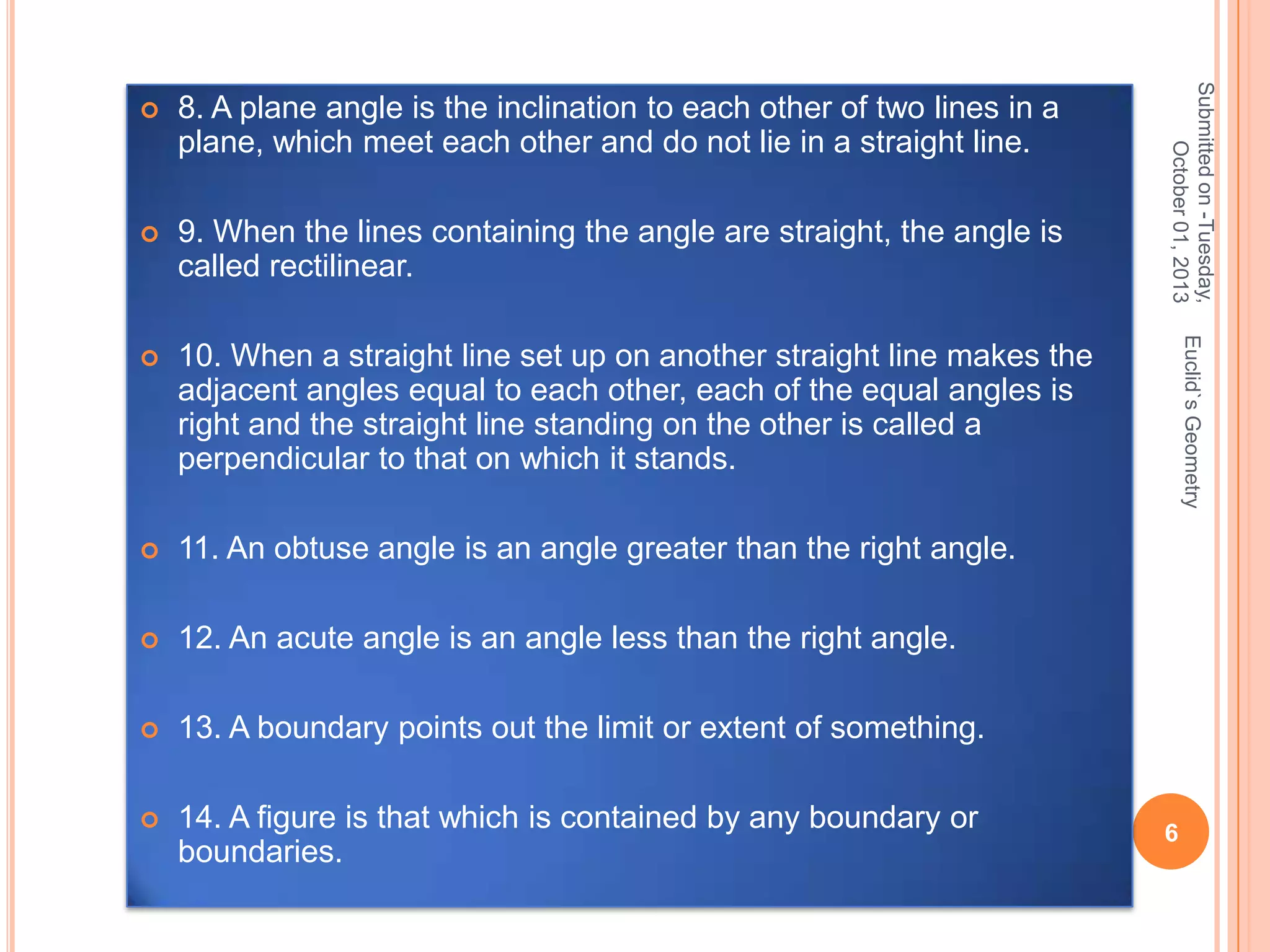
Euclid's Geometry defines basic geometric concepts like points, lines, and planes. It describes 23 definitions put forth by the ancient Greek mathematician Euclid, including the definition of a point as having no parts and of a line as having no breadth. It also explains Euclid's five postulates, such as the ability to draw straight lines between points and the property that straight lines extending infinitely will meet on the inside of two angles summing to less than two right angles. The document aims to explain Euclid's geometry clearly for students to better understand its complicated concepts.


