Basics of Geometry  1.2 POINTS! LINES! PLANES! OH MY!
What are the undefined terms in geometry?  What concepts present the foundations of geometry? Can you sketch the intersection of lines and planes? These questions (and much more!!) will be answered by the end of this presentation. Are you ready?
The terms points, lines, and planes are the foundations of geometry, but… point, line, and plane are all what we call  undefined terms . How can that be?  Well, any definition we could give them would depend on the definition of some other mathematical idea that these three terms help define. In other words, the definition would be circular! Undefined Terms?
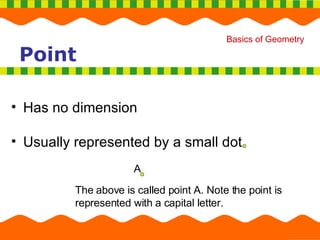
Has no dimension Usually represented by a small dot Point A The above is called point A. Note the point is represented with a capital letter.
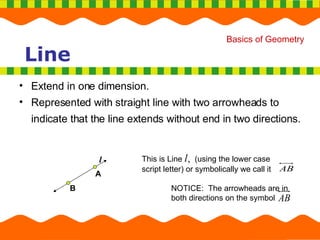
Extend in one dimension. Represented with straight line with two arrowheads to indicate that the line extends without end in two directions.   Line B A l This is Line  l ,   (using the lower case script letter) or symbolically we call it  NOTICE:  The arrowheads are in both directions on the symbol
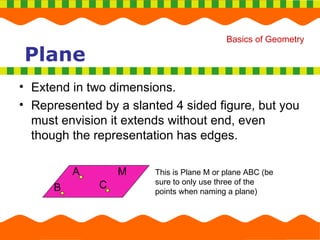
Extend in two dimensions. Represented by a slanted 4 sided figure, but you must envision it extends without end, even though the representation has edges. Plane M This is Plane M or plane ABC (be sure to only use three of the points when naming a plane) A B C
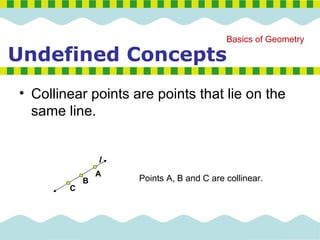
Undefined Concepts Collinear points are points that lie on the same line. C A B Points A, B and C are collinear. l
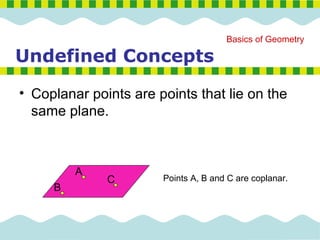
Undefined Concepts Coplanar points are points that lie on the same plane. Points A, B and C are coplanar. A B C
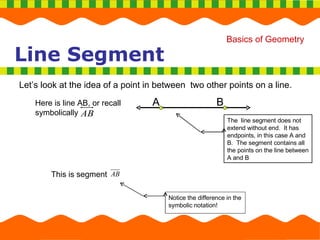
Line Segment Let’s look at the idea of a point in between  two other points on a line. This is segment  Here is line AB, or recall symbolically  A B The  line segment does not extend without end.  It has endpoints, in this case A and B.  The segment contains all the points on the line between A and B A B Notice the difference in the symbolic notation!
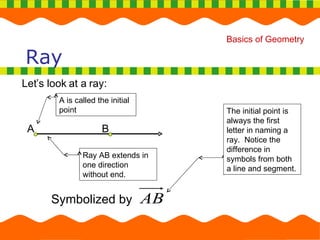
Symbolized by Ray Let’s look at a ray: The initial point is always the first letter in naming a ray.  Notice the difference in symbols from both a line and segment. A B A is called the initial point Ray AB extends in one direction without end.
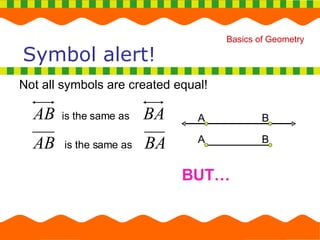
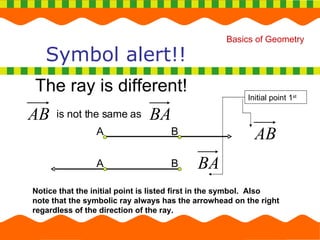
Not all symbols are created equal!  Symbol alert! is the same as BUT… is the same as A B A B
Symbol alert!! The ray is different! Notice that the initial point is listed first in the symbol.  Also note that the symbolic ray always has the arrowhead on the right regardless of the direction of the ray. is not the same as A B A B Initial point 1 st
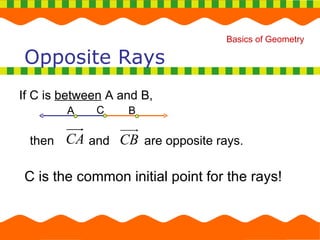
If C is  between  A and B, Opposite Rays then  and  are opposite rays. C is the common initial point for the rays! A B C
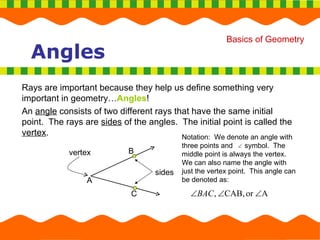
Rays are important because they help us define something very important in geometry… Angles ! An  angle  consists of two different rays that have the same initial point.  The rays are  sides  of the angles.  The initial point is called the  vertex . Angles vertex sides A B C Notation:  We denote an angle with three points and  symbol.  The middle point is always the vertex.  We can also name the angle with just the vertex point.  This angle can be denoted as:
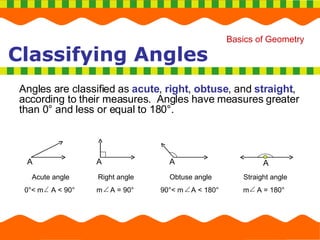
Classifying Angles Angles are classified as  acute ,  right ,  obtuse , and  straight , according to their measures.  Angles have measures greater than 0 ° and less or equal to 180°. Straight angle m  A = 180° Obtuse angle 90 °< m  A < 180° Acute angle 0 °< m  A < 90° Right angle m  A = 90° A A A A
Two or more geometric figures  intersect  if they have one or more points in common. The  intersection  of the figures is the set of points the figure has in common  Intersections of lines and planes Think!! How do 2 line intersect? How do 2 planes intersect? What about a line and a plane?
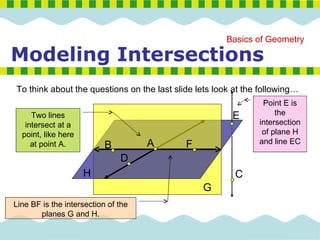
Modeling Intersections To think about the questions on the last slide lets look at the following… E Two lines intersect at a point, like here at point A. Line BF is the intersection of the planes G and H. G H Point E is the intersection of plane H and line EC C B A F D
Something to think about… You have just finished the first section in Geometry!  This is a very important section because it lays the foundation for the rest of the year!  Much of the vocabulary you will encounter in this course will have its foundation in the ideas presented in this lesson.  Can you name the three undefined terms in geometry? Do you know the difference between and obtuse and straight angle?  Can you sketch the intersection of a plane and a line?  How about two planes?  Can you visualize the intersection of two planes?  How about three?  The classfun and homefun provided will help you in developing a better understanding of the concepts!
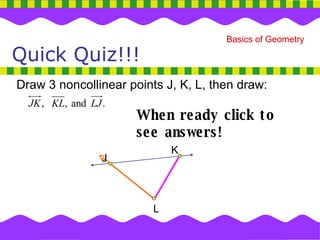
Draw 3 noncollinear points J, K, L, then draw: Quick Quiz!!! L When ready click to see answers! K J
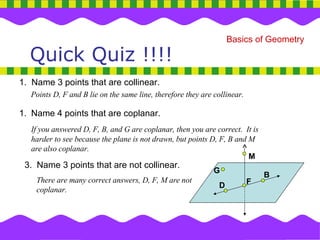
Quick Quiz !!!! 1.  Name 3 points that are collinear. Points D, F and B lie on the same line, therefore they are collinear. Name 4 points that are coplanar. If you answered D, F, B, and G are coplanar, then you are correct.  It is harder to see because the plane is not drawn, but points D, F, B and M are also coplanar. 3.  Name 3 points that are not collinear. There are many correct answers, D, F, M are not coplanar. M G D F B
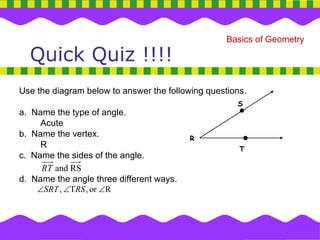
Use the diagram below to answer the following questions. a.  Name the type of angle. Acute b.  Name the vertex. R c.  Name the sides of the angle. d.  Name the angle three different ways. Quick Quiz !!!! R S T

Basics Of Geometry 1

  • 1.
    Basics of Geometry 1.2 POINTS! LINES! PLANES! OH MY!
  • 2.
    What are theundefined terms in geometry? What concepts present the foundations of geometry? Can you sketch the intersection of lines and planes? These questions (and much more!!) will be answered by the end of this presentation. Are you ready?
  • 3.
    The terms points,lines, and planes are the foundations of geometry, but… point, line, and plane are all what we call undefined terms . How can that be? Well, any definition we could give them would depend on the definition of some other mathematical idea that these three terms help define. In other words, the definition would be circular! Undefined Terms?
  • 4.
    Has no dimensionUsually represented by a small dot Point A The above is called point A. Note the point is represented with a capital letter.
  • 5.
    Extend in onedimension. Represented with straight line with two arrowheads to indicate that the line extends without end in two directions. Line B A l This is Line l , (using the lower case script letter) or symbolically we call it NOTICE: The arrowheads are in both directions on the symbol
  • 6.
    Extend in twodimensions. Represented by a slanted 4 sided figure, but you must envision it extends without end, even though the representation has edges. Plane M This is Plane M or plane ABC (be sure to only use three of the points when naming a plane) A B C
  • 7.
    Undefined Concepts Collinearpoints are points that lie on the same line. C A B Points A, B and C are collinear. l
  • 8.
    Undefined Concepts Coplanarpoints are points that lie on the same plane. Points A, B and C are coplanar. A B C
  • 9.
    Line Segment Let’slook at the idea of a point in between two other points on a line. This is segment Here is line AB, or recall symbolically A B The line segment does not extend without end. It has endpoints, in this case A and B. The segment contains all the points on the line between A and B A B Notice the difference in the symbolic notation!
  • 10.
    Symbolized by RayLet’s look at a ray: The initial point is always the first letter in naming a ray. Notice the difference in symbols from both a line and segment. A B A is called the initial point Ray AB extends in one direction without end.
  • 11.
    Not all symbolsare created equal! Symbol alert! is the same as BUT… is the same as A B A B
  • 12.
    Symbol alert!! Theray is different! Notice that the initial point is listed first in the symbol. Also note that the symbolic ray always has the arrowhead on the right regardless of the direction of the ray. is not the same as A B A B Initial point 1 st
  • 13.
    If C is between A and B, Opposite Rays then and are opposite rays. C is the common initial point for the rays! A B C
  • 14.
    Rays are importantbecause they help us define something very important in geometry… Angles ! An angle consists of two different rays that have the same initial point. The rays are sides of the angles. The initial point is called the vertex . Angles vertex sides A B C Notation: We denote an angle with three points and symbol. The middle point is always the vertex. We can also name the angle with just the vertex point. This angle can be denoted as:
  • 15.
    Classifying Angles Anglesare classified as acute , right , obtuse , and straight , according to their measures. Angles have measures greater than 0 ° and less or equal to 180°. Straight angle m A = 180° Obtuse angle 90 °< m A < 180° Acute angle 0 °< m A < 90° Right angle m A = 90° A A A A
  • 16.
    Two or moregeometric figures intersect if they have one or more points in common. The intersection of the figures is the set of points the figure has in common Intersections of lines and planes Think!! How do 2 line intersect? How do 2 planes intersect? What about a line and a plane?
  • 17.
    Modeling Intersections Tothink about the questions on the last slide lets look at the following… E Two lines intersect at a point, like here at point A. Line BF is the intersection of the planes G and H. G H Point E is the intersection of plane H and line EC C B A F D
  • 18.
    Something to thinkabout… You have just finished the first section in Geometry! This is a very important section because it lays the foundation for the rest of the year! Much of the vocabulary you will encounter in this course will have its foundation in the ideas presented in this lesson. Can you name the three undefined terms in geometry? Do you know the difference between and obtuse and straight angle? Can you sketch the intersection of a plane and a line? How about two planes? Can you visualize the intersection of two planes? How about three? The classfun and homefun provided will help you in developing a better understanding of the concepts!
  • 19.
    Draw 3 noncollinearpoints J, K, L, then draw: Quick Quiz!!! L When ready click to see answers! K J
  • 20.
    Quick Quiz !!!!1. Name 3 points that are collinear. Points D, F and B lie on the same line, therefore they are collinear. Name 4 points that are coplanar. If you answered D, F, B, and G are coplanar, then you are correct. It is harder to see because the plane is not drawn, but points D, F, B and M are also coplanar. 3. Name 3 points that are not collinear. There are many correct answers, D, F, M are not coplanar. M G D F B
  • 21.
    Use the diagrambelow to answer the following questions. a. Name the type of angle. Acute b. Name the vertex. R c. Name the sides of the angle. d. Name the angle three different ways. Quick Quiz !!!! R S T