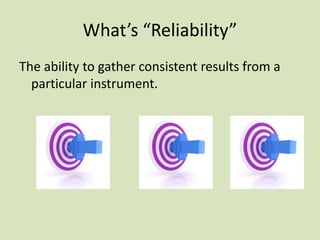
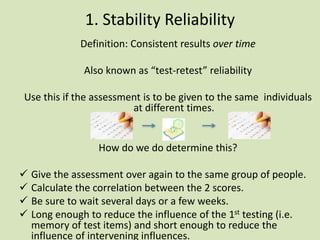
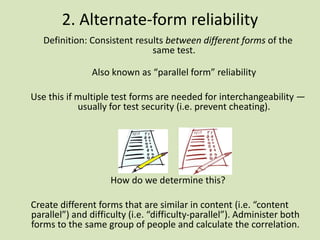
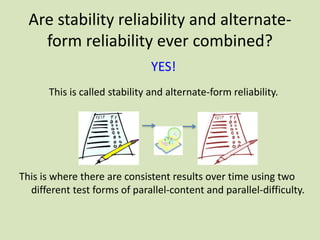
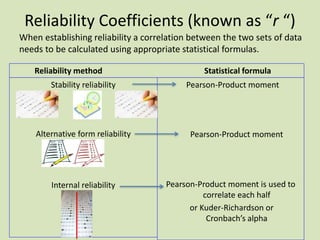
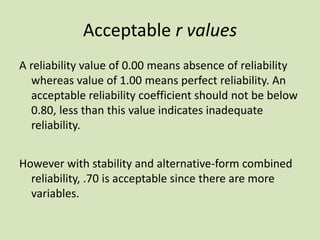
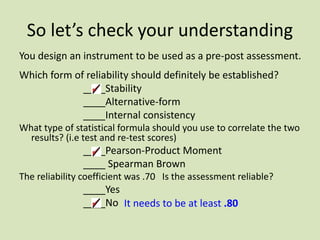
This document discusses validity and reliability in assessment instruments. It defines validity as the ability of an instrument to measure what it intends to measure, and reliability as an instrument's ability to provide consistent results. There are several types of validity discussed, including content validity, construct validity, and criterion validity. Establishing validity involves defining the domain and components being measured, developing items, and expert review. Reliability can be determined through stability, alternate forms, and internal consistency. Statistical analysis is used to calculate reliability coefficients, with 0.80 or higher generally indicating adequate reliability. For an assessment to be useful, it must demonstrate both validity and reliability.