Pronoun Agreement & Reference
Pronouns Pronouns are words that take the place of nouns (persons, places, or things). The word pronoun means “for a noun.”
Pronouns Pronouns are shortcuts that keep you from unnecessarily repeating words in writing . Here are some examples: Kim had not finished  her  paper. ( Her  is a pronoun that takes the place of  Kim’s ) Tim swung so hard on the branch that  it  snapped. ( It  replaces  branch )
Pronouns This power-point will present the rules that help you avoid two common mistakes people make with pronouns. The rules are: 1. A pronoun must agree in number with the word or words it replaces. 2. A pronoun must clearly refer to the word it replaces.
Pronoun Agreement A pronoun must agree with the word or words it replaces.  If the word the pronoun refers to is singular, the pronoun must be singular; if the word is plural, the pronoun must be plural. Note that the word a pronoun refers to is also known as the  antecedent .
Pronoun Agreement Here are some examples of agreement: Kayla  agreed to lend me  her  Ray Charles CD. Her  refers to the singular word  Kayla People  walking the trail must watch  their  step. Their  refers to the plural word  people .
Indefinite Pronouns The following words, known as indefinite pronouns, are always singular. -one words : one, anyone, everyone, someone -body words : nobody, anybody, everybody, somebody, & each, either, neither
Indefinite Pronouns Here are some examples: Each  father  felt  his  child was the brightest. One  of the women could not find  her  purse.  Everyone  must be in  his or her  seat before the instructor takes attendance. *** If everyone in the last example was a man, you could use  his . If everyone was a woman, you could use  her . If the class has both sexes, or gender is unknown, use  his or her .
Compound Subjects A compound subject is formed by two or more words, phrases, or clauses joined by  and ,  or ,  nor ,  either… or , or  neither …nor . 1. When the parts of the antecedent are joined by  and , use a plural pronoun.  2. When the antecedent is preceded by  each  or  every , use a singular pronoun.
Compound Subjects 3. For singular antecedents joined by  either…or  ,or,  neither …nor , use singular pronouns.  4. For plural antecedents joined by  either…or  ,or,  neither …nor , use plural pronouns. 5. If one singular and one plural antecedent are joined by  or ,  either…or , or,  neither…nor , be sure the pronoun agrees with the antecedent closest to it.
Collective Nouns Collective nouns have a singular form & refer to a group of people or things. Some are: Audience, panel, band, class, team, society, jury. 1. If the group is functioning as a single unit, the pronoun is singular. A civilized  society  must protect  its  citizens. 2. If the members of the group are functioning individually, the pronoun is plural. The  team  signed  their  contracts for next season.
Pronoun Reference A sentence is confusing & unclear if a pronoun appears to refer to more than one word, or if the pronoun does not refer to any specific word. There are two types of mistakes that writers often make: ambiguous reference & unstated reference.
Ambiguous Reference Ambiguous reference occurs when the reader cannot tell which antecedent the pronoun refers to. Ex. When Joe placed the heavy vase on the shelf,  it  broke. What broke? The vase or the shelf? To correct this sentence, replace the pronoun with a noun. Ex. When Joe placed the heavy vase on the shelf, the shelf broke.
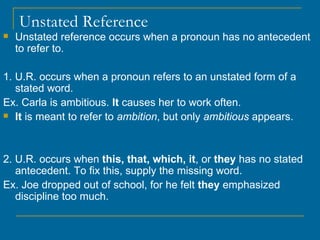
Unstated Reference Unstated reference occurs when a pronoun has no antecedent to refer to. 1. U.R. occurs when a pronoun refers to an unstated form of a stated word. Ex. Carla is ambitious.  It  causes her to work often. It  is meant to refer to  ambition , but only  ambitious  appears. 2. U.R. occurs when  this, that, which, it , or  they  has no stated antecedent. To fix this, supply the missing word. Ex. Joe dropped out of school, for he felt  they  emphasized discipline too much.
Unstated Reference 3. U.R. occurs when  you  appears with no antecedent. To fix this, replace the pronoun with a noun. Ex. The teacher becomes frustrated when  you  do not ask questions. 4. U.R. occurs when a subject pronoun refers to a possessive noun. To fix this, replace the noun with a pronoun and the pronoun with a noun. Ex. In Barbara Kingston’s novels, she writes about strong women.

Pronoun Agreement & Reference

  • 1.
  • 2.
    Pronouns Pronouns arewords that take the place of nouns (persons, places, or things). The word pronoun means “for a noun.”
  • 3.
    Pronouns Pronouns areshortcuts that keep you from unnecessarily repeating words in writing . Here are some examples: Kim had not finished her paper. ( Her is a pronoun that takes the place of Kim’s ) Tim swung so hard on the branch that it snapped. ( It replaces branch )
  • 4.
    Pronouns This power-pointwill present the rules that help you avoid two common mistakes people make with pronouns. The rules are: 1. A pronoun must agree in number with the word or words it replaces. 2. A pronoun must clearly refer to the word it replaces.
  • 5.
    Pronoun Agreement Apronoun must agree with the word or words it replaces. If the word the pronoun refers to is singular, the pronoun must be singular; if the word is plural, the pronoun must be plural. Note that the word a pronoun refers to is also known as the antecedent .
  • 6.
    Pronoun Agreement Hereare some examples of agreement: Kayla agreed to lend me her Ray Charles CD. Her refers to the singular word Kayla People walking the trail must watch their step. Their refers to the plural word people .
  • 7.
    Indefinite Pronouns Thefollowing words, known as indefinite pronouns, are always singular. -one words : one, anyone, everyone, someone -body words : nobody, anybody, everybody, somebody, & each, either, neither
  • 8.
    Indefinite Pronouns Hereare some examples: Each father felt his child was the brightest. One of the women could not find her purse. Everyone must be in his or her seat before the instructor takes attendance. *** If everyone in the last example was a man, you could use his . If everyone was a woman, you could use her . If the class has both sexes, or gender is unknown, use his or her .
  • 9.
    Compound Subjects Acompound subject is formed by two or more words, phrases, or clauses joined by and , or , nor , either… or , or neither …nor . 1. When the parts of the antecedent are joined by and , use a plural pronoun. 2. When the antecedent is preceded by each or every , use a singular pronoun.
  • 10.
    Compound Subjects 3.For singular antecedents joined by either…or ,or, neither …nor , use singular pronouns. 4. For plural antecedents joined by either…or ,or, neither …nor , use plural pronouns. 5. If one singular and one plural antecedent are joined by or , either…or , or, neither…nor , be sure the pronoun agrees with the antecedent closest to it.
  • 11.
    Collective Nouns Collectivenouns have a singular form & refer to a group of people or things. Some are: Audience, panel, band, class, team, society, jury. 1. If the group is functioning as a single unit, the pronoun is singular. A civilized society must protect its citizens. 2. If the members of the group are functioning individually, the pronoun is plural. The team signed their contracts for next season.
  • 12.
    Pronoun Reference Asentence is confusing & unclear if a pronoun appears to refer to more than one word, or if the pronoun does not refer to any specific word. There are two types of mistakes that writers often make: ambiguous reference & unstated reference.
  • 13.
    Ambiguous Reference Ambiguousreference occurs when the reader cannot tell which antecedent the pronoun refers to. Ex. When Joe placed the heavy vase on the shelf, it broke. What broke? The vase or the shelf? To correct this sentence, replace the pronoun with a noun. Ex. When Joe placed the heavy vase on the shelf, the shelf broke.
  • 14.
    Unstated Reference Unstatedreference occurs when a pronoun has no antecedent to refer to. 1. U.R. occurs when a pronoun refers to an unstated form of a stated word. Ex. Carla is ambitious. It causes her to work often. It is meant to refer to ambition , but only ambitious appears. 2. U.R. occurs when this, that, which, it , or they has no stated antecedent. To fix this, supply the missing word. Ex. Joe dropped out of school, for he felt they emphasized discipline too much.
  • 15.
    Unstated Reference 3.U.R. occurs when you appears with no antecedent. To fix this, replace the pronoun with a noun. Ex. The teacher becomes frustrated when you do not ask questions. 4. U.R. occurs when a subject pronoun refers to a possessive noun. To fix this, replace the noun with a pronoun and the pronoun with a noun. Ex. In Barbara Kingston’s novels, she writes about strong women.