
ADJECTIVES
Kinds of Adjectives
MEANING OF ADJECTIVE
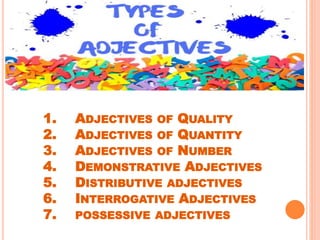
1. ADJECTIVES OF QUALITY
2. ADJECTIVES OF QUANTITY
3. ADJECTIVES OF NUMBER
4. DEMONSTRATIVE ADJECTIVES
5. DISTRIBUTIVE ADJECTIVES
6. INTERROGATIVE ADJECTIVES
7. POSSESSIVE ADJECTIVES
1. ADJECTIVES OF QUALITY
They tell us what kind of a person, place
or a thing is.
I am a I saw a beautiful The boy was happy
strong boy. girl in blue dress. because he won
the game.
2. ADJECTIVES OF QUANTITY
They tell us how much a thing is intended.
The words much, little, some, any, enough,
sufficient, whole and no are Adjectives of
Quantity.
He had
much
money.
We have
enough
bread to
make
sandwiches.
There is
little
food in
the
house.
He has no
sense and
annoys
everyone.
3. ADJECTIVES OF NUMBER
They tell us ‘how many?’ or ‘in what order?’
persons or things stand.
The words are all, many, several, five, some, f
first, twelfth, most etc.
Some children are singing.
He had ten rupee note.
She secured first position
in the race.
THERE ARE TWO TYPES OF
ADJECTIVES OF NUMBER
1.Definite Numeral Adjectives-
(i)Cardinals- one, two, three.
They show ‘how many’.
(ii) Ordinals- First, second, third.
They tell the ‘order of things’ in a
series.
2. Indefinite Numeral Adjectives-
All, some, several, no, many etc.
They do not denote exact number.
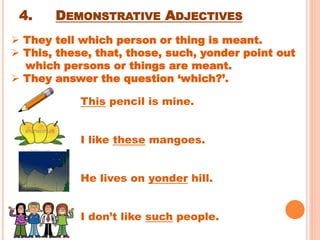
4. DEMONSTRATIVE ADJECTIVES
This pencil is mine.
I like these mangoes.
He lives on yonder hill.
I don’t like such people.
 They tell which person or thing is meant.
 This, these, that, those, such, yonder point out
which persons or things are meant.
 They answer the question ‘which?’.
5. DISTRIBUTIVE ADJECTIVES
They show that persons or things are taken
one at a time.
Each, every, either, neither etc. are examples
of Distributive Adjective.
Each women carried a basket.
Either pen will do.
Every word of this story is
true.
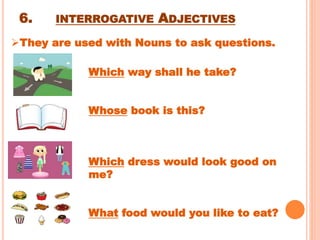
6. INTERROGATIVE ADJECTIVES
Which way shall he take?
Whose book is this?
Which dress would look good on
me?
What food would you like to eat?
They are used with Nouns to ask questions.
7. POSSESSIVE ADJECTIVES
my
your
his
her
its
our
your
their
They show possession or belonging.
They tell ‘whose’ is the thing.
Is this your
umbrella?
It is their house.
Your room is very
tidy.
ORDER TO ARRANGE ADJECTIVES
Determiners Quality Size/
Shape/ Age
Colour Material Noun
The five expensive large orange plastic boxes
A few empty triangular silver metal containers
The three naughty five year old - - boys
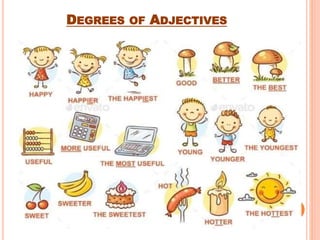
DEGREES OF ADJECTIVES
1.Positive Degree- When no comparison is made.
2.Comparison Degree- When two persons or
things are compared.
3.Superlative Degree- When more than two
persons or things are made
DEGREES OF ADJECTIVES
 There are some adjectives which are already
in highest degree.
 We cannot use comparative or superlative
degree with them.
Examples-
Unique
Perfect
Complete
Entire
Full
Chief
Some Exceptions
FORMATION OF ADJECTIVES
From Nouns-
 Fool- Foolish
 Dirt- Dirty
 Courage-
Courageous
 Glory- Glorious
 Gold- Golden
 Beauty- Beautiful
 Wood- Wooden
 Care- Careful
 Sense- Senseless
From Verbs-
•Talk- Talkative
•Move- Moveable
•Tire- Tireless
•Cease- Ceaseless
•Sick- Sickly
•Black- Blackish
•Whole- Wholesome
•Green- Greenish
•Fill- Full
•Enable- able
PRESENTED BY-
MS. SWATI HASIJA