PRONOUNS CASE
B E T W E E N Y O U A N D M E
B Y R O N A L D S P E E N E R
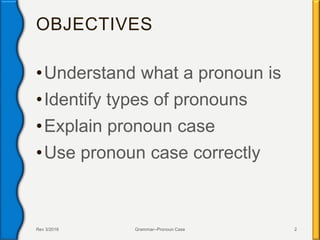
OBJECTIVES
•Understand what a pronoun is
•Identify types of pronouns
•Explain pronoun case
•Use pronoun case correctly
Rev 3/2016 Grammar--Pronoun Case 2
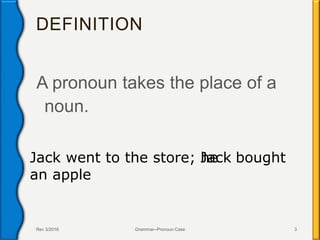
DEFINITION
A pronoun takes the place of a
noun.
Rev 3/2016 Grammar--Pronoun Case 3
Jack went to the store; bought
an apple
Jackhe
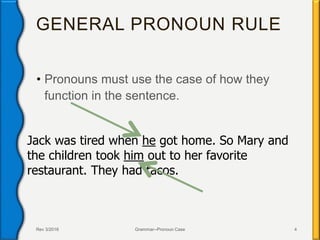
GENERAL PRONOUN RULE
• Pronouns must use the case of how they
function in the sentence.
Rev 3/2016 Grammar--Pronoun Case 4
Jack was tired when he got home. So Mary and
the children took him out to her favorite
restaurant. They had tacos.
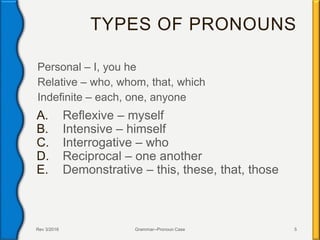
TYPES OF PRONOUNS
Personal – I, you he
Relative – who, whom, that, which
Indefinite – each, one, anyone
A. Reflexive – myself
B. Intensive – himself
C. Interrogative – who
D. Reciprocal – one another
E. Demonstrative – this, these, that, those
Rev 3/2016 Grammar--Pronoun Case 5
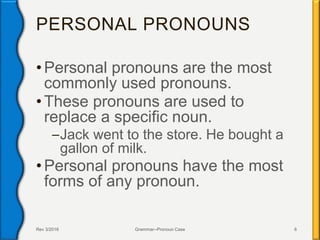
PERSONAL PRONOUNS
• Personal pronouns are the most
commonly used pronouns.
• These pronouns are used to
replace a specific noun.
–Jack went to the store. He bought a
gallon of milk.
• Personal pronouns have the most
forms of any pronoun.
Rev 3/2016 Grammar--Pronoun Case 6
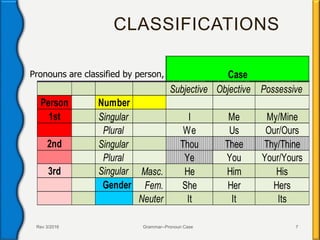
CLASSIFICATIONS
Rev 3/2016 Grammar--Pronoun Case 7
Pronouns are classified by person, number, case, and gender.Column1 Column2 Column3 Column4
Column5 Column6 Column7
Subjective Objective Possessive
Person Number
1st Singular I Me My/Mine
Plural We Us Our/Ours
2nd Singular Thou Thee Thy/Thine
Plural Ye You Your/Yours
3rd Singular Masc. He Him His
Gender Fem. She Her Hers
Neuter It It Its
Case
CASE
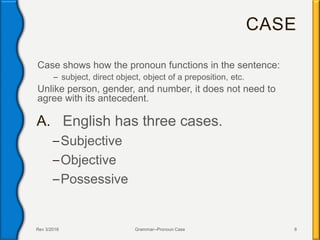
Case shows how the pronoun functions in the sentence:
– subject, direct object, object of a preposition, etc.
Unlike person, gender, and number, it does not need to
agree with its antecedent.
A. English has three cases.
–Subjective
–Objective
–Possessive
Rev 3/2016 Grammar--Pronoun Case 8
SUBJECTIVE CASE
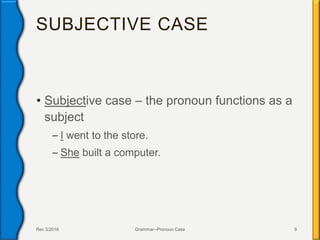
• Subjective case – the pronoun functions as a
subject
– I went to the store.
– She built a computer.
Rev 3/2016 Grammar--Pronoun Case 9
SUBJECTIVE CASE
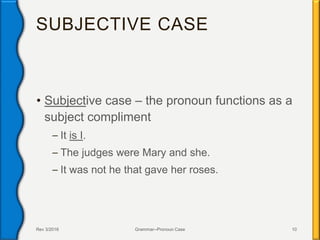
• Subjective case – the pronoun functions as a
subject compliment
– It is I.
– The judges were Mary and she.
– It was not he that gave her roses.
Rev 3/2016 Grammar--Pronoun Case 10
SUBJECTIVE CASE
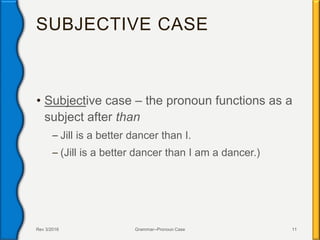
• Subjective case – the pronoun functions as a
subject after than
– Jill is a better dancer than I.
– (Jill is a better dancer than I am a dancer.)
Rev 3/2016 Grammar--Pronoun Case 11
SUBJECTIVE CASE
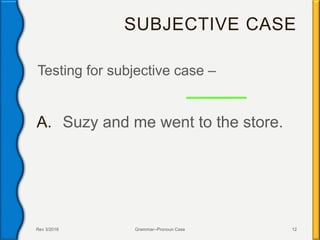
Testing for subjective case –
A. Suzy and me went to the store.
Rev 3/2016 Grammar--Pronoun Case 12
OBJECTIVE CASE
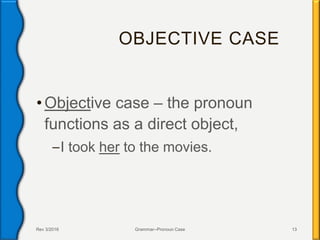
•Objective case – the pronoun
functions as a direct object,
–I took her to the movies.
Rev 3/2016 Grammar--Pronoun Case 13
OBJECTIVE CASE
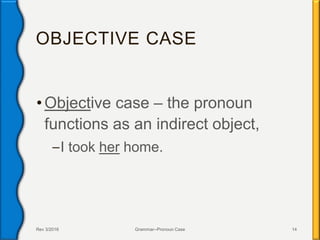
•Objective case – the pronoun
functions as an indirect object,
–I took her home.
Rev 3/2016 Grammar--Pronoun Case 14
OBJECTIVE CASE
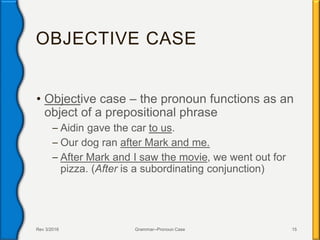
• Objective case – the pronoun functions as an
object of a prepositional phrase
– Aidin gave the car to us.
– Our dog ran after Mark and me.
– After Mark and I saw the movie, we went out for
pizza. (After is a subordinating conjunction)
Rev 3/2016 Grammar--Pronoun Case 15
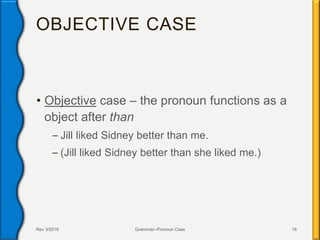
OBJECTIVE CASE
• Objective case – the pronoun functions as a
object after than
– Jill liked Sidney better than me.
– (Jill liked Sidney better than she liked me.)
Rev 3/2016 Grammar--Pronoun Case 16
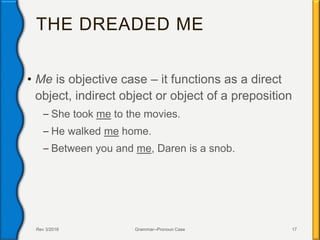
THE DREADED ME
• Me is objective case – it functions as a direct
object, indirect object or object of a preposition
– She took me to the movies.
– He walked me home.
– Between you and me, Daren is a snob.
Rev 3/2016 Grammar--Pronoun Case 17
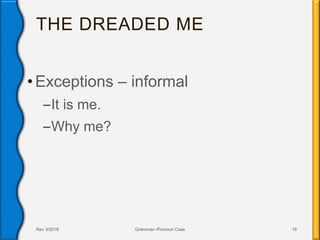
THE DREADED ME
• Exceptions – informal
–It is me.
–Why me?
Rev 3/2016 Grammar--Pronoun Case 18
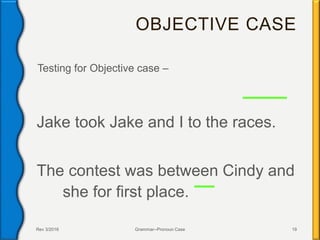
OBJECTIVE CASE
Testing for Objective case –
Jake took Jake and I to the races.
The contest was between Cindy and
she for first place.
Rev 3/2016 Grammar--Pronoun Case 19
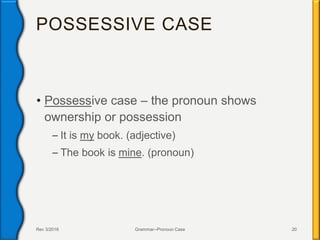
POSSESSIVE CASE
• Possessive case – the pronoun shows
ownership or possession
– It is my book. (adjective)
– The book is mine. (pronoun)
Rev 3/2016 Grammar--Pronoun Case 20
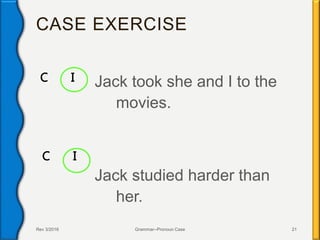
CASE EXERCISE
Jack took she and I to the
movies.
Jack studied harder than
her.
Rev 3/2016 Grammar--Pronoun Case 21
C I
C I
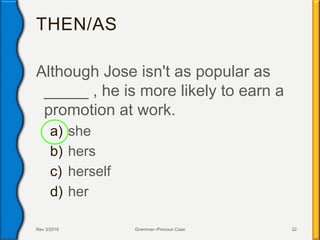
THEN/AS
Although Jose isn't as popular as
_____ , he is more likely to earn a
promotion at work.
a) she
b) hers
c) herself
d) her
Rev 3/2016 Grammar--Pronoun Case 22
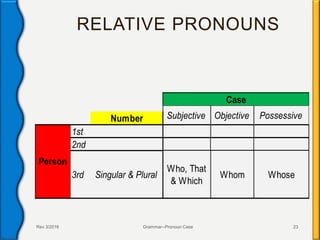
RELATIVE PRONOUNS
Rev 3/2016 Grammar--Pronoun Case 23
1st
2nd
3rd
Who, That
& Which
Whom Whose
Person
Possessive
Case
Singular & Plural
Number Subjective Objective
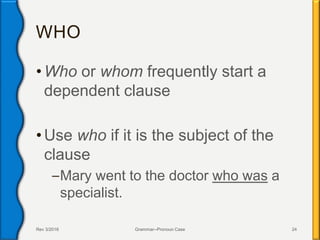
WHO
• Who or whom frequently start a
dependent clause
• Use who if it is the subject of the
clause
–Mary went to the doctor who was a
specialist.
Rev 3/2016 Grammar--Pronoun Case 24
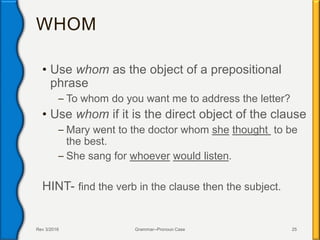
WHOM
• Use whom as the object of a prepositional
phrase
– To whom do you want me to address the letter?
• Use whom if it is the direct object of the clause
– Mary went to the doctor whom she thought to be
the best.
– She sang for whoever would listen.
HINT- find the verb in the clause then the subject.
Rev 3/2016 Grammar--Pronoun Case 25
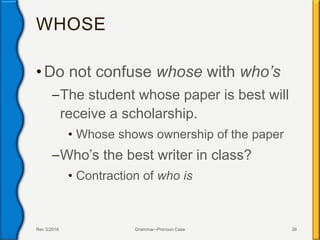
WHOSE
• Do not confuse whose with who’s
–The student whose paper is best will
receive a scholarship.
• Whose shows ownership of the paper
–Who’s the best writer in class?
• Contraction of who is
Rev 3/2016 Grammar--Pronoun Case 26
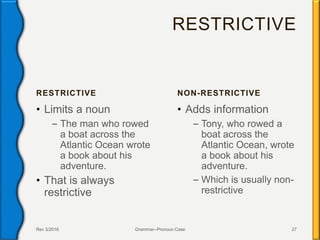
RESTRICTIVE
RESTRICTIVE
• Limits a noun
– The man who rowed
a boat across the
Atlantic Ocean wrote
a book about his
adventure.
• That is always
restrictive
NON-RESTRICTIVE
• Adds information
– Tony, who rowed a
boat across the
Atlantic Ocean, wrote
a book about his
adventure.
– Which is usually non-
restrictive
Rev 3/2016 Grammar--Pronoun Case 27
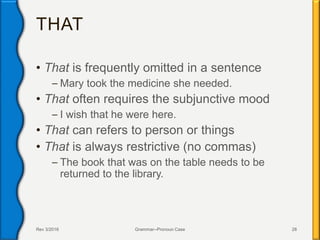
THAT
• That is frequently omitted in a sentence
– Mary took the medicine she needed.
• That often requires the subjunctive mood
– I wish that he were here.
• That can refers to person or things
• That is always restrictive (no commas)
– The book that was on the table needs to be
returned to the library.
Rev 3/2016 Grammar--Pronoun Case 28
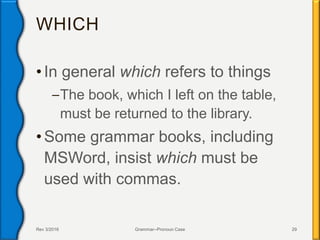
WHICH
• In general which refers to things
–The book, which I left on the table,
must be returned to the library.
• Some grammar books, including
MSWord, insist which must be
used with commas.
Rev 3/2016 Grammar--Pronoun Case 29
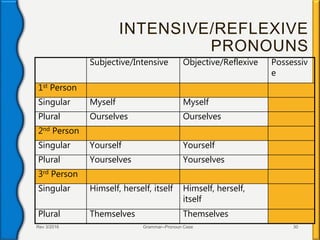
INTENSIVE/REFLEXIVE
PRONOUNS
Subjective/Intensive Objective/Reflexive Possessiv
e
1st Person
Singular Myself Myself
Plural Ourselves Ourselves
2nd Person
Singular Yourself Yourself
Plural Yourselves Yourselves
3rd Person
Singular Himself, herself, itself Himself, herself,
itself
Plural Themselves Themselves
Rev 3/2016 Grammar--Pronoun Case 30
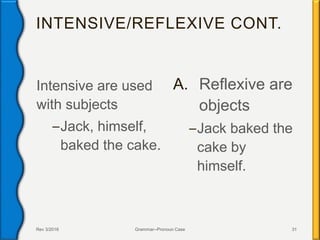
INTENSIVE/REFLEXIVE CONT.
Intensive are used
with subjects
–Jack, himself,
baked the cake.
A. Reflexive are
objects
–Jack baked the
cake by
himself.
Rev 3/2016 Grammar--Pronoun Case 31
INTENSIVE/REFLEXIVE CONT.
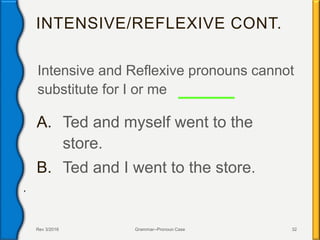
Intensive and Reflexive pronouns cannot
substitute for I or me
A. Ted and myself went to the
store.
B. Ted and I went to the store.
Rev 3/2016 Grammar--Pronoun Case 32
.
INTENSIVE/REFLEXIVE CONT.
• Hisself, Theirself and Theirselves
are not acceptable English words
Rev 3/2016 Grammar--Pronoun Case 33
.
SUMMARY
• Pronouns must match the case of
how they function in the sentence
Rev 3/2016 Grammar--Pronoun Case 34
PRONOUN EXERCISE 1
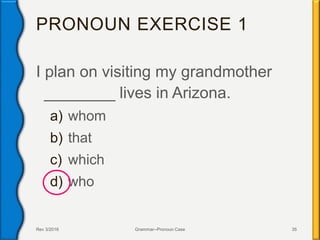
I plan on visiting my grandmother
________ lives in Arizona.
a) whom
b) that
c) which
d) who
Rev 3/2016 Grammar--Pronoun Case 35
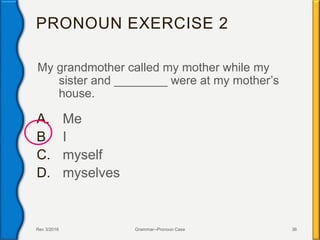
PRONOUN EXERCISE 2
My grandmother called my mother while my
sister and ________ were at my mother’s
house.
A. Me
B. I
C. myself
D. myselves
Rev 3/2016 Grammar--Pronoun Case 36
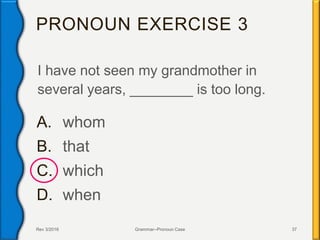
PRONOUN EXERCISE 3
I have not seen my grandmother in
several years, ________ is too long.
A. whom
B. that
C. which
D. when
Rev 3/2016 Grammar--Pronoun Case 37
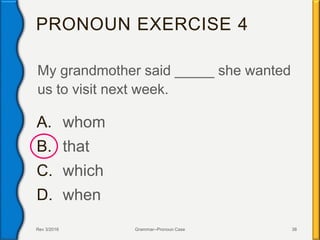
PRONOUN EXERCISE 4
My grandmother said _____ she wanted
us to visit next week.
A. whom
B. that
C. which
D. when
Rev 3/2016 Grammar--Pronoun Case 38
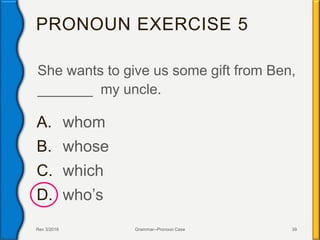
PRONOUN EXERCISE 5
She wants to give us some gift from Ben,
_______ my uncle.
A. whom
B. whose
C. which
D. who’s
Rev 3/2016 Grammar--Pronoun Case 39
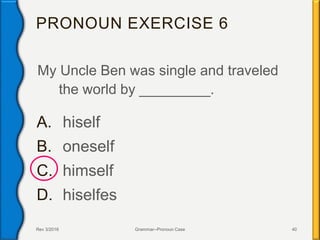
PRONOUN EXERCISE 6
My Uncle Ben was single and traveled
the world by _________.
A. hiself
B. oneself
C. himself
D. hiselfes
Rev 3/2016 Grammar--Pronoun Case 40
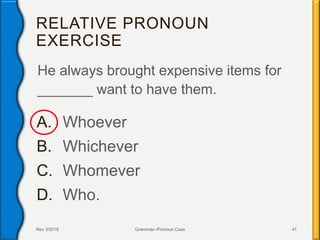
RELATIVE PRONOUN
EXERCISE
He always brought expensive items for
_______ want to have them.
A. Whoever
B. Whichever
C. Whomever
D. Who.
Rev 3/2016 Grammar--Pronoun Case 41
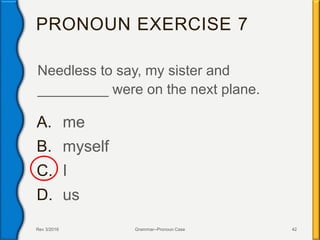
PRONOUN EXERCISE 7
Needless to say, my sister and
_________ were on the next plane.
A. me
B. myself
C. I
D. us
Rev 3/2016 Grammar--Pronoun Case 42
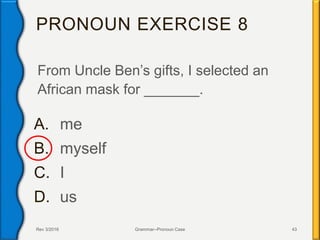
PRONOUN EXERCISE 8
From Uncle Ben’s gifts, I selected an
African mask for _______.
A. me
B. myself
C. I
D. us
Rev 3/2016 Grammar--Pronoun Case 43
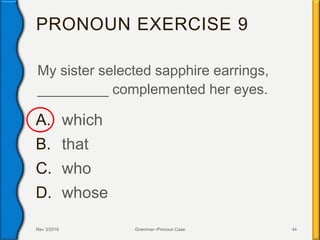
PRONOUN EXERCISE 9
My sister selected sapphire earrings,
_________ complemented her eyes.
A. which
B. that
C. who
D. whose
Rev 3/2016 Grammar--Pronoun Case 44
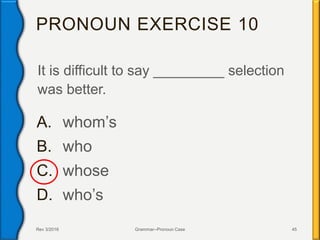
PRONOUN EXERCISE 10
It is difficult to say _________ selection
was better.
A. whom’s
B. who
C. whose
D. who’s
Rev 3/2016 Grammar--Pronoun Case 45

Pronouns case

  • 1.
    PRONOUNS CASE B ET W E E N Y O U A N D M E B Y R O N A L D S P E E N E R
  • 2.
    OBJECTIVES •Understand what apronoun is •Identify types of pronouns •Explain pronoun case •Use pronoun case correctly Rev 3/2016 Grammar--Pronoun Case 2
  • 3.
    DEFINITION A pronoun takesthe place of a noun. Rev 3/2016 Grammar--Pronoun Case 3 Jack went to the store; bought an apple Jackhe
  • 4.
    GENERAL PRONOUN RULE •Pronouns must use the case of how they function in the sentence. Rev 3/2016 Grammar--Pronoun Case 4 Jack was tired when he got home. So Mary and the children took him out to her favorite restaurant. They had tacos.
  • 5.
    TYPES OF PRONOUNS Personal– I, you he Relative – who, whom, that, which Indefinite – each, one, anyone A. Reflexive – myself B. Intensive – himself C. Interrogative – who D. Reciprocal – one another E. Demonstrative – this, these, that, those Rev 3/2016 Grammar--Pronoun Case 5
  • 6.
    PERSONAL PRONOUNS • Personalpronouns are the most commonly used pronouns. • These pronouns are used to replace a specific noun. –Jack went to the store. He bought a gallon of milk. • Personal pronouns have the most forms of any pronoun. Rev 3/2016 Grammar--Pronoun Case 6
  • 7.
    CLASSIFICATIONS Rev 3/2016 Grammar--PronounCase 7 Pronouns are classified by person, number, case, and gender.Column1 Column2 Column3 Column4 Column5 Column6 Column7 Subjective Objective Possessive Person Number 1st Singular I Me My/Mine Plural We Us Our/Ours 2nd Singular Thou Thee Thy/Thine Plural Ye You Your/Yours 3rd Singular Masc. He Him His Gender Fem. She Her Hers Neuter It It Its Case
  • 8.
    CASE Case shows howthe pronoun functions in the sentence: – subject, direct object, object of a preposition, etc. Unlike person, gender, and number, it does not need to agree with its antecedent. A. English has three cases. –Subjective –Objective –Possessive Rev 3/2016 Grammar--Pronoun Case 8
  • 9.
    SUBJECTIVE CASE • Subjectivecase – the pronoun functions as a subject – I went to the store. – She built a computer. Rev 3/2016 Grammar--Pronoun Case 9
  • 10.
    SUBJECTIVE CASE • Subjectivecase – the pronoun functions as a subject compliment – It is I. – The judges were Mary and she. – It was not he that gave her roses. Rev 3/2016 Grammar--Pronoun Case 10
  • 11.
    SUBJECTIVE CASE • Subjectivecase – the pronoun functions as a subject after than – Jill is a better dancer than I. – (Jill is a better dancer than I am a dancer.) Rev 3/2016 Grammar--Pronoun Case 11
  • 12.
    SUBJECTIVE CASE Testing forsubjective case – A. Suzy and me went to the store. Rev 3/2016 Grammar--Pronoun Case 12
  • 13.
    OBJECTIVE CASE •Objective case– the pronoun functions as a direct object, –I took her to the movies. Rev 3/2016 Grammar--Pronoun Case 13
  • 14.
    OBJECTIVE CASE •Objective case– the pronoun functions as an indirect object, –I took her home. Rev 3/2016 Grammar--Pronoun Case 14
  • 15.
    OBJECTIVE CASE • Objectivecase – the pronoun functions as an object of a prepositional phrase – Aidin gave the car to us. – Our dog ran after Mark and me. – After Mark and I saw the movie, we went out for pizza. (After is a subordinating conjunction) Rev 3/2016 Grammar--Pronoun Case 15
  • 16.
    OBJECTIVE CASE • Objectivecase – the pronoun functions as a object after than – Jill liked Sidney better than me. – (Jill liked Sidney better than she liked me.) Rev 3/2016 Grammar--Pronoun Case 16
  • 17.
    THE DREADED ME •Me is objective case – it functions as a direct object, indirect object or object of a preposition – She took me to the movies. – He walked me home. – Between you and me, Daren is a snob. Rev 3/2016 Grammar--Pronoun Case 17
  • 18.
    THE DREADED ME •Exceptions – informal –It is me. –Why me? Rev 3/2016 Grammar--Pronoun Case 18
  • 19.
    OBJECTIVE CASE Testing forObjective case – Jake took Jake and I to the races. The contest was between Cindy and she for first place. Rev 3/2016 Grammar--Pronoun Case 19
  • 20.
    POSSESSIVE CASE • Possessivecase – the pronoun shows ownership or possession – It is my book. (adjective) – The book is mine. (pronoun) Rev 3/2016 Grammar--Pronoun Case 20
  • 21.
    CASE EXERCISE Jack tookshe and I to the movies. Jack studied harder than her. Rev 3/2016 Grammar--Pronoun Case 21 C I C I
  • 22.
    THEN/AS Although Jose isn'tas popular as _____ , he is more likely to earn a promotion at work. a) she b) hers c) herself d) her Rev 3/2016 Grammar--Pronoun Case 22
  • 23.
    RELATIVE PRONOUNS Rev 3/2016Grammar--Pronoun Case 23 1st 2nd 3rd Who, That & Which Whom Whose Person Possessive Case Singular & Plural Number Subjective Objective
  • 24.
    WHO • Who orwhom frequently start a dependent clause • Use who if it is the subject of the clause –Mary went to the doctor who was a specialist. Rev 3/2016 Grammar--Pronoun Case 24
  • 25.
    WHOM • Use whomas the object of a prepositional phrase – To whom do you want me to address the letter? • Use whom if it is the direct object of the clause – Mary went to the doctor whom she thought to be the best. – She sang for whoever would listen. HINT- find the verb in the clause then the subject. Rev 3/2016 Grammar--Pronoun Case 25
  • 26.
    WHOSE • Do notconfuse whose with who’s –The student whose paper is best will receive a scholarship. • Whose shows ownership of the paper –Who’s the best writer in class? • Contraction of who is Rev 3/2016 Grammar--Pronoun Case 26
  • 27.
    RESTRICTIVE RESTRICTIVE • Limits anoun – The man who rowed a boat across the Atlantic Ocean wrote a book about his adventure. • That is always restrictive NON-RESTRICTIVE • Adds information – Tony, who rowed a boat across the Atlantic Ocean, wrote a book about his adventure. – Which is usually non- restrictive Rev 3/2016 Grammar--Pronoun Case 27
  • 28.
    THAT • That isfrequently omitted in a sentence – Mary took the medicine she needed. • That often requires the subjunctive mood – I wish that he were here. • That can refers to person or things • That is always restrictive (no commas) – The book that was on the table needs to be returned to the library. Rev 3/2016 Grammar--Pronoun Case 28
  • 29.
    WHICH • In generalwhich refers to things –The book, which I left on the table, must be returned to the library. • Some grammar books, including MSWord, insist which must be used with commas. Rev 3/2016 Grammar--Pronoun Case 29
  • 30.
    INTENSIVE/REFLEXIVE PRONOUNS Subjective/Intensive Objective/Reflexive Possessiv e 1stPerson Singular Myself Myself Plural Ourselves Ourselves 2nd Person Singular Yourself Yourself Plural Yourselves Yourselves 3rd Person Singular Himself, herself, itself Himself, herself, itself Plural Themselves Themselves Rev 3/2016 Grammar--Pronoun Case 30
  • 31.
    INTENSIVE/REFLEXIVE CONT. Intensive areused with subjects –Jack, himself, baked the cake. A. Reflexive are objects –Jack baked the cake by himself. Rev 3/2016 Grammar--Pronoun Case 31
  • 32.
    INTENSIVE/REFLEXIVE CONT. Intensive andReflexive pronouns cannot substitute for I or me A. Ted and myself went to the store. B. Ted and I went to the store. Rev 3/2016 Grammar--Pronoun Case 32 .
  • 33.
    INTENSIVE/REFLEXIVE CONT. • Hisself,Theirself and Theirselves are not acceptable English words Rev 3/2016 Grammar--Pronoun Case 33 .
  • 34.
    SUMMARY • Pronouns mustmatch the case of how they function in the sentence Rev 3/2016 Grammar--Pronoun Case 34
  • 35.
    PRONOUN EXERCISE 1 Iplan on visiting my grandmother ________ lives in Arizona. a) whom b) that c) which d) who Rev 3/2016 Grammar--Pronoun Case 35
  • 36.
    PRONOUN EXERCISE 2 Mygrandmother called my mother while my sister and ________ were at my mother’s house. A. Me B. I C. myself D. myselves Rev 3/2016 Grammar--Pronoun Case 36
  • 37.
    PRONOUN EXERCISE 3 Ihave not seen my grandmother in several years, ________ is too long. A. whom B. that C. which D. when Rev 3/2016 Grammar--Pronoun Case 37
  • 38.
    PRONOUN EXERCISE 4 Mygrandmother said _____ she wanted us to visit next week. A. whom B. that C. which D. when Rev 3/2016 Grammar--Pronoun Case 38
  • 39.
    PRONOUN EXERCISE 5 Shewants to give us some gift from Ben, _______ my uncle. A. whom B. whose C. which D. who’s Rev 3/2016 Grammar--Pronoun Case 39
  • 40.
    PRONOUN EXERCISE 6 MyUncle Ben was single and traveled the world by _________. A. hiself B. oneself C. himself D. hiselfes Rev 3/2016 Grammar--Pronoun Case 40
  • 41.
    RELATIVE PRONOUN EXERCISE He alwaysbrought expensive items for _______ want to have them. A. Whoever B. Whichever C. Whomever D. Who. Rev 3/2016 Grammar--Pronoun Case 41
  • 42.
    PRONOUN EXERCISE 7 Needlessto say, my sister and _________ were on the next plane. A. me B. myself C. I D. us Rev 3/2016 Grammar--Pronoun Case 42
  • 43.
    PRONOUN EXERCISE 8 FromUncle Ben’s gifts, I selected an African mask for _______. A. me B. myself C. I D. us Rev 3/2016 Grammar--Pronoun Case 43
  • 44.
    PRONOUN EXERCISE 9 Mysister selected sapphire earrings, _________ complemented her eyes. A. which B. that C. who D. whose Rev 3/2016 Grammar--Pronoun Case 44
  • 45.
    PRONOUN EXERCISE 10 Itis difficult to say _________ selection was better. A. whom’s B. who C. whose D. who’s Rev 3/2016 Grammar--Pronoun Case 45

Editor's Notes