When you come in…
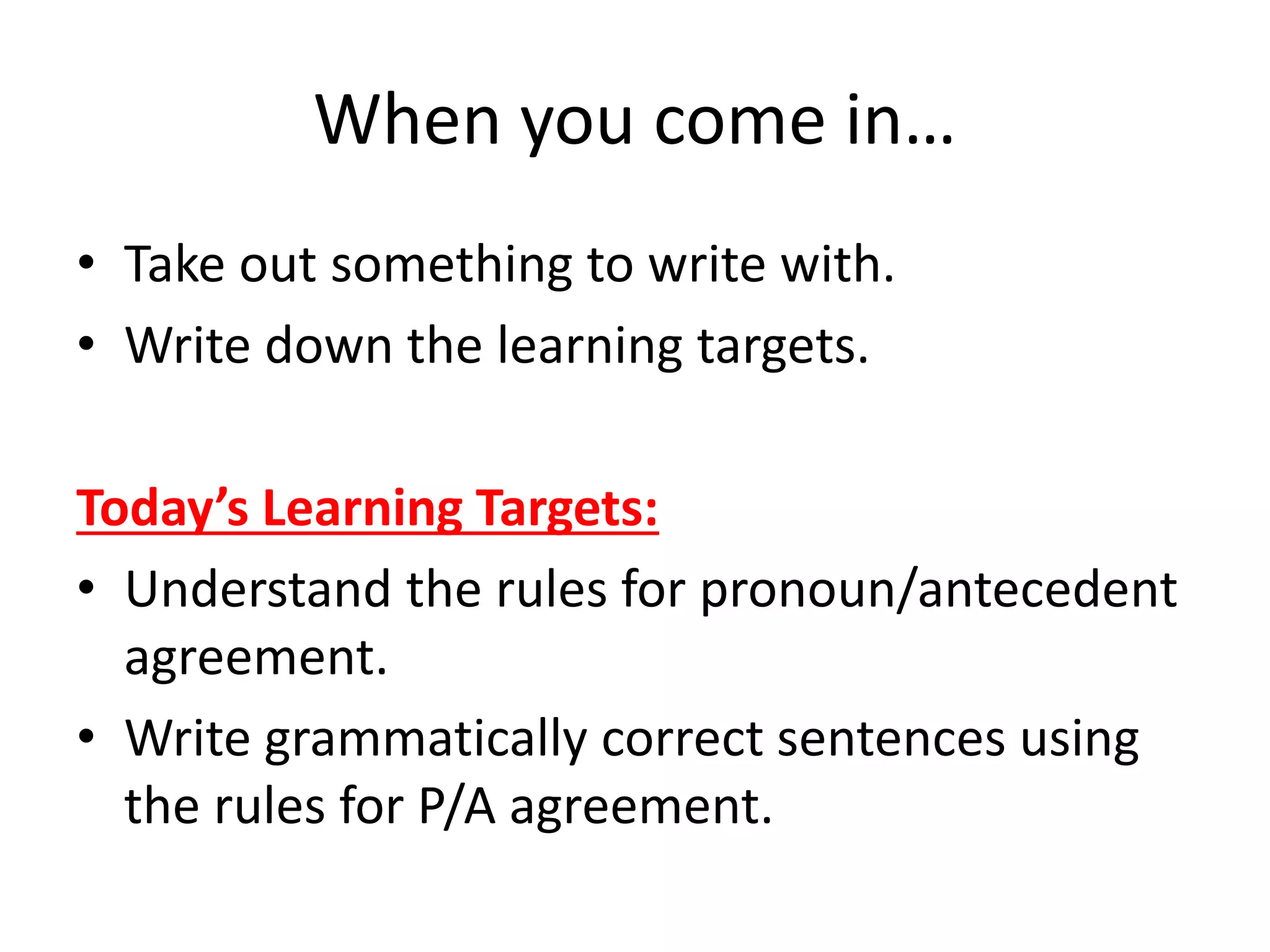
• Take out something to write with.
• Write down the learning targets.
Today’s Learning Targets:
• Understand the rules for pronoun/antecedent
agreement.
• Write grammatically correct sentences using
the rules for P/A agreement.
PART I: Learning the Rules
As we move through the slides, take notes on
your guided note sheet.
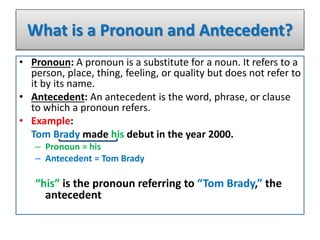
What is a Pronoun and Antecedent?
• Pronoun: A pronoun is a substitute for a noun. It refers to a
person, place, thing, feeling, or quality but does not refer to
it by its name.
• Antecedent: An antecedent is the word, phrase, or clause
to which a pronoun refers.
• Example:
Tom Brady made his debut in the year 2000.
– Pronoun = his
– Antecedent = Tom Brady
“his” is the pronoun referring to “Tom Brady,” the
antecedent
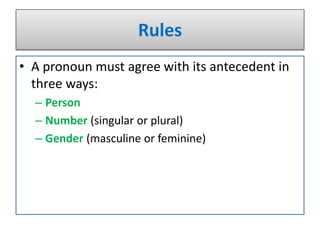
Rules
• A pronoun must agree with its antecedent in
three ways:
– Person
– Number (singular or plural)
– Gender (masculine or feminine)
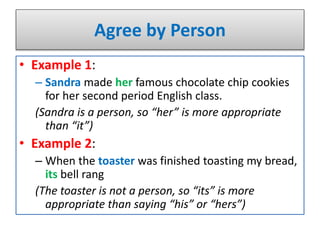
Agree by Person
• Example 1:
– Sandra made her famous chocolate chip cookies
for her second period English class.
(Sandra is a person, so “her” is more appropriate
than “it”)
• Example 2:
– When the toaster was finished toasting my bread,
its bell rang
(The toaster is not a person, so “its” is more
appropriate than saying “his” or “hers”)
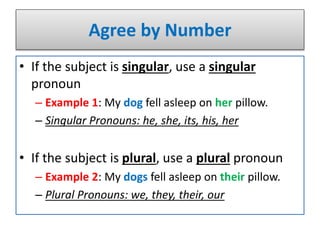
Agree by Number
• If the subject is singular, use a singular
pronoun
– Example 1: My dog fell asleep on her pillow.
– Singular Pronouns: he, she, its, his, her
• If the subject is plural, use a plural pronoun
– Example 2: My dogs fell asleep on their pillow.
– Plural Pronouns: we, they, their, our
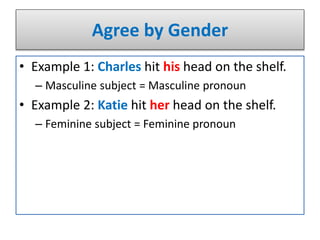
Agree by Gender
• Example 1: Charles hit his head on the shelf.
– Masculine subject = Masculine pronoun
• Example 2: Katie hit her head on the shelf.
– Feminine subject = Feminine pronoun
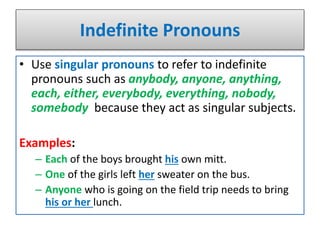
Indefinite Pronouns
• Use singular pronouns to refer to indefinite
pronouns such as anybody, anyone, anything,
each, either, everybody, everything, nobody,
somebody because they act as singular subjects.
Examples:
– Each of the boys brought his own mitt.
– One of the girls left her sweater on the bus.
– Anyone who is going on the field trip needs to bring
his or her lunch.
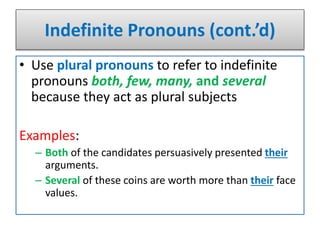
Indefinite Pronouns (cont.’d)
• Use plural pronouns to refer to indefinite
pronouns both, few, many, and several
because they act as plural subjects
Examples:
– Both of the candidates persuasively presented their
arguments.
– Several of these coins are worth more than their face
values.
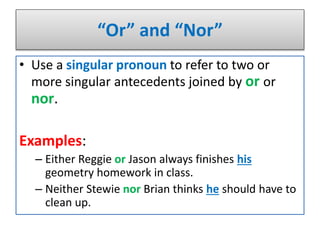
“Or” and “Nor”
• Use a singular pronoun to refer to two or
more singular antecedents joined by or or
nor.
Examples:
– Either Reggie or Jason always finishes his
geometry homework in class.
– Neither Stewie nor Brian thinks he should have to
clean up.
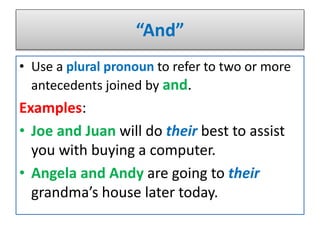
“And”
• Use a plural pronoun to refer to two or more
antecedents joined by and.
Examples:
• Joe and Juan will do their best to assist
you with buying a computer.
• Angela and Andy are going to their
grandma’s house later today.
Part II: Pronoun Antecedent
Agreement Game
• You are going to work in your groups
• You will see a sentence pop up on the screen
• You will decide, as a group, what word best
completes the sentence
• Write the word on your whiteboard
• Get a point for your team if you are correct!!!
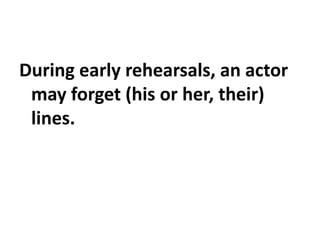
During early rehearsals, an actor
may forget (his or her, their)
lines.
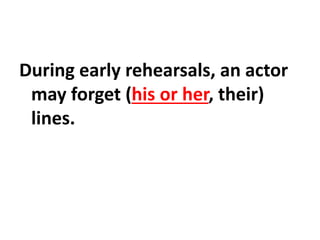
During early rehearsals, an actor
may forget (his or her, their)
lines.
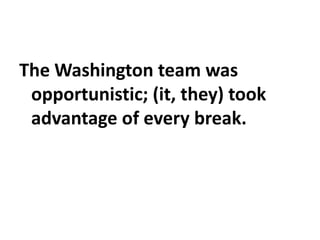
The Washington team was
opportunistic; (it, they) took
advantage of every break.
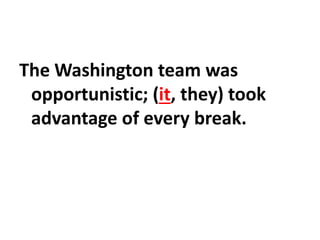
The Washington team was
opportunistic; (it, they) took
advantage of every break.
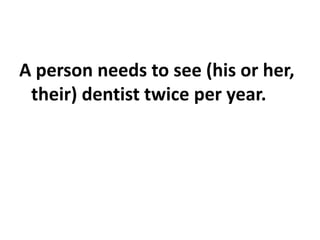
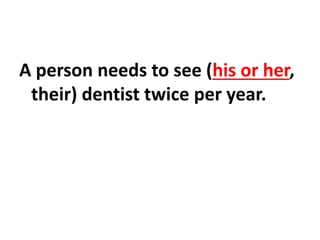
A person needs to see (his or her,
their) dentist twice per year.
A person needs to see (his or her,
their) dentist twice per year.
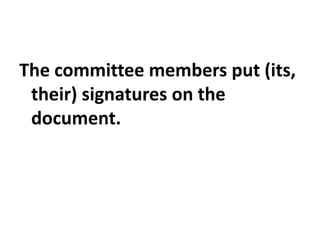
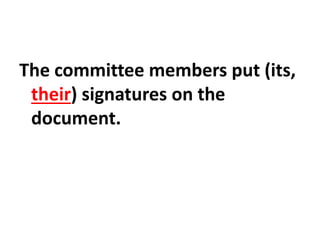
The committee members put (its,
their) signatures on the
document.
The committee members put (its,
their) signatures on the
document.
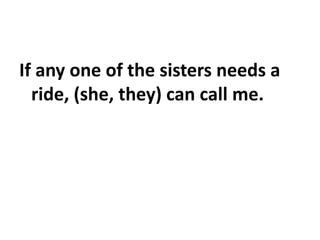
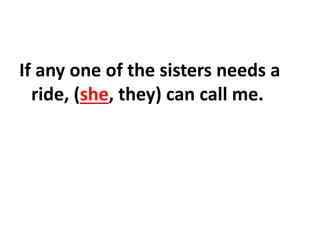
If any one of the sisters needs a
ride, (she, they) can call me.
If any one of the sisters needs a
ride, (she, they) can call me.
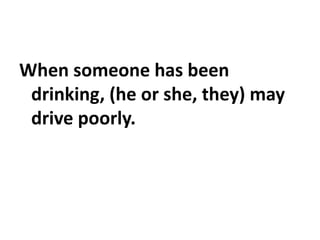
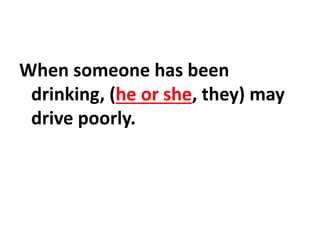
When someone has been
drinking, (he or she, they) may
drive poorly.
When someone has been
drinking, (he or she, they) may
drive poorly.
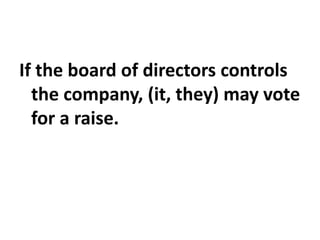
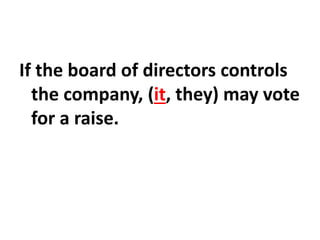
If the board of directors controls
the company, (it, they) may vote
for a raise.
If the board of directors controls
the company, (it, they) may vote
for a raise.
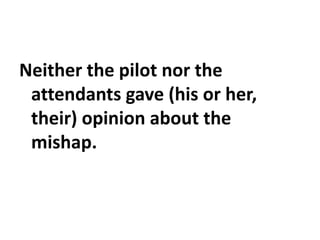
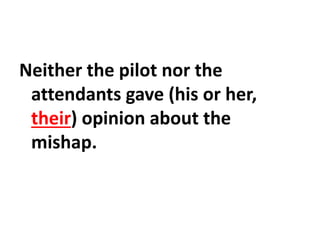
Neither the pilot nor the
attendants gave (his or her,
their) opinion about the
mishap.
Neither the pilot nor the
attendants gave (his or her,
their) opinion about the
mishap.
Each of these companies had (its,
their) books audited.
Each of these companies had (its,
their) books audited.
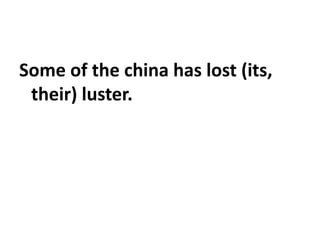
Some of the china has lost (its,
their) luster.
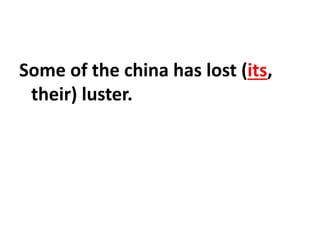
Some of the china has lost (its,
their) luster.
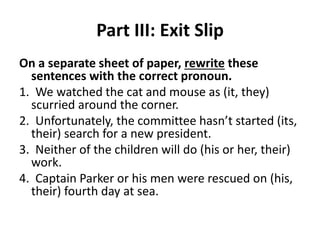
Part III: Exit Slip
On a separate sheet of paper, rewrite these
sentences with the correct pronoun.
1. We watched the cat and mouse as (it, they)
scurried around the corner.
2. Unfortunately, the committee hasn’t started (its,
their) search for a new president.
3. Neither of the children will do (his or her, their)
work.
4. Captain Parker or his men were rescued on (his,
their) fourth day at sea.

Proantpres

  • 1.
    When you comein… • Take out something to write with. • Write down the learning targets. Today’s Learning Targets: • Understand the rules for pronoun/antecedent agreement. • Write grammatically correct sentences using the rules for P/A agreement.
  • 2.
    PART I: Learningthe Rules As we move through the slides, take notes on your guided note sheet.
  • 3.
    What is aPronoun and Antecedent? • Pronoun: A pronoun is a substitute for a noun. It refers to a person, place, thing, feeling, or quality but does not refer to it by its name. • Antecedent: An antecedent is the word, phrase, or clause to which a pronoun refers. • Example: Tom Brady made his debut in the year 2000. – Pronoun = his – Antecedent = Tom Brady “his” is the pronoun referring to “Tom Brady,” the antecedent
  • 4.
    Rules • A pronounmust agree with its antecedent in three ways: – Person – Number (singular or plural) – Gender (masculine or feminine)
  • 5.
    Agree by Person •Example 1: – Sandra made her famous chocolate chip cookies for her second period English class. (Sandra is a person, so “her” is more appropriate than “it”) • Example 2: – When the toaster was finished toasting my bread, its bell rang (The toaster is not a person, so “its” is more appropriate than saying “his” or “hers”)
  • 6.
    Agree by Number •If the subject is singular, use a singular pronoun – Example 1: My dog fell asleep on her pillow. – Singular Pronouns: he, she, its, his, her • If the subject is plural, use a plural pronoun – Example 2: My dogs fell asleep on their pillow. – Plural Pronouns: we, they, their, our
  • 7.
    Agree by Gender •Example 1: Charles hit his head on the shelf. – Masculine subject = Masculine pronoun • Example 2: Katie hit her head on the shelf. – Feminine subject = Feminine pronoun
  • 8.
    Indefinite Pronouns • Usesingular pronouns to refer to indefinite pronouns such as anybody, anyone, anything, each, either, everybody, everything, nobody, somebody because they act as singular subjects. Examples: – Each of the boys brought his own mitt. – One of the girls left her sweater on the bus. – Anyone who is going on the field trip needs to bring his or her lunch.
  • 9.
    Indefinite Pronouns (cont.’d) •Use plural pronouns to refer to indefinite pronouns both, few, many, and several because they act as plural subjects Examples: – Both of the candidates persuasively presented their arguments. – Several of these coins are worth more than their face values.
  • 10.
    “Or” and “Nor” •Use a singular pronoun to refer to two or more singular antecedents joined by or or nor. Examples: – Either Reggie or Jason always finishes his geometry homework in class. – Neither Stewie nor Brian thinks he should have to clean up.
  • 11.
    “And” • Use aplural pronoun to refer to two or more antecedents joined by and. Examples: • Joe and Juan will do their best to assist you with buying a computer. • Angela and Andy are going to their grandma’s house later today.
  • 12.
    Part II: PronounAntecedent Agreement Game • You are going to work in your groups • You will see a sentence pop up on the screen • You will decide, as a group, what word best completes the sentence • Write the word on your whiteboard • Get a point for your team if you are correct!!!
  • 13.
    During early rehearsals,an actor may forget (his or her, their) lines.
  • 14.
    During early rehearsals,an actor may forget (his or her, their) lines.
  • 15.
    The Washington teamwas opportunistic; (it, they) took advantage of every break.
  • 16.
    The Washington teamwas opportunistic; (it, they) took advantage of every break.
  • 17.
    A person needsto see (his or her, their) dentist twice per year.
  • 18.
    A person needsto see (his or her, their) dentist twice per year.
  • 19.
    The committee membersput (its, their) signatures on the document.
  • 20.
    The committee membersput (its, their) signatures on the document.
  • 21.
    If any oneof the sisters needs a ride, (she, they) can call me.
  • 22.
    If any oneof the sisters needs a ride, (she, they) can call me.
  • 23.
    When someone hasbeen drinking, (he or she, they) may drive poorly.
  • 24.
    When someone hasbeen drinking, (he or she, they) may drive poorly.
  • 25.
    If the boardof directors controls the company, (it, they) may vote for a raise.
  • 26.
    If the boardof directors controls the company, (it, they) may vote for a raise.
  • 27.
    Neither the pilotnor the attendants gave (his or her, their) opinion about the mishap.
  • 28.
    Neither the pilotnor the attendants gave (his or her, their) opinion about the mishap.
  • 29.
    Each of thesecompanies had (its, their) books audited.
  • 30.
    Each of thesecompanies had (its, their) books audited.
  • 31.
    Some of thechina has lost (its, their) luster.
  • 32.
    Some of thechina has lost (its, their) luster.
  • 33.
    Part III: ExitSlip On a separate sheet of paper, rewrite these sentences with the correct pronoun. 1. We watched the cat and mouse as (it, they) scurried around the corner. 2. Unfortunately, the committee hasn’t started (its, their) search for a new president. 3. Neither of the children will do (his or her, their) work. 4. Captain Parker or his men were rescued on (his, their) fourth day at sea.