PROJECTIVE
TECHNIQUES
Projective Techniques :Objectives
1. Identify major characteristics of projective techniques
2. Describe the projective hypothesis
3. Identify major uses of projective techniques and most
frequently used projective.
4. Outline major features of the Rorschach, including Exner's
Comprehensive System
5. Outline major features of the Thematic Apperception Test
6. Outline major features of sentence completion and human
figure drawing techniques
7. Discuss factors affecting future use of projective techniques
General Characteristics of
Projective Techniques
 Major characteristics:
 ambiguous stimulus
 constructed-response format (free-response format)
 The Projective Hypothesis
 If the stimulus for a response is ambiguous, then the
response itself will be determined by the examinee’s
personality dynamics.
 In an ambiguous situation, response will be determined by
personality dynamics
 The response will be formulated in terms of the person’s
desires, fantasies, inclinations, fears, motives and so on.
 The projective test is an ideal way of uncovering deep-seated,
perhaps unconscious, personality characteristics.
 The projective test may probe deeply,
 The objective personality test only touches
surface features of the personality.
 NB: Historical (but not necessary) connection
with psychoanalytic approach.
Uses of Projective Techniques
 There are two principal uses for projective
techniques:
1. Assessment of individual cases in clinical,
counseling and school psychology.
 All surveys show projectives widely used
 Some possible artifacts in the surveys
 use as an ice-breaker, use in informal way, no formal
scoring, use only part of the stimulus materials, almost
part of a conversation in clinical interview.
1. Research
 The research falls into two major categories:
 Research on the psychometric characteristics of the
projective measures.
 Projective techniques are often used as a criterion
variable.
The Eight Widely used Projective
Techniques
 Rorschach Inkblot Test
 Thematic Apperception Test (TAT)
 Children's Apperception Test (CAT)
 Bender Visual-Motor Gestalt Test
 Sentence Completion Tests
 Human Figure Drawings
 House-Tree-Person Test (HTP)
 Kinetic Family Drawing Test (KFD)
Indicators for the Use of Projective
Techniques
 There are circumstances that may lead a
psychologist to prefer use of a projective test
to an objective personality test.
 Most projectives do not require reading.
 Projective tests are susceptible to faking (good or
bad).
 Projective techniques allow for development of an
exceptionally broad range of hypotheses about
personality dynamics.
More Introduction
 “Indicators” for use
 reading problem
 faking issue
 hypothesis generation
 Forewarning on Administration and Scoring
 informal
 holistic
 formal
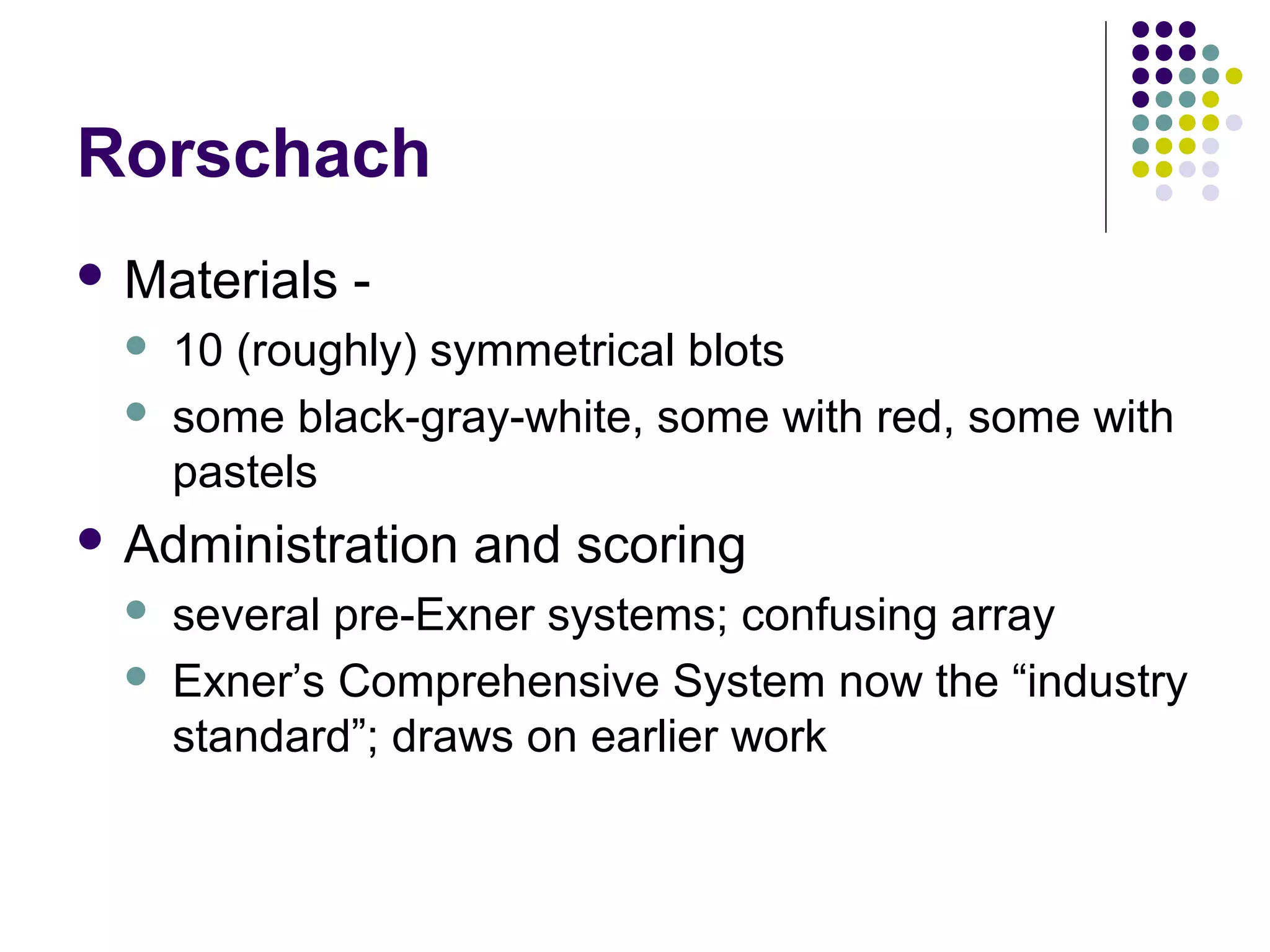
Rorschach
 Materials -
 10 (roughly) symmetrical blots
 some black-gray-white, some with red, some with
pastels
 Administration and scoring
 several pre-Exner systems; confusing array
 Exner’s Comprehensive System now the “industry
standard”; draws on earlier work
Sample Inkblot
(Fig 14-2) Not an original Rorschach
Key Concepts, Procedures in
Exner’s Comprehensive System
 Administration
 response phase
 verbatim recording
 inquiry phase
 The protocol and coding
Some of the Major Coding Categories
(see Table 14.2)
 Location
 Developmental Quality
 Determinants
 Form Quality
 Content
 Populars
Examples of Codes
 Location (see Table 14.3)
 W - whole
 D - common detail
 Dd - unusual detail
 S - Space
 Determinants (see Table 14.4)
 movement (e.g., M, FM)
 color
 etc.
A Few More Codes
 Populars
 norm referenced: one-third
 Special Scores (18)
 Mor(bid), Ag(gressive), etc.
 Ratios & percents: lots of them
Rorschach:
Reports & Evaluation
 Report
 Sequence of Scores and Structural Summary
 See examples at RIAP website
 Evaluation of the Rorschach
 extraordinary differences of opinion
TAT
TAT: Thematic Apperception Test
See Figure 14.3 for sample card
 Notes on use
 very widespread, generally 2nd to Rorschach
 some decline in recent years
 Roots in Murray’s theory of needs, presses
TAT: Structure &
Administration
 30 cards with ambiguous pictures
(one blank)
 Cards for subgroups by gender, age
 Tell a story: what happened, will happen,
thoughts and feelings
TAT: Variations
 Murray’s original system
 Bellak’s “manual”
 Oral (usual), written response
 CAT, SAT
TAT: Evaluation
 Some positive results with well-defined
constructs, e.g., affiliation, aggression
 Most reviews unfavorable
 Big Problem: Lack of agreement on system
for administration and scoring
 Some decline in usage
RISB:
Rotter Incomplete Sentences Blank
 NB:Many incomplete sentence tests
 RISB:
 3 forms
 40 incomplete sentences (most 2 words; Table 14.5)
 Simple directions:
 Complete the sentence, express your feelings
 Note comparison with other projectives
 fairly constricted response
 aims for one construct: adjustment/maladjustment
RISB
 Scoring
 Each response on 7-point scale
(0 = very well adjusted, 6 = very maladjusted)
 Add item scores = Overall Adjustment Score
 Good scoring guidelines in manual
 Evaluation
 Reliability: internal consistency and short-term good;
longer-term drops
 Validity: for “adjustment” respectable; other variables?
 Basis for cut-off score?
Human Figure Drawings
 The confusing plethora of initials:
 HFD, DAP, HTP, KFD
 Frequency of Use
 Very widely used
 Often uncertain exactly what was used
 Scoring: from very informal to very formal
Draw-a-Man Test
 Variations in administrative procedures
 Goodenough’s test for intelligence
 Machover’s claims (see Table 14.7)
 DAP: SPED
 Offshoots of the technique
 House-Tree-Person (HTP)
 Kinetic Family Drawing (KFD)
HFDs: Evaluation
 Problem of administration and scoring
variations (again)
 For very well-defined constructs and scoring
(as in DAP: SPED) some respectable results
 For less defined situations: generally poor
Future of Projectives
 Place in training
 Influence of managed care
 Move to objective administration, scoring

Projective techniques

  • 1.
  • 2.
    Projective Techniques :Objectives 1.Identify major characteristics of projective techniques 2. Describe the projective hypothesis 3. Identify major uses of projective techniques and most frequently used projective. 4. Outline major features of the Rorschach, including Exner's Comprehensive System 5. Outline major features of the Thematic Apperception Test 6. Outline major features of sentence completion and human figure drawing techniques 7. Discuss factors affecting future use of projective techniques
  • 3.
    General Characteristics of ProjectiveTechniques  Major characteristics:  ambiguous stimulus  constructed-response format (free-response format)  The Projective Hypothesis  If the stimulus for a response is ambiguous, then the response itself will be determined by the examinee’s personality dynamics.  In an ambiguous situation, response will be determined by personality dynamics  The response will be formulated in terms of the person’s desires, fantasies, inclinations, fears, motives and so on.  The projective test is an ideal way of uncovering deep-seated, perhaps unconscious, personality characteristics.
  • 4.
     The projectivetest may probe deeply,  The objective personality test only touches surface features of the personality.  NB: Historical (but not necessary) connection with psychoanalytic approach.
  • 5.
    Uses of ProjectiveTechniques  There are two principal uses for projective techniques: 1. Assessment of individual cases in clinical, counseling and school psychology.  All surveys show projectives widely used  Some possible artifacts in the surveys  use as an ice-breaker, use in informal way, no formal scoring, use only part of the stimulus materials, almost part of a conversation in clinical interview. 1. Research  The research falls into two major categories:  Research on the psychometric characteristics of the projective measures.  Projective techniques are often used as a criterion variable.
  • 6.
    The Eight Widelyused Projective Techniques  Rorschach Inkblot Test  Thematic Apperception Test (TAT)  Children's Apperception Test (CAT)  Bender Visual-Motor Gestalt Test  Sentence Completion Tests  Human Figure Drawings  House-Tree-Person Test (HTP)  Kinetic Family Drawing Test (KFD)
  • 7.
    Indicators for theUse of Projective Techniques  There are circumstances that may lead a psychologist to prefer use of a projective test to an objective personality test.  Most projectives do not require reading.  Projective tests are susceptible to faking (good or bad).  Projective techniques allow for development of an exceptionally broad range of hypotheses about personality dynamics.
  • 8.
    More Introduction  “Indicators”for use  reading problem  faking issue  hypothesis generation  Forewarning on Administration and Scoring  informal  holistic  formal
  • 9.
    Rorschach  Materials - 10 (roughly) symmetrical blots  some black-gray-white, some with red, some with pastels  Administration and scoring  several pre-Exner systems; confusing array  Exner’s Comprehensive System now the “industry standard”; draws on earlier work
  • 10.
    Sample Inkblot (Fig 14-2)Not an original Rorschach
  • 11.
    Key Concepts, Proceduresin Exner’s Comprehensive System  Administration  response phase  verbatim recording  inquiry phase  The protocol and coding
  • 12.
    Some of theMajor Coding Categories (see Table 14.2)  Location  Developmental Quality  Determinants  Form Quality  Content  Populars
  • 13.
    Examples of Codes Location (see Table 14.3)  W - whole  D - common detail  Dd - unusual detail  S - Space  Determinants (see Table 14.4)  movement (e.g., M, FM)  color  etc.
  • 14.
    A Few MoreCodes  Populars  norm referenced: one-third  Special Scores (18)  Mor(bid), Ag(gressive), etc.  Ratios & percents: lots of them
  • 15.
    Rorschach: Reports & Evaluation Report  Sequence of Scores and Structural Summary  See examples at RIAP website  Evaluation of the Rorschach  extraordinary differences of opinion
  • 16.
    TAT TAT: Thematic ApperceptionTest See Figure 14.3 for sample card  Notes on use  very widespread, generally 2nd to Rorschach  some decline in recent years  Roots in Murray’s theory of needs, presses
  • 17.
    TAT: Structure & Administration 30 cards with ambiguous pictures (one blank)  Cards for subgroups by gender, age  Tell a story: what happened, will happen, thoughts and feelings
  • 18.
    TAT: Variations  Murray’soriginal system  Bellak’s “manual”  Oral (usual), written response  CAT, SAT
  • 19.
    TAT: Evaluation  Somepositive results with well-defined constructs, e.g., affiliation, aggression  Most reviews unfavorable  Big Problem: Lack of agreement on system for administration and scoring  Some decline in usage
  • 20.
    RISB: Rotter Incomplete SentencesBlank  NB:Many incomplete sentence tests  RISB:  3 forms  40 incomplete sentences (most 2 words; Table 14.5)  Simple directions:  Complete the sentence, express your feelings  Note comparison with other projectives  fairly constricted response  aims for one construct: adjustment/maladjustment
  • 21.
    RISB  Scoring  Eachresponse on 7-point scale (0 = very well adjusted, 6 = very maladjusted)  Add item scores = Overall Adjustment Score  Good scoring guidelines in manual  Evaluation  Reliability: internal consistency and short-term good; longer-term drops  Validity: for “adjustment” respectable; other variables?  Basis for cut-off score?
  • 22.
    Human Figure Drawings The confusing plethora of initials:  HFD, DAP, HTP, KFD  Frequency of Use  Very widely used  Often uncertain exactly what was used  Scoring: from very informal to very formal
  • 23.
    Draw-a-Man Test  Variationsin administrative procedures  Goodenough’s test for intelligence  Machover’s claims (see Table 14.7)  DAP: SPED  Offshoots of the technique  House-Tree-Person (HTP)  Kinetic Family Drawing (KFD)
  • 24.
    HFDs: Evaluation  Problemof administration and scoring variations (again)  For very well-defined constructs and scoring (as in DAP: SPED) some respectable results  For less defined situations: generally poor
  • 25.
    Future of Projectives Place in training  Influence of managed care  Move to objective administration, scoring

Editor's Notes

  • #3 © 2007 John Wiley & Sons, Inc. This presentation may be used and adapted for use in classes using the second edition of Psychological Testing. It may not be re-distributed except to students enrolled in such classes and in such case must be password protected to limit access to students enrolled in such classes. Students may not re-distribute portions of the original presentation.