Research Hypotheses
Dr. Amitabh Mishra
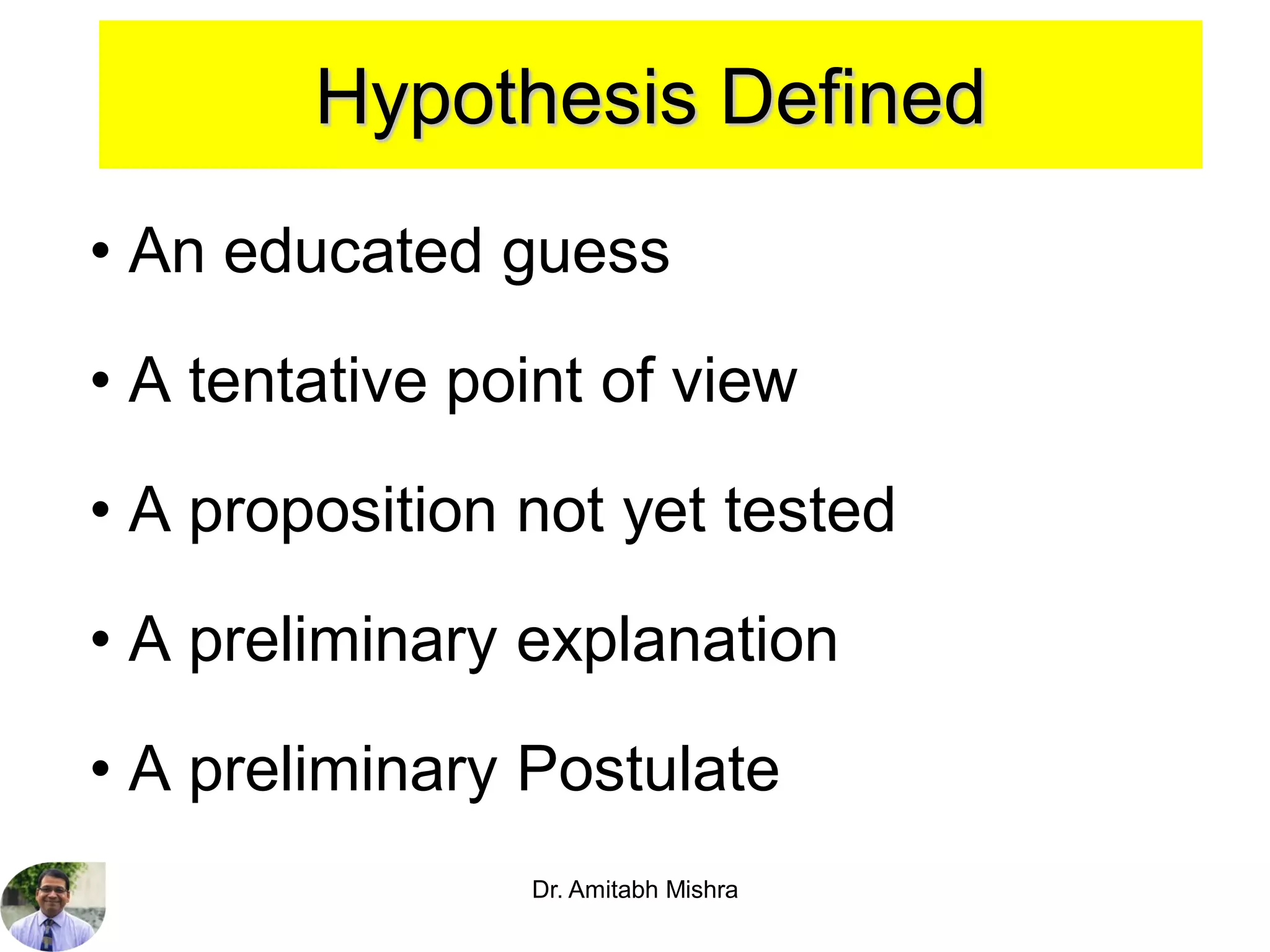
Hypothesis Defined
• An educated guess
• A tentative point of view
• A proposition not yet tested
• A preliminary explanation
• A preliminary Postulate
Dr. Amitabh Mishra
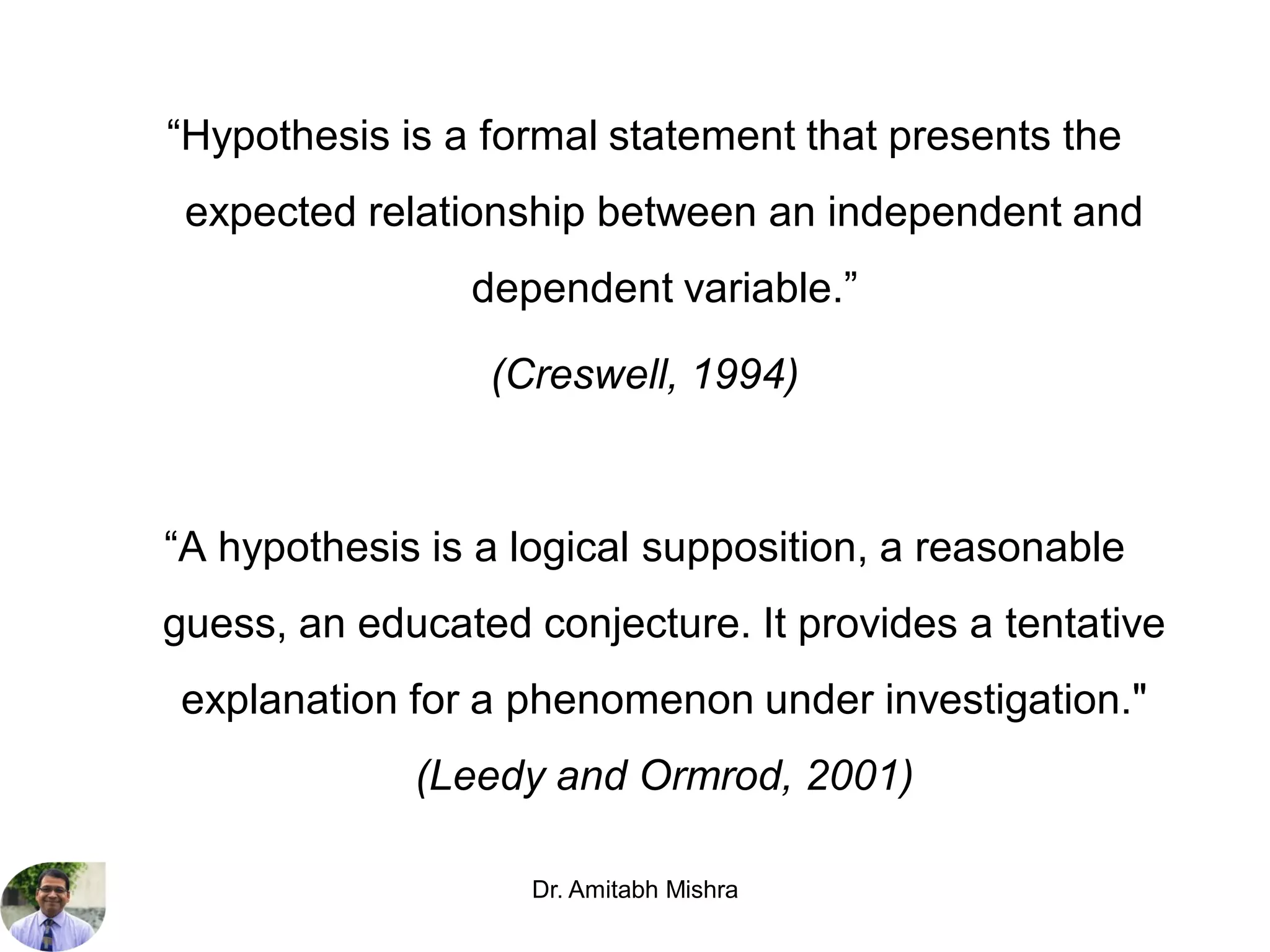
“Hypothesis is a formal statement that presents the
expected relationship between an independent and
dependent variable.”
(Creswell, 1994)
“A hypothesis is a logical supposition, a reasonable
guess, an educated conjecture. It provides a tentative
explanation for a phenomenon under investigation."
(Leedy and Ormrod, 2001)
Dr. Amitabh Mishra
HYPOTHESIS: Example
–The mileage of Maruti Wagon R is as good as
Hyundai Santro.
–The customer loyalty of Parle is better than
Britannia.
•These hypotheses are capable of
objectively verified and tested
Hypothesis vs. Theory
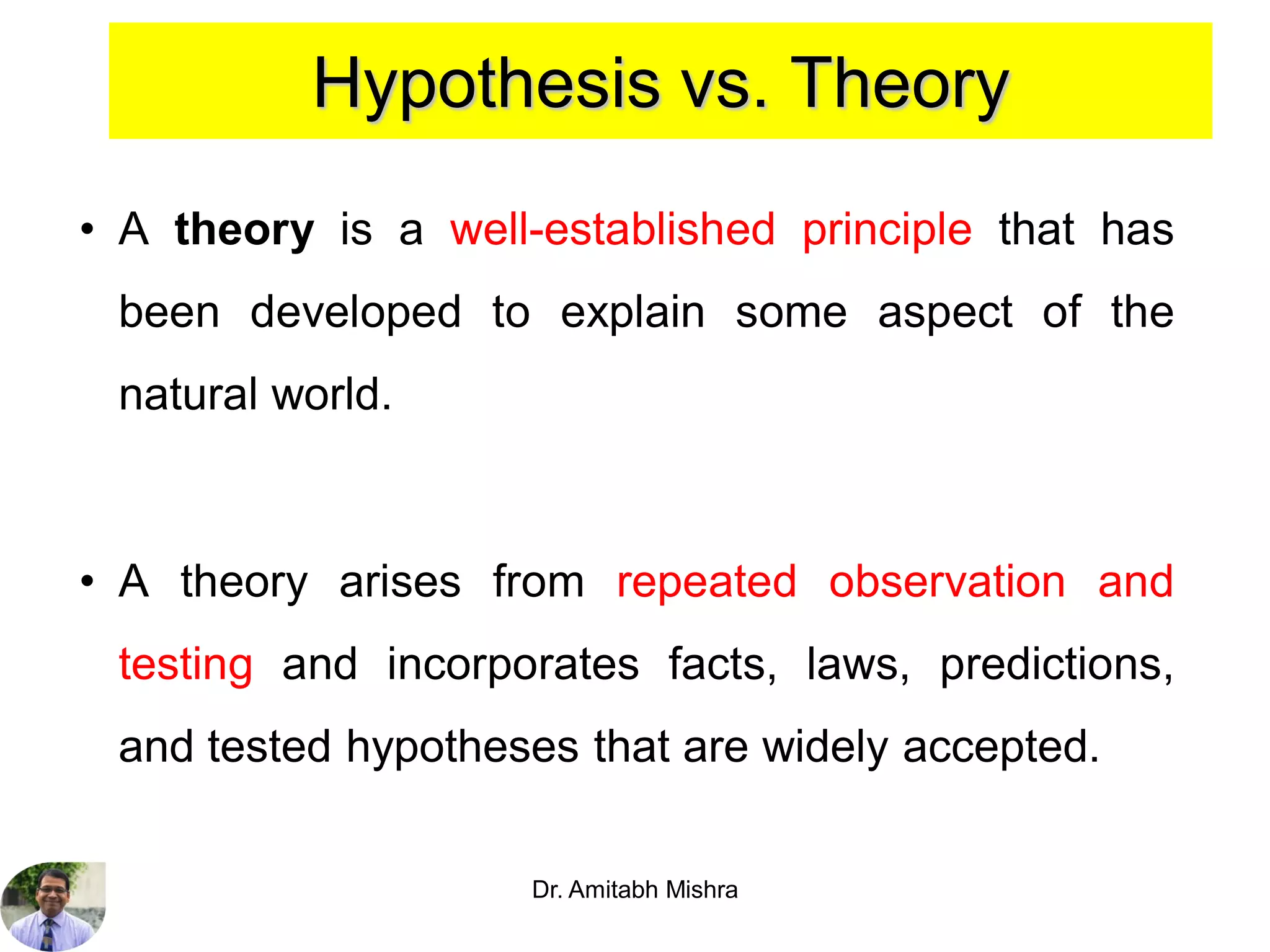
• A theory is a well-established principle that has
been developed to explain some aspect of the
natural world.
• A theory arises from repeated observation and
testing and incorporates facts, laws, predictions,
and tested hypotheses that are widely accepted.
Dr. Amitabh Mishra
Hypothesis vs. Theory
•A hypothesis is a specific, testable prediction about
what you expect to happen in your study.
–For example: a study designed to look at the relationship between
study habits and test anxiety might have a hypothesis that states,
“This study is designed to assess the hypothesis that students with
better study habits will suffer less test anxiety.” Unless your study is
exploratory in nature, your hypothesis should always explain what
you expect to happen during the course of your experiment or
research.
Dr. Amitabh Mishra
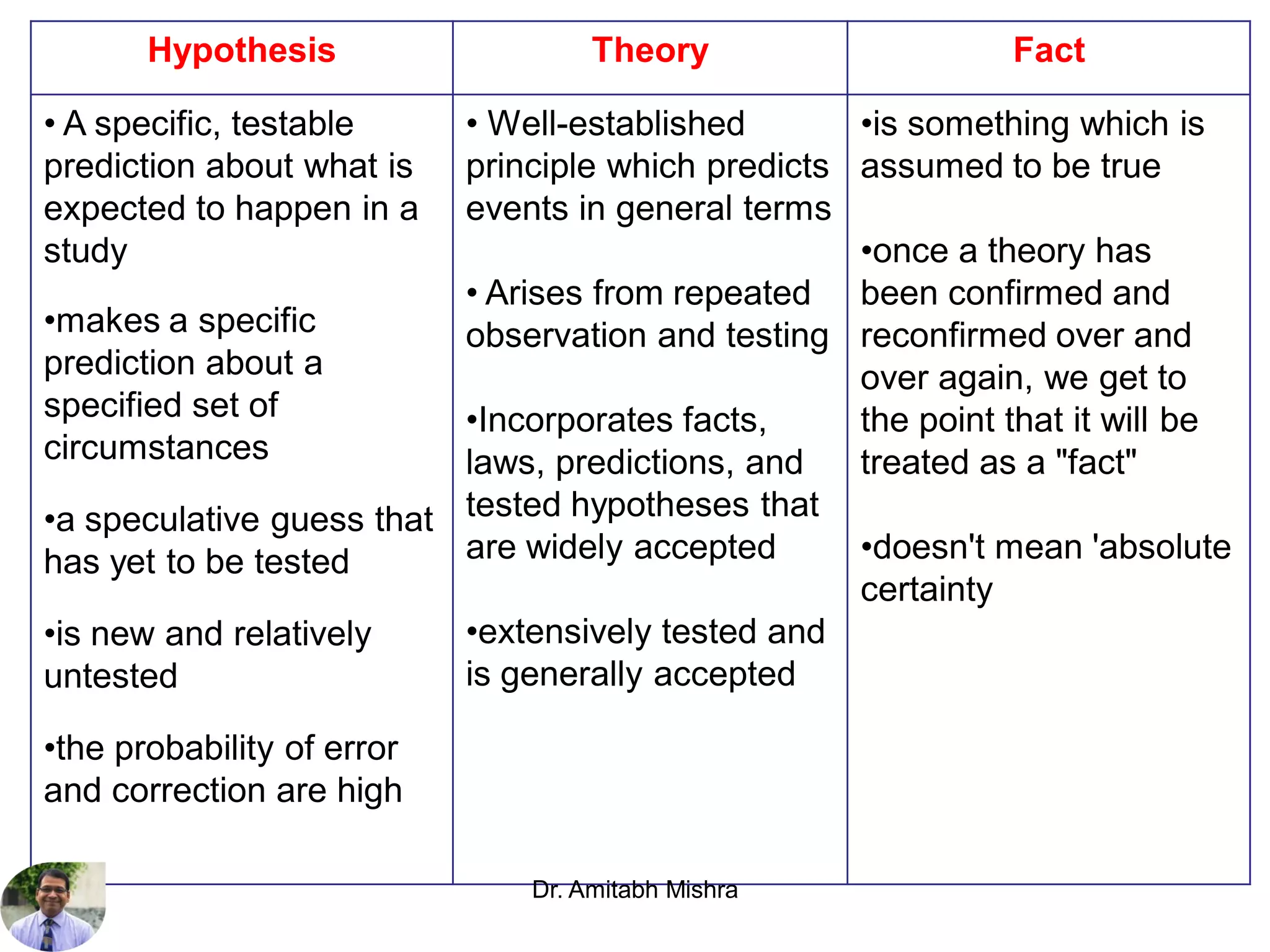
Hypothesis Theory Fact
• A specific, testable
prediction about what is
expected to happen in a
study
•makes a specific
prediction about a
specified set of
circumstances
•a speculative guess that
has yet to be tested
•is new and relatively
untested
•the probability of error
and correction are high
• Well-established
principle which predicts
events in general terms
• Arises from repeated
observation and testing
•Incorporates facts,
laws, predictions, and
tested hypotheses that
are widely accepted
•extensively tested and
is generally accepted
•is something which is
assumed to be true
•once a theory has
been confirmed and
reconfirmed over and
over again, we get to
the point that it will be
treated as a "fact"
•doesn't mean 'absolute
certainty
Dr. Amitabh Mishra
Why it is needed?
• To bring direction, specificity & focus to a research
study.
• To have something to test.
• The hypothesis can be proved to be:
– right,
– partly right,
– wrong (false).
Dr. Amitabh Mishra
Functions of a hypothesis
• Providing focus
• What data to collect and what data not to collect
• Enhancing objectivity
• Making conclusions easier
Dr. Amitabh Mishra
1. A Hypothesis must be conceptually clear
– Concepts should be clearly defined
– The definitions should be commonly accepted
– The definitions should be easily communicable
2. The hypothesis should have empirical reference
– Variables in the hypothesis should be empirical realities
– If they are not, it would not be possible to make the observation
and ultimately the test
Characteristics of a Testable Hypothesis
Dr. Amitabh Mishra
3. The Hypothesis must be specific
– Place, situation and operation
4. A hypothesis should be related to available
techniques of research
– Either the techniques are already available, or
– The researcher should be in a position to develop suitable
techniques
Characteristics of a Testable Hypothesis
Dr. Amitabh Mishra
5. The hypothesis should be related to a
body of theory
– Hypothesis has to be supported by theoretical argumentation
– It should depend on the existing body of knowledge
– In this way the study could benefit from the existing knowledge and later
on through testing the hypothesis could contribute to the reservoir of
knowledge
Characteristics of a Testable Hypothesis
Dr. Amitabh Mishra
Types of Hypotheses
13Dr. Amitabh Mishra
Categorizing Hypotheses
Can be categorized in different ways
1. Based on their formulation
– Null Hypotheses and Alternate Hypotheses
2. Based on direction
– Directional and Non-directional Hypothesis
3. Based on their derivation
– Inductive and Deductive Hypotheses
14Dr. Amitabh Mishra
Categorizing Hypotheses
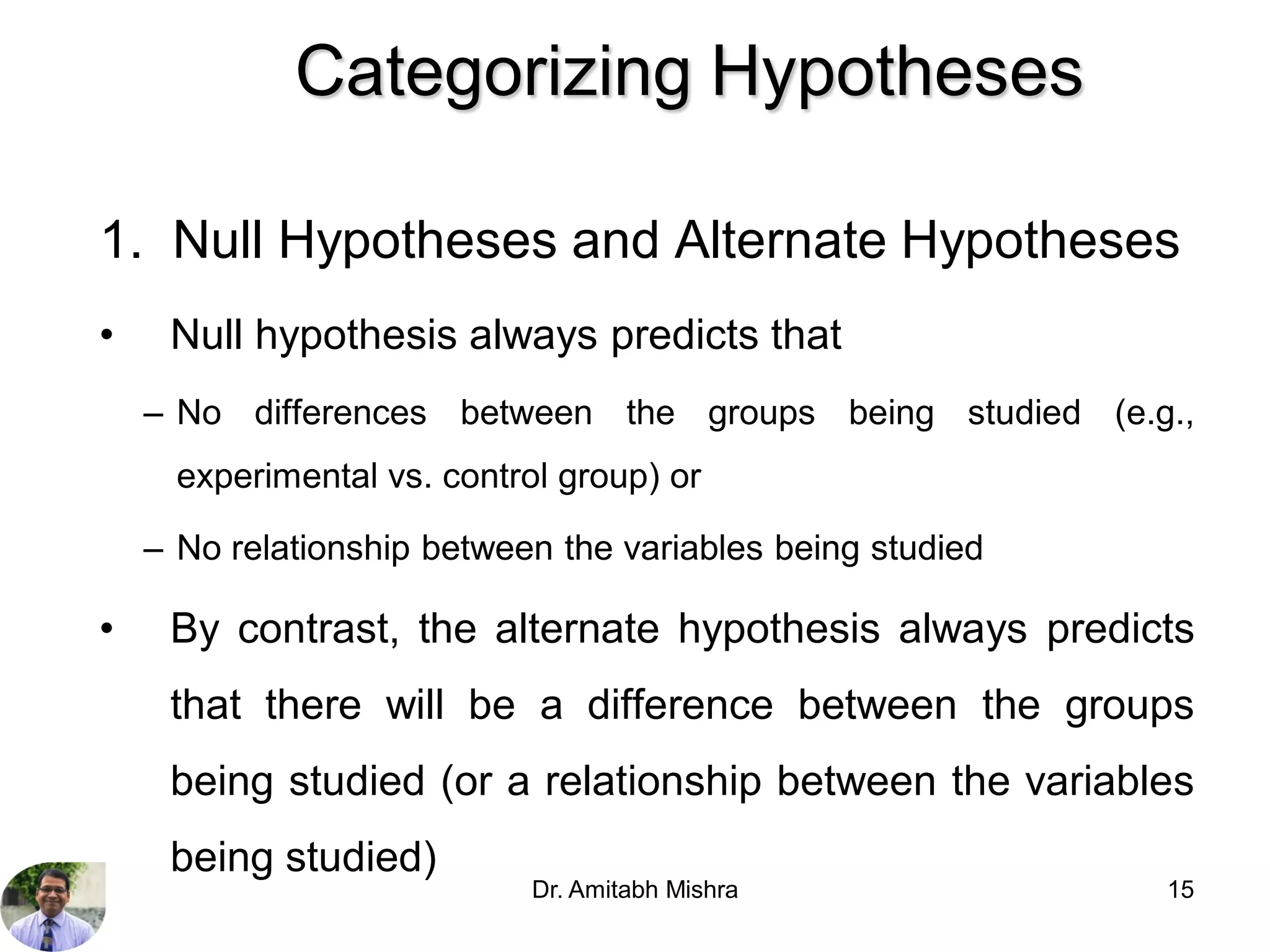
1. Null Hypotheses and Alternate Hypotheses
• Null hypothesis always predicts that
– No differences between the groups being studied (e.g.,
experimental vs. control group) or
– No relationship between the variables being studied
• By contrast, the alternate hypothesis always predicts
that there will be a difference between the groups
being studied (or a relationship between the variables
being studied)
15Dr. Amitabh Mishra
Categorizing Hypotheses
• Alternate Hypothesis can further be
classified as
2. Directional Hypothesis and Non-
directional Hypothesis
Simply based on the wording of the hypotheses
we can tell the difference between directional
and non-directional
16Dr. Amitabh Mishra
Categorizing Hypotheses
2. Directional Hypothesis and Non-directional Hypothesis
• If the hypothesis simply predicts that there will be a difference
between the two groups, then it is a non-directional hypothesis. It is
non-directional because it predicts that there will be a difference but
does not specify how the groups will differ.
• If, however, the hypothesis uses so-called comparison terms, such as
“greater,”“less,”“better,” or “worse,” then it is a directional
hypothesis. It is directional because it predicts that there will be a
difference between the two groups and it specifies how the two
groups will differ.
17Dr. Amitabh Mishra
Categorizing Hypotheses
3. Inductive and Deductive Hypotheses
(classified in terms of how they were derived):
• Inductive hypothesis - a generalization based on
observation
• Deductive hypothesis - derived from theory
Theory Hypothesis Observation Confirmation
Observation Pattern Hypothesis Theory
18Dr. Amitabh Mishra
Hypotheses Testing
19Dr. Amitabh Mishra
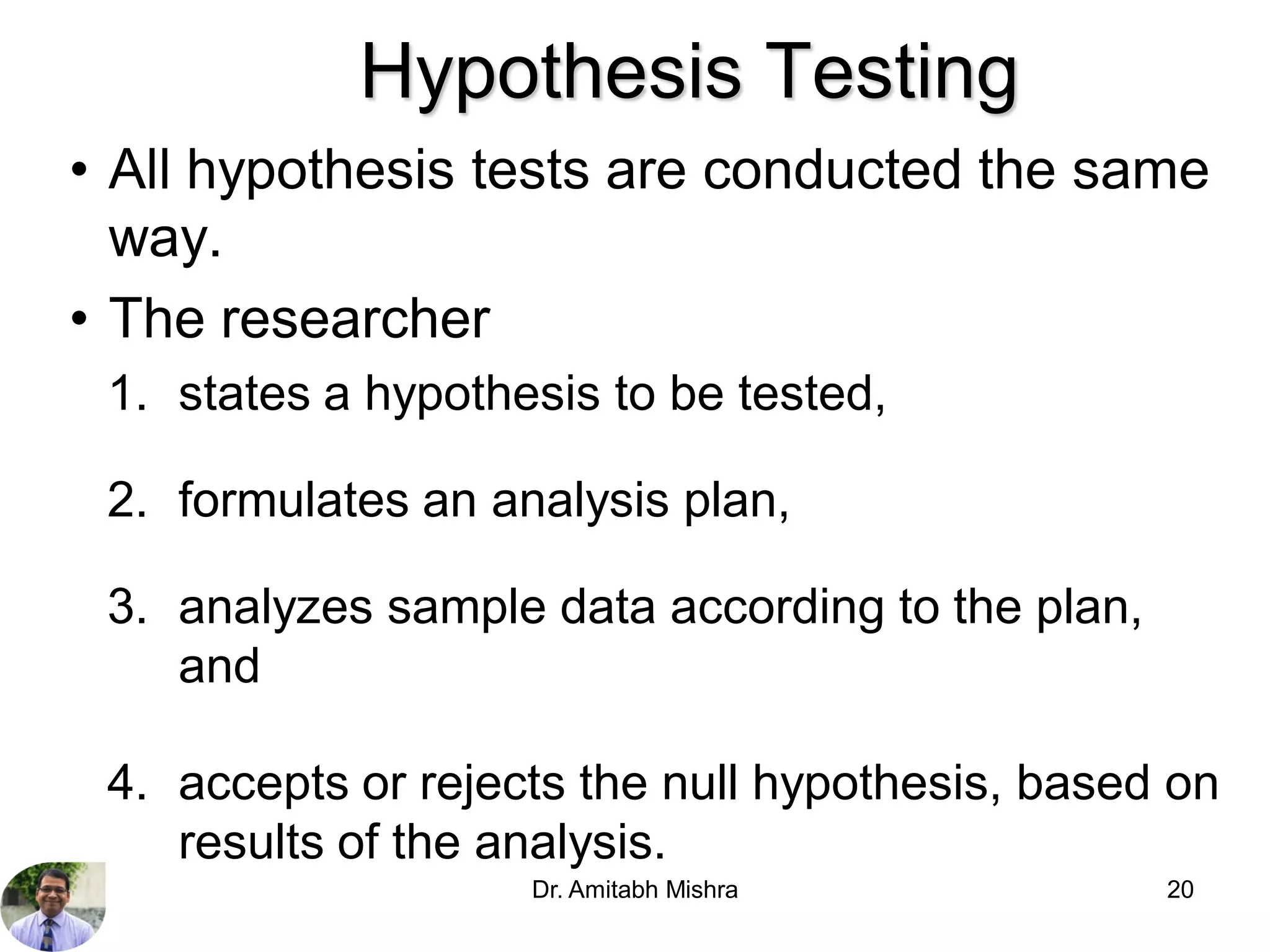
Hypothesis Testing
• All hypothesis tests are conducted the same
way.
• The researcher
1. states a hypothesis to be tested,
2. formulates an analysis plan,
3. analyzes sample data according to the plan,
and
4. accepts or rejects the null hypothesis, based on
results of the analysis.
20Dr. Amitabh Mishra
Problem Definition
Clearly state the null and
alternate hypotheses.
Choose the relevant test
and the appropriate
probability distribution
Choose the critical value
Compare test statistic and
critical value
Reject null
Does the test statistic fall
in the critical region?
Determine the
significance level
Compute relevant
test statistic
Determine the
degrees of
freedom
Decide if one-or
two-tailed test
Do not reject null
No
Yes
Steps in HypothesisTesting
21Dr. Amitabh Mishra
Errors in
Hypotheses Testing
22Dr. Amitabh Mishra
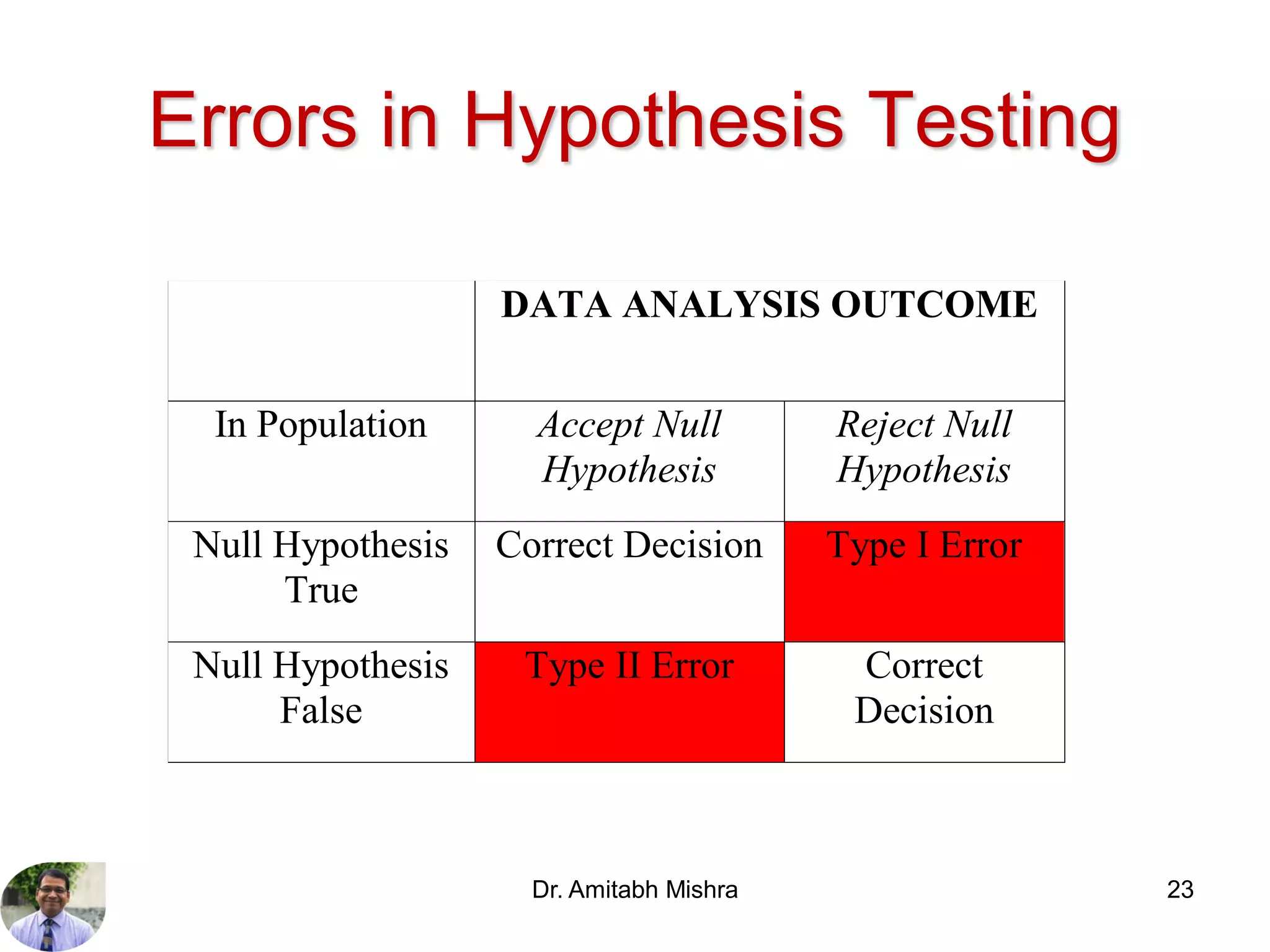
Errors in Hypothesis Testing
DATA ANALYSIS OUTCOME
In Population Accept Null
Hypothesis
Reject Null
Hypothesis
Null Hypothesis
True
Correct Decision Type I Error
Null Hypothesis
False
Type II Error Correct
Decision
23Dr. Amitabh Mishra
Type I Error
• Type I error occurs when the sample results lead to the rejection of
the null hypothesis when it is in fact true.
• The probability of type I error (α) is also called the level of
significance.
Type II Error
• Type II error occurs when, based on the sample results, the null
hypothesis is not rejected when it is in fact false.
• The probability of type II error is denoted by β.
• Unlike α, which is specified by the researcher, the magnitude of β
depends on the actual value of the population parameter
(proportion).
Dr. Amitabh Mishra

Hypothesis

  • 1.
  • 2.
    Hypothesis Defined • Aneducated guess • A tentative point of view • A proposition not yet tested • A preliminary explanation • A preliminary Postulate Dr. Amitabh Mishra
  • 3.
    “Hypothesis is aformal statement that presents the expected relationship between an independent and dependent variable.” (Creswell, 1994) “A hypothesis is a logical supposition, a reasonable guess, an educated conjecture. It provides a tentative explanation for a phenomenon under investigation." (Leedy and Ormrod, 2001) Dr. Amitabh Mishra
  • 4.
    HYPOTHESIS: Example –The mileageof Maruti Wagon R is as good as Hyundai Santro. –The customer loyalty of Parle is better than Britannia. •These hypotheses are capable of objectively verified and tested
  • 5.
    Hypothesis vs. Theory •A theory is a well-established principle that has been developed to explain some aspect of the natural world. • A theory arises from repeated observation and testing and incorporates facts, laws, predictions, and tested hypotheses that are widely accepted. Dr. Amitabh Mishra
  • 6.
    Hypothesis vs. Theory •Ahypothesis is a specific, testable prediction about what you expect to happen in your study. –For example: a study designed to look at the relationship between study habits and test anxiety might have a hypothesis that states, “This study is designed to assess the hypothesis that students with better study habits will suffer less test anxiety.” Unless your study is exploratory in nature, your hypothesis should always explain what you expect to happen during the course of your experiment or research. Dr. Amitabh Mishra
  • 7.
    Hypothesis Theory Fact •A specific, testable prediction about what is expected to happen in a study •makes a specific prediction about a specified set of circumstances •a speculative guess that has yet to be tested •is new and relatively untested •the probability of error and correction are high • Well-established principle which predicts events in general terms • Arises from repeated observation and testing •Incorporates facts, laws, predictions, and tested hypotheses that are widely accepted •extensively tested and is generally accepted •is something which is assumed to be true •once a theory has been confirmed and reconfirmed over and over again, we get to the point that it will be treated as a "fact" •doesn't mean 'absolute certainty Dr. Amitabh Mishra
  • 8.
    Why it isneeded? • To bring direction, specificity & focus to a research study. • To have something to test. • The hypothesis can be proved to be: – right, – partly right, – wrong (false). Dr. Amitabh Mishra
  • 9.
    Functions of ahypothesis • Providing focus • What data to collect and what data not to collect • Enhancing objectivity • Making conclusions easier Dr. Amitabh Mishra
  • 10.
    1. A Hypothesismust be conceptually clear – Concepts should be clearly defined – The definitions should be commonly accepted – The definitions should be easily communicable 2. The hypothesis should have empirical reference – Variables in the hypothesis should be empirical realities – If they are not, it would not be possible to make the observation and ultimately the test Characteristics of a Testable Hypothesis Dr. Amitabh Mishra
  • 11.
    3. The Hypothesismust be specific – Place, situation and operation 4. A hypothesis should be related to available techniques of research – Either the techniques are already available, or – The researcher should be in a position to develop suitable techniques Characteristics of a Testable Hypothesis Dr. Amitabh Mishra
  • 12.
    5. The hypothesisshould be related to a body of theory – Hypothesis has to be supported by theoretical argumentation – It should depend on the existing body of knowledge – In this way the study could benefit from the existing knowledge and later on through testing the hypothesis could contribute to the reservoir of knowledge Characteristics of a Testable Hypothesis Dr. Amitabh Mishra
  • 13.
  • 14.
    Categorizing Hypotheses Can becategorized in different ways 1. Based on their formulation – Null Hypotheses and Alternate Hypotheses 2. Based on direction – Directional and Non-directional Hypothesis 3. Based on their derivation – Inductive and Deductive Hypotheses 14Dr. Amitabh Mishra
  • 15.
    Categorizing Hypotheses 1. NullHypotheses and Alternate Hypotheses • Null hypothesis always predicts that – No differences between the groups being studied (e.g., experimental vs. control group) or – No relationship between the variables being studied • By contrast, the alternate hypothesis always predicts that there will be a difference between the groups being studied (or a relationship between the variables being studied) 15Dr. Amitabh Mishra
  • 16.
    Categorizing Hypotheses • AlternateHypothesis can further be classified as 2. Directional Hypothesis and Non- directional Hypothesis Simply based on the wording of the hypotheses we can tell the difference between directional and non-directional 16Dr. Amitabh Mishra
  • 17.
    Categorizing Hypotheses 2. DirectionalHypothesis and Non-directional Hypothesis • If the hypothesis simply predicts that there will be a difference between the two groups, then it is a non-directional hypothesis. It is non-directional because it predicts that there will be a difference but does not specify how the groups will differ. • If, however, the hypothesis uses so-called comparison terms, such as “greater,”“less,”“better,” or “worse,” then it is a directional hypothesis. It is directional because it predicts that there will be a difference between the two groups and it specifies how the two groups will differ. 17Dr. Amitabh Mishra
  • 18.
    Categorizing Hypotheses 3. Inductiveand Deductive Hypotheses (classified in terms of how they were derived): • Inductive hypothesis - a generalization based on observation • Deductive hypothesis - derived from theory Theory Hypothesis Observation Confirmation Observation Pattern Hypothesis Theory 18Dr. Amitabh Mishra
  • 19.
  • 20.
    Hypothesis Testing • Allhypothesis tests are conducted the same way. • The researcher 1. states a hypothesis to be tested, 2. formulates an analysis plan, 3. analyzes sample data according to the plan, and 4. accepts or rejects the null hypothesis, based on results of the analysis. 20Dr. Amitabh Mishra
  • 21.
    Problem Definition Clearly statethe null and alternate hypotheses. Choose the relevant test and the appropriate probability distribution Choose the critical value Compare test statistic and critical value Reject null Does the test statistic fall in the critical region? Determine the significance level Compute relevant test statistic Determine the degrees of freedom Decide if one-or two-tailed test Do not reject null No Yes Steps in HypothesisTesting 21Dr. Amitabh Mishra
  • 22.
  • 23.
    Errors in HypothesisTesting DATA ANALYSIS OUTCOME In Population Accept Null Hypothesis Reject Null Hypothesis Null Hypothesis True Correct Decision Type I Error Null Hypothesis False Type II Error Correct Decision 23Dr. Amitabh Mishra
  • 24.
    Type I Error •Type I error occurs when the sample results lead to the rejection of the null hypothesis when it is in fact true. • The probability of type I error (α) is also called the level of significance. Type II Error • Type II error occurs when, based on the sample results, the null hypothesis is not rejected when it is in fact false. • The probability of type II error is denoted by β. • Unlike α, which is specified by the researcher, the magnitude of β depends on the actual value of the population parameter (proportion). Dr. Amitabh Mishra