Project
and
Organizational Structure
PREPARED BY
 PRAJWAL ACHARYA (067BCT527)
 RAVI AGRAWAL (067BCT531)
 SAGAR SHARMA (067BCT534)
 SAWAL MASKEY (067BCT539 )
Background
Project Organization - A structure that facilitates the coordination and implementation of
project activities.
Helps to create an environment that fosters interactions among the team members with a
minimum amount of disruptions, overlaps and conflict.
Main objectives of the structure is to reduce uncertainty and confusion that typically occurs at
the project initiation phase.
Defines the relationships among members of the project management and the relationships
with the external environment
The design of an organizational structure should consider
◦ Organizational Environment
◦ Project Characteristics
◦ Level of authority of Project Manager
System View of Project
Management
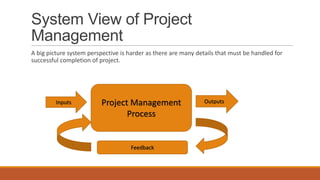
A big picture system perspective is harder as there are many details that must be handled for
successful completion of project.
Inputs Project Management
Process
Outputs
Feedback
Inputs, Outputs and Feedback
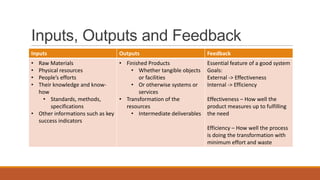
Inputs Outputs Feedback
• Raw Materials
• Physical resources
• People’s efforts
• Their knowledge and know-
how
• Standards, methods,
specifications
• Other informations such as key
success indicators
• Finished Products
• Whether tangible objects
or facilities
• Or otherwise systems or
services
• Transformation of the
resources
• Intermediate deliverables
Essential feature of a good system
Goals:
External -> Effectiveness
Internal -> Efficiency
Effectiveness – How well the
product measures up to fulfilling
the need
Efficiency – How well the process
is doing the transformation with
minimum effort and waste
Organizational Structure
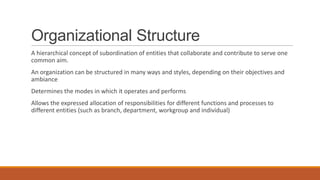
A hierarchical concept of subordination of entities that collaborate and contribute to serve one
common aim.
An organization can be structured in many ways and styles, depending on their objectives and
ambiance
Determines the modes in which it operates and performs
Allows the expressed allocation of responsibilities for different functions and processes to
different entities (such as branch, department, workgroup and individual)
Types of Organizational Structures
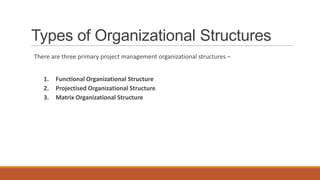
There are three primary project management organizational structures –
1. Functional Organizational Structure
2. Projectised Organizational Structure
3. Matrix Organizational Structure
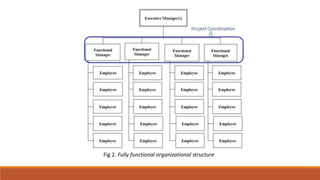
Functional Organizational Structure
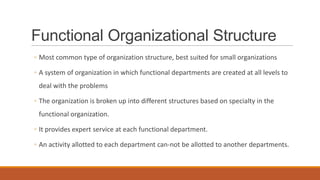
◦ Most common type of organization structure, best suited for small organizations
◦ A system of organization in which functional departments are created at all levels to
deal with the problems
◦ The organization is broken up into different structures based on specialty in the
functional organization.
◦ It provides expert service at each functional department.
◦ An activity allotted to each department can-not be allotted to another departments.
Fig 2. Fully functional organizational structure
Advantages of Functional
Organization
• Staff is managed by a person with experience in their same specialty who can adequately
understand and review their work.
• Staffers have the opportunity to move up within their functional areas, which gives a reason
for them to stay long term. The company gets the advantage of their expertise and company
knowledge over time.
• Staffers work with others in their field, which allows for knowledge sharing and lateral job
moves to learn new skills.
Disadvantages of Functional
Organization
• Functional areas may have difficulties working with other functional areas.
• As the company grows larger, the functional areas can become difficult to manage due to
their size. They can become almost like small companies on their own, with their own
cultures, facilities, and management methods.
• Functional areas may become distracted by their own goals and focus on them, rather than
on overall company objectives
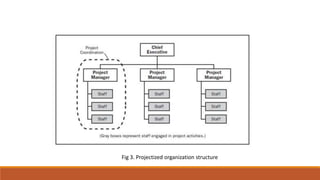
Projectised Organizational Structure
◦ An organizational structure in which the project manager has full authority to assign
priorities, apply resources, and direct the work of persons assigned to the project.
◦ Project team member report to the project manager.
◦ The project manager controls the budget, resource, and work assignment.
◦ When the project ends, project team is disbanded and team members and other resources
are released.
Fig 3. Projectized organization structure
Advantages of Projectized
Organization
◦ Clear line of authority.
◦ Strong communication with single reporting system.
◦ Flexibility in trade-offs and decision making.
◦ Fast decision making.
◦ Usually responses to stakeholders’ concern are very fast.
Disadvantages of Projectized
Organization
◦ Authority and power can make project manager arrogant.
◦ The work environment can be stressful because there is always a deadline (milestones).
◦ Resources may be duplicated.
◦ Team members have sense of insecurity because once the project finishes, they may lose
their jobs.
◦ If the project get elongated, cost of employee and equipment can go higher.
◦ If the organization has multiple projects, then there is very poor communication and co-
operation among the different project teams.
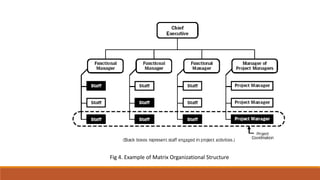
Matrix Organizational Structure
◦ Employs best features of both projectized and functional organization structure
◦ The knowledge and skills of the talented employees could be shared between the functional
departments and the project management teams, as needed.
◦ Exists in large multi-projects organizations so that they can move or relocate employees to
any team wherever their services are needed.
◦ Employees are considered to be shared resources between the project teams and the
functional units.
Fig 4. Example of Matrix Organizational Structure
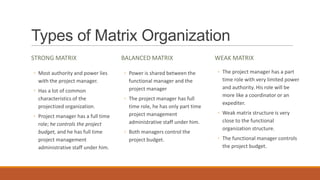
Types of Matrix Organization
STRONG MATRIX
◦ Most authority and power lies
with the project manager.
◦ Has a lot of common
characteristics of the
projectized organization.
◦ Project manager has a full time
role; he controls the project
budget, and he has full time
project management
administrative staff under him.
BALANCED MATRIX
◦ Power is shared between the
functional manager and the
project manager
◦ The project manager has full
time role, he has only part time
project management
administrative staff under him.
◦ Both managers control the
project budget.
WEAK MATRIX
◦ The project manager has a part
time role with very limited power
and authority. His role will be
more like a coordinator or an
expediter.
◦ Weak matrix structure is very
close to the functional
organization structure.
◦ The functional manager controls
the project budget.
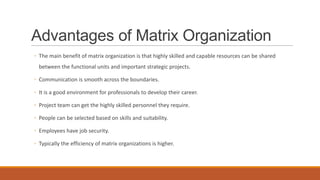
Advantages of Matrix Organization
◦ The main benefit of matrix organization is that highly skilled and capable resources can be shared
between the functional units and important strategic projects.
◦ Communication is smooth across the boundaries.
◦ It is a good environment for professionals to develop their career.
◦ Project team can get the highly skilled personnel they require.
◦ People can be selected based on skills and suitability.
◦ Employees have job security.
◦ Typically the efficiency of matrix organizations is higher.
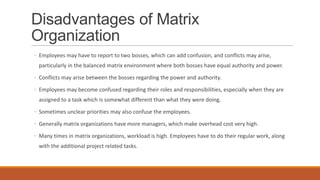
Disadvantages of Matrix
Organization
◦ Employees may have to report to two bosses, which can add confusion, and conflicts may arise,
particularly in the balanced matrix environment where both bosses have equal authority and power.
◦ Conflicts may arise between the bosses regarding the power and authority.
◦ Employees may become confused regarding their roles and responsibilities, especially when they are
assigned to a task which is somewhat different than what they were doing.
◦ Sometimes unclear priorities may also confuse the employees.
◦ Generally matrix organizations have more managers, which make overhead cost very high.
◦ Many times in matrix organizations, workload is high. Employees have to do their regular work, along
with the additional project related tasks.
How to overcome disadvantages of
the Matrix structure
◦ Well-defined and strong communication is very important to gain support from executives, managers,
and employees. Organizations must communicate their vision, objectives and goal with the employees.
◦ There must be close cooperation between the project manager and the functional manager to avoid
confusion and conflicts.
◦ Conflict between the project manager and the functional manager must resolve as early as possible,
and in private.
◦ Roles and responsibilities must be documented and clearly communicated to avoid the confusion.
Organizational Structure influence on
Projects
Organizational structure can help or hurt project success.
From the allocation of resources to where the decision-making authority lies is all embedded in
an organization's characteristics.
Most organizations have developed unique and desirable cultures that are reflected in
numerous factors such as
◦ Shared values, norms, beliefs and expectations
◦ Policies and procedures
◦ View of authority relationships
◦ Work ethic and work hours
References:
◦ PM Study Circle (PMSC) http://pmstudycircle.com
◦ Education Portal http://education-portal.com
◦ Project Management Organizational Structures Paper
http://www.articlearn.com/project-management-organizational-
structures-paper/

Project and organizational structure

  • 1.
    Project and Organizational Structure PREPARED BY PRAJWAL ACHARYA (067BCT527)  RAVI AGRAWAL (067BCT531)  SAGAR SHARMA (067BCT534)  SAWAL MASKEY (067BCT539 )
  • 2.
    Background Project Organization -A structure that facilitates the coordination and implementation of project activities. Helps to create an environment that fosters interactions among the team members with a minimum amount of disruptions, overlaps and conflict. Main objectives of the structure is to reduce uncertainty and confusion that typically occurs at the project initiation phase. Defines the relationships among members of the project management and the relationships with the external environment The design of an organizational structure should consider ◦ Organizational Environment ◦ Project Characteristics ◦ Level of authority of Project Manager
  • 3.
    System View ofProject Management A big picture system perspective is harder as there are many details that must be handled for successful completion of project. Inputs Project Management Process Outputs Feedback
  • 4.
    Inputs, Outputs andFeedback Inputs Outputs Feedback • Raw Materials • Physical resources • People’s efforts • Their knowledge and know- how • Standards, methods, specifications • Other informations such as key success indicators • Finished Products • Whether tangible objects or facilities • Or otherwise systems or services • Transformation of the resources • Intermediate deliverables Essential feature of a good system Goals: External -> Effectiveness Internal -> Efficiency Effectiveness – How well the product measures up to fulfilling the need Efficiency – How well the process is doing the transformation with minimum effort and waste
  • 5.
    Organizational Structure A hierarchicalconcept of subordination of entities that collaborate and contribute to serve one common aim. An organization can be structured in many ways and styles, depending on their objectives and ambiance Determines the modes in which it operates and performs Allows the expressed allocation of responsibilities for different functions and processes to different entities (such as branch, department, workgroup and individual)
  • 6.
    Types of OrganizationalStructures There are three primary project management organizational structures – 1. Functional Organizational Structure 2. Projectised Organizational Structure 3. Matrix Organizational Structure
  • 7.
    Functional Organizational Structure ◦Most common type of organization structure, best suited for small organizations ◦ A system of organization in which functional departments are created at all levels to deal with the problems ◦ The organization is broken up into different structures based on specialty in the functional organization. ◦ It provides expert service at each functional department. ◦ An activity allotted to each department can-not be allotted to another departments.
  • 8.
    Fig 2. Fullyfunctional organizational structure
  • 9.
    Advantages of Functional Organization •Staff is managed by a person with experience in their same specialty who can adequately understand and review their work. • Staffers have the opportunity to move up within their functional areas, which gives a reason for them to stay long term. The company gets the advantage of their expertise and company knowledge over time. • Staffers work with others in their field, which allows for knowledge sharing and lateral job moves to learn new skills.
  • 10.
    Disadvantages of Functional Organization •Functional areas may have difficulties working with other functional areas. • As the company grows larger, the functional areas can become difficult to manage due to their size. They can become almost like small companies on their own, with their own cultures, facilities, and management methods. • Functional areas may become distracted by their own goals and focus on them, rather than on overall company objectives
  • 11.
    Projectised Organizational Structure ◦An organizational structure in which the project manager has full authority to assign priorities, apply resources, and direct the work of persons assigned to the project. ◦ Project team member report to the project manager. ◦ The project manager controls the budget, resource, and work assignment. ◦ When the project ends, project team is disbanded and team members and other resources are released.
  • 12.
    Fig 3. Projectizedorganization structure
  • 13.
    Advantages of Projectized Organization ◦Clear line of authority. ◦ Strong communication with single reporting system. ◦ Flexibility in trade-offs and decision making. ◦ Fast decision making. ◦ Usually responses to stakeholders’ concern are very fast.
  • 14.
    Disadvantages of Projectized Organization ◦Authority and power can make project manager arrogant. ◦ The work environment can be stressful because there is always a deadline (milestones). ◦ Resources may be duplicated. ◦ Team members have sense of insecurity because once the project finishes, they may lose their jobs. ◦ If the project get elongated, cost of employee and equipment can go higher. ◦ If the organization has multiple projects, then there is very poor communication and co- operation among the different project teams.
  • 15.
    Matrix Organizational Structure ◦Employs best features of both projectized and functional organization structure ◦ The knowledge and skills of the talented employees could be shared between the functional departments and the project management teams, as needed. ◦ Exists in large multi-projects organizations so that they can move or relocate employees to any team wherever their services are needed. ◦ Employees are considered to be shared resources between the project teams and the functional units.
  • 16.
    Fig 4. Exampleof Matrix Organizational Structure
  • 17.
    Types of MatrixOrganization STRONG MATRIX ◦ Most authority and power lies with the project manager. ◦ Has a lot of common characteristics of the projectized organization. ◦ Project manager has a full time role; he controls the project budget, and he has full time project management administrative staff under him. BALANCED MATRIX ◦ Power is shared between the functional manager and the project manager ◦ The project manager has full time role, he has only part time project management administrative staff under him. ◦ Both managers control the project budget. WEAK MATRIX ◦ The project manager has a part time role with very limited power and authority. His role will be more like a coordinator or an expediter. ◦ Weak matrix structure is very close to the functional organization structure. ◦ The functional manager controls the project budget.
  • 18.
    Advantages of MatrixOrganization ◦ The main benefit of matrix organization is that highly skilled and capable resources can be shared between the functional units and important strategic projects. ◦ Communication is smooth across the boundaries. ◦ It is a good environment for professionals to develop their career. ◦ Project team can get the highly skilled personnel they require. ◦ People can be selected based on skills and suitability. ◦ Employees have job security. ◦ Typically the efficiency of matrix organizations is higher.
  • 19.
    Disadvantages of Matrix Organization ◦Employees may have to report to two bosses, which can add confusion, and conflicts may arise, particularly in the balanced matrix environment where both bosses have equal authority and power. ◦ Conflicts may arise between the bosses regarding the power and authority. ◦ Employees may become confused regarding their roles and responsibilities, especially when they are assigned to a task which is somewhat different than what they were doing. ◦ Sometimes unclear priorities may also confuse the employees. ◦ Generally matrix organizations have more managers, which make overhead cost very high. ◦ Many times in matrix organizations, workload is high. Employees have to do their regular work, along with the additional project related tasks.
  • 20.
    How to overcomedisadvantages of the Matrix structure ◦ Well-defined and strong communication is very important to gain support from executives, managers, and employees. Organizations must communicate their vision, objectives and goal with the employees. ◦ There must be close cooperation between the project manager and the functional manager to avoid confusion and conflicts. ◦ Conflict between the project manager and the functional manager must resolve as early as possible, and in private. ◦ Roles and responsibilities must be documented and clearly communicated to avoid the confusion.
  • 21.
    Organizational Structure influenceon Projects Organizational structure can help or hurt project success. From the allocation of resources to where the decision-making authority lies is all embedded in an organization's characteristics. Most organizations have developed unique and desirable cultures that are reflected in numerous factors such as ◦ Shared values, norms, beliefs and expectations ◦ Policies and procedures ◦ View of authority relationships ◦ Work ethic and work hours
  • 22.
    References: ◦ PM StudyCircle (PMSC) http://pmstudycircle.com ◦ Education Portal http://education-portal.com ◦ Project Management Organizational Structures Paper http://www.articlearn.com/project-management-organizational- structures-paper/