ENGR. 5280
FAISAL BADAHMAN
OJEAGA OGBEIDE
 Knowing

what a matrix organization
 Identifying the types of matrix structure
 Advantages and Disadvantages of matrix
What

is an organization
Structure?
 Is

a system that provides a framework for
launching and implementing project within
a parent organization

Types
 Functional
 Projectized
 Matrix
 What

is a functional and
Projectized Organization
Structure???




The classic organizational structure where
the employees are grouped hierarchically
of specialization.
Managed through clear lines of authority
and report ultimately to one top person.


The entire organization structure is
designed to support project or product
team.

An example of this would be a company that
produces three distinct products, "product
a", "product b", and "product c". This
company would have a separate division for
each product.
 By

its simplest definition, a matrix
organization is a type of an organization
structure which takes the best features of
both world. i.e the projectized and
functional organization structure
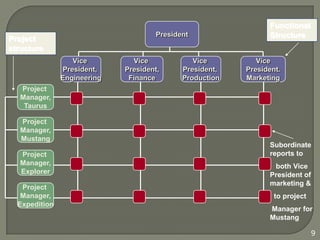
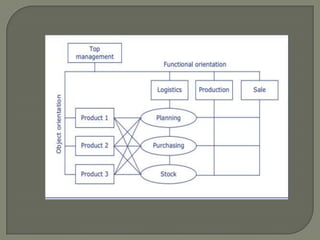
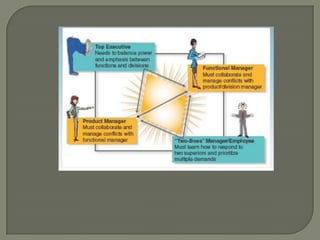
 The matrix is a grid-like organization
structure that allows a company to address
multiple business dimension using multiply
command structure
President

Project
structure
Vice
President,
Engineering

Vice
President,
Finance

Vice
President,
Production

Functional
Structure
Vice
President.
Marketing

Project
Manager,
Taurus
Project
Manager,
Mustang
Project
Manager,
Explorer
Project
Manager,
Expedition

Subordinate
reports to
both Vice
President of
marketing &

to project
Manager for
Mustang

9
 In

matrix organization there are two chain
of command one along functional lines
(vertically) and the other along the project
line (horizontally)
 The matrix structure is designed to
optimally utilize resource by having
individual work on multiple projects as well
as being capable of performing normal
functional duties
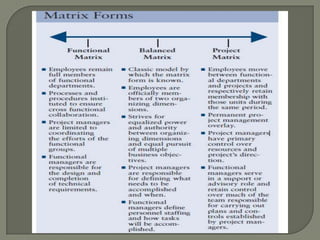
 Strong/

Project
 Balanced
 Weak/Functional
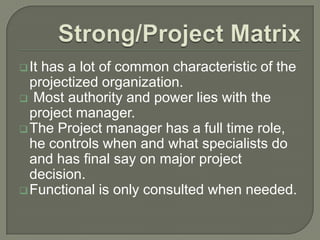
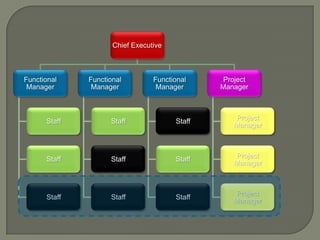
 It

has a lot of common characteristic of the
projectized organization.
 Most authority and power lies with the
project manager.
 The Project manager has a full time role,
he controls when and what specialists do
and has final say on major project
decision.
 Functional is only consulted when needed.
Chief Executive

Functional
Manager

Functional
Manager

Functional
Manager

Project
Manager

Staff

Staff

Staff

Project
Manager

Staff

Staff

Staff

Project
Manager

Staff

Staff

Staff

Project
Manager
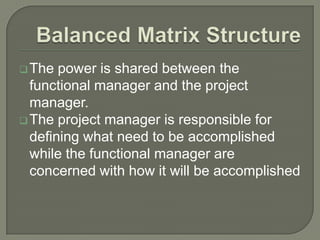
 The

power is shared between the
functional manager and the project
manager.
 The project manager is responsible for
defining what need to be accomplished
while the functional manager are
concerned with how it will be accomplished
Chief
Executive

Functional
Manager

Functional
Manager

Functional
Manager

Staff

Staff

Staff

Staff

Staff

Staff

Project
Manager

Staff

Staff
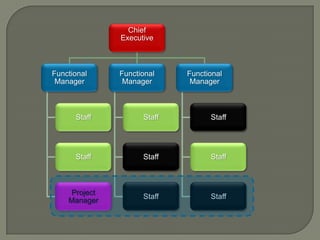
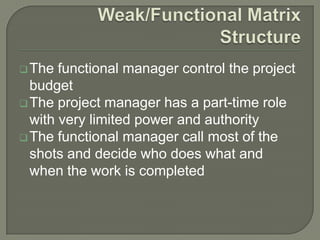
 The

functional manager control the project
budget
 The project manager has a part-time role
with very limited power and authority
 The functional manager call most of the
shots and decide who does what and
when the work is completed
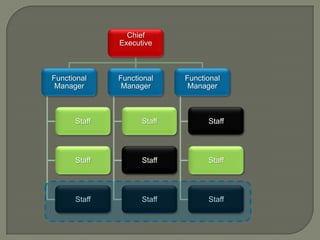
Chief
Executive

Functional
Manager

Functional
Manager

Functional
Manager

Staff

Staff

Staff

Staff

Staff

Staff

Staff

Staff

Staff
Have

you ever reported to more than
one manager? What were the
challenges of such a situation???


Internal Complexity

Some employees may become confused
as to who their direct supervisor is.
 The dual authority and communication
problems may cause division among
employees and managers.
 Miscommunication and ineffective
managing can result in employee
dissatisfaction and low morale.
 Prolonged issues may cause an
organization to experience high employee
turnover.

 Expensive

to Maintain and Internal

Conflict
A company's overhead cost typically increases
because of the need for double management.
 The extra salaries an organization must pay can put a
strain on its resources.
 The sharing of employees may cause unhealthy
competition between managers within a company.
 The competition for scare resources may cause
hostility within the workplace and hinder production

Stressful
Stress placed on workers due to
reporting to more than one boss.

Slow
Decision making can get bogged down do
to arguments between multiple functional
groups, causing agreements to be forged.
.Especially true for balanced matrix.
Efficient

Information
Exchange

 Departments/functional

work closely together
and communicate with each other frequently
to solve issues
 With efficient lines of communication,
productivity is enhance and allow for quick
decision-making.
 The specialized information exchange allows
managers to respond quickly to the needs of
customers and the organization.
Strong Project focus
Project manager coordination the
contribution of multiple units.

Easier Post Project
Transition
Project teams are over-laid on top of the
functional division, allowing specialists to
maintain ties within their functional groups.
Allowing transition back once the project is
complete.
The matrix structure encourages a
democratic leadership style.
 This style incorporates the input of team
 members before managers make
decisions.
 Managers are involved in the day-to-day
operations, which allows them to make
decisions through the viewpoint of
employees.

 What

components do you
think can make Your Work
Successfully in a Matrix
Management Structure????
 Define

Your Role

It's essential to understand not only your role
and responsibilities, but also those of your
managers. Meet with them, ask how they
see your role, and explore what they feel
your top objectives should be. You may find
that their views on your priorities differ, so
you may need to agree a consistent set of
roles and responsibilities.
 Manage

Deadlines

You're likely to have multiple deadlines competing for
your attention at any one time. Some of them might
even conflict with one another, so it's essential to learn
how to schedule and prioritize tasks effectively.
Communicate Clearly
Good communication is essential for avoiding
conflicting deadlines or unrealistic expectations. Talk
with your managers to find out how they would like you
to communicate with them. They may find it most
helpful to meet regularly, or they may prefer you to send
weekly progress updates, for example.

 Appreciate

Diversity

The diversity of knowledge, working styles, and
opinions within a matrix organization team can
present learning opportunities, but it can also lead to
tension. If you find it difficult to understand others'
opinions, use the Perceptual Positions exercise to
see things from different viewpoints.
If arguments erupt within the group, learn how to
manage conflict , so that you can resolve issues
and get everyone back on track
a

project manager role as part time?
 A functional manager control project
budget?
 In balanced matrix structure a project
manager report to whom??
 A project manager has final say on project
decision???
 What

types of matrix structure is best
for your organization?
 Well

, it depends on your strategy; the
choice is all about where you want the
balance of power to lie. This may
depend on your history, will certainly
depend on your current challenges and
priorities and also on the capabilities of
your people. . It is important to note that
none of them is better than the other, as
the success of the structure depends
on the purpose and function of the
organization itself.
Matrix organizations are a blend of functional and
projectized characteristics.
 Weak matrices main many of the characteristics of a
functional organization and the project manager role is
more that of a coordinator or expediter than that of a
manager.
 Strong matrices have many of the characteristics of the
projectized organization, and can have full-time project
managers with considerable authority and full-time
project administrative staff.
 The balanced matrix organization recognizes the need
for a project manager, it does not provide the project
manager with the full authority over the project and
project funding.

o

Gray, Clifford F., and Erik W. Larson. Project
Management: The Managerial Process. 4th ed.
Boston: McGraw-Hill/Irwin, 2008. Print

o

http://www.businessweek.com/debateroom/arc
hives/2009/08/matrix_is_the_l.html
http://smallbusiness.chron.com/advantagesdisadvantages-matrix-organizationalstructures-business-organizations-26350.html
www.google.com

o

o

Matrix organization structure project final,fab 1

  • 1.
  • 2.
     Knowing what amatrix organization  Identifying the types of matrix structure  Advantages and Disadvantages of matrix
  • 3.
  • 4.
     Is a systemthat provides a framework for launching and implementing project within a parent organization Types  Functional  Projectized  Matrix
  • 5.
     What is afunctional and Projectized Organization Structure???
  • 6.
      The classic organizationalstructure where the employees are grouped hierarchically of specialization. Managed through clear lines of authority and report ultimately to one top person.
  • 7.
     The entire organizationstructure is designed to support project or product team. An example of this would be a company that produces three distinct products, "product a", "product b", and "product c". This company would have a separate division for each product.
  • 8.
     By its simplestdefinition, a matrix organization is a type of an organization structure which takes the best features of both world. i.e the projectized and functional organization structure  The matrix is a grid-like organization structure that allows a company to address multiple business dimension using multiply command structure
  • 9.
  • 10.
     In matrix organizationthere are two chain of command one along functional lines (vertically) and the other along the project line (horizontally)  The matrix structure is designed to optimally utilize resource by having individual work on multiple projects as well as being capable of performing normal functional duties
  • 12.
  • 13.
     It has alot of common characteristic of the projectized organization.  Most authority and power lies with the project manager.  The Project manager has a full time role, he controls when and what specialists do and has final say on major project decision.  Functional is only consulted when needed.
  • 14.
  • 15.
     The power isshared between the functional manager and the project manager.  The project manager is responsible for defining what need to be accomplished while the functional manager are concerned with how it will be accomplished
  • 16.
  • 17.
     The functional managercontrol the project budget  The project manager has a part-time role with very limited power and authority  The functional manager call most of the shots and decide who does what and when the work is completed
  • 18.
  • 20.
    Have you ever reportedto more than one manager? What were the challenges of such a situation???
  • 21.
     Internal Complexity Some employeesmay become confused as to who their direct supervisor is.  The dual authority and communication problems may cause division among employees and managers.  Miscommunication and ineffective managing can result in employee dissatisfaction and low morale.  Prolonged issues may cause an organization to experience high employee turnover. 
  • 22.
     Expensive to Maintainand Internal Conflict A company's overhead cost typically increases because of the need for double management.  The extra salaries an organization must pay can put a strain on its resources.  The sharing of employees may cause unhealthy competition between managers within a company.  The competition for scare resources may cause hostility within the workplace and hinder production 
  • 23.
    Stressful Stress placed onworkers due to reporting to more than one boss. Slow Decision making can get bogged down do to arguments between multiple functional groups, causing agreements to be forged. .Especially true for balanced matrix.
  • 24.
    Efficient Information Exchange  Departments/functional work closelytogether and communicate with each other frequently to solve issues  With efficient lines of communication, productivity is enhance and allow for quick decision-making.  The specialized information exchange allows managers to respond quickly to the needs of customers and the organization.
  • 25.
    Strong Project focus Projectmanager coordination the contribution of multiple units. Easier Post Project Transition Project teams are over-laid on top of the functional division, allowing specialists to maintain ties within their functional groups. Allowing transition back once the project is complete.
  • 26.
    The matrix structureencourages a democratic leadership style.  This style incorporates the input of team  members before managers make decisions.  Managers are involved in the day-to-day operations, which allows them to make decisions through the viewpoint of employees. 
  • 27.
     What components doyou think can make Your Work Successfully in a Matrix Management Structure????
  • 28.
     Define Your Role It'sessential to understand not only your role and responsibilities, but also those of your managers. Meet with them, ask how they see your role, and explore what they feel your top objectives should be. You may find that their views on your priorities differ, so you may need to agree a consistent set of roles and responsibilities.
  • 29.
     Manage Deadlines You're likelyto have multiple deadlines competing for your attention at any one time. Some of them might even conflict with one another, so it's essential to learn how to schedule and prioritize tasks effectively. Communicate Clearly Good communication is essential for avoiding conflicting deadlines or unrealistic expectations. Talk with your managers to find out how they would like you to communicate with them. They may find it most helpful to meet regularly, or they may prefer you to send weekly progress updates, for example. 
  • 30.
     Appreciate Diversity The diversityof knowledge, working styles, and opinions within a matrix organization team can present learning opportunities, but it can also lead to tension. If you find it difficult to understand others' opinions, use the Perceptual Positions exercise to see things from different viewpoints. If arguments erupt within the group, learn how to manage conflict , so that you can resolve issues and get everyone back on track
  • 31.
    a project manager roleas part time?  A functional manager control project budget?  In balanced matrix structure a project manager report to whom??  A project manager has final say on project decision???
  • 32.
     What types ofmatrix structure is best for your organization?
  • 33.
     Well , itdepends on your strategy; the choice is all about where you want the balance of power to lie. This may depend on your history, will certainly depend on your current challenges and priorities and also on the capabilities of your people. . It is important to note that none of them is better than the other, as the success of the structure depends on the purpose and function of the organization itself.
  • 34.
    Matrix organizations area blend of functional and projectized characteristics.  Weak matrices main many of the characteristics of a functional organization and the project manager role is more that of a coordinator or expediter than that of a manager.  Strong matrices have many of the characteristics of the projectized organization, and can have full-time project managers with considerable authority and full-time project administrative staff.  The balanced matrix organization recognizes the need for a project manager, it does not provide the project manager with the full authority over the project and project funding. 
  • 37.
    o Gray, Clifford F.,and Erik W. Larson. Project Management: The Managerial Process. 4th ed. Boston: McGraw-Hill/Irwin, 2008. Print o http://www.businessweek.com/debateroom/arc hives/2009/08/matrix_is_the_l.html http://smallbusiness.chron.com/advantagesdisadvantages-matrix-organizationalstructures-business-organizations-26350.html www.google.com o o

Editor's Notes

  • #3 What is a matrix organization
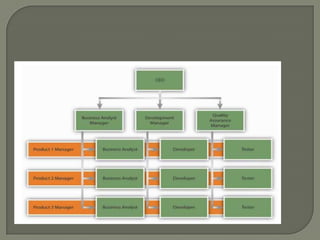
  • #36 An example of a matrix structure at a software development company. Business analysts, developers, and testers each report to a functional department manager and to a project manager simultaneously. The matrix structure is used in many information technology companies engaged in software development. Sportswear manufacturer Nike is another company that uses the matrix organization successfully. New product introduction is a task shared by regional managers and product managers. While product managers are in charge of deciding how to launch a product, regional managers are allowed to make modifications based on the region.[308]