Science and time
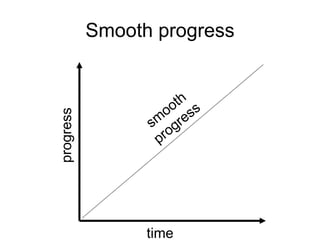
Smooth progress 
time 
progress
progress 
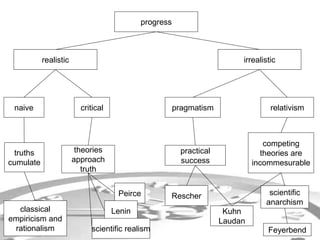
realistic irrealistic 
naive critical pragmatism relativism 
truths 
cumulate 
classical 
empiricism and 
rationalism 
theories 
approach 
truth 
Peirce 
Lenin 
scientific realism 
practical 
success 
competing 
theories are 
incommesurable 
scientific 
anarchism 
Rescher 
Kuhn 
Laudan 
Feyerbend
Progress in science 
• Is scientific knowledge progressive? 
• Has scientific knowledge always grown? In this 
respect, how do the natural sciences compare 
with other Areas of Knowledge, for example, 
history, the human sciences, ethics and the 
arts? 
• Could there ever be an ‘end’ to science? In other 
words, could we reach a point where everything 
important in a scientific sense is known? 
• If so, what might be the consequences of this?
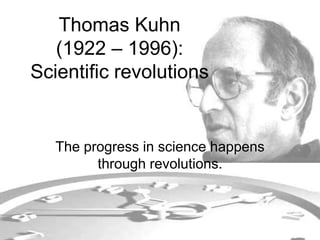
Thomas Kuhn 
(1922 – 1996): 
Scientific revolutions 
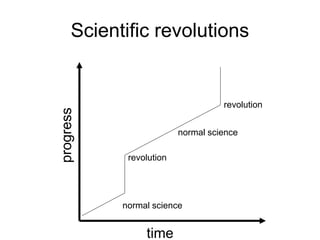
The progress in science happens 
through revolutions.
The structure of scientific 
revolutions 
• Thomas Kuhn is most famous for his book 
The Structure of Scientific Revolutions 
(1962) in which he presented the idea that 
science does not evolve gradually toward 
truth, but instead undergoes periodic 
revolutions which he calls "paradigm 
shifts."
Some terminology 
• Normal science 
• Scientific crisis 
• Scientific revolution 
• Paradigm 
• Anomaly 
• Auxiliary hypothesis
Normal science 
• during periods of what Kuhn calls normal 
science the vast majority of scientists work 
within the dominant paradigm without 
seriously questioning it. 
• Most scientists are bricklayers patiently 
filling in the details and extending the body 
of scientific knowledge.
Forcing nature into the conceptual 
boxes 
• A scientific community cannot practice its trade without some set of 
received beliefs. 
– These beliefs form the foundation of the "educational initiation that 
prepares and licenses the student for professional practice". 
– The nature of the "rigorous and rigid" preparation helps ensure that the 
received beliefs exert a "deep hold" on the student's mind. 
• Normal science "is predicated on the assumption that the scientific 
community knows what the world is like" —scientists take great 
pains to defend that assumption. 
• To this end, "normal science often suppresses fundamental 
novelties because they are necessarily subversive of its basic 
commitments". 
• Research is "a strenuous and devoted attempt to force nature into 
the conceptual boxes supplied by professional education".
Scientific crisis 
• During periods of scientific crisis there are 
likely to be violent arguments between 
those who adhere to the old paradigm and 
those who advocate the new one.
Scientific revolution 
• A scientific revolution takes place when 
scientists become dissatisfied with the 
prevailing paradigm, and put forward a 
completely new way of looking at things.
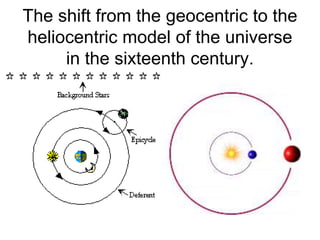
The shift from the geocentric to the 
heliocentric model of the universe 
in the sixteenth century.
Replacement of Aristotelian physics by 
Newtonian mechanics in the seventeeth 
century.
The replacement of the Newtonian 
mechanics by Einstein’s theory of 
relativity in the early twentieth century.
Scientific revolutions 
revolution 
time 
progress 
normal science 
normal science 
revolution
Summary of Kuhn’s position 
1. During periods of normal science, most 
scientists do not question the paradigm in 
which they are operating and focus instead on 
solving problems. 
2. The history of science suggests that, rather 
than progressing smoothly, science goes 
through a series of revolutionary jumps. 
3. During periods of scientific crisis, there is no 
purely rational way of deciding between rival 
paradigms.
Assessing Kuhn’s position 
• Is a normal scientist, as Kuhn describes 
him, a badly thought or simple minded 
scientist? Shouldn’t scientists always be 
critical? This is what Karl Popper claims.
Will everything we believe 
eventually be falsified? 
• It is sometimes taken to imply that all of our 
current scientific beliefs will one day be swept 
away in a new revolution. 
• It is difficult to imagine future scientists rejecting 
our belief that the earth goes round the sun. 
• They may, however, discover that such beliefs 
are approximations to richer and more inclusive 
theories the details of which we cannot at 
present imagine.
“A new scientific truth does 
not win by convincing its 
opponents and making 
them see the light, but 
rather because its 
opponents eventually die 
and a new generation 
grows up that is familiar 
with it.” Max Planck 
“In questions of science 
the authority of a 
thousand is not worth 
the humble reasoning 
of a single individual” 
Galileo Galilei.
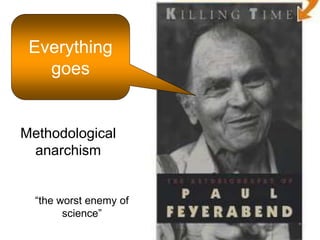
Everything 
goes 
Methodological 
anarchism 
“the worst enemy of 
science”
Paul Karl Feyerabend 
(1924 –1994) 
• Austrian-born philosopher of science. 
• Major works: 
– Against Method (1975) 
– Science in a Free Society (1978) 
– Farewell to Reason (1987). 
• Famous for his anarchistic view of science and 
his rejection of the existence of universal 
methodological rules. 
• He is an influential figure in the philosophy of 
science, and also in the sociology of scientific 
knowledge.
Epistemological anarchism 
- There are no useful and exception-free 
methodological rules governing the progress of 
science or the growth of knowledge 
• the idea that science can or should 
operate according to universal and 
fixed rules is unrealistic, pernicious 
and detrimental to science itself. 
• anarchism reflects methodological 
pluralism 
• scientific method does not have a 
monopoly on truth or useful results 
• dadaistic "anything goes“ attitude
Science is an ideology 
• Feyerabend holds that science is an 
ideology alongside others such as religion, 
magic and mythology. 
• The dominance of science in society 
authoritarian and unjustified.

Progress in science

  • 1.
  • 2.
  • 3.
    progress realistic irrealistic naive critical pragmatism relativism truths cumulate classical empiricism and rationalism theories approach truth Peirce Lenin scientific realism practical success competing theories are incommesurable scientific anarchism Rescher Kuhn Laudan Feyerbend
  • 4.
    Progress in science • Is scientific knowledge progressive? • Has scientific knowledge always grown? In this respect, how do the natural sciences compare with other Areas of Knowledge, for example, history, the human sciences, ethics and the arts? • Could there ever be an ‘end’ to science? In other words, could we reach a point where everything important in a scientific sense is known? • If so, what might be the consequences of this?
  • 5.
    Thomas Kuhn (1922– 1996): Scientific revolutions The progress in science happens through revolutions.
  • 6.
    The structure ofscientific revolutions • Thomas Kuhn is most famous for his book The Structure of Scientific Revolutions (1962) in which he presented the idea that science does not evolve gradually toward truth, but instead undergoes periodic revolutions which he calls "paradigm shifts."
  • 7.
    Some terminology •Normal science • Scientific crisis • Scientific revolution • Paradigm • Anomaly • Auxiliary hypothesis
  • 8.
    Normal science •during periods of what Kuhn calls normal science the vast majority of scientists work within the dominant paradigm without seriously questioning it. • Most scientists are bricklayers patiently filling in the details and extending the body of scientific knowledge.
  • 9.
    Forcing nature intothe conceptual boxes • A scientific community cannot practice its trade without some set of received beliefs. – These beliefs form the foundation of the "educational initiation that prepares and licenses the student for professional practice". – The nature of the "rigorous and rigid" preparation helps ensure that the received beliefs exert a "deep hold" on the student's mind. • Normal science "is predicated on the assumption that the scientific community knows what the world is like" —scientists take great pains to defend that assumption. • To this end, "normal science often suppresses fundamental novelties because they are necessarily subversive of its basic commitments". • Research is "a strenuous and devoted attempt to force nature into the conceptual boxes supplied by professional education".
  • 10.
    Scientific crisis •During periods of scientific crisis there are likely to be violent arguments between those who adhere to the old paradigm and those who advocate the new one.
  • 11.
    Scientific revolution •A scientific revolution takes place when scientists become dissatisfied with the prevailing paradigm, and put forward a completely new way of looking at things.
  • 12.
    The shift fromthe geocentric to the heliocentric model of the universe in the sixteenth century.
  • 13.
    Replacement of Aristotelianphysics by Newtonian mechanics in the seventeeth century.
  • 14.
    The replacement ofthe Newtonian mechanics by Einstein’s theory of relativity in the early twentieth century.
  • 15.
    Scientific revolutions revolution time progress normal science normal science revolution
  • 16.
    Summary of Kuhn’sposition 1. During periods of normal science, most scientists do not question the paradigm in which they are operating and focus instead on solving problems. 2. The history of science suggests that, rather than progressing smoothly, science goes through a series of revolutionary jumps. 3. During periods of scientific crisis, there is no purely rational way of deciding between rival paradigms.
  • 17.
    Assessing Kuhn’s position • Is a normal scientist, as Kuhn describes him, a badly thought or simple minded scientist? Shouldn’t scientists always be critical? This is what Karl Popper claims.
  • 18.
    Will everything webelieve eventually be falsified? • It is sometimes taken to imply that all of our current scientific beliefs will one day be swept away in a new revolution. • It is difficult to imagine future scientists rejecting our belief that the earth goes round the sun. • They may, however, discover that such beliefs are approximations to richer and more inclusive theories the details of which we cannot at present imagine.
  • 19.
    “A new scientifictruth does not win by convincing its opponents and making them see the light, but rather because its opponents eventually die and a new generation grows up that is familiar with it.” Max Planck “In questions of science the authority of a thousand is not worth the humble reasoning of a single individual” Galileo Galilei.
  • 20.
    Everything goes Methodological anarchism “the worst enemy of science”
  • 21.
    Paul Karl Feyerabend (1924 –1994) • Austrian-born philosopher of science. • Major works: – Against Method (1975) – Science in a Free Society (1978) – Farewell to Reason (1987). • Famous for his anarchistic view of science and his rejection of the existence of universal methodological rules. • He is an influential figure in the philosophy of science, and also in the sociology of scientific knowledge.
  • 22.
    Epistemological anarchism -There are no useful and exception-free methodological rules governing the progress of science or the growth of knowledge • the idea that science can or should operate according to universal and fixed rules is unrealistic, pernicious and detrimental to science itself. • anarchism reflects methodological pluralism • scientific method does not have a monopoly on truth or useful results • dadaistic "anything goes“ attitude
  • 23.
    Science is anideology • Feyerabend holds that science is an ideology alongside others such as religion, magic and mythology. • The dominance of science in society authoritarian and unjustified.