Punjabi University,Patiala
Department of SociologyandSocialAnthropology
Ph.D. CourseWorkPresentation
RecentDevelopmentsin Sociology
Dr. DeepakKumar
MohammadHadi Movahhed
Roll No.2245206
Thomas Samuel Kuhn (1922–1996)
Discourse Analysis;
A Paradigm Shift
Kuhn’s Major Contributions
The Structure of Scientific Revolutions (1962)
Kuhn’s contribution to the philosophy of science
not only a break with several key positivist doctrines
but also inaugurated a new style of philosophy of science that brought it
closer to the history of science.
 His account of the development of science held that science enjoys periods of
stable growth punctuated by revisionary revolutions.
 Kuhn added the controversial ‘incommensurability thesis’, that theories from
differing periods suffer from certain deep kinds of failure of comparability.
Life and Career 1/2
Thomas Kuhn’s academic life started in physics;
He then switched to the history of science, then moved over to the philosophy
of science, retaining a strong interest in the history of physics;
Master’s degree in physics in 1946, and his doctorate in 1949, also in physics.
Until 1956, Kuhn taught a class in science for undergraduates in the
humanities;
His initial bewilderment on reading the scientific work of Aristotle was a
formative experience, followed as it was by a more or less sudden ability to
understand Aristotle properly, undistorted by knowledge of subsequent science.
Life and Career 2/2
Moving to the University of California at Berkeley in 1956 and taking up a
post in the history of science made him develop an interest in the philosophy
of science.
He got introduced to the work of Wittgenstein and Paul Feyerabend and
started to draft The Structure of Scientific Revolutions.
The central idea of this extraordinary book is that the development of
science is driven, in normal periods of science, by adherence to what he calls
a ‘paradigm’.
The development of science 1/2
•The development of science is not uniform but has alternating
‘normal’ and ‘revolutionary’ (or ‘extraordinary’) phases.
•Normal science does resemble the standard cumulative picture
of scientific progress, on the surface at least.
•normal science as ‘puzzle-solving’ (1962/1970a, 35–42).
• Kuhn rejects a teleological view of science progressing towards
truth and favours an evolutionary view.
The development of science 2/2
 Science improves by allowing its theories to evolve in response to
puzzles and progress is measured by its success in solving those
puzzles and not by progress toward an ideal true theory.
 The revolutionary new theory that succeeds in replacing another
that is subject to the crisis, may fail to satisfy all the needs of those
working with the earlier theory.
What Is Paradigm?
Paradigm is the accepted examples of actual scientific practices which
include law, theory, application, and instrumentation together from
which spring particular coherent traditions of scientific research.
He argues that disciplines reach maturity only when developing a
paradigm.
The role of the paradigm is to socialize and enunciate the upcoming
generation and scientists in the theory, application, and worldview of
the dominant paradigm. Therefore, it determines the method and the
goals of the members of the discipline.
History of Science and the Text Book Image 1/2
The history of science should be re-read.
The textbook image of science and scientific activity should be
reconsidered.
The textbook image of science has portrayed scientific development as a
uniquely accumulated process.
It implies that science has reached the present stage of the efforts of men
seeking novelty of facts and theory.
This textbook image of science gives science as very prices, authentic and
objective knowledge about the natural world.
History of Science and the Text Book Image 2/2
•Kuhn disagrees with this textbook image of science after the history of the
development of science.
•He examines the historical evidence in the development of science.
•He suggests that the members of the paradigm in the dominant discipline
are not really seeking to discover new facts. They are trying to prove the
same formula and striving to fulfil the original promise of their accepted
paradigm by extending the knowledge of those facts which the paradigm
has displayed.
Normal Sciences
• He identifies two periods in the development of science:
Normal science (research firmly based upon one or more past scientific
achievements that some particular scientific community acknowledges for a time as
supplying the foundation for its further practices).
• It is nothing but puzzle-solving.
• Normal sciences practitioners do not seek novelty but verify the chosen
principles of the paradigm. Like the laws of Einstein, Newton and, …
Anomaly, Crisis, and Incommensurability
Changes only come when anomalies in the existing paradigm emerge and
they are not able to resolve by the existing theories, laws, and instruments
of the paradigm.
Losing the rules in the inherent sciences is accepted to such an extent that
an alternative paradigm is suggested.
In this competition;
 practitioners of certain paradigms do not accept the new paradigm because of
incommensurability.
 There are existential problems with their paradigm and engagement.
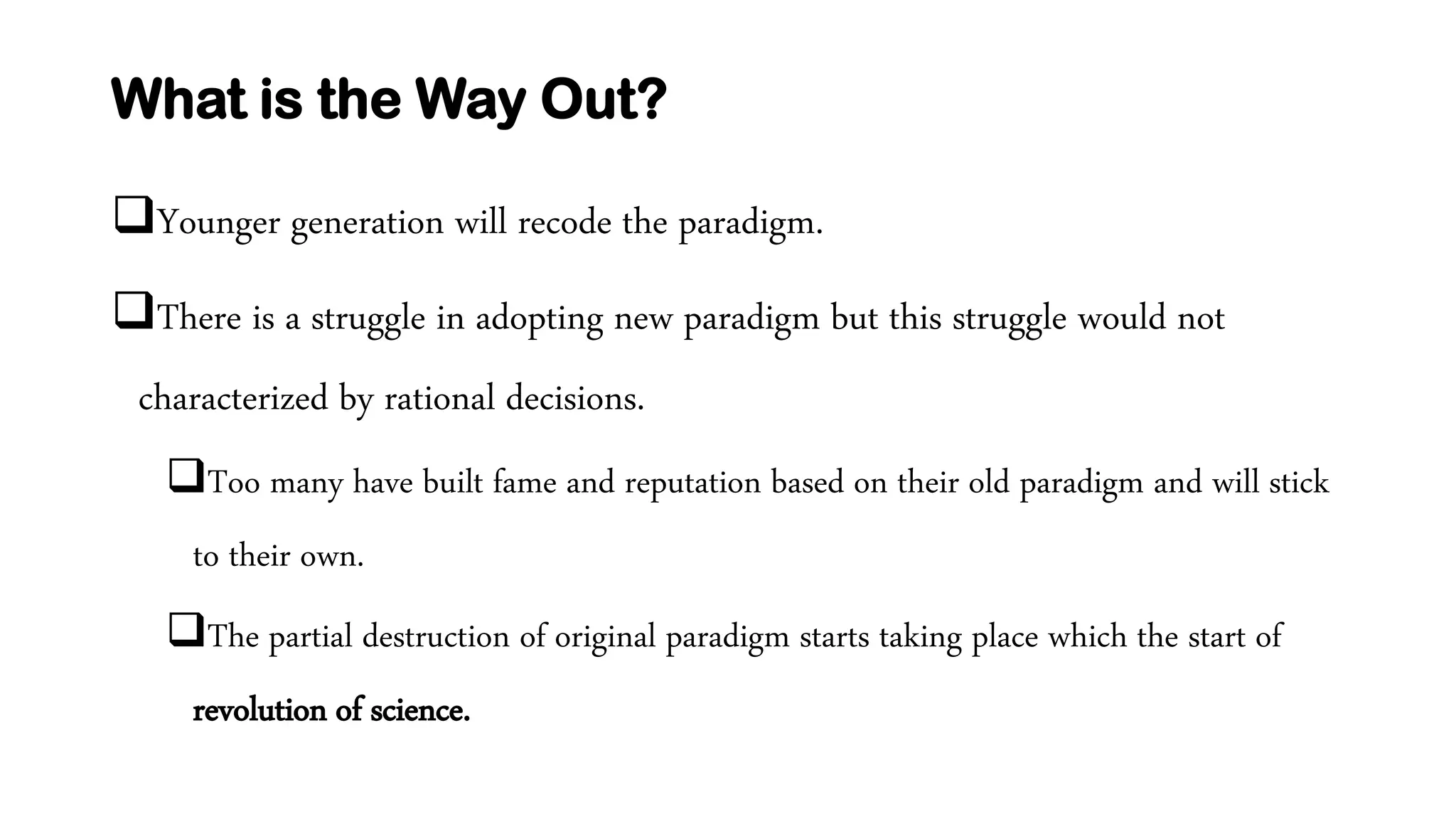
What is the Way Out?
Younger generation will recode the paradigm.
There is a struggle in adopting new paradigm but this struggle would not
characterized by rational decisions.
Too many have built fame and reputation based on their old paradigm and will stick
to their own.
The partial destruction of original paradigm starts taking place which the start of
revolution of science.
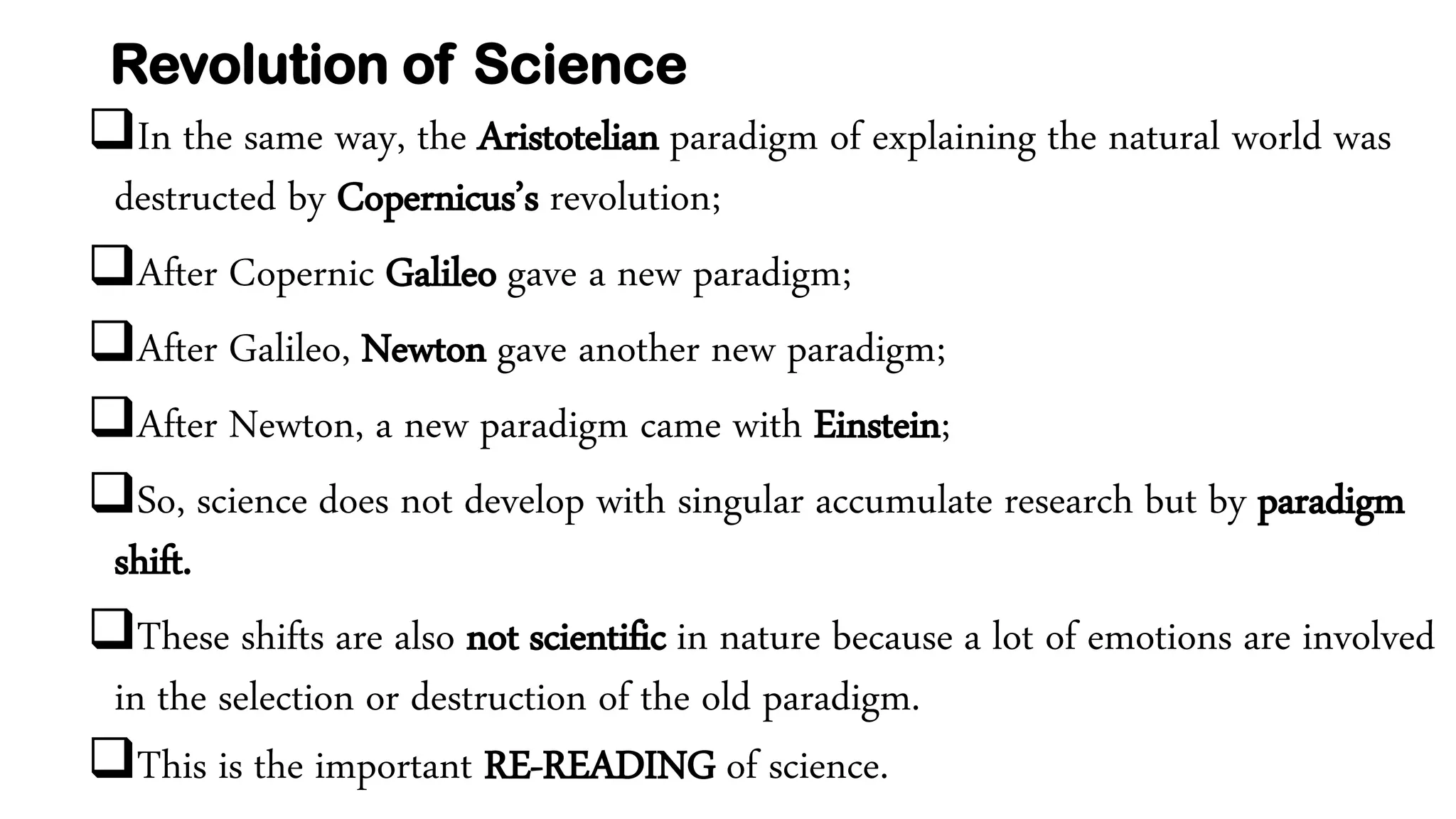
Revolution of Science
In the same way, the Aristotelian paradigm of explaining the natural world was
destructed by Copernicus’s revolution;
After Copernic Galileo gave a new paradigm;
After Galileo, Newton gave another new paradigm;
After Newton, a new paradigm came with Einstein;
So, science does not develop with singular accumulate research but by paradigm
shift.
These shifts are also not scientific in nature because a lot of emotions are involved
in the selection or destruction of the old paradigm.
This is the important RE-READING of science.
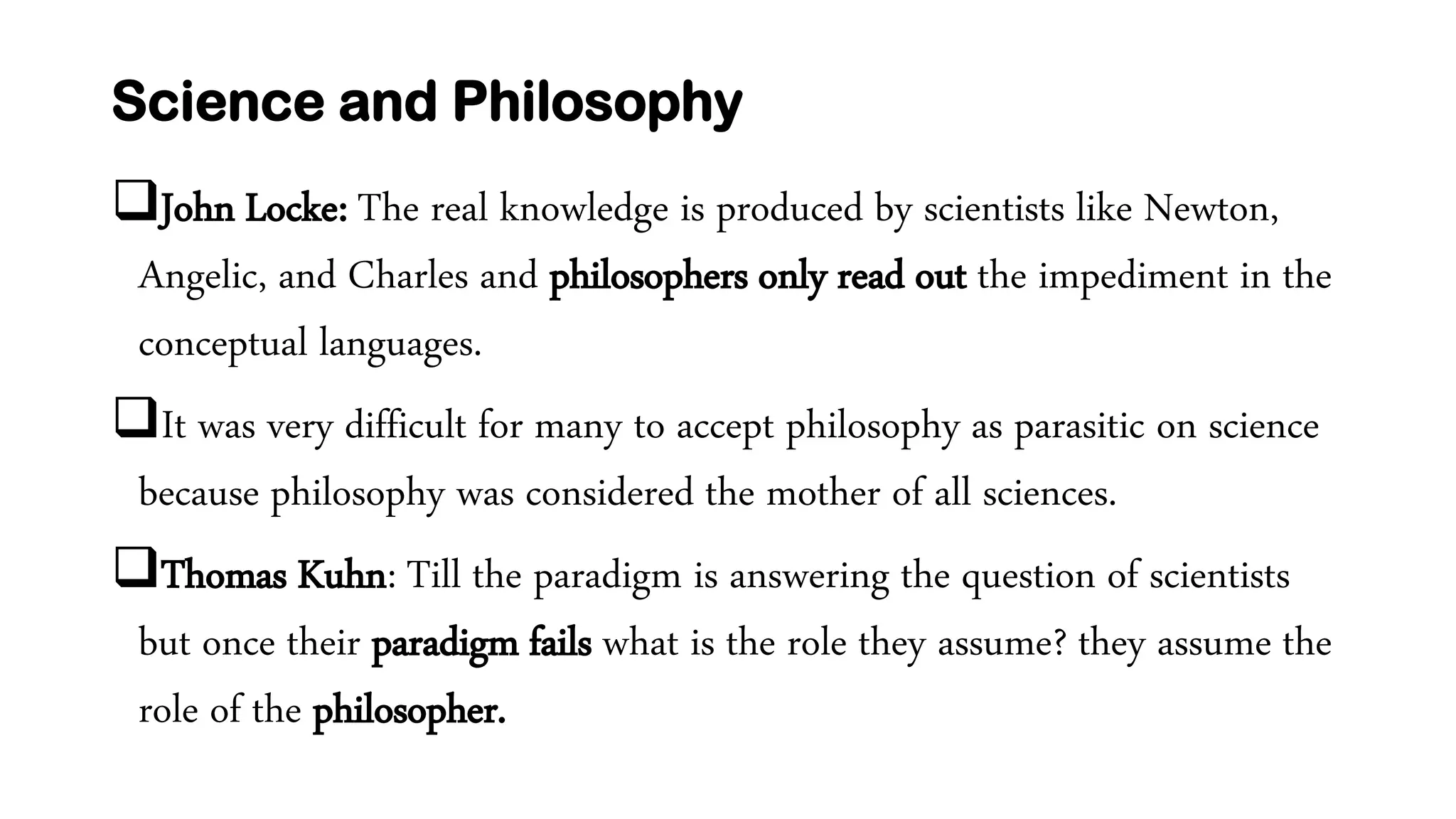
Science and Philosophy
John Locke: The real knowledge is produced by scientists like Newton,
Angelic, and Charles and philosophers only read out the impediment in the
conceptual languages.
It was very difficult for many to accept philosophy as parasitic on science
because philosophy was considered the mother of all sciences.
Thomas Kuhn: Till the paradigm is answering the question of scientists
but once their paradigm fails what is the role they assume? they assume the
role of the philosopher.
Thank You!
Any question?

Thomas Samuel Kuhn (1922–1996): Discourse Analysis: A Paradigm Shift

  • 1.
    Punjabi University,Patiala Department ofSociologyandSocialAnthropology Ph.D. CourseWorkPresentation RecentDevelopmentsin Sociology Dr. DeepakKumar MohammadHadi Movahhed Roll No.2245206
  • 2.
    Thomas Samuel Kuhn(1922–1996) Discourse Analysis; A Paradigm Shift
  • 3.
    Kuhn’s Major Contributions TheStructure of Scientific Revolutions (1962) Kuhn’s contribution to the philosophy of science not only a break with several key positivist doctrines but also inaugurated a new style of philosophy of science that brought it closer to the history of science.  His account of the development of science held that science enjoys periods of stable growth punctuated by revisionary revolutions.  Kuhn added the controversial ‘incommensurability thesis’, that theories from differing periods suffer from certain deep kinds of failure of comparability.
  • 4.
    Life and Career1/2 Thomas Kuhn’s academic life started in physics; He then switched to the history of science, then moved over to the philosophy of science, retaining a strong interest in the history of physics; Master’s degree in physics in 1946, and his doctorate in 1949, also in physics. Until 1956, Kuhn taught a class in science for undergraduates in the humanities; His initial bewilderment on reading the scientific work of Aristotle was a formative experience, followed as it was by a more or less sudden ability to understand Aristotle properly, undistorted by knowledge of subsequent science.
  • 5.
    Life and Career2/2 Moving to the University of California at Berkeley in 1956 and taking up a post in the history of science made him develop an interest in the philosophy of science. He got introduced to the work of Wittgenstein and Paul Feyerabend and started to draft The Structure of Scientific Revolutions. The central idea of this extraordinary book is that the development of science is driven, in normal periods of science, by adherence to what he calls a ‘paradigm’.
  • 6.
    The development ofscience 1/2 •The development of science is not uniform but has alternating ‘normal’ and ‘revolutionary’ (or ‘extraordinary’) phases. •Normal science does resemble the standard cumulative picture of scientific progress, on the surface at least. •normal science as ‘puzzle-solving’ (1962/1970a, 35–42). • Kuhn rejects a teleological view of science progressing towards truth and favours an evolutionary view.
  • 7.
    The development ofscience 2/2  Science improves by allowing its theories to evolve in response to puzzles and progress is measured by its success in solving those puzzles and not by progress toward an ideal true theory.  The revolutionary new theory that succeeds in replacing another that is subject to the crisis, may fail to satisfy all the needs of those working with the earlier theory.
  • 8.
    What Is Paradigm? Paradigmis the accepted examples of actual scientific practices which include law, theory, application, and instrumentation together from which spring particular coherent traditions of scientific research. He argues that disciplines reach maturity only when developing a paradigm. The role of the paradigm is to socialize and enunciate the upcoming generation and scientists in the theory, application, and worldview of the dominant paradigm. Therefore, it determines the method and the goals of the members of the discipline.
  • 9.
    History of Scienceand the Text Book Image 1/2 The history of science should be re-read. The textbook image of science and scientific activity should be reconsidered. The textbook image of science has portrayed scientific development as a uniquely accumulated process. It implies that science has reached the present stage of the efforts of men seeking novelty of facts and theory. This textbook image of science gives science as very prices, authentic and objective knowledge about the natural world.
  • 10.
    History of Scienceand the Text Book Image 2/2 •Kuhn disagrees with this textbook image of science after the history of the development of science. •He examines the historical evidence in the development of science. •He suggests that the members of the paradigm in the dominant discipline are not really seeking to discover new facts. They are trying to prove the same formula and striving to fulfil the original promise of their accepted paradigm by extending the knowledge of those facts which the paradigm has displayed.
  • 11.
    Normal Sciences • Heidentifies two periods in the development of science: Normal science (research firmly based upon one or more past scientific achievements that some particular scientific community acknowledges for a time as supplying the foundation for its further practices). • It is nothing but puzzle-solving. • Normal sciences practitioners do not seek novelty but verify the chosen principles of the paradigm. Like the laws of Einstein, Newton and, …
  • 12.
    Anomaly, Crisis, andIncommensurability Changes only come when anomalies in the existing paradigm emerge and they are not able to resolve by the existing theories, laws, and instruments of the paradigm. Losing the rules in the inherent sciences is accepted to such an extent that an alternative paradigm is suggested. In this competition;  practitioners of certain paradigms do not accept the new paradigm because of incommensurability.  There are existential problems with their paradigm and engagement.
  • 13.
    What is theWay Out? Younger generation will recode the paradigm. There is a struggle in adopting new paradigm but this struggle would not characterized by rational decisions. Too many have built fame and reputation based on their old paradigm and will stick to their own. The partial destruction of original paradigm starts taking place which the start of revolution of science.
  • 14.
    Revolution of Science Inthe same way, the Aristotelian paradigm of explaining the natural world was destructed by Copernicus’s revolution; After Copernic Galileo gave a new paradigm; After Galileo, Newton gave another new paradigm; After Newton, a new paradigm came with Einstein; So, science does not develop with singular accumulate research but by paradigm shift. These shifts are also not scientific in nature because a lot of emotions are involved in the selection or destruction of the old paradigm. This is the important RE-READING of science.
  • 15.
    Science and Philosophy JohnLocke: The real knowledge is produced by scientists like Newton, Angelic, and Charles and philosophers only read out the impediment in the conceptual languages. It was very difficult for many to accept philosophy as parasitic on science because philosophy was considered the mother of all sciences. Thomas Kuhn: Till the paradigm is answering the question of scientists but once their paradigm fails what is the role they assume? they assume the role of the philosopher.
  • 16.
  • 17.