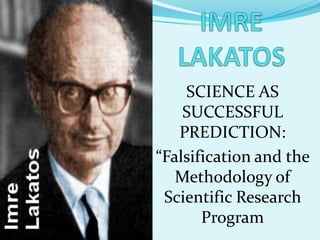
SCIENCE AS
    SUCCESSFUL
   PREDICTION:
“Falsification and the
   Methodology of
 Scientific Research
       Program
PROFILE
 (November 9, 1922 – February 2, 1974)
 born Imre (Avrum) Lipsitz to a Jewish family
    in Debrecen, Hungary
   was a philosopher of mathematics and science
   received a degree in mathematics, physics,
    and philosophy from the University of Debrecen in
    1944
   He became an active communist during the Second
    World War
    He changed his last name once again
    to Lakatos (Locksmith) in honor of Géza Lakatos
 After the Soviet Union invaded Hungary in November
  1956, Lakatos fled to Vienna, and later reached
  England. He received a doctorate in philosophy in 1961
  from the University of Cambridge. The book Proofs
  and Refutations: The Logic of Mathematical
  Discovery, published after his death, is based on this
  work.
 Lakatos never obtained British Citizenship, in effect
  remaining stateless.
Science:
Reason or
Religion?
For Centuries, Knowledge


meant Proven Knowledge.
Popper
- Falsifiability Method
     - virtue lies not in caution in
avoiding errors, but in ruthlessness
in eliminating them (Freudan and
Marxist Errors)
     - Belief may be a regrettably
unavoidable biological weakness to
be kept under the control of
criticism.
     - Commitment is for
Popper, an outright crime.
Kuhn                          Popper
 Revolution is
    exceptional, extra-       •Revolution is
    scientific                permanence
   Criticism is, in normal
    times, anathema.          •Criticism is the heart
   Transition from           of the scientific
    Criticism to
    Commitment marks the      enterprise
    point where progress      •“Logic of Discovery”
    and normal science
    begins.
   New Theories only
    emerge where ``crisis``
    begins
   ``Psychology of
    Discovery``
     Truth lies on power
     Religious Change
Fallabilism vs.
  Falsificationism
 Sophisticated versus Naive
Methodological Falsificationism.
Progressive and Degenerating
        Problemshifts
Sophisticated versus
        Naive
  Methodological
  Falsificationism.
Differs from its rules of
       acceptance
      (demarcation
    criterion) and its
  rules of falsification
     or elimination
Naive
                                  Sophisticated
Falsificationist                  Falsificationist
 Any theory which can be     • A theory is
 interpreted as                 "acceptable" or
 experimentally
 falsifiable, is "acceptable"
                                "scientific" only if it has
 or "scientific."               corroborated excess
                                empirical content over
                                its predecessor (or
                                rival), that is, only if it
                                leads to the discovery
                                of novel facts.
• This condition can be
  analyzed into two
  clauses: that the new
  theory has excess
  empirical content
  ("acceptability"1) and
  that some of this excess
  empirical content is
  verified
  ("acceptability"2). The
  first clause can be
  checked instantly by a
  priori logical analysis;
  the second can be
  checked only
  empirically and this
  may take an indefinite
  time.
 A theory             • regards a scientific
 is falsified by a       theory T as
 "(fortified)            falsified if and only
 observational"          if another
 statement which         theory T' has been
 conflicts with it (or
                         proposed with the
 rather, which he
 decides to
                         following
 interpret as            characteristics:
 conflicting with
 it).
(1) T' has excess empirical content over T:
  that is, it predicts novel facts, that is, facts
  improbable in the light of, or even
  forbidden, by T,
(2) T' explains the previous success
  of T, that is, all the unrefuted content
  of T is contained (within the limits of
  observational error) in the content of T';
  and
(3) some of the excess content of T' is
  corroborated.
Excess Empirical Content


                  New
     PROGRESSIVE (or constitutes a
                  Fact!!
  theoretically progressive problemshift
EMPIRICALLYPROGRESSIVE (or constitutes an
    empirically progressive problemshift
PROBLEMSHIFT
 Progressive if both empirically and theoretically
  progressive
 Accept if they are at least theoretically progressive
 “FALSIFIED”
 “Degenerating” if it is not.
 “Reject” if not and termed as “Pseudoscience.”
 Progress is measured by the degree to which a
  problemshift is progressive, by the degree to which
  the series of theories leads us to the discovery of
  novel facts. We regard a theory in the series
  "falsified" when it is superseded by a theory with
  higher corroborated content.
A given fact is
      explained
scientifically only if a
    new fact s also
  explained with it.
Sophisticated
Falsificationism          Only a series of
                        theories can be said
                         to be scientific or
                        unscientific: to apply
                               Theories
                           them the term
                            "scientific" to
Theories                one single theory is a
                         category mistake.


                   Theories
Revised Methodological
Falsificationism Features:
 it denies that "in the case of a scientific theory, our
  decision depends upon the result of experiments.
 It denies that "what ultimately decides the fate of a
  theory is the result of the test, i.e., an agreement
  about basic statements.
 Contrary to naive falsificationism, no
  experiment, experimental
  report, observation statement or well-corroborated
  low-level falsifying hypothesis alone can lead to
  falsification. There is no falsification before the
  emergence of a better theory.
 Falsification can thus be said to have a "historical
  character.”
 Some of the theories which bring about
  falsification are frequently proposed after the
  "counterevidence."
Thus the crucial
       element in
  falsificationism is
   whether the new
   theory offers any
     novel, excess
      information
 compared with its
   predecessor and
whether some of this
excess information is
     corroborated.
Confirming
Refutation
      Naive
Falsificationists
Methodological
 Fasificationist
The rather rare
 excess information
 which are the
 crucial ones
 receives the
 attention.
Falsification in the Sense of naive
falsificationism
 Not sufficient condition for eliminating a specific
  theory
 Falsification is not necessary for Sophisticated
  Falsification: a progressive problemshift does not have
  to be interspersed with ‘refutations.’
Sophisticated Falisificationism
“Proliferation of theories” is
 important
Stresses that the urgency of
 replacing any hypothesis by a
 better one.
THE POPPERIAN
VERSUS THE KUHNIAN
RESEARCH PROGRAM
KUHN
 In Kuhn’s view there can be
  no logic, but only
  psychology of discovery.
 Scientific revolution is
  irrational, matter of mob
  psychology.

Imre lakatos

  • 2.
    SCIENCE AS SUCCESSFUL PREDICTION: “Falsification and the Methodology of Scientific Research Program
  • 3.
    PROFILE  (November 9,1922 – February 2, 1974)  born Imre (Avrum) Lipsitz to a Jewish family in Debrecen, Hungary  was a philosopher of mathematics and science  received a degree in mathematics, physics, and philosophy from the University of Debrecen in 1944  He became an active communist during the Second World War  He changed his last name once again to Lakatos (Locksmith) in honor of Géza Lakatos
  • 4.
     After theSoviet Union invaded Hungary in November 1956, Lakatos fled to Vienna, and later reached England. He received a doctorate in philosophy in 1961 from the University of Cambridge. The book Proofs and Refutations: The Logic of Mathematical Discovery, published after his death, is based on this work.  Lakatos never obtained British Citizenship, in effect remaining stateless.
  • 5.
  • 6.
  • 8.
    Popper - Falsifiability Method - virtue lies not in caution in avoiding errors, but in ruthlessness in eliminating them (Freudan and Marxist Errors) - Belief may be a regrettably unavoidable biological weakness to be kept under the control of criticism. - Commitment is for Popper, an outright crime.
  • 9.
    Kuhn Popper  Revolution is exceptional, extra- •Revolution is scientific permanence  Criticism is, in normal times, anathema. •Criticism is the heart  Transition from of the scientific Criticism to Commitment marks the enterprise point where progress •“Logic of Discovery” and normal science begins.  New Theories only emerge where ``crisis`` begins  ``Psychology of Discovery``  Truth lies on power  Religious Change
  • 10.
    Fallabilism vs. Falsificationism Sophisticated versus Naive Methodological Falsificationism. Progressive and Degenerating Problemshifts
  • 11.
    Sophisticated versus Naive Methodological Falsificationism. Differs from its rules of acceptance (demarcation criterion) and its rules of falsification or elimination
  • 12.
    Naive Sophisticated Falsificationist Falsificationist  Any theory which can be • A theory is interpreted as "acceptable" or experimentally falsifiable, is "acceptable" "scientific" only if it has or "scientific." corroborated excess empirical content over its predecessor (or rival), that is, only if it leads to the discovery of novel facts.
  • 13.
    • This conditioncan be analyzed into two clauses: that the new theory has excess empirical content ("acceptability"1) and that some of this excess empirical content is verified ("acceptability"2). The first clause can be checked instantly by a priori logical analysis; the second can be checked only empirically and this may take an indefinite time.
  • 14.
     A theory • regards a scientific is falsified by a theory T as "(fortified) falsified if and only observational" if another statement which theory T' has been conflicts with it (or proposed with the rather, which he decides to following interpret as characteristics: conflicting with it).
  • 15.
    (1) T' hasexcess empirical content over T: that is, it predicts novel facts, that is, facts improbable in the light of, or even forbidden, by T, (2) T' explains the previous success of T, that is, all the unrefuted content of T is contained (within the limits of observational error) in the content of T'; and (3) some of the excess content of T' is corroborated.
  • 16.
    Excess Empirical Content New PROGRESSIVE (or constitutes a Fact!! theoretically progressive problemshift EMPIRICALLYPROGRESSIVE (or constitutes an empirically progressive problemshift
  • 17.
    PROBLEMSHIFT  Progressive ifboth empirically and theoretically progressive  Accept if they are at least theoretically progressive  “FALSIFIED”  “Degenerating” if it is not.  “Reject” if not and termed as “Pseudoscience.”  Progress is measured by the degree to which a problemshift is progressive, by the degree to which the series of theories leads us to the discovery of novel facts. We regard a theory in the series "falsified" when it is superseded by a theory with higher corroborated content.
  • 18.
    A given factis explained scientifically only if a new fact s also explained with it.
  • 19.
    Sophisticated Falsificationism Only a series of theories can be said to be scientific or unscientific: to apply Theories them the term "scientific" to Theories one single theory is a category mistake. Theories
  • 20.
    Revised Methodological Falsificationism Features: it denies that "in the case of a scientific theory, our decision depends upon the result of experiments.  It denies that "what ultimately decides the fate of a theory is the result of the test, i.e., an agreement about basic statements.  Contrary to naive falsificationism, no experiment, experimental report, observation statement or well-corroborated low-level falsifying hypothesis alone can lead to falsification. There is no falsification before the emergence of a better theory.
  • 21.
     Falsification canthus be said to have a "historical character.”  Some of the theories which bring about falsification are frequently proposed after the "counterevidence."
  • 22.
    Thus the crucial element in falsificationism is whether the new theory offers any novel, excess information compared with its predecessor and whether some of this excess information is corroborated.
  • 23.
  • 24.
    Refutation Naive Falsificationists
  • 25.
    Methodological Fasificationist The ratherrare excess information which are the crucial ones receives the attention.
  • 26.
    Falsification in theSense of naive falsificationism  Not sufficient condition for eliminating a specific theory  Falsification is not necessary for Sophisticated Falsification: a progressive problemshift does not have to be interspersed with ‘refutations.’
  • 27.
    Sophisticated Falisificationism “Proliferation oftheories” is important Stresses that the urgency of replacing any hypothesis by a better one.
  • 28.
    THE POPPERIAN VERSUS THEKUHNIAN RESEARCH PROGRAM
  • 29.
    KUHN  In Kuhn’sview there can be no logic, but only psychology of discovery.  Scientific revolution is irrational, matter of mob psychology.