Teaching-Learning Methods to Cultivate
Skills for Patient Centred Care (PCC)
An oration to be delivered on 22-07-2020 for the Dept
of Medical Education, JIPMER. India.
By Prof K.R. Sethuraman.
Dean of Medicine, AIMST University, Malaysia.
{ a JIPMERian for 40 years}
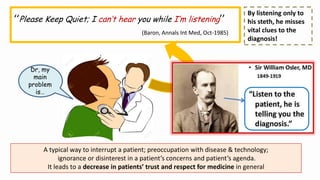
‘‘Please Keep Quiet; I can’t hear you while I’m listening’’
(Baron, Annals Int Med, Oct-1985)
A typical way to interrupt a patient; preoccupation with disease & technology;
ignorance or disinterest in a patient’s concerns and patient’s agenda.
It leads to a decrease in patients’ trust and respect for medicine in general
Dr, my
main
problem
is…
By listening only to
his steth, he misses
vital clues to the
diagnosis!
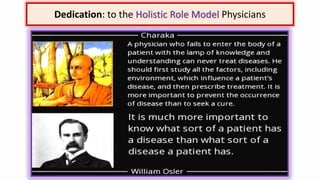
Dedication: to the Holistic Role Model Physicians
My Agenda Today…
• To introduce the concept of Patient Centred Care (PCC) from the
viewpoints of various stakeholders
• To discuss PCC as a System at Macro, Meso and Micro levels
• To highlight the importance of Humanistic approach as the great
motivator that drives PCC
• To discuss the communication strategies, which help mediate and deliver
PCC
• To consider various options for teaching-learning of PCC
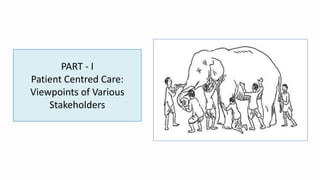
PART - I
Patient Centred Care:
Viewpoints of Various
Stakeholders
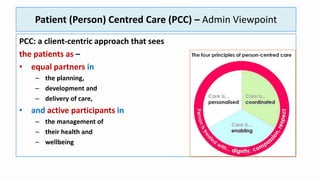
Patient (Person) Centred Care (PCC) – Admin Viewpoint
PCC: a client-centric approach that sees
the patients as –
• equal partners in
– the planning,
– development and
– delivery of care,
• and active participants in
– the management of
– their health and
– wellbeing
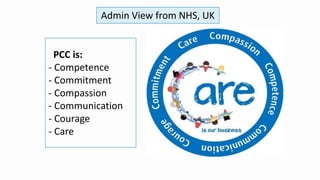
PCC is:
- Competence
- Commitment
- Compassion
- Communication
- Courage
- Care
Admin View from NHS, UK
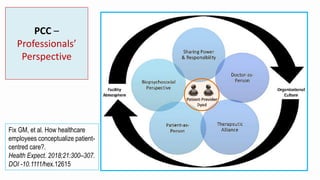
PCC –
Professionals’
Perspective
Fix GM, et al. How healthcare
employees conceptualize patient-
centred care?.
Health Expect. 2018;21:300–307.
DOI -10.1111/hex.12615
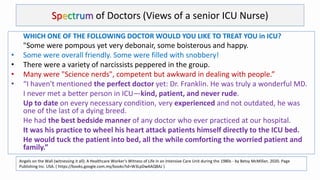
Spectrum of Doctors (Views of a senior ICU Nurse)
WHICH ONE OF THE FOLLOWING DOCTOR WOULD YOU LIKE TO TREAT YOU in ICU?
"Some were pompous yet very debonair, some boisterous and happy.
• Some were overall friendly. Some were filled with snobbery!
• There were a variety of narcissists peppered in the group.
• Many were "Science nerds", competent but awkward in dealing with people.”
• “I haven't mentioned the perfect doctor yet: Dr. Franklin. He was truly a wonderful MD.
I never met a better person in ICU—kind, patient, and never rude.
Up to date on every necessary condition, very experienced and not outdated, he was
one of the last of a dying breed.
He had the best bedside manner of any doctor who ever practiced at our hospital.
It was his practice to wheel his heart attack patients himself directly to the ICU bed.
He would tuck the patient into bed, all the while comforting the worried patient and
family.”
Angels on the Wall (witnessing it all): A Healthcare Worker's Witness of Life in an Intensive Care Unit during the 1980s - by Betsy McMillan. 2020. Page
Publishing Inc. USA. ( https://books.google.com.my/books?id=W3LpDwAAQBAJ )
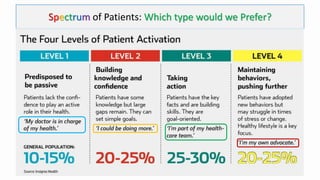
Spectrum of Patients: Which type would we Prefer?
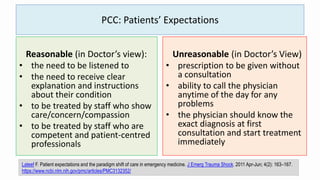
PCC: Patients’ Expectations
Reasonable (in Doctor’s view):
• the need to be listened to
• the need to receive clear
explanation and instructions
about their condition
• to be treated by staff who show
care/concern/compassion
• to be treated by staff who are
competent and patient-centred
professionals
Unreasonable (in Doctor’s View)
• prescription to be given without
a consultation
• ability to call the physician
anytime of the day for any
problems
• the physician should know the
exact diagnosis at first
consultation and start treatment
immediately
Lateef F. Patient expectations and the paradigm shift of care in emergency medicine. J Emerg Trauma Shock. 2011 Apr-Jun; 4(2): 163–167.
https://www.ncbi.nlm.nih.gov/pmc/articles/PMC3132352/
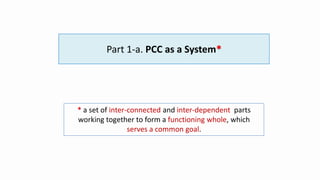
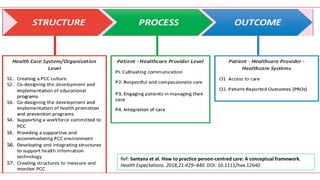
Part 1-a. PCC as a System*
* a set of inter-connected and inter-dependent parts
working together to form a functioning whole, which
serves a common goal.
Ref: Santana et al. How to practice person-centred care: A conceptual framework.
Health Expectations. 2018;21:429–440. DOI: 10.1111/hex.12640
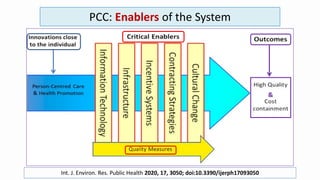
PCC: Enablers of the System
Int. J. Environ. Res. Public Health 2020, 17, 3050; doi:10.3390/ijerph17093050
&
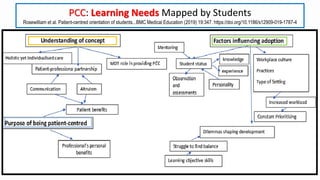
PCC: Learning Needs Mapped by Students
Rosewilliam et al. Patient-centred orientation of students...BMC Medical Education (2019) 19:347. https://doi.org/10.1186/s12909-019-1787-4
PART – II
The Relevance of
Humanism and Communication Skills
to Compassionate PCC
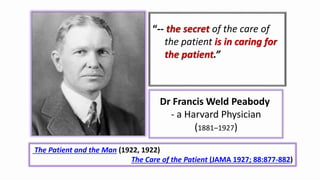
Dr Francis Weld Peabody
- a Harvard Physician
(1881–1927)
“-- the secret of the care of
the patient is in caring for
the patient.”
The Patient and the Man (1922, 1922)
The Care of the Patient (JAMA 1927; 88:877-882)
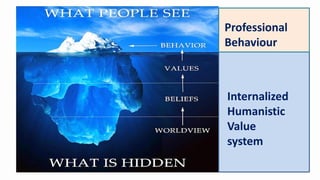
Professional
Behaviour
Internalized
Humanistic
Value
system
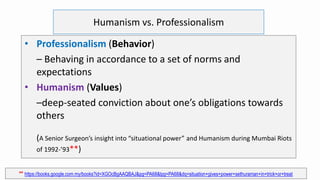
Humanism vs. Professionalism
• Professionalism (Behavior)
– Behaving in accordance to a set of norms and
expectations
• Humanism (Values)
–deep-seated conviction about one’s obligations towards
others
(A Senior Surgeon’s insight into “situational power” and Humanism during Mumbai Riots
of 1992-’93**)
** https://books.google.com.my/books?id=XGOcBgAAQBAJ&pg=PA68&lpg=PA68&dq=situation+gives+power+sethuraman+in+trick+or+treat
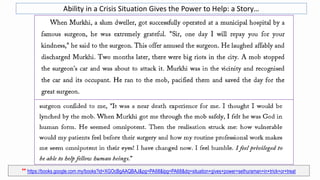
Ability in a Crisis Situation Gives the Power to Help: a Story…
** https://books.google.com.my/books?id=XGOcBgAAQBAJ&pg=PA68&lpg=PA68&dq=situation+gives+power+sethuraman+in+trick+or+treat
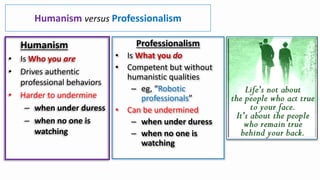
Humanism versus Professionalism
Humanism
• Is Who you are
• Drives authentic
professional behaviors
• Harder to undermine
– when under duress
– when no one is
watching
Professionalism
• Is What you do
• Competent but without
humanistic qualities
– eg, “Robotic
professionals”
• Can be undermined
– when under duress
– when no one is
watching
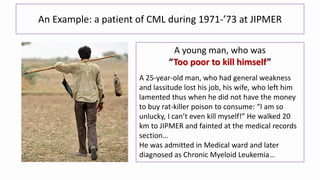
An Example: a patient of CML during 1971-’73 at JIPMER
A young man, who was
“Too poor to kill himself”
A 25-year-old man, who had general weakness
and lassitude lost his job, his wife, who left him
lamented thus when he did not have the money
to buy rat-killer poison to consume: “I am so
unlucky, I can’t even kill myself!” He walked 20
km to JIPMER and fainted at the medical records
section…
He was admitted in Medical ward and later
diagnosed as Chronic Myeloid Leukemia…
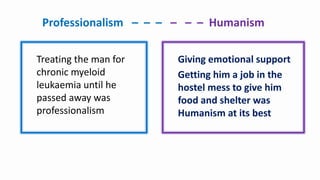
Professionalism – – – – – – Humanism
Treating the man for
chronic myeloid
leukaemia until he
passed away was
professionalism
Giving emotional support
Getting him a job in the
hostel mess to give him
food and shelter was
Humanism at its best
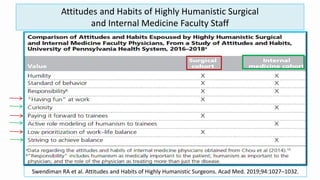
Attitudes and Habits of Highly Humanistic Surgical
and Internal Medicine Faculty Staff
Swendiman RA et al. Attitudes and Habits of Highly Humanistic Surgeons. Acad Med. 2019;94:1027–1032.
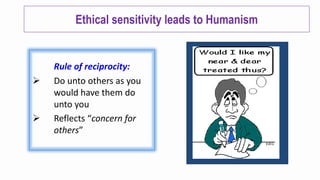
Ethical sensitivity leads to Humanism
Rule of reciprocity:
➢ Do unto others as you
would have them do
unto you
➢ Reflects “concern for
others”
Part-II B
Communication Skills
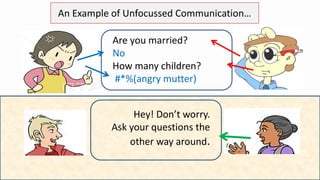
An Example of Unfocussed Communication…
Are you married?
No
How many children?
#*%(angry mutter)
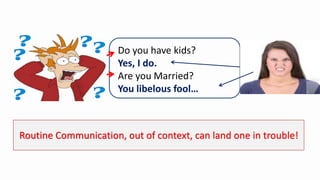
Do you have kids
Yes, I do.
Are you Married?
You libelous fool…
Hey! Don’t worry.
Ask your questions the
other way around.
Routine Communication, out of context, can land one in trouble!
Do you have kids?
Yes, I do.
Are you Married?
You libelous fool…
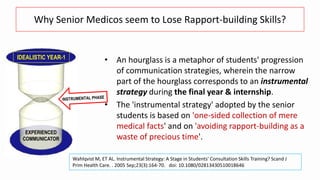
IDEALISTIC YEAR-1
EXPERIENCED
COMMUNICATOR
Why Senior Medicos seem to Lose Rapport-building Skills?
• An hourglass is a metaphor of students' progression
of communication strategies, wherein the narrow
part of the hourglass corresponds to an instrumental
strategy during the final year & internship.
• The 'instrumental strategy' adopted by the senior
students is based on 'one-sided collection of mere
medical facts' and on 'avoiding rapport-building as a
waste of precious time'.
Wahlqvist M, ET AL. Instrumental Strategy: A Stage in Students' Consultation Skills Training? Scand J
Prim Health Care. . 2005 Sep;23(3):164-70. doi: 10.1080/02813430510018646
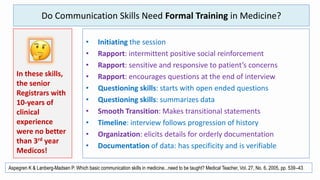
Do Communication Skills Need Formal Training in Medicine?
• Initiating the session
• Rapport: intermittent positive social reinforcement
• Rapport: sensitive and responsive to patient’s concerns
• Rapport: encourages questions at the end of interview
• Questioning skills: starts with open ended questions
• Questioning skills: summarizes data
• Smooth Transition: Makes transitional statements
• Timeline: interview follows progression of history
• Organization: elicits details for orderly documentation
• Documentation of data: has specificity and is verifiable
Aspegren K & Lønberg-Madsen P. Which basic communication skills in medicine...need to be taught? Medical Teacher, Vol. 27, No. 6, 2005, pp. 539–43
In these skills,
the senior
Registrars with
10-years of
clinical
experience
were no better
than 3rd year
Medicos!
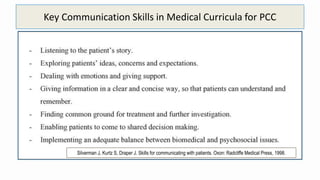
Key Communication Skills in Medical Curricula for PCC
Silverman J, Kurtz S, Draper J. Skills for communicating with patients. Oxon: Radcliffe Medical Press, 1998.
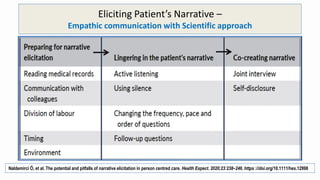
Eliciting Patient’s Narrative –
Empathic communication with Scientific approach
Naldemirci Ö, et al. The potential and pitfalls of narrative elicitation in person centred care. Health Expect. 2020;23:238–246. https ://doi.org/10.1111/hex.12998
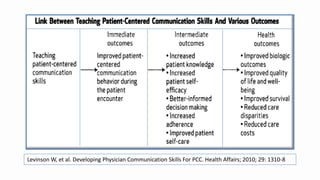
Levinson W, et al. Developing Physician Communication Skills For PCC. Health Affairs; 2010; 29: 1310-8
T-L Strategies to Foster Holistic Approach,
Communication Skills and
Attitude to Compassionate PCC
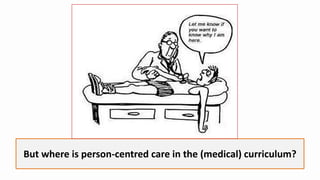
But where is person-centred care in the (medical) curriculum?
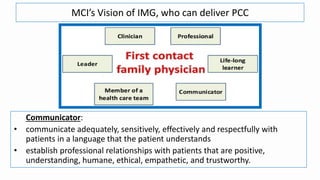
MCI’s Vision of IMG, who can deliver PCC
Communicator:
• communicate adequately, sensitively, effectively and respectfully with
patients in a language that the patient understands
• establish professional relationships with patients that are positive,
understanding, humane, ethical, empathetic, and trustworthy.
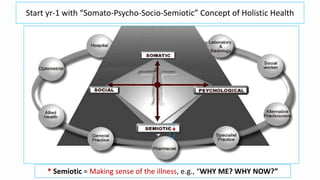
Start yr-1 with “Somato-Psycho-Socio-Semiotic” Concept of Holistic Health
*
* Semiotic = Making sense of the illness, e.g., “WHY ME? WHY NOW?”
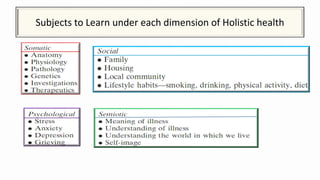
Subjects to Learn under each dimension of Holistic health
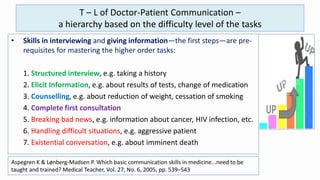
T – L of Doctor-Patient Communication –
a hierarchy based on the difficulty level of the tasks
• Skills in interviewing and giving information—the first steps—are pre-
requisites for mastering the higher order tasks:
1. Structured interview, e.g. taking a history
2. Elicit Information, e.g. about results of tests, change of medication
3. Counselling, e.g. about reduction of weight, cessation of smoking
4. Complete first consultation
5. Breaking bad news, e.g. information about cancer, HIV infection, etc.
6. Handling difficult situations, e.g. aggressive patient
7. Existential conversation, e.g. about imminent death
Aspegren K & Lønberg-Madsen P. Which basic communication skills in medicine...need to be
taught and trained? Medical Teacher, Vol. 27, No. 6, 2005, pp. 539–543
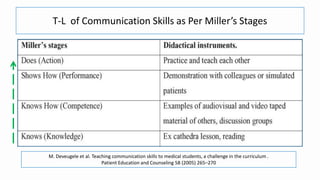
T-L of Communication Skills as Per Miller’s Stages
M. Deveugele et al. Teaching communication skills to medical students, a challenge in the curriculum .
Patient Education and Counseling 58 (2005) 265–270
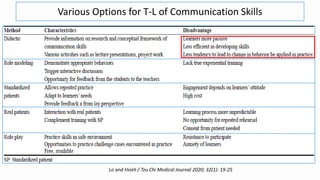
Various Options for T-L of Communication Skills
Lo and Hsieh / Tzu Chi Medical Journal 2020; 32(1): 19-25
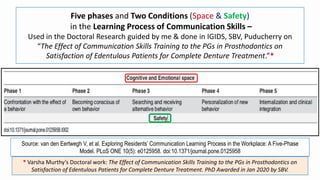
Five phases and Two Conditions (Space & Safety)
in the Learning Process of Communication Skills –
Used in the Doctoral Research guided by me & done in IGIDS, SBV, Puducherry on
“The Effect of Communication Skills Training to the PGs in Prosthodontics on
Satisfaction of Edentulous Patients for Complete Denture Treatment.”*
Source: van den Eertwegh V, et al. Exploring Residents’ Communication Learning Process in the Workplace: A Five-Phase
Model. PLoS ONE 10(5): e0125958. doi:10.1371/journal.pone.0125958
* Varsha Murthy’s Doctoral work: The Effect of Communication Skills Training to the PGs in Prosthodontics on
Satisfaction of Edentulous Patients for Complete Denture Treatment. PhD Awarded in Jan 2020 by SBV.
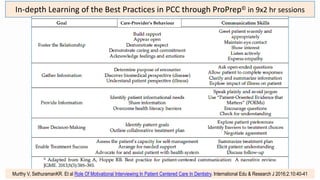
In-depth Learning of the Best Practices in PCC through ProPrep© in 9x2 hr sessions
Care-Provider’s Behaviour
Murthy V, SethuramanKR. Et al Role Of Motivational Interviewing In Patient Centered Care In Dentistry. International Edu & Research J 2016;2.10:40-41
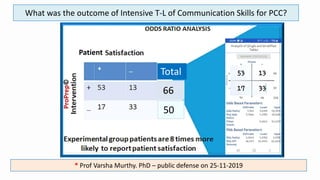
What was the outcome of Intensive T-L of Communication Skills for PCC?
Total
66
50
Patient
* Prof Varsha Murthy. PhD – public defense on 25-11-2019
ProPrep©
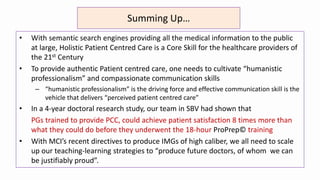
Summing Up…
• With semantic search engines providing all the medical information to the public
at large, Holistic Patient Centred Care is a Core Skill for the healthcare providers of
the 21st Century
• To provide authentic Patient centred care, one needs to cultivate “humanistic
professionalism” and compassionate communication skills
– “humanistic professionalism” is the driving force and effective communication skill is the
vehicle that delivers “perceived patient centred care”
• In a 4-year doctoral research study, our team in SBV had shown that
PGs trained to provide PCC, could achieve patient satisfaction 8 times more than
what they could do before they underwent the 18-hour ProPrep© training
• With MCI’s recent directives to produce IMGs of high caliber, we all need to scale
up our teaching-learning strategies to “produce future doctors, of whom we can
be justifiably proud”.
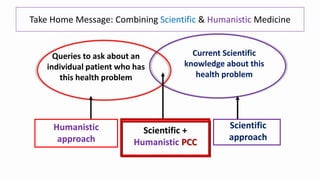
Queries to ask about an
individual patient who has
this health problem
Current Scientific
knowledge about this
health problem
Humanistic
approach
Scientific
approach
Scientific +
Humanistic PCC
Take Home Message: Combining Scientific & Humanistic Medicine
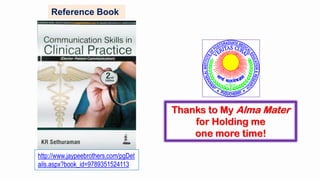
Reference Book
http://www.jaypeebrothers.com/pgDet
ails.aspx?book_id=9789351524113
Thanks to My Alma Mater
for Holding me
one more time!
Thank You All, For
Patient Listening!
Mail to: dean.aimst@gmail.com
வணக்கம்
TERIMA KASIH

Teaching learning methods for patient centred care

  • 1.
    Teaching-Learning Methods toCultivate Skills for Patient Centred Care (PCC) An oration to be delivered on 22-07-2020 for the Dept of Medical Education, JIPMER. India. By Prof K.R. Sethuraman. Dean of Medicine, AIMST University, Malaysia. { a JIPMERian for 40 years}
  • 2.
    ‘‘Please Keep Quiet;I can’t hear you while I’m listening’’ (Baron, Annals Int Med, Oct-1985) A typical way to interrupt a patient; preoccupation with disease & technology; ignorance or disinterest in a patient’s concerns and patient’s agenda. It leads to a decrease in patients’ trust and respect for medicine in general Dr, my main problem is… By listening only to his steth, he misses vital clues to the diagnosis!
  • 3.
    Dedication: to theHolistic Role Model Physicians
  • 4.
    My Agenda Today… •To introduce the concept of Patient Centred Care (PCC) from the viewpoints of various stakeholders • To discuss PCC as a System at Macro, Meso and Micro levels • To highlight the importance of Humanistic approach as the great motivator that drives PCC • To discuss the communication strategies, which help mediate and deliver PCC • To consider various options for teaching-learning of PCC
  • 5.
    PART - I PatientCentred Care: Viewpoints of Various Stakeholders
  • 6.
    Patient (Person) CentredCare (PCC) – Admin Viewpoint PCC: a client-centric approach that sees the patients as – • equal partners in – the planning, – development and – delivery of care, • and active participants in – the management of – their health and – wellbeing
  • 7.
    PCC is: - Competence -Commitment - Compassion - Communication - Courage - Care Admin View from NHS, UK
  • 8.
    PCC – Professionals’ Perspective Fix GM,et al. How healthcare employees conceptualize patient- centred care?. Health Expect. 2018;21:300–307. DOI -10.1111/hex.12615
  • 9.
    Spectrum of Doctors(Views of a senior ICU Nurse) WHICH ONE OF THE FOLLOWING DOCTOR WOULD YOU LIKE TO TREAT YOU in ICU? "Some were pompous yet very debonair, some boisterous and happy. • Some were overall friendly. Some were filled with snobbery! • There were a variety of narcissists peppered in the group. • Many were "Science nerds", competent but awkward in dealing with people.” • “I haven't mentioned the perfect doctor yet: Dr. Franklin. He was truly a wonderful MD. I never met a better person in ICU—kind, patient, and never rude. Up to date on every necessary condition, very experienced and not outdated, he was one of the last of a dying breed. He had the best bedside manner of any doctor who ever practiced at our hospital. It was his practice to wheel his heart attack patients himself directly to the ICU bed. He would tuck the patient into bed, all the while comforting the worried patient and family.” Angels on the Wall (witnessing it all): A Healthcare Worker's Witness of Life in an Intensive Care Unit during the 1980s - by Betsy McMillan. 2020. Page Publishing Inc. USA. ( https://books.google.com.my/books?id=W3LpDwAAQBAJ )
  • 10.
    Spectrum of Patients:Which type would we Prefer?
  • 11.
    PCC: Patients’ Expectations Reasonable(in Doctor’s view): • the need to be listened to • the need to receive clear explanation and instructions about their condition • to be treated by staff who show care/concern/compassion • to be treated by staff who are competent and patient-centred professionals Unreasonable (in Doctor’s View) • prescription to be given without a consultation • ability to call the physician anytime of the day for any problems • the physician should know the exact diagnosis at first consultation and start treatment immediately Lateef F. Patient expectations and the paradigm shift of care in emergency medicine. J Emerg Trauma Shock. 2011 Apr-Jun; 4(2): 163–167. https://www.ncbi.nlm.nih.gov/pmc/articles/PMC3132352/
  • 12.
    Part 1-a. PCCas a System* * a set of inter-connected and inter-dependent parts working together to form a functioning whole, which serves a common goal.
  • 13.
    Ref: Santana etal. How to practice person-centred care: A conceptual framework. Health Expectations. 2018;21:429–440. DOI: 10.1111/hex.12640
  • 14.
    PCC: Enablers ofthe System Int. J. Environ. Res. Public Health 2020, 17, 3050; doi:10.3390/ijerph17093050 &
  • 15.
    PCC: Learning NeedsMapped by Students Rosewilliam et al. Patient-centred orientation of students...BMC Medical Education (2019) 19:347. https://doi.org/10.1186/s12909-019-1787-4
  • 16.
    PART – II TheRelevance of Humanism and Communication Skills to Compassionate PCC
  • 17.
    Dr Francis WeldPeabody - a Harvard Physician (1881–1927) “-- the secret of the care of the patient is in caring for the patient.” The Patient and the Man (1922, 1922) The Care of the Patient (JAMA 1927; 88:877-882)
  • 18.
  • 19.
    Humanism vs. Professionalism •Professionalism (Behavior) – Behaving in accordance to a set of norms and expectations • Humanism (Values) –deep-seated conviction about one’s obligations towards others (A Senior Surgeon’s insight into “situational power” and Humanism during Mumbai Riots of 1992-’93**) ** https://books.google.com.my/books?id=XGOcBgAAQBAJ&pg=PA68&lpg=PA68&dq=situation+gives+power+sethuraman+in+trick+or+treat
  • 20.
    Ability in aCrisis Situation Gives the Power to Help: a Story… ** https://books.google.com.my/books?id=XGOcBgAAQBAJ&pg=PA68&lpg=PA68&dq=situation+gives+power+sethuraman+in+trick+or+treat
  • 21.
    Humanism versus Professionalism Humanism •Is Who you are • Drives authentic professional behaviors • Harder to undermine – when under duress – when no one is watching Professionalism • Is What you do • Competent but without humanistic qualities – eg, “Robotic professionals” • Can be undermined – when under duress – when no one is watching
  • 22.
    An Example: apatient of CML during 1971-’73 at JIPMER A young man, who was “Too poor to kill himself” A 25-year-old man, who had general weakness and lassitude lost his job, his wife, who left him lamented thus when he did not have the money to buy rat-killer poison to consume: “I am so unlucky, I can’t even kill myself!” He walked 20 km to JIPMER and fainted at the medical records section… He was admitted in Medical ward and later diagnosed as Chronic Myeloid Leukemia…
  • 23.
    Professionalism – –– – – – Humanism Treating the man for chronic myeloid leukaemia until he passed away was professionalism Giving emotional support Getting him a job in the hostel mess to give him food and shelter was Humanism at its best
  • 24.
    Attitudes and Habitsof Highly Humanistic Surgical and Internal Medicine Faculty Staff Swendiman RA et al. Attitudes and Habits of Highly Humanistic Surgeons. Acad Med. 2019;94:1027–1032.
  • 25.
    Ethical sensitivity leadsto Humanism Rule of reciprocity: ➢ Do unto others as you would have them do unto you ➢ Reflects “concern for others”
  • 26.
  • 27.
    An Example ofUnfocussed Communication… Are you married? No How many children? #*%(angry mutter) Do you have kids Yes, I do. Are you Married? You libelous fool… Hey! Don’t worry. Ask your questions the other way around.
  • 28.
    Routine Communication, outof context, can land one in trouble! Do you have kids? Yes, I do. Are you Married? You libelous fool…
  • 29.
    IDEALISTIC YEAR-1 EXPERIENCED COMMUNICATOR Why SeniorMedicos seem to Lose Rapport-building Skills? • An hourglass is a metaphor of students' progression of communication strategies, wherein the narrow part of the hourglass corresponds to an instrumental strategy during the final year & internship. • The 'instrumental strategy' adopted by the senior students is based on 'one-sided collection of mere medical facts' and on 'avoiding rapport-building as a waste of precious time'. Wahlqvist M, ET AL. Instrumental Strategy: A Stage in Students' Consultation Skills Training? Scand J Prim Health Care. . 2005 Sep;23(3):164-70. doi: 10.1080/02813430510018646
  • 30.
    Do Communication SkillsNeed Formal Training in Medicine? • Initiating the session • Rapport: intermittent positive social reinforcement • Rapport: sensitive and responsive to patient’s concerns • Rapport: encourages questions at the end of interview • Questioning skills: starts with open ended questions • Questioning skills: summarizes data • Smooth Transition: Makes transitional statements • Timeline: interview follows progression of history • Organization: elicits details for orderly documentation • Documentation of data: has specificity and is verifiable Aspegren K & Lønberg-Madsen P. Which basic communication skills in medicine...need to be taught? Medical Teacher, Vol. 27, No. 6, 2005, pp. 539–43 In these skills, the senior Registrars with 10-years of clinical experience were no better than 3rd year Medicos!
  • 31.
    Key Communication Skillsin Medical Curricula for PCC Silverman J, Kurtz S, Draper J. Skills for communicating with patients. Oxon: Radcliffe Medical Press, 1998.
  • 32.
    Eliciting Patient’s Narrative– Empathic communication with Scientific approach Naldemirci Ö, et al. The potential and pitfalls of narrative elicitation in person centred care. Health Expect. 2020;23:238–246. https ://doi.org/10.1111/hex.12998
  • 33.
    Levinson W, etal. Developing Physician Communication Skills For PCC. Health Affairs; 2010; 29: 1310-8
  • 34.
    T-L Strategies toFoster Holistic Approach, Communication Skills and Attitude to Compassionate PCC
  • 35.
    But where isperson-centred care in the (medical) curriculum?
  • 36.
    MCI’s Vision ofIMG, who can deliver PCC Communicator: • communicate adequately, sensitively, effectively and respectfully with patients in a language that the patient understands • establish professional relationships with patients that are positive, understanding, humane, ethical, empathetic, and trustworthy.
  • 37.
    Start yr-1 with“Somato-Psycho-Socio-Semiotic” Concept of Holistic Health * * Semiotic = Making sense of the illness, e.g., “WHY ME? WHY NOW?”
  • 38.
    Subjects to Learnunder each dimension of Holistic health
  • 41.
    T – Lof Doctor-Patient Communication – a hierarchy based on the difficulty level of the tasks • Skills in interviewing and giving information—the first steps—are pre- requisites for mastering the higher order tasks: 1. Structured interview, e.g. taking a history 2. Elicit Information, e.g. about results of tests, change of medication 3. Counselling, e.g. about reduction of weight, cessation of smoking 4. Complete first consultation 5. Breaking bad news, e.g. information about cancer, HIV infection, etc. 6. Handling difficult situations, e.g. aggressive patient 7. Existential conversation, e.g. about imminent death Aspegren K & Lønberg-Madsen P. Which basic communication skills in medicine...need to be taught and trained? Medical Teacher, Vol. 27, No. 6, 2005, pp. 539–543
  • 42.
    T-L of CommunicationSkills as Per Miller’s Stages M. Deveugele et al. Teaching communication skills to medical students, a challenge in the curriculum . Patient Education and Counseling 58 (2005) 265–270
  • 43.
    Various Options forT-L of Communication Skills Lo and Hsieh / Tzu Chi Medical Journal 2020; 32(1): 19-25
  • 44.
    Five phases andTwo Conditions (Space & Safety) in the Learning Process of Communication Skills – Used in the Doctoral Research guided by me & done in IGIDS, SBV, Puducherry on “The Effect of Communication Skills Training to the PGs in Prosthodontics on Satisfaction of Edentulous Patients for Complete Denture Treatment.”* Source: van den Eertwegh V, et al. Exploring Residents’ Communication Learning Process in the Workplace: A Five-Phase Model. PLoS ONE 10(5): e0125958. doi:10.1371/journal.pone.0125958 * Varsha Murthy’s Doctoral work: The Effect of Communication Skills Training to the PGs in Prosthodontics on Satisfaction of Edentulous Patients for Complete Denture Treatment. PhD Awarded in Jan 2020 by SBV.
  • 45.
    In-depth Learning ofthe Best Practices in PCC through ProPrep© in 9x2 hr sessions Care-Provider’s Behaviour Murthy V, SethuramanKR. Et al Role Of Motivational Interviewing In Patient Centered Care In Dentistry. International Edu & Research J 2016;2.10:40-41
  • 46.
    What was theoutcome of Intensive T-L of Communication Skills for PCC? Total 66 50 Patient * Prof Varsha Murthy. PhD – public defense on 25-11-2019 ProPrep©
  • 47.
    Summing Up… • Withsemantic search engines providing all the medical information to the public at large, Holistic Patient Centred Care is a Core Skill for the healthcare providers of the 21st Century • To provide authentic Patient centred care, one needs to cultivate “humanistic professionalism” and compassionate communication skills – “humanistic professionalism” is the driving force and effective communication skill is the vehicle that delivers “perceived patient centred care” • In a 4-year doctoral research study, our team in SBV had shown that PGs trained to provide PCC, could achieve patient satisfaction 8 times more than what they could do before they underwent the 18-hour ProPrep© training • With MCI’s recent directives to produce IMGs of high caliber, we all need to scale up our teaching-learning strategies to “produce future doctors, of whom we can be justifiably proud”.
  • 48.
    Queries to askabout an individual patient who has this health problem Current Scientific knowledge about this health problem Humanistic approach Scientific approach Scientific + Humanistic PCC Take Home Message: Combining Scientific & Humanistic Medicine
  • 49.
  • 50.
    Thank You All,For Patient Listening! Mail to: dean.aimst@gmail.com வணக்கம் TERIMA KASIH