Chapter 1-3 
Presented by: 
Stefanie Lutero 
Cindy Corrales 
Paula Schoorl
Chapter 1 Clarity Precedes Competence 
What is a Professional Learning Community? 
-six characteristics 
-critical questions 
-challenges
Six characteristics of high-performing PLCs: 
1. Shared mission, vision, values, and goals, which are all focused on student learning 
– focus on educating the “whole child” 
– focus on faith formation and academic 
excellence 
– focus on mission (school and Church)
2. A collaborative culture with a focus on learning 
– Community approach to education 
– Parent as Primary educator 
3. Collective inquiry into best-practice and current 
reality 
– Focused on 21st century education 
– Aligned with our mission
4. Action orientation or “learning by doing” 
-practice what you preach 
5. A commitment to continuous improvement 
– We can always do better 
6. A results orientation 
– Analysis helps determine course 
of schools
Critical Questions: 
1. What do we want our students to learn? 
2. How will we know if each student is 
learning? 
3. How will we respond when some 
do not learn? 
2. How will we enrich and extend 
learning for students who are 
proficient?
Challenges: 
- treated as a program rather than a process 
-failure to grasp full meaning of process on a 
deep-operational level 
-failure to comprehend deeper cultural meaning 
of PLCs
Systemness 
– We are a system of Catholic schools aligned 
by 
Catholic identity 
– We must work toward same goals to achieve 
coherence
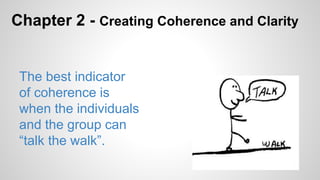
Chapter 2 - Creating Coherence and Clarity 
The best indicator 
of coherence is 
when the individuals 
and the group can 
“talk the walk”.
Drivers 
Wrong Drivers Right Drivers 
Accountability Capacity Building 
Human Capital (talent of individuals) Social Capital (quality of the group) 
Technology Instruction 
Fragmented Strategies Systemness 
Reflect a moment - Which drivers do you see present in your school? 
It’s important to note that the “wrong drivers” do have a place...as long as they are in 
service to the “right drivers”.
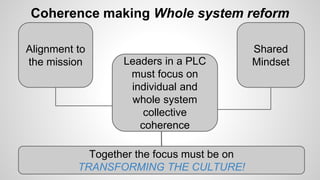
Coherence making Whole system reform 
Alignment to 
the mission 
Shared 
Leaders in a PLC Mindset 
must focus on 
individual and 
whole system 
collective 
coherence 
Together the focus must be on 
TRANSFORMING THE CULTURE!
Barriers to Coherence 
1. Failure to establish shared leadership 
2. Not communicating purpose and priorities 
clearly and consistently 
3. Confusing intent with action 
4. Launching a “program” rather than 
implementing a process of improvement 
5. Too many initiatives instead of focus on 
continuous improvement
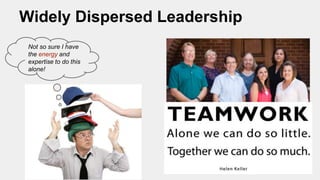
Widely Dispersed Leadership
Clear communication 
● The effectiveness at all levels is diminished 
without clear communication from a 
cohesive team of leaders. 
● Leaders must align their own behavior and 
the processes of the school with the mission 
● Check for understanding! ASK for feedback
Strategies for Coherence Making 
● The core elements of coherence 
o Focus on the people and not structures 
 Ex: having time for teacher collaboration is 
important…however, if the mindset is toxic…
Strategies cont. 
1. Focus on a small number of ambitious goals 
2. Making instruction and student achievement the daily 
agenda - through the lens of Catholic Identity 
3. Organizing continuous capacity building around that 
agenda 
4. Cultivating a sense of systemness on the part of all - 
Catholic Education
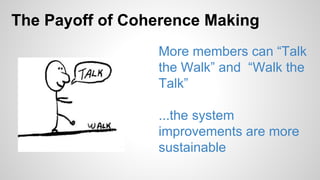
The Payoff of Coherence Making 
More members can “Talk 
the Walk” and “Walk the 
Talk” 
...the system 
improvements are more 
sustainable
Chapter 3 The Loose Tight Dilemma 
Effective change involves developing an 
engaging process that draws people into 
something that the vast majority of people 
find worthwhile while the number of 
skeptics becomes smaller and smaller.
The "Taylor approach" 
● top down 
● punitive 
● no autonomy 
● scripted 
● no shared coherence 
Results in 
● confusion 
● initiative fatigue 
● no sense of purpose 
● lack of ability to articulate goals 
Without involvement there is no commitment
The Danger of Carrots and Sticks 
● Has adverse effects 
● People resort to unethical behavior 
● Fosters short-term thinking 
● Causes entities to "Game the system"
Gaming Techniques 
● increase dropout rate 
● focus on "bubble" kids 
● eliminate subgroups 
● eliminate electives 
● hold students backGaming results in a short-term fix 
and not continuous improvement or any 
improvement at all.
The Too-Loose Problem 
● decrease in student achievement 
● change-if-you-wish attitude 
● no direction provided 
Autonomy essential for effective teaching but 
has to be balanced with 
● direction 
● coordination 
● accountability
The Right Balance 
INTERDEPENDENCE IS THE KEY 
autonomy but not isolation
The challenge is finding the right blend 
Develop vertical and horizontal partnerships through 
● Non-negotiable anchor points 
● Systemwide content and performance standards 
● Clarity of purpose with tighter controls 
● Non-negotiable goals for learning and instruction 
● Clear sense of direction 
Referred to as "direct empowerment' and "defined autonomy" 
System develops priorities and non-negotiables but empowers 
individual schools to be creative in carrying out priorities.
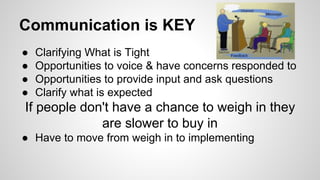
Communication is KEY 
● Clarifying What is Tight 
● Opportunities to voice & have concerns responded to 
● Opportunities to provide input and ask questions 
● Clarify what is expected 
If people don't have a chance to weigh in they 
are slower to buy in 
● Have to move from weigh in to implementing
Non-negotiables usually include 
● Collaborative teams 
● Viable curriculum 
● Common assessments 
● Using evidence to improve teaching and learning 
● Plan for immediate remediation/intervention 
● Interaction between schools 
www.newcreationca.org 
Best Practices
Public School Catholic Schools 
System sets the non-negotiables. 
Principals responsible for 
implementation of non-negotiable but 
have some autonomy in how they 
carry them out. 
The loose-tight process helps to 
develop ownership over time which 
eventually fosters cohesion and an 
organic culture of sustained 
continuous improvement 
codemagazine.com 
Principals are responsible for 
establishing and implementing 
the non-negotiable. Have 
complete autonomy in how the 
PLC looks and is carried out in 
their school. 
How are you going to get buy-in 
from your faculty? 
How are you going to develop 
ownership to create sustained 
continuous improvement?

Professional learning communities

  • 1.
    Chapter 1-3 Presentedby: Stefanie Lutero Cindy Corrales Paula Schoorl
  • 2.
    Chapter 1 ClarityPrecedes Competence What is a Professional Learning Community? -six characteristics -critical questions -challenges
  • 3.
    Six characteristics ofhigh-performing PLCs: 1. Shared mission, vision, values, and goals, which are all focused on student learning – focus on educating the “whole child” – focus on faith formation and academic excellence – focus on mission (school and Church)
  • 4.
    2. A collaborativeculture with a focus on learning – Community approach to education – Parent as Primary educator 3. Collective inquiry into best-practice and current reality – Focused on 21st century education – Aligned with our mission
  • 5.
    4. Action orientationor “learning by doing” -practice what you preach 5. A commitment to continuous improvement – We can always do better 6. A results orientation – Analysis helps determine course of schools
  • 6.
    Critical Questions: 1.What do we want our students to learn? 2. How will we know if each student is learning? 3. How will we respond when some do not learn? 2. How will we enrich and extend learning for students who are proficient?
  • 7.
    Challenges: - treatedas a program rather than a process -failure to grasp full meaning of process on a deep-operational level -failure to comprehend deeper cultural meaning of PLCs
  • 8.
    Systemness – Weare a system of Catholic schools aligned by Catholic identity – We must work toward same goals to achieve coherence
  • 9.
    Chapter 2 -Creating Coherence and Clarity The best indicator of coherence is when the individuals and the group can “talk the walk”.
  • 10.
    Drivers Wrong DriversRight Drivers Accountability Capacity Building Human Capital (talent of individuals) Social Capital (quality of the group) Technology Instruction Fragmented Strategies Systemness Reflect a moment - Which drivers do you see present in your school? It’s important to note that the “wrong drivers” do have a place...as long as they are in service to the “right drivers”.
  • 11.
    Coherence making Wholesystem reform Alignment to the mission Shared Leaders in a PLC Mindset must focus on individual and whole system collective coherence Together the focus must be on TRANSFORMING THE CULTURE!
  • 12.
    Barriers to Coherence 1. Failure to establish shared leadership 2. Not communicating purpose and priorities clearly and consistently 3. Confusing intent with action 4. Launching a “program” rather than implementing a process of improvement 5. Too many initiatives instead of focus on continuous improvement
  • 13.
  • 14.
    Clear communication ●The effectiveness at all levels is diminished without clear communication from a cohesive team of leaders. ● Leaders must align their own behavior and the processes of the school with the mission ● Check for understanding! ASK for feedback
  • 15.
    Strategies for CoherenceMaking ● The core elements of coherence o Focus on the people and not structures  Ex: having time for teacher collaboration is important…however, if the mindset is toxic…
  • 16.
    Strategies cont. 1.Focus on a small number of ambitious goals 2. Making instruction and student achievement the daily agenda - through the lens of Catholic Identity 3. Organizing continuous capacity building around that agenda 4. Cultivating a sense of systemness on the part of all - Catholic Education
  • 17.
    The Payoff ofCoherence Making More members can “Talk the Walk” and “Walk the Talk” ...the system improvements are more sustainable
  • 18.
    Chapter 3 TheLoose Tight Dilemma Effective change involves developing an engaging process that draws people into something that the vast majority of people find worthwhile while the number of skeptics becomes smaller and smaller.
  • 19.
    The "Taylor approach" ● top down ● punitive ● no autonomy ● scripted ● no shared coherence Results in ● confusion ● initiative fatigue ● no sense of purpose ● lack of ability to articulate goals Without involvement there is no commitment
  • 20.
    The Danger ofCarrots and Sticks ● Has adverse effects ● People resort to unethical behavior ● Fosters short-term thinking ● Causes entities to "Game the system"
  • 21.
    Gaming Techniques ●increase dropout rate ● focus on "bubble" kids ● eliminate subgroups ● eliminate electives ● hold students backGaming results in a short-term fix and not continuous improvement or any improvement at all.
  • 22.
    The Too-Loose Problem ● decrease in student achievement ● change-if-you-wish attitude ● no direction provided Autonomy essential for effective teaching but has to be balanced with ● direction ● coordination ● accountability
  • 23.
    The Right Balance INTERDEPENDENCE IS THE KEY autonomy but not isolation
  • 24.
    The challenge isfinding the right blend Develop vertical and horizontal partnerships through ● Non-negotiable anchor points ● Systemwide content and performance standards ● Clarity of purpose with tighter controls ● Non-negotiable goals for learning and instruction ● Clear sense of direction Referred to as "direct empowerment' and "defined autonomy" System develops priorities and non-negotiables but empowers individual schools to be creative in carrying out priorities.
  • 25.
    Communication is KEY ● Clarifying What is Tight ● Opportunities to voice & have concerns responded to ● Opportunities to provide input and ask questions ● Clarify what is expected If people don't have a chance to weigh in they are slower to buy in ● Have to move from weigh in to implementing
  • 26.
    Non-negotiables usually include ● Collaborative teams ● Viable curriculum ● Common assessments ● Using evidence to improve teaching and learning ● Plan for immediate remediation/intervention ● Interaction between schools www.newcreationca.org Best Practices
  • 27.
    Public School CatholicSchools System sets the non-negotiables. Principals responsible for implementation of non-negotiable but have some autonomy in how they carry them out. The loose-tight process helps to develop ownership over time which eventually fosters cohesion and an organic culture of sustained continuous improvement codemagazine.com Principals are responsible for establishing and implementing the non-negotiable. Have complete autonomy in how the PLC looks and is carried out in their school. How are you going to get buy-in from your faculty? How are you going to develop ownership to create sustained continuous improvement?

Editor's Notes

  • #3 In order to clearly define what a PLC is and how it fits into the context of Catholic schooling, we’ll look at the six defining characteristics, some critical questions that drive the focus on student learning, and some challenges that can stand in the way of bringing the PLC process to life.
  • #4 Shared mission, vision, values, and goals, which are all focused on student learning. In a Catholic school, the focus has always been on educating the whole child…nurturing the academic, physical, social, emotional, and spiritual aspects of every student through various disciplines. Both faith formation and academic excellence are key to a Catholic school, not so much so that Catholic schools can remain competitive with the public school system, but so that our students can be well equipped to carry out the Gospel message of Christ and in turn make an impact in our world. Everything that we do in our schools must tie back to our mission statements of both the school and the greater Church.
  • #5 A collaborative culture with a focus on learning As Catholics, we believe that raising a child takes the participation of many…of the community. Our Catholic faith, by nature, is very community oriented. We grow in our faith through our communion with others. It is the same with education-it is a community effort. All involved from parents to teachers to other members in the community have a role to play. In addition, we believe that parents are the primary educators of their children. Catholic schools serve as an extension of family life. There exists a great amount of respect for the collaboration between the school and the parents. Collective Inquiry into best-practice and current reality In many of our Catholic schools now, we are more focused on educating children for the 21st century, which requires that students are equipped with a completely new skill-set. This is the new reality we are preparing our children for. In our search for best practices and ways to be innovative in the classroom, we must still ensure that we are mission driven and that we uphold the rich traditions of Catholic schooling.
  • #6 Action orientation or “learning by doing” As with most learning, in order for it to be meaningful and take root, you must “do”, not just say. A commitment to continuous improvement Catholic education has a long-standing tradition of excellence. We’re not focusing on improvement because we have not done well in the past, but because we recognize that times are changing and that it is essential that we always do better. A results orientation Analysis is a part of our culture, in that it helps to determine the direction of our schools.
  • #7 There are 4 critical questions that help educators focus relentlessly on student learning. What do we want our students to learn? This is where a clear understanding of our mission, School-Wide Learning Expectations and knowledge of our standards is essential. How will we know if each student is learning? As a school, we must be critical looking at how we assess our students and how we analyze the data from those assessments. How do we respond when some of our students do not learn? In Catholic schools, we believe that every child has a fundamental right to experience success in school. It is vital that we do what is necessary to ensure that the needs of all children are met, wherever they are at. How will we enrich and extend learning for students who are proficient? Meeting children where they are at also extends to providing enriching opportunities for those who are proficient. How do we engage them on a deeper level?
  • #8 There will inevitably be challenges in creating a culture in which a PLC can thrive at your school. This is not intended to be a program that will come and go. We must be open to changing our mindset and way of interacting. This will be a constant work in progress, as changing a culture takes true time. Awareness of the resistance of some “experienced” educators (Cindy added) They have weathered lots of “programs”
  • #9 “In a systemic PLC, there should be no clear distinction between the system and the individual. “ (p.18) We are a system of schools aligned by our Catholic identity. As Catholic schools, we want to mirror “community”. Within our individual school communities and within the “Catholic school community” as a whole, we must all work toward the same goals, which should be rooted in our mission. We must be speaking “the same language” and deliver the “same message”. This way, we achieve coherence.
  • #11 Drivers are policies intended to have a positive impact on a particular domain, such as student learning. These policies (wrong) tend to be focused on individuals and not on developing new capacities.
  • #14 School leadership teams with shared objectives can serve as advocates.
  • #19 Catholic schools are having to reinvent themselves or come up with new ways to bring in more students. Sometimes this reinvention may involve deep systemic change. How can you make the process of adding PLCs to your school so inviting that the majority of your faculty and staff will see the value and hop on board?
  • #20 Alive and well in education. Too complicated to carry out and monitor, expensive. Doesn’t produce good results. Need to be aware of to avoid.
  • #21 Using a reward and punishment system usually ends in negative, short-term results.
  • #22 Some of the behaviors schools/districts will resort to to avoid the stick. Again be aware of to recognize if they are being used and to avoid.
  • #23 Here’s what we want to implement do it however you want, if you want to. There has to be some direction, coordination and accountability or the change will never happen in a manner that will increase student achievement.
  • #24 Catholic schools by design are isolated they need to work together more in sharing best practices to increase student learning. This also means within a school too. Not everyone closing their door and doing their own thing, but working toward a common goal, mission.
  • #25 Partnerships from the top down and the bottom up. Within grade levels and across grade levels. So that you know where your students are coming from and where they are expected to by the end of the year. Between schools stepping outside your own system and sharing best practices with other Catholic schools. For Catholic schools the school is the system. Individual sites will be developing their own non negotiables. Each principal will have to find their own balance within their school.
  • #26 Making sure everyone has the opportunity to voice their opinion, share their concerns and provide input. This stage is a must to eventually build total buy-in.
  • #27 How can collaborative teams be set up within single grade, double grade and high schools? How can you form collaborative teams between schools?