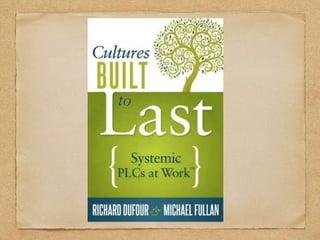
Cultures Built to Last: 
Systemic PLCs at Work 
written by: Richard DuFour and Michael Fullan 
presented by Sara Luft 
October 24, 2014
The Purpose of the 
Book 
Continued support of the PLC process 
Frame PLCs as a way to create cultural 
change in the national education system
Cultural Change 
deeply held and often unexamined assumptions 
that people use to make sense of their world 
altering assumptions, beliefs, expectations and 
habits is doable but difficult 
has the potential to be a part of systemic 
educational change
Chapter 1: 
Clarity Precedes Competence 
clearly define what a PLC is, its characteristics, 
the underlying assumptions that drive the 
process, the challenges of implementation and 
the need for all individuals to contribute to the 
process
PLCs are a 
process not a 
program.
Chapter 2: 
Creating Coherence and Clarity 
“Alignment is structure; coherence 
is mindset. Shared mindset 
equals system coherence.” 
pg. 31
Chapter 3: 
The Loose-Tight Dilemma 
Loose—encouraging people to engage in the 
change process, but leaving participation 
optional 
Tight—assertive, top-down directions that 
mandate change
“When well-intentioned district leaders 
remove teachers and principals from the 
dialogue and the decision-making 
process, they remove them from the 
learning that is one of the most 
significant by-products of the process.” 
pg 44
Chapter 4: 
The Loose-Tight System In Action 
Building shared knowledge and deep understanding 
Creating a guaranteed implemented curriculum 
Monitoring progress at the school site 
Supporting improvement through reciprocal accountability 
Building ongoing adult learning into the system 
Celebrating incremental progress
Chapter 5: 
Sustaining the Improvement 
Process 
“Visions of what the system can become 
someday must be converted into specific 
steps that can be taken today to generate 
forward momentum.” 
pg. 66
Chapter 5: 
Sustaining the Improvement 
Process 
“It is not turn-over of leadership per 
se that is the problem for most 
organizations, but rather the 
discontinuity of direction.” 
pg. 71
Thinking (and Doing) Bigger 
Leaders are attracted to bigger challenges 
District leader is successful in their district: 
looks for ways to contribute to other districts 
PLC is successful at a school: district adopts 
the PLC process

Cultures Built to Last: Systemic PLCs at Work

  • 1.
    Cultures Built toLast: Systemic PLCs at Work written by: Richard DuFour and Michael Fullan presented by Sara Luft October 24, 2014
  • 3.
    The Purpose ofthe Book Continued support of the PLC process Frame PLCs as a way to create cultural change in the national education system
  • 4.
    Cultural Change deeplyheld and often unexamined assumptions that people use to make sense of their world altering assumptions, beliefs, expectations and habits is doable but difficult has the potential to be a part of systemic educational change
  • 5.
    Chapter 1: ClarityPrecedes Competence clearly define what a PLC is, its characteristics, the underlying assumptions that drive the process, the challenges of implementation and the need for all individuals to contribute to the process
  • 6.
    PLCs are a process not a program.
  • 7.
    Chapter 2: CreatingCoherence and Clarity “Alignment is structure; coherence is mindset. Shared mindset equals system coherence.” pg. 31
  • 8.
    Chapter 3: TheLoose-Tight Dilemma Loose—encouraging people to engage in the change process, but leaving participation optional Tight—assertive, top-down directions that mandate change
  • 9.
    “When well-intentioned districtleaders remove teachers and principals from the dialogue and the decision-making process, they remove them from the learning that is one of the most significant by-products of the process.” pg 44
  • 10.
    Chapter 4: TheLoose-Tight System In Action Building shared knowledge and deep understanding Creating a guaranteed implemented curriculum Monitoring progress at the school site Supporting improvement through reciprocal accountability Building ongoing adult learning into the system Celebrating incremental progress
  • 11.
    Chapter 5: Sustainingthe Improvement Process “Visions of what the system can become someday must be converted into specific steps that can be taken today to generate forward momentum.” pg. 66
  • 12.
    Chapter 5: Sustainingthe Improvement Process “It is not turn-over of leadership per se that is the problem for most organizations, but rather the discontinuity of direction.” pg. 71
  • 13.
    Thinking (and Doing)Bigger Leaders are attracted to bigger challenges District leader is successful in their district: looks for ways to contribute to other districts PLC is successful at a school: district adopts the PLC process