Prepared by:
Abida shamim
Ishrat Sharif
Almas
Mariam
Sobia
Aruje
Assignment on Reading skills
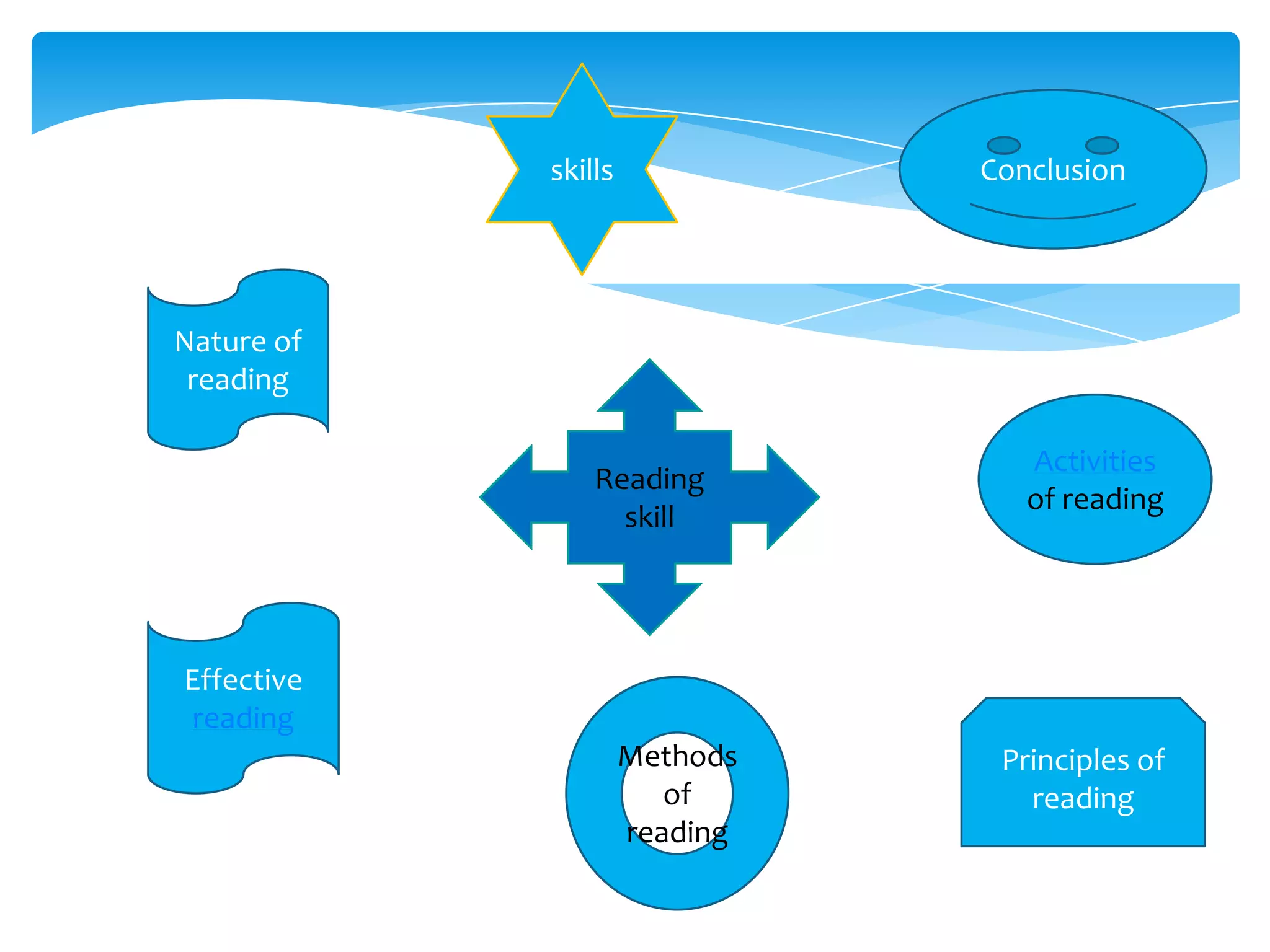
Reading
skill
skills
Nature of
reading
Effective
reading
Activities
of reading
Principles of
reading
Methods
of
reading
Conclusion
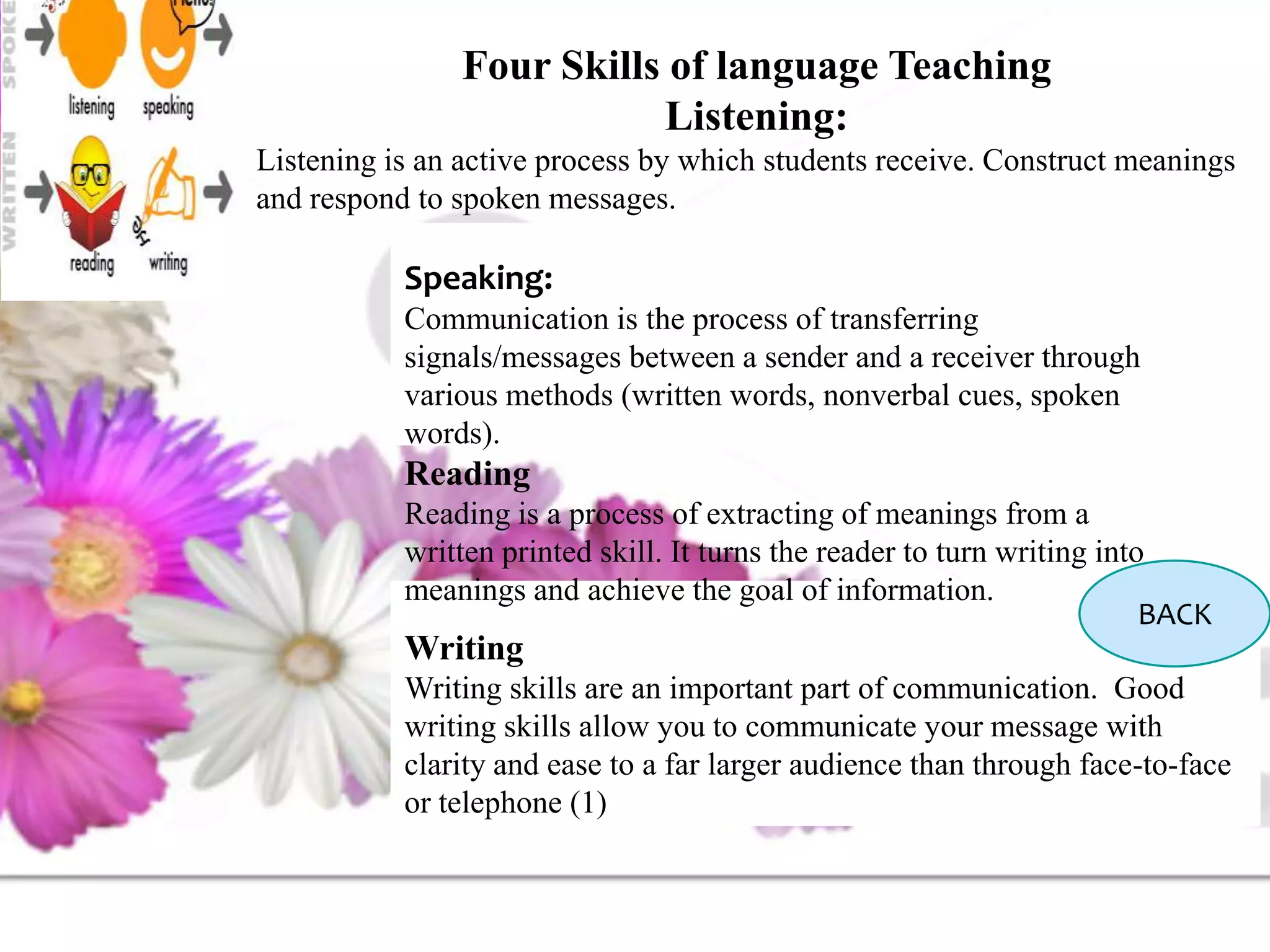
Four Skills of language Teaching
Listening:
Listening is an active process by which students receive. Construct meanings
and respond to spoken messages.
Speaking:
Communication is the process of transferring
signals/messages between a sender and a receiver through
various methods (written words, nonverbal cues, spoken
words).
Writing
Writing skills are an important part of communication. Good
writing skills allow you to communicate your message with
clarity and ease to a far larger audience than through face-to-face
or telephone (1)
Reading
Reading is a process of extracting of meanings from a
written printed skill. It turns the reader to turn writing into
meanings and achieve the goal of information.
BACK
than testing the students understanding of details.
Tasks should help Pjjthstudents to develop students’ reading skills.
Teachers should help the students to read to their own, so they eventually become
independent readers.
Principles of Reading
• The text should be accessible to the students.
• Tasks should be clearly given in advance.
• Tasks should be designed to encourage reading
for the main meanings rather than testing the
students understanding of details.
• Tasks should help the students to develop
students’reading skills.
• Teachers should help the students to read to their
own, so they eventually become independent
readers.
What Effective readers do?
Have a clear purpose
Read silently
Skim the rest, and skip the insignificant parts
Read phrase by phrase, rather than word by word
Have and use background information to help understand th
text
Guess the meaning of new words from the context.
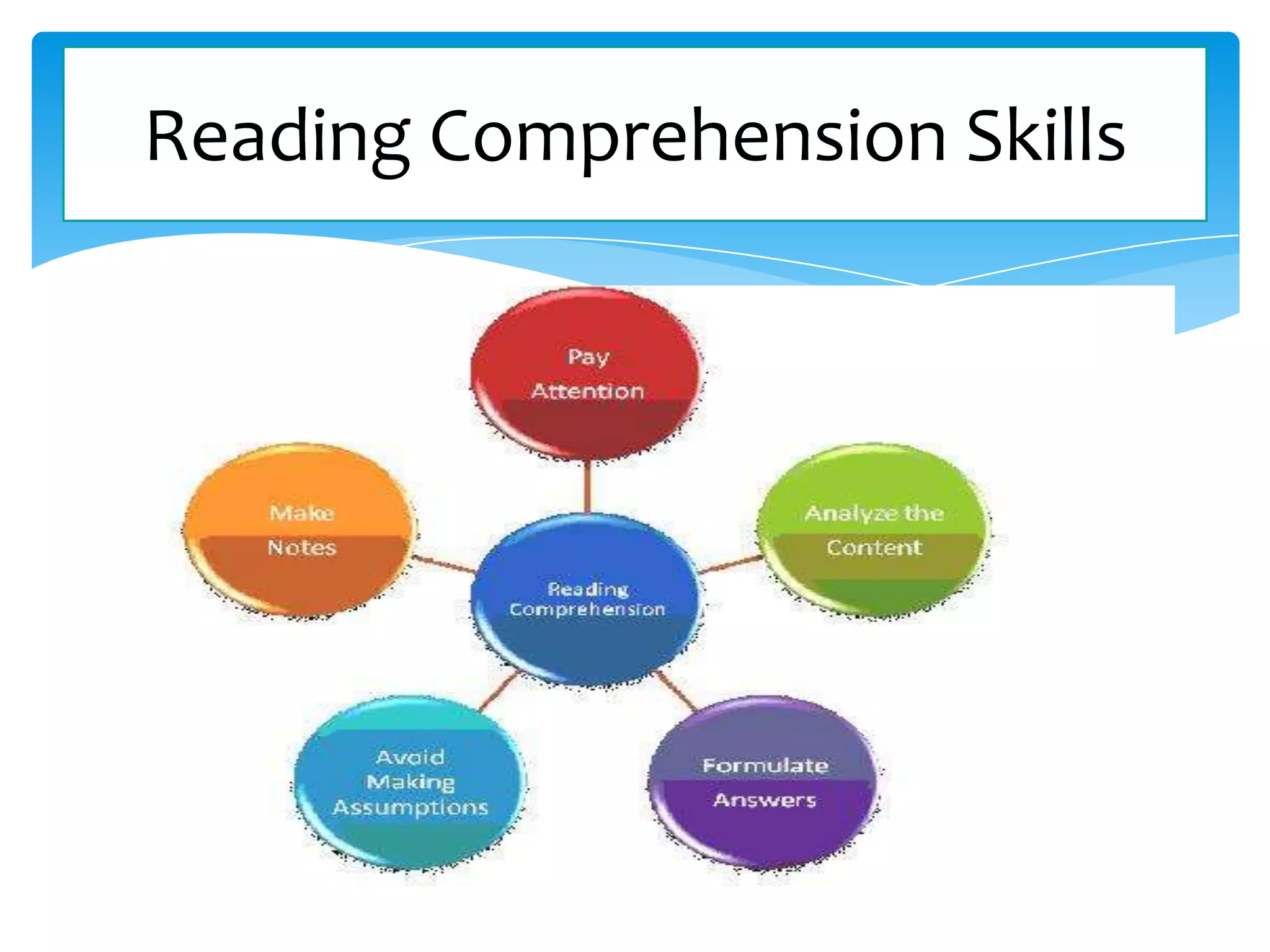
Reading Comprehension Skills
Methods Of Reading
There are five methods of reading.
Anticipation:
Distinguishing the main idea from
supporting details;
Skimming:
Skimming involves reading for the main
idea.
Scanning:
Reading to look for specific information.
Predicting:
Guessing what is coming next.
SQ3R
Survey the text, make questions, read text
and finally review it to enhance reading.
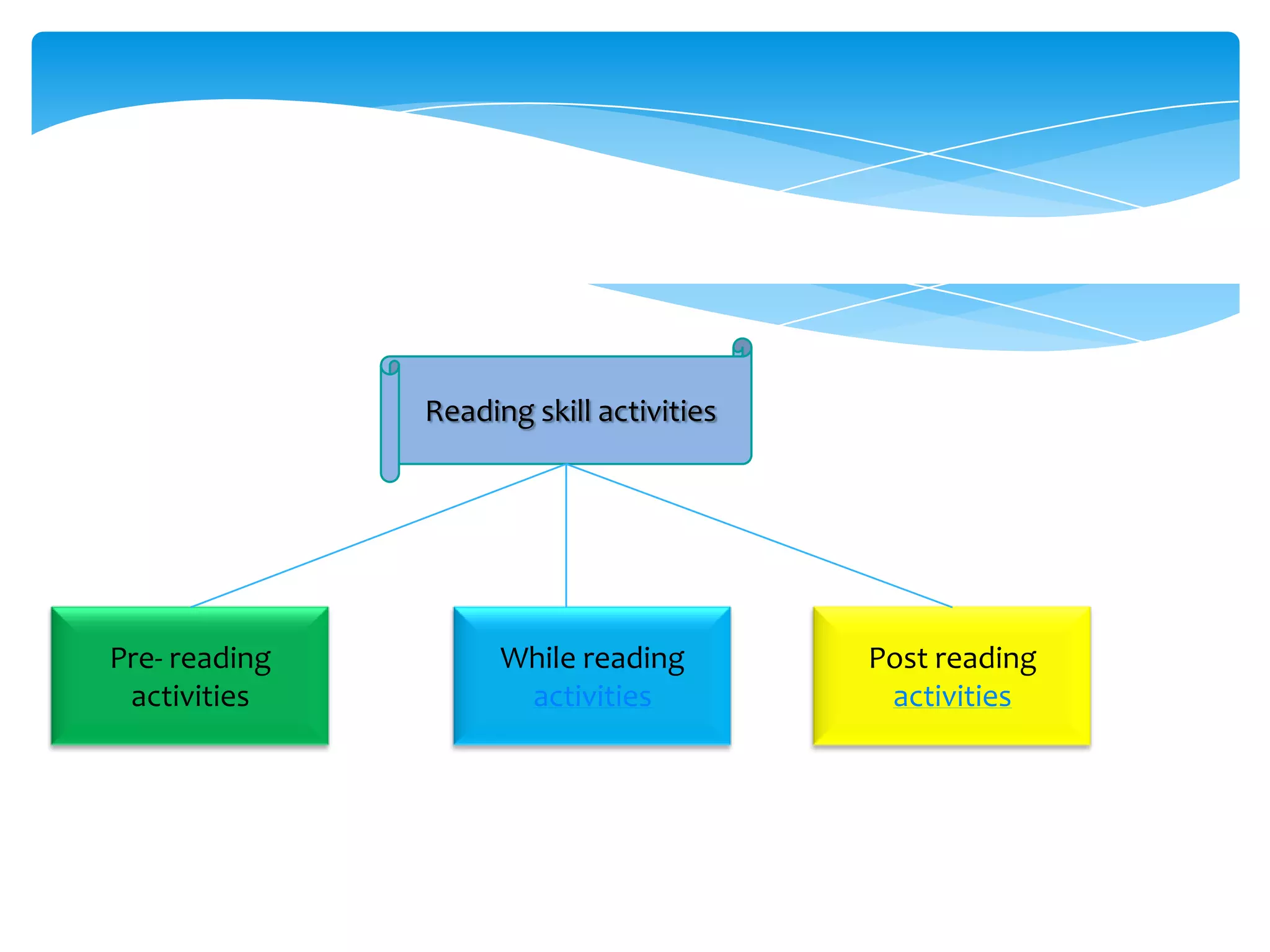
Pre- reading
activities
While reading
activities
Post reading
activities
Reading skill activities
Pre- reading activities
The purpose of pre-reading (also called Lead-in)
is to facilitate while-reading activities.
Predicting: There are three ways of predicting.
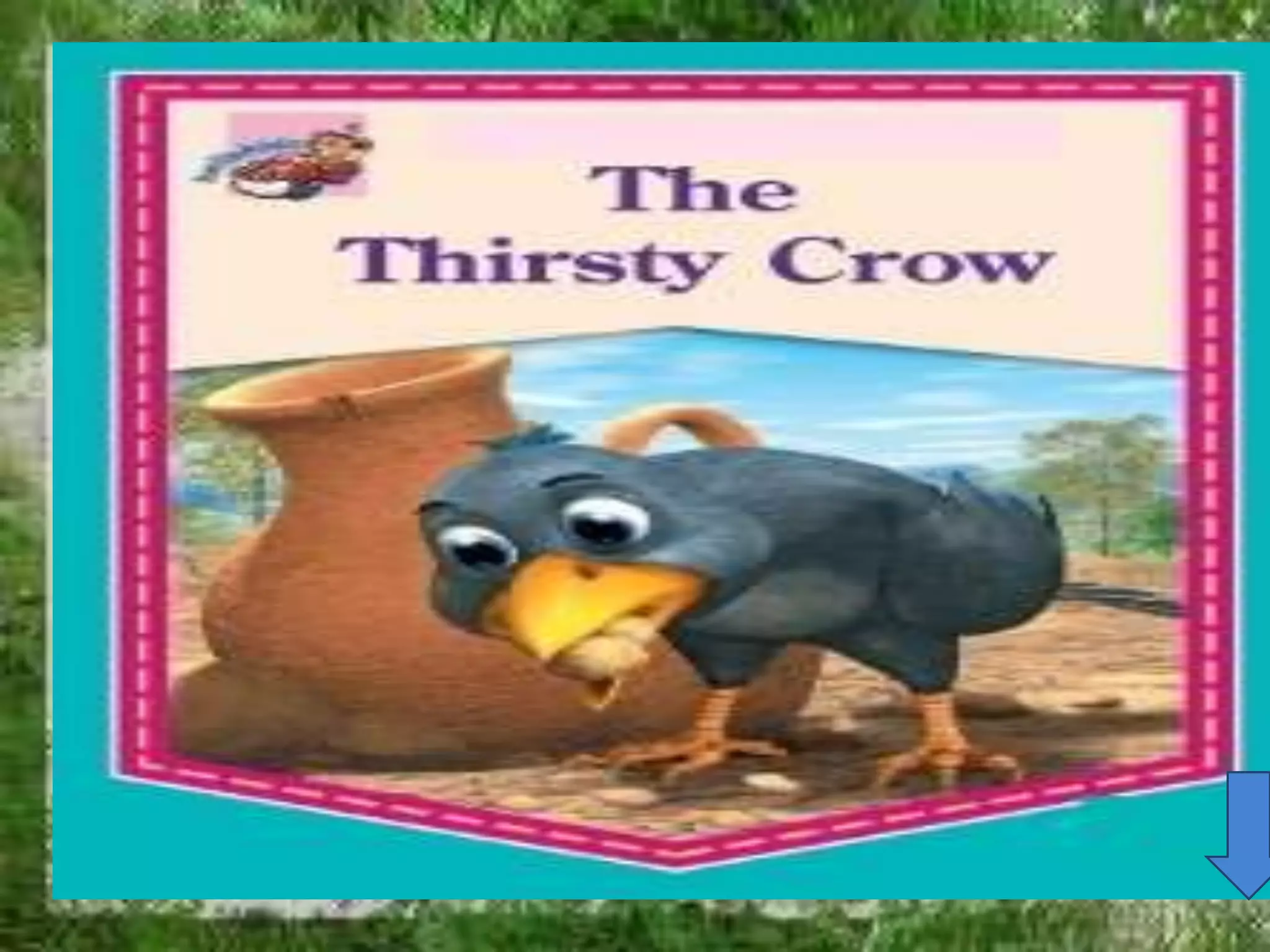
Predicting based on title or picture.
Predicting based on vocabulary.
Predicting through questions.
Predicting through
Vocabulary:
Vocabulary can be given to students
to predict what is coming next.
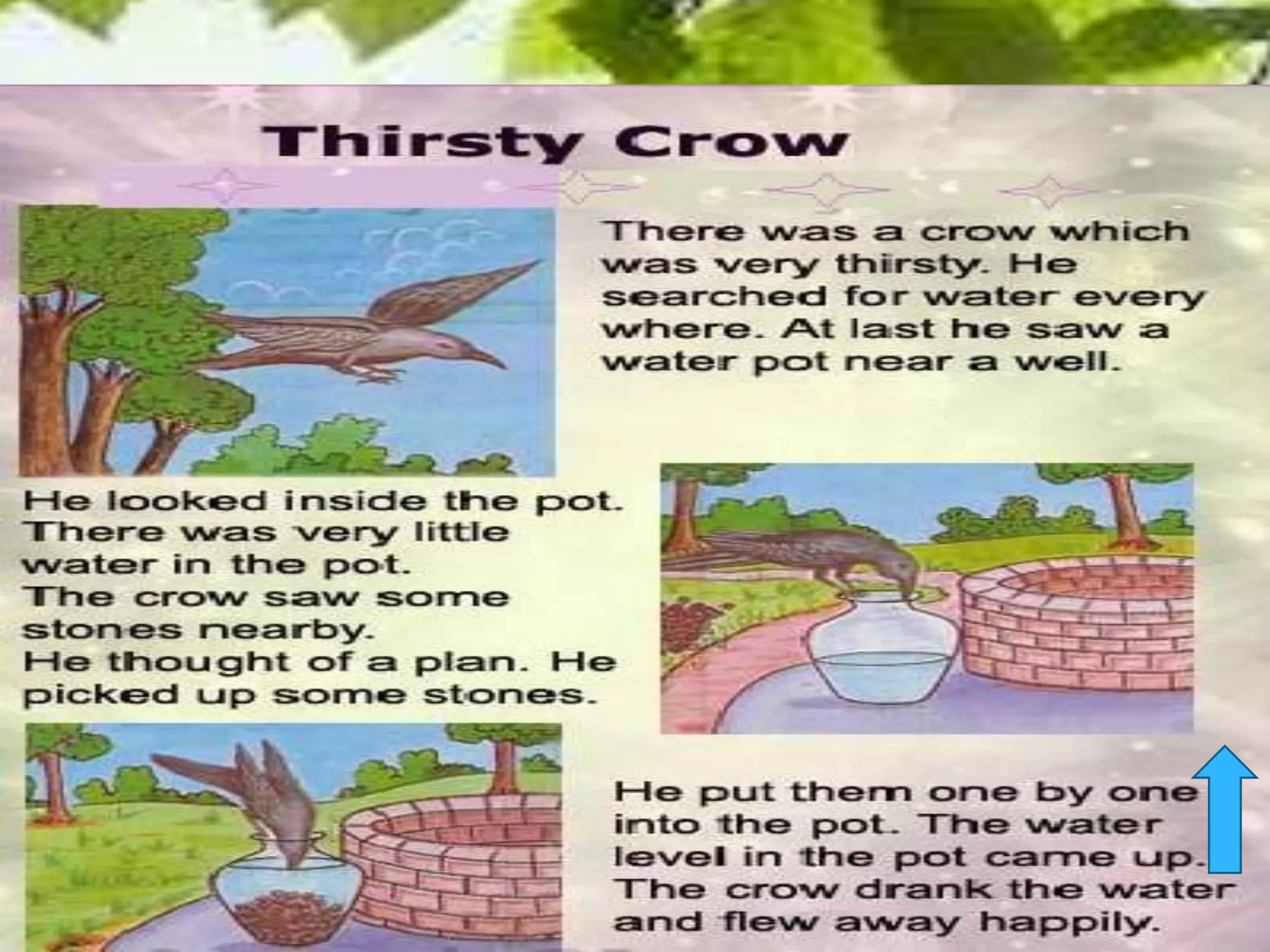
Crow, Pot, stones, thirsty, garden
While-reading Activities
While- reading activities focus
on the process of understanding
rather than the result of reading.
• Read the text
• Information transfer activities
• Understanding references
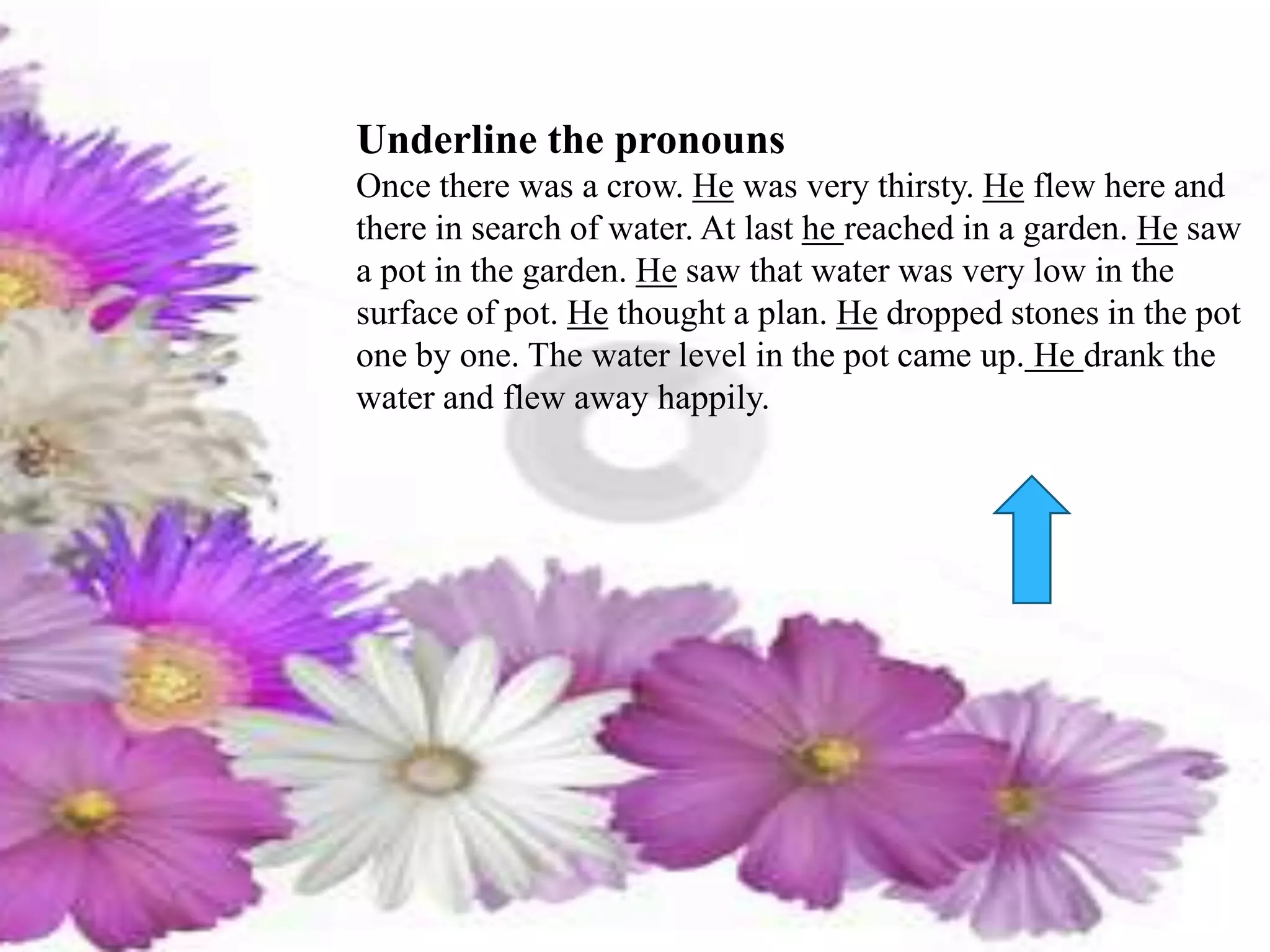
Underline the pronouns
Once there was a crow. He was very thirsty. He flew here and
there in search of water. At last he reached in a garden. He saw
a pot in the garden. He saw that water was very low in the
surface of pot. He thought a plan. He dropped stones in the pot
one by one. The water level in the pot came up. He drank the
water and flew away happily.
Post reading activities
Post reading activities task should enable students to
produce language based on what they have learned.
Gap-filling Activity
What can be the moral of the story.
Fill in the blanks
Once there was . He was very .
here and there in search of water. At last he
reached . He saw in the garden. He
saw that in the surface of pot. He
thought a plan. He dropped in the pot
one by one. in the pot came up.
the water and flew away .
Conclusion
The teaching of reading should
focus on developing students’
reading skills and strategies.
Reading should be an
interactive process. Reading in
the classroom can be divided
into three stages: pre-reading
activities, while reading
activities and post reading
activities.
Reading skill

  • 2.
    Prepared by: Abida shamim IshratSharif Almas Mariam Sobia Aruje Assignment on Reading skills
  • 4.
  • 5.
    Four Skills oflanguage Teaching Listening: Listening is an active process by which students receive. Construct meanings and respond to spoken messages. Speaking: Communication is the process of transferring signals/messages between a sender and a receiver through various methods (written words, nonverbal cues, spoken words). Writing Writing skills are an important part of communication. Good writing skills allow you to communicate your message with clarity and ease to a far larger audience than through face-to-face or telephone (1) Reading Reading is a process of extracting of meanings from a written printed skill. It turns the reader to turn writing into meanings and achieve the goal of information. BACK
  • 6.
    than testing thestudents understanding of details. Tasks should help Pjjthstudents to develop students’ reading skills. Teachers should help the students to read to their own, so they eventually become independent readers. Principles of Reading • The text should be accessible to the students. • Tasks should be clearly given in advance. • Tasks should be designed to encourage reading for the main meanings rather than testing the students understanding of details. • Tasks should help the students to develop students’reading skills. • Teachers should help the students to read to their own, so they eventually become independent readers.
  • 7.
    What Effective readersdo? Have a clear purpose Read silently Skim the rest, and skip the insignificant parts Read phrase by phrase, rather than word by word Have and use background information to help understand th text Guess the meaning of new words from the context.
  • 8.
  • 9.
    Methods Of Reading Thereare five methods of reading. Anticipation: Distinguishing the main idea from supporting details; Skimming: Skimming involves reading for the main idea. Scanning: Reading to look for specific information. Predicting: Guessing what is coming next. SQ3R Survey the text, make questions, read text and finally review it to enhance reading.
  • 10.
    Pre- reading activities While reading activities Postreading activities Reading skill activities
  • 11.
    Pre- reading activities Thepurpose of pre-reading (also called Lead-in) is to facilitate while-reading activities. Predicting: There are three ways of predicting. Predicting based on title or picture. Predicting based on vocabulary. Predicting through questions.
  • 13.
    Predicting through Vocabulary: Vocabulary canbe given to students to predict what is coming next. Crow, Pot, stones, thirsty, garden
  • 14.
    While-reading Activities While- readingactivities focus on the process of understanding rather than the result of reading. • Read the text • Information transfer activities • Understanding references
  • 17.
    Underline the pronouns Oncethere was a crow. He was very thirsty. He flew here and there in search of water. At last he reached in a garden. He saw a pot in the garden. He saw that water was very low in the surface of pot. He thought a plan. He dropped stones in the pot one by one. The water level in the pot came up. He drank the water and flew away happily.
  • 18.
    Post reading activities Postreading activities task should enable students to produce language based on what they have learned. Gap-filling Activity What can be the moral of the story.
  • 19.
    Fill in theblanks Once there was . He was very . here and there in search of water. At last he reached . He saw in the garden. He saw that in the surface of pot. He thought a plan. He dropped in the pot one by one. in the pot came up. the water and flew away .
  • 20.
    Conclusion The teaching ofreading should focus on developing students’ reading skills and strategies. Reading should be an interactive process. Reading in the classroom can be divided into three stages: pre-reading activities, while reading activities and post reading activities.