USING
CAT4 DATA
TO DEVELOP
LITERACY
AND
LEARNING
STRATEGIES
FOR ALL
USING
CAT4 DATA
TO DEVELOP
LITERACY
AND
LEARNING
STRATEGIES
FOR ALL
BY: JOHN DSOUZA
ONE TEAM
ONE VISION
ONE MISSION
SMALL CHANGES, SIGNIFICANT IMPACT
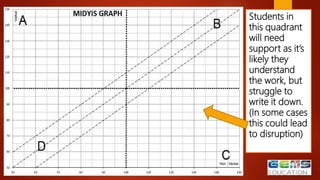
TOMORROW’S
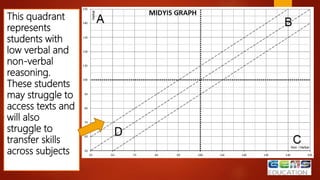
CLASSROOM TODAY…
TODAY’S
CLASSROOM NOW…
…Striving to Integrate…
Excellence… Beyond Borders!
3Ways of Working (WoW)
• Mobile devices used only to support learning – i.e. note taking, research, creation
• No calls, messaging, emailing
• Bags / school work away from table
• Be HERE
• Have an open mind
• Ask questions
• Listen to learn
• Be honest, positive and constructive
• Interact and collaborate with others with active participation
• Take responsibility for your own learning
• Show respect, confidentiality and professionalism
IT’S PART OF
EDUCATION
4
WE CAN’T DROP THAT CAT
ICE-BREAKER
We’re in the TT Room…..
Who was the last person you spoke to and what
was the conversation?
5
- Lose Talk or Serious Talk?
- Complement or Complaint?
- Lunch Review or Weekend Plans?
- Leaders, Teachers or Students?
Share what you spoke and why you liked it with another
person on the same table….
6
Learning Objectives: 7
- To recognise how data can be used to
identify and characterise the classroom.
- To interpret a class set of data using
MIDYIS graphs
- To distinguish between effective and
ineffective teaching methods for the
individual
8
Outcome:
- To create a session, informed by
CATS data, that appropriately
supports and stretches a new
class
9
How will we
get there?
Alternative ways to Analyze Data
Effective Teaching Methods for the Individual
Embedding Literacy and Learning Strategies
An Example – Grade 8 CAT4 Scores
10
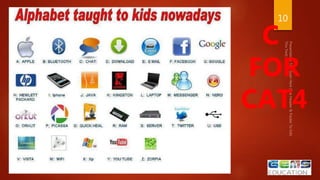
C
FOR
CAT4
11
BRAIN-STORM
Are we using this DATA anywhere in our
assessment documents?
Has anyone used this data for effective
teaching and learning strategies?
What are the 4 pairs of tests which assess
different aspects of ability?
Any idea about this FAT CAT?
12
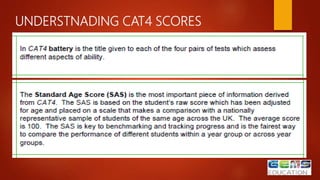
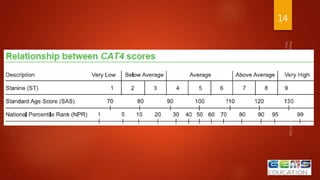
UNDERSTNADING CAT4 SCORES
14
Alternative Ways to Analyze Data
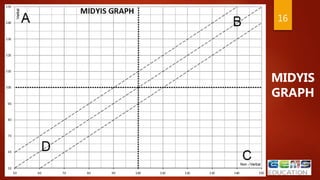
• GRAPHS CAN GIVE US A QUICK SNAPSHOT OF
THE LEARNERS IN OUR CLASS AND THEIR
RELATIVE SKILL LEVELS.
• THE QUARTILE THEY FIT IN HELPS US TO
ASCERTAIN WHERE THEIR LEARNING ABILITIES
(STRENGTHS AND WEAKNESSES) MAY LIE AND
POSSIBLE TECHNIQUES THAT WILL HELP
THEM.
15
16
MIDYIS
GRAPH
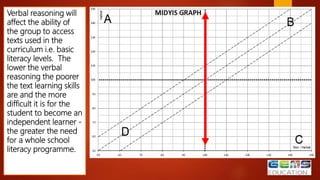
Verbal reasoning will
affect the ability of
the group to access
texts used in the
curriculum i.e. basic
literacy levels. The
lower the verbal
reasoning the poorer
the text learning skills
are and the more
difficult it is for the
student to become an
independent learner -
the greater the need
for a whole school
literacy programme.
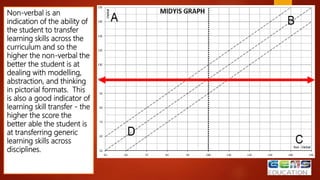
Non-verbal is an
indication of the ability of
the student to transfer
learning skills across the
curriculum and so the
higher the non-verbal the
better the student is at
dealing with modelling,
abstraction, and thinking
in pictorial formats. This
is also a good indicator of
learning skill transfer - the
higher the score the
better able the student is
at transferring generic
learning skills across
disciplines.
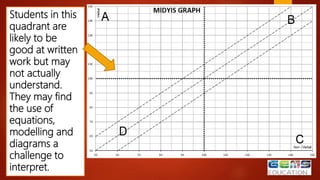
Students in this
quadrant are
likely to be
good at written
work but may
not actually
understand.
They may find
the use of
equations,
modelling and
diagrams a
challenge to
interpret.
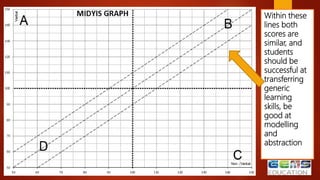
Within these
lines both
scores are
similar, and
students
should be
successful at
transferring
generic
learning
skills, be
good at
modelling
and
abstraction
Students in
this quadrant
will need
support as it’s
likely they
understand
the work, but
struggle to
write it down.
(In some cases
this could lead
to disruption)
This quadrant
represents
students with
low verbal and
non-verbal
reasoning.
These students
may struggle to
access texts and
will also
struggle to
transfer skills
across subjects
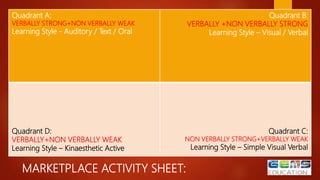
MARKETPLACE ACTIVITY SHEET:
23
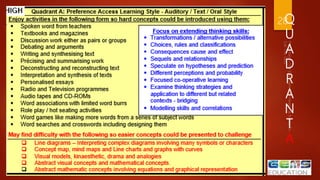
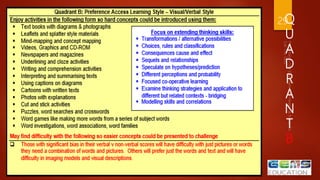
Quadrant A:
VERBALLY STRONG+NON VERBALLY WEAK
Learning Style - Auditory / Text / Oral
Quadrant B:
VERBALLY +NON VERBALLY STRONG
Learning Style – Visual / Verbal
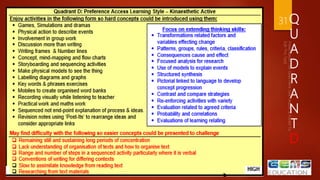
Quadrant D:
VERBALLY+NON VERBALLY WEAK
Learning Style – Kinaesthetic Active
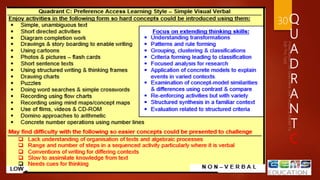
Quadrant C:
NON VERBALLY STRONG+VERBALLY WEAK
Learning Style – Simple Visual Verbal
24
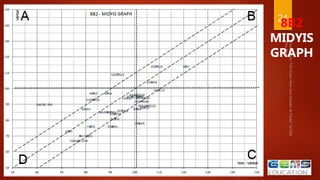
8B2
MIDYIS
GRAPH
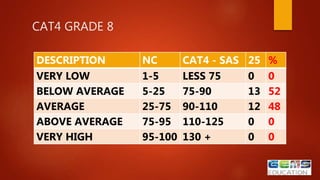
CAT4 GRADE 8
DESCRIPTION NC CAT4 - SAS 25 %
VERY LOW 1-5 LESS 75 0 0
BELOW AVERAGE 5-25 75-90 13 52
AVERAGE 25-75 90-110 12 48
ABOVE AVERAGE 75-95 110-125 0 0
VERY HIGH 95-100 130 + 0 0
Effective Teaching Methods:
EACH GROUP HAS ONE QUADRANT TO FOCUS
ON.
FOR YOUR QUADRANT:
- IDENTIFY THE CHARACTERISTICS ASSOCIATED
WITH LEARNERS IN THAT QUADRANT
- SUGGEST A RANGE OF ACTIVITIES THAT
WOULD SUPPORT THESE LEARNERS IN
LESSONS
- PRESENT IDEAS ON THE FLIPCHART READY TO
26
27
28Q
U
A
D
R
A
N
T
A
29Q
U
A
D
R
A
N
T
B
30Q
U
A
D
R
A
N
T
C
31 Q
U
A
D
R
A
N
T
D
Market Place 32
• Choose your group representative.
• You will have 4 minutes to present the characteristics of learners in your
quadrant and some possible strategies that could be used with these
learners.
• If you are an information gatherer, use the blank MIDYIS graph template
to summarise the information provided by the representative you visit.
• This can then be shared with your group representative at the end of
the activity.
Reflection:
• FOR ONE PARTICULAR CLASS YOU TEACH,
THINK ABOUT SOME OF THE CHARACTERS
AND WHERE YOU THINK THEY WOULD PLACE
ON A MIDYIS GRAPH.
• WHAT STRATEGIES COULD YOU TRY TO HELP
THEM ACCESS MORE CHALLENGING ASPECTS
OF YOUR SUBJECT?
33
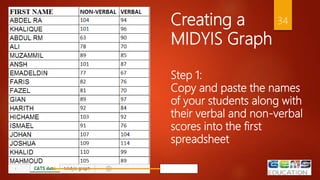
Creating a
MIDYIS Graph
34
Step 1:
Copy and paste the names
of your students along with
their verbal and non-verbal
scores into the first
spreadsheet
CATS Data Tab
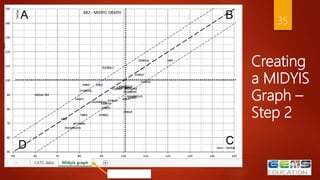
Creating
a MIDYIS
Graph –
Step 2
35
MIDYIS Graph Tab
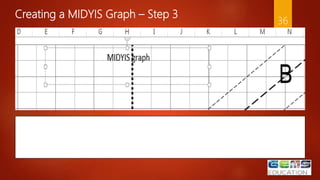
Creating a MIDYIS Graph – Step 3
36
Step 3:
If you want to add a title to your graph, left click on the
‘MIDYIS graph’ text box and enter your chosen title.
37
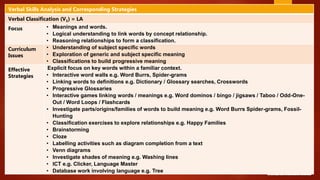
Verbal Skills Analysis and Corresponding Strategies
Verbal Classification (V1) = LA
Focus • Meanings and words.
• Logical understanding to link words by concept relationship.
• Reasoning relationships to form a classification.
Curriculum
Issues
• Understanding of subject specific words
• Exploration of generic and subject specific meaning
• Classifications to build progressive meaning
Effective
Strategies
Explicit focus on key words within a familiar context.
• Interactive word walls e.g. Word Burrs, Spider-grams
• Linking words to definitions e.g. Dictionary / Glossary searches, Crosswords
• Progressive Glossaries
• Interactive games linking words / meanings e.g. Word dominos / bingo / jigsaws / Taboo / Odd-One-
Out / Word Loops / Flashcards
• Investigate parts/origins/families of words to build meaning e.g. Word Burrs Spider-grams, Fossil-
Hunting
• Classification exercises to explore relationships e.g. Happy Families
• Brainstorming
• Cloze
• Labelling activities such as diagram completion from a text
• Venn diagrams
• Investigate shades of meaning e.g. Washing lines
• ICT e.g. Clicker, Language Master
• Database work involving language e.g. Tree
38
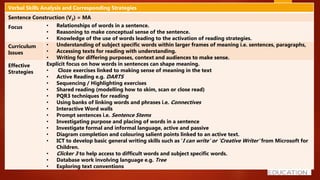
Verbal Skills Analysis and Corresponding Strategies
Sentence Construction (V2) = MA
Focus • Relationships of words in a sentence.
• Reasoning to make conceptual sense of the sentence.
• Knowledge of the use of words leading to the activation of reading strategies.
Curriculum
Issues
• Understanding of subject specific words within larger frames of meaning i.e. sentences, paragraphs,
• Accessing texts for reading with understanding.
• Writing for differing purposes, context and audiences to make sense.
Effective
Strategies
Explicit focus on how words in sentences can shape meaning.
• Cloze exercises linked to making sense of meaning in the text
• Active Reading e.g. DARTS
• Sequencing / Highlighting exercises
• Shared reading (modelling how to skim, scan or close read)
• PQR3 techniques for reading
• Using banks of linking words and phrases i.e. Connectives
• Interactive Word walls
• Prompt sentences i.e. Sentence Stems
• Investigating purpose and placing of words in a sentence
• Investigate formal and informal language, active and passive
• Diagram completion and colouring salient points linked to an active text.
• ICT to develop basic general writing skills such as 'I can write’ or 'Creative Writer' from Microsoft for
Children.
• Clicker 3 to help access to difficult words and subject specific words.
• Database work involving language e.g. Tree
• Exploring text conventions
39
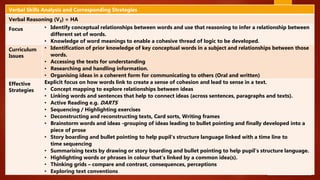
Verbal Skills Analysis and Corresponding Strategies
Verbal Reasoning (V3) = HA
Focus • Identify conceptual relationships between words and use that reasoning to infer a relationship between
different set of words.
• Knowledge of word meanings to enable a cohesive thread of logic to be developed.
Curriculum
Issues
• Identification of prior knowledge of key conceptual words in a subject and relationships between those
words.
• Accessing the texts for understanding
• Researching and handling information.
• Organising ideas in a coherent form for communicating to others (Oral and written)
Effective
Strategies
Explicit focus on how words link to create a sense of cohesion and lead to sense in a text.
• Concept mapping to explore relationships between ideas
• Linking words and sentences that help to connect ideas (across sentences, paragraphs and texts).
• Active Reading e.g. DARTS
• Sequencing / Highlighting exercises
• Deconstructing and reconstructing texts, Card sorts, Writing frames
• Brainstorm words and ideas -grouping of ideas leading to bullet pointing and finally developed into a
piece of prose
• Story boarding and bullet pointing to help pupil's structure language linked with a time line to
time sequencing
• Summarising texts by drawing or story boarding and bullet pointing to help pupil's structure language.
• Highlighting words or phrases in colour that’s linked by a common idea(s).
• Thinking grids – compare and contrast, consequences, perceptions
• Exploring text conventions
40Non-Verbal Skills Analysis and Corresponding Strategies
Figure Classification (N1) = LA
Focus • Transfer of inductive and deductive reasoning in a minimal knowledge context
• Analysis to create rules or criteria for classification
Curriculum
Issues
• Transferring or translating information from one context to another
• Determination of criteria to create a classification
• Good short-term memory for visualisation of symbols or diagrams
• Constructing linear progressions of information and sequencing.
• Ability to construct or organise conceptual progressions
• Ability to access material in a verbal format linked with illustrations
Effective
Strategies
Effective strategies relating to spatial organisation of concepts and their relationships.
• Clustering diagrams like Spider maps or word burrs
• Sequencing exercises with pictures – visual clues
• Continuum lines and time lines
• Flow charting, Cycles
• Brain storming
• Concept cartoons, Concept maps
• Hierarchical concept maps
• Branching databases
• Flash cards linked with sequencing
• Sorting exercises
• Venn diagrams for criteria relationships
• Double bubble maps
41Non-Verbal Skills Analysis and Corresponding Strategies
Figure Analogies (N2) = MA
Focus • Transfer of inductive and deductive reasoning in a minimal knowledge context
• Analysis to create rules and transfer them to a new system
• Visualisation in a 2 dimension structure
Curriculum
Issues
• Able to transfer learning strategies from one subject to another i.e. good bridging skills
• Moves easily from cause and effect to consequences and probabilities of event
• Quick to identify when it is appropriate to use a learning strategy from another discipline
• Able to spot links and hypo these using linked factors or related data
• Good at transferring physical and analogical models
Effective
Strategies
Effective strategies relating to associations and bridging activities
• Story boarding, Relations diagram
• Association maps
• Four thought organisers – picture, feelings, questions, predictions / possible events
• Decision trees
• Consequence mapping
• CASE – transformation analysis skills
• CAME – transformation analysis skills
• Think tank problem solving
• Matrix for compare and contrast
• Critical path analysis
• Venn diagrams
• Grids approach to SWOT analysis
42
Non-Verbal Skills Analysis and Corresponding Strategies
Figure Analysis (N3) = HA
Focus • Transfer of inductive and deductive reasoning in a minimal knowledge context
• Visualisation and analysis of a series of actions
• Predict outcome based upon analysis of visualisation
Curriculum
Issues
• Understanding graphical, symbolic and diagrammatic materials
• Moving from the concrete experiential representation of a model to the abstract visual representation
model
• Manipulation of algebraic forms
• Extrapolation from graphical symbolic and diagrammatic materials
• Development of models
• Evaluation of strengths and weaknesses
Effective
Strategies
Effective strategies relating to metacognitive activities – individual closely linked to group activities
• Analysis for analogies to create a model
• Maths graphic organisers – The Facts, The Steps, The Question, Diagrams, The Solutions
• Design organisers – Structure or object, Purpose, Design, Good features, Alterations
• Represent quantities/objects by symbols to build a simple equation
• Prediction activities involving graphs
• Using ‘Story of the graph’ to help students understand changes and proportions
• Zones of relevance and argument mapping
• Graph prediction linked to shape of graph and change
• Force Field analysis, Fish or herring bone chart
• Bridge mapping to show cross subject links
The Challenge: 43
How do I embed
so many
different
techniques into
lessons?
Learning Objectives: 44
- To recognise how data can be used to identify and
characterise the classroom.
- To interpret a class set of data using MIDYIS graphs.
- To distinguish between effective and ineffective teaching
methods for the individual.
Outcome:
- To create a session, informed by CATS data, that
appropriately supports and stretches a new class.
What are your Key Takeaways?
• WHAT NEW INFORMATION HAVE YOU FOUND USEFUL?
• WHAT HAVE YOU ENJOYED?
• HOW WILL YOU USE WHAT YOU HAVE LEARNT TODAY TOMORROW / NEXT
WEEK?
45
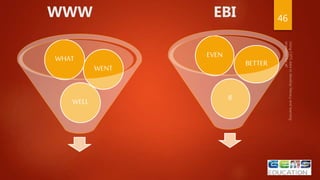
WWW EBI 46
WELL
WENT
WHAT
IF
BETTER
EVEN
47
THANK YOU

USING CAT4 DATA

  • 1.
    USING CAT4 DATA TO DEVELOP LITERACY AND LEARNING STRATEGIES FORALL USING CAT4 DATA TO DEVELOP LITERACY AND LEARNING STRATEGIES FOR ALL BY: JOHN DSOUZA
  • 2.
    ONE TEAM ONE VISION ONEMISSION SMALL CHANGES, SIGNIFICANT IMPACT TOMORROW’S CLASSROOM TODAY… TODAY’S CLASSROOM NOW… …Striving to Integrate… Excellence… Beyond Borders!
  • 3.
    3Ways of Working(WoW) • Mobile devices used only to support learning – i.e. note taking, research, creation • No calls, messaging, emailing • Bags / school work away from table • Be HERE • Have an open mind • Ask questions • Listen to learn • Be honest, positive and constructive • Interact and collaborate with others with active participation • Take responsibility for your own learning • Show respect, confidentiality and professionalism
  • 4.
    IT’S PART OF EDUCATION 4 WECAN’T DROP THAT CAT
  • 5.
    ICE-BREAKER We’re in theTT Room….. Who was the last person you spoke to and what was the conversation? 5 - Lose Talk or Serious Talk? - Complement or Complaint? - Lunch Review or Weekend Plans? - Leaders, Teachers or Students? Share what you spoke and why you liked it with another person on the same table….
  • 6.
  • 7.
    Learning Objectives: 7 -To recognise how data can be used to identify and characterise the classroom. - To interpret a class set of data using MIDYIS graphs - To distinguish between effective and ineffective teaching methods for the individual
  • 8.
    8 Outcome: - To createa session, informed by CATS data, that appropriately supports and stretches a new class
  • 9.
    9 How will we getthere? Alternative ways to Analyze Data Effective Teaching Methods for the Individual Embedding Literacy and Learning Strategies An Example – Grade 8 CAT4 Scores
  • 10.
  • 11.
    11 BRAIN-STORM Are we usingthis DATA anywhere in our assessment documents? Has anyone used this data for effective teaching and learning strategies? What are the 4 pairs of tests which assess different aspects of ability? Any idea about this FAT CAT?
  • 12.
  • 13.
  • 14.
  • 15.
    Alternative Ways toAnalyze Data • GRAPHS CAN GIVE US A QUICK SNAPSHOT OF THE LEARNERS IN OUR CLASS AND THEIR RELATIVE SKILL LEVELS. • THE QUARTILE THEY FIT IN HELPS US TO ASCERTAIN WHERE THEIR LEARNING ABILITIES (STRENGTHS AND WEAKNESSES) MAY LIE AND POSSIBLE TECHNIQUES THAT WILL HELP THEM. 15
  • 16.
  • 17.
    Verbal reasoning will affectthe ability of the group to access texts used in the curriculum i.e. basic literacy levels. The lower the verbal reasoning the poorer the text learning skills are and the more difficult it is for the student to become an independent learner - the greater the need for a whole school literacy programme.
  • 18.
    Non-verbal is an indicationof the ability of the student to transfer learning skills across the curriculum and so the higher the non-verbal the better the student is at dealing with modelling, abstraction, and thinking in pictorial formats. This is also a good indicator of learning skill transfer - the higher the score the better able the student is at transferring generic learning skills across disciplines.
  • 19.
    Students in this quadrantare likely to be good at written work but may not actually understand. They may find the use of equations, modelling and diagrams a challenge to interpret.
  • 20.
    Within these lines both scoresare similar, and students should be successful at transferring generic learning skills, be good at modelling and abstraction
  • 21.
    Students in this quadrant willneed support as it’s likely they understand the work, but struggle to write it down. (In some cases this could lead to disruption)
  • 22.
    This quadrant represents students with lowverbal and non-verbal reasoning. These students may struggle to access texts and will also struggle to transfer skills across subjects
  • 23.
    MARKETPLACE ACTIVITY SHEET: 23 QuadrantA: VERBALLY STRONG+NON VERBALLY WEAK Learning Style - Auditory / Text / Oral Quadrant B: VERBALLY +NON VERBALLY STRONG Learning Style – Visual / Verbal Quadrant D: VERBALLY+NON VERBALLY WEAK Learning Style – Kinaesthetic Active Quadrant C: NON VERBALLY STRONG+VERBALLY WEAK Learning Style – Simple Visual Verbal
  • 24.
  • 25.
    CAT4 GRADE 8 DESCRIPTIONNC CAT4 - SAS 25 % VERY LOW 1-5 LESS 75 0 0 BELOW AVERAGE 5-25 75-90 13 52 AVERAGE 25-75 90-110 12 48 ABOVE AVERAGE 75-95 110-125 0 0 VERY HIGH 95-100 130 + 0 0
  • 26.
    Effective Teaching Methods: EACHGROUP HAS ONE QUADRANT TO FOCUS ON. FOR YOUR QUADRANT: - IDENTIFY THE CHARACTERISTICS ASSOCIATED WITH LEARNERS IN THAT QUADRANT - SUGGEST A RANGE OF ACTIVITIES THAT WOULD SUPPORT THESE LEARNERS IN LESSONS - PRESENT IDEAS ON THE FLIPCHART READY TO 26
  • 27.
  • 28.
  • 29.
  • 30.
  • 31.
  • 32.
    Market Place 32 •Choose your group representative. • You will have 4 minutes to present the characteristics of learners in your quadrant and some possible strategies that could be used with these learners. • If you are an information gatherer, use the blank MIDYIS graph template to summarise the information provided by the representative you visit. • This can then be shared with your group representative at the end of the activity.
  • 33.
    Reflection: • FOR ONEPARTICULAR CLASS YOU TEACH, THINK ABOUT SOME OF THE CHARACTERS AND WHERE YOU THINK THEY WOULD PLACE ON A MIDYIS GRAPH. • WHAT STRATEGIES COULD YOU TRY TO HELP THEM ACCESS MORE CHALLENGING ASPECTS OF YOUR SUBJECT? 33
  • 34.
    Creating a MIDYIS Graph 34 Step1: Copy and paste the names of your students along with their verbal and non-verbal scores into the first spreadsheet CATS Data Tab
  • 35.
    Creating a MIDYIS Graph – Step2 35 MIDYIS Graph Tab
  • 36.
    Creating a MIDYISGraph – Step 3 36 Step 3: If you want to add a title to your graph, left click on the ‘MIDYIS graph’ text box and enter your chosen title.
  • 37.
    37 Verbal Skills Analysisand Corresponding Strategies Verbal Classification (V1) = LA Focus • Meanings and words. • Logical understanding to link words by concept relationship. • Reasoning relationships to form a classification. Curriculum Issues • Understanding of subject specific words • Exploration of generic and subject specific meaning • Classifications to build progressive meaning Effective Strategies Explicit focus on key words within a familiar context. • Interactive word walls e.g. Word Burrs, Spider-grams • Linking words to definitions e.g. Dictionary / Glossary searches, Crosswords • Progressive Glossaries • Interactive games linking words / meanings e.g. Word dominos / bingo / jigsaws / Taboo / Odd-One- Out / Word Loops / Flashcards • Investigate parts/origins/families of words to build meaning e.g. Word Burrs Spider-grams, Fossil- Hunting • Classification exercises to explore relationships e.g. Happy Families • Brainstorming • Cloze • Labelling activities such as diagram completion from a text • Venn diagrams • Investigate shades of meaning e.g. Washing lines • ICT e.g. Clicker, Language Master • Database work involving language e.g. Tree
  • 38.
    38 Verbal Skills Analysisand Corresponding Strategies Sentence Construction (V2) = MA Focus • Relationships of words in a sentence. • Reasoning to make conceptual sense of the sentence. • Knowledge of the use of words leading to the activation of reading strategies. Curriculum Issues • Understanding of subject specific words within larger frames of meaning i.e. sentences, paragraphs, • Accessing texts for reading with understanding. • Writing for differing purposes, context and audiences to make sense. Effective Strategies Explicit focus on how words in sentences can shape meaning. • Cloze exercises linked to making sense of meaning in the text • Active Reading e.g. DARTS • Sequencing / Highlighting exercises • Shared reading (modelling how to skim, scan or close read) • PQR3 techniques for reading • Using banks of linking words and phrases i.e. Connectives • Interactive Word walls • Prompt sentences i.e. Sentence Stems • Investigating purpose and placing of words in a sentence • Investigate formal and informal language, active and passive • Diagram completion and colouring salient points linked to an active text. • ICT to develop basic general writing skills such as 'I can write’ or 'Creative Writer' from Microsoft for Children. • Clicker 3 to help access to difficult words and subject specific words. • Database work involving language e.g. Tree • Exploring text conventions
  • 39.
    39 Verbal Skills Analysisand Corresponding Strategies Verbal Reasoning (V3) = HA Focus • Identify conceptual relationships between words and use that reasoning to infer a relationship between different set of words. • Knowledge of word meanings to enable a cohesive thread of logic to be developed. Curriculum Issues • Identification of prior knowledge of key conceptual words in a subject and relationships between those words. • Accessing the texts for understanding • Researching and handling information. • Organising ideas in a coherent form for communicating to others (Oral and written) Effective Strategies Explicit focus on how words link to create a sense of cohesion and lead to sense in a text. • Concept mapping to explore relationships between ideas • Linking words and sentences that help to connect ideas (across sentences, paragraphs and texts). • Active Reading e.g. DARTS • Sequencing / Highlighting exercises • Deconstructing and reconstructing texts, Card sorts, Writing frames • Brainstorm words and ideas -grouping of ideas leading to bullet pointing and finally developed into a piece of prose • Story boarding and bullet pointing to help pupil's structure language linked with a time line to time sequencing • Summarising texts by drawing or story boarding and bullet pointing to help pupil's structure language. • Highlighting words or phrases in colour that’s linked by a common idea(s). • Thinking grids – compare and contrast, consequences, perceptions • Exploring text conventions
  • 40.
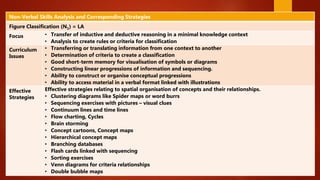
    40Non-Verbal Skills Analysisand Corresponding Strategies Figure Classification (N1) = LA Focus • Transfer of inductive and deductive reasoning in a minimal knowledge context • Analysis to create rules or criteria for classification Curriculum Issues • Transferring or translating information from one context to another • Determination of criteria to create a classification • Good short-term memory for visualisation of symbols or diagrams • Constructing linear progressions of information and sequencing. • Ability to construct or organise conceptual progressions • Ability to access material in a verbal format linked with illustrations Effective Strategies Effective strategies relating to spatial organisation of concepts and their relationships. • Clustering diagrams like Spider maps or word burrs • Sequencing exercises with pictures – visual clues • Continuum lines and time lines • Flow charting, Cycles • Brain storming • Concept cartoons, Concept maps • Hierarchical concept maps • Branching databases • Flash cards linked with sequencing • Sorting exercises • Venn diagrams for criteria relationships • Double bubble maps
  • 41.
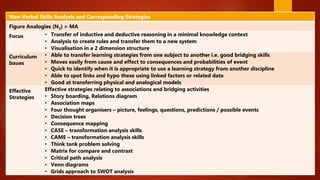
    41Non-Verbal Skills Analysisand Corresponding Strategies Figure Analogies (N2) = MA Focus • Transfer of inductive and deductive reasoning in a minimal knowledge context • Analysis to create rules and transfer them to a new system • Visualisation in a 2 dimension structure Curriculum Issues • Able to transfer learning strategies from one subject to another i.e. good bridging skills • Moves easily from cause and effect to consequences and probabilities of event • Quick to identify when it is appropriate to use a learning strategy from another discipline • Able to spot links and hypo these using linked factors or related data • Good at transferring physical and analogical models Effective Strategies Effective strategies relating to associations and bridging activities • Story boarding, Relations diagram • Association maps • Four thought organisers – picture, feelings, questions, predictions / possible events • Decision trees • Consequence mapping • CASE – transformation analysis skills • CAME – transformation analysis skills • Think tank problem solving • Matrix for compare and contrast • Critical path analysis • Venn diagrams • Grids approach to SWOT analysis
  • 42.
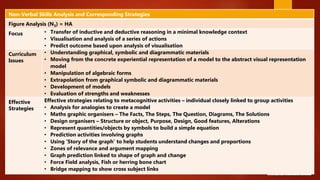
    42 Non-Verbal Skills Analysisand Corresponding Strategies Figure Analysis (N3) = HA Focus • Transfer of inductive and deductive reasoning in a minimal knowledge context • Visualisation and analysis of a series of actions • Predict outcome based upon analysis of visualisation Curriculum Issues • Understanding graphical, symbolic and diagrammatic materials • Moving from the concrete experiential representation of a model to the abstract visual representation model • Manipulation of algebraic forms • Extrapolation from graphical symbolic and diagrammatic materials • Development of models • Evaluation of strengths and weaknesses Effective Strategies Effective strategies relating to metacognitive activities – individual closely linked to group activities • Analysis for analogies to create a model • Maths graphic organisers – The Facts, The Steps, The Question, Diagrams, The Solutions • Design organisers – Structure or object, Purpose, Design, Good features, Alterations • Represent quantities/objects by symbols to build a simple equation • Prediction activities involving graphs • Using ‘Story of the graph’ to help students understand changes and proportions • Zones of relevance and argument mapping • Graph prediction linked to shape of graph and change • Force Field analysis, Fish or herring bone chart • Bridge mapping to show cross subject links
  • 43.
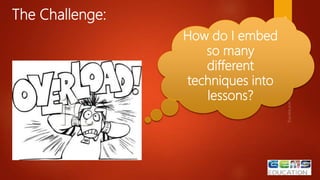
    The Challenge: 43 Howdo I embed so many different techniques into lessons?
  • 44.
    Learning Objectives: 44 -To recognise how data can be used to identify and characterise the classroom. - To interpret a class set of data using MIDYIS graphs. - To distinguish between effective and ineffective teaching methods for the individual. Outcome: - To create a session, informed by CATS data, that appropriately supports and stretches a new class.
  • 45.
    What are yourKey Takeaways? • WHAT NEW INFORMATION HAVE YOU FOUND USEFUL? • WHAT HAVE YOU ENJOYED? • HOW WILL YOU USE WHAT YOU HAVE LEARNT TODAY TOMORROW / NEXT WEEK? 45
  • 46.
  • 47.
  • 48.

Editor's Notes

  • #6 Have four tables for each of the four categories. Colleagues choose a table and share with other people on that table.
  • #16 MIDYIS graphs will be introduced as an alternative way to look at data. The following two slides will explain exactly what the verbal and non-verbal axes mean.
  • #18 This will be introduced as a group along with the next slide to allow for questions about the design of the graph.
  • #22 The following slides are for reference only and will be provided to individual groups during the third activity. Each group will be given a quadrant to focus on. They will be expected to discuss the potential characteristics of the learners and what appropriate support could be provided.