The Professional Learning Community The engine room for change and sustained school improvement Marian College Wednesday 28 January, 2009
Welcome Who we are…
Read first before looking at picture. The attached picture was used in a case study on stress levels at St.Mary's Hospital. Look at both dolphins jumping out of the water. Both dolphins are identical. The researchers concluded that a person is under stress if he/she finds both dolphins look different.  If there are many differences found between both dolphins, it means that the person is experiencing a great amount of stress. So, if you see too many differences between the two dolphins, you are advised to pack your bag, Go home immediately and take a rest. Have a nice day. 
 
RULES FOR WOMEN TEACHERS (1915) You will not marry during the term of contract. You are not to keep company with men. You must be home between the hours of 8p.m. and 6 a.m., unless attending a school function. You may not loiter downtown in Ice-Cream parlours. You may not travel beyond the city limits without the permission of the Chairman of the Board. You may not ride in a carriage or an automobile with any man unless he is your father or your brother. You may not smoke cigarettes. You may not dress in bright colours. You may under no circumstances dye your hair. 10.You must wear at least two petticoats and your dresses must not be shorter than 2” above the ankles. 11. To keep the school room clean you must: sweep the floor at least once daily scrub the floor with hot spongy water at least once a week clean the blackboard once a day start the fire at 7am, so that the room will be warm by 8a.m
Outline A Professional Learning Community What is it? What it is not? Where are we now? Why: what the literature says Morning Tea Getting real – the practical realities Where to next ?
WHAT IS A PROFESSIONAL LEARNING COMMUNITY? What is a professional learning team?
Misconceptions…Mythconceptions VISION :  is it about all of us travelling in the same direction????
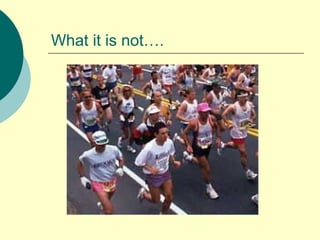
What it is not….
Winners and losers philosophy
Creating and Sustaining Effective Professional Learning Communities Project, 2001-2004 An effective professional learning community has the capacity to promote and sustain the learning of  all  professionals in the school community with the collective purpose of enhancing pupil learning. Co-directors: Ray Bolam, Agnes McMahon, Louise Stoll, Sally Thomas and Mike Wallace
Going beyond show and tell… Beyond bring and brag… What's the difference between talking to each other to share practice and being part of a learning conversation ?
Three types of conversations: Instructional Learning Community (West Burnham and Otero, 2005)
WHY?????? IF IT AIN’T BROKE, DON’T FIX IT!!!!!
Futures Possible futures  - things which could happen, although many are unlikely Probable futures  - things which probably  will happen, unless something is done to turn events around Preferable futures  - things you prefer to have happen and/or what you would like to plan to happen Beare (2001)
Three key change forces  influencing schools Powerful industrial sector associated with new technologies views education as a market place Growing awareness of the need for new approaches to learning and realisation that the only genuinely marketable skill is that of learning itself ‘ Child power’: children with increasingly less regard for school as it lags behind the society  it serves Papert (1996)
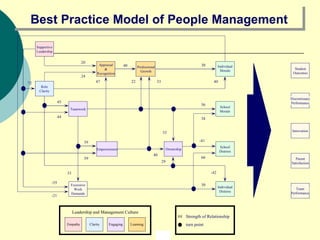
Role Clarity Supportive Leadership Excessive Work Demands Teamwork Appraisal & Recognition Empowerment Professional Growth Ownership Individual Morale School Morale School Distress Individual Distress 20 24 40 40 33 29 -41 66 30 40 38 56 33 33 47 72 45 44 59 39 -55 -21 30 -42 22 Best Practice Model of People Management Strength of Relationship turn point ## Team Performance Student Outcomes Discretionary Performance Innovation Parent Satisfaction Engaging Clarity Learning Empathy Leadership and Management Culture
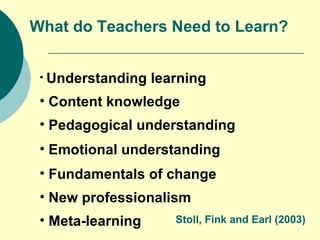
What do Teachers Need to Learn? Understanding learning Content knowledge Pedagogical understanding Emotional understanding Fundamentals of change New professionalism Meta-learning Stoll, Fink and Earl (2003)
No single teacher knows, or could know, the totality of the staff’s professional knowledge.  David Hargreaves, 1999
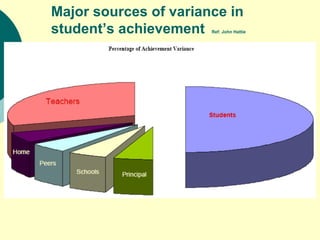
Major sources of variance in student’s achievement   Ref: John Hattie
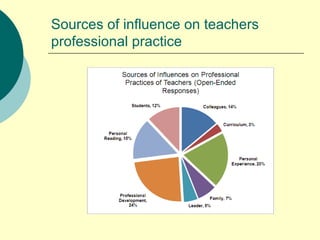
Sources of influence on teachers professional practice
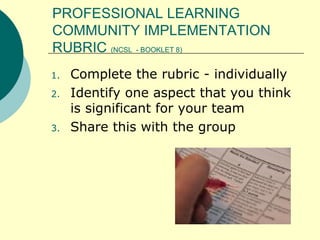
PROFESSIONAL LEARNING COMMUNITY IMPLEMENTATION RUBRIC  (NCSL  - BOOKLET 8) Complete the rubric - individually Identify one aspect that you think is significant for your team Share this with the group
Capacity . . .  is a complex blend of motivation, skill, positive learning, organisational conditions and culture, and infrastructure of support.  Put together, it gives individuals, groups and, ultimately whole school communities the power to get involved in and sustain learning. Stoll, Stobart et al (2003)
Are You Part of a Professional Learning Community? “… the most promising strategy for substantive school improvement is developing the capacity for school personnel to function as a professional learning community (PLC).” Robert Eaker, Richard DuFour, and Rebecca DuFour,  Getting Started: Reculturing Schools to Become Professional Learning Communities
What causes student achievement? The data from our studies suggest that where there is a high degree of teacher and leadership  efficacy , the gains in student achievement are more than three times greater than when teachers and leaders assume that their impact on achievement is minimal.  (Reeves, 2008, p. 5)
What is expected gets inspected… Schools with the highest scores on  monitoring  showed  more than five times  the gains in achievement compared to schools with the lowest scores on monitoring. The schools with the best scores on monitoring in our study were able to provide frequent feedback to their colleagues in a constructive manner.  (Reeves, 2008, p.5)
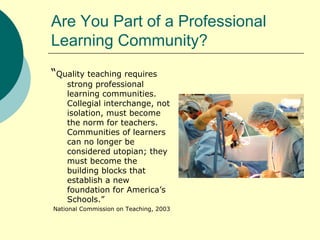
Are You Part of a Professional Learning Community? “ Quality teaching requires strong professional learning communities.  Collegial interchange, not isolation, must become the norm for teachers.  Communities of learners can no longer be considered utopian; they must become the building blocks that establish a new foundation for America’s Schools.” National Commission on Teaching, 2003
A collaborative venture… “ Isolation is the enemy of learning. Principals who support the learning of adults in their school organize teachers schedules to provide opportunities for teachers to work, plan, and think together.” NAESP,  Leading Learning Communities: Standards for What Principals Should Know and Be Able to Do
Characteristics of professional learning communities Shared values and vision Collective responsibility for pupil’s learning Reflective enquiry Collaboration focused on learning Group as well as individual professional learning Openness, networks and partnerships Inclusive membership Mutual trust, respect and support
MORNING TEA
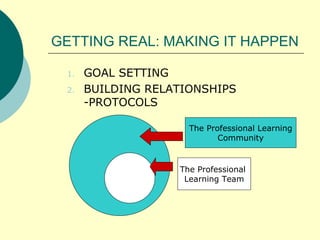
GETTING REAL: MAKING IT HAPPEN GOAL SETTING BUILDING RELATIONSHIPS -PROTOCOLS The Professional  Learning Team The Professional Learning Community
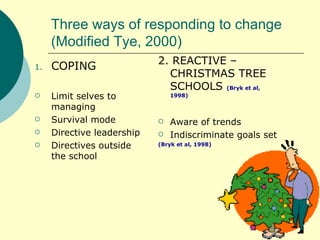
Three ways of responding to change (Modified Tye, 2000) COPING Limit selves to managing Survival mode Directive leadership Directives outside the school 2. REACTIVE –CHRISTMAS TREE SCHOOLS  (Bryk et al, 1998) Aware of trends Indiscriminate goals set (Bryk et al, 1998)
GOAL FOCUSED !!!!!!! Select a few reasonable goals Establish priorities Ignore or manage other pressures
Marian College  LEARNING AND TEACHING ACTIONS  - 2009 To continue to work at implementing a curriculum underpinned by Habits of Mind as Thinking, Personal Learning and Interpersonal strategies.  (Years 8 – 10) To investigate the embedding of the Habits of Mind into the curriculum.  (Year 7 Focus – implementation 2010) To showcase approaches to Habits of Mind at Curriculum and staff meetings. To showcase student work at team and staff meetings. To develop and implement Student achievement and Consolidation policy To introduce the Student of the Term and Semester Academic Excellence Award To review the current curriculum structure and design proposed new Curriculum Program structure (Years 7 -10) To integrate ICT across the curriculum To investigate the National Curriculum’s impact on Marian College.
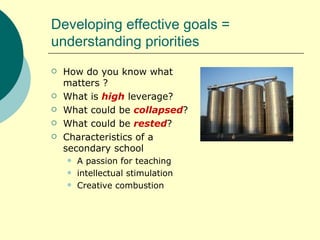
Developing effective goals = understanding priorities How do you know what matters ? What is  high  leverage? What could be  collapsed ? What could be  rested ? Characteristics of a secondary school A passion for teaching  intellectual stimulation Creative combustion
Goal setting – advice from the literature THREE WHOLE SCHOOL INITIATIVES One goal which: sustains/ reinforces existing practice deepens learning and teaching capacity builds opportunity for risk-taking and innovation builds pool of expertise creates refined performance benchmarks (qualitative and quantitative Two new goals which: are new challenge shift the goal posts What are the implications of this for the Brigidine nature of Marian College?
Structuring team goals? Respecting the role of the adult learner means using time wisely  (you have been allocated 12 sessions) Are goals long term or short term? Are goals realistic? Are goals specific ? Are goals achievable in the next 12 months ? Are the goals too ambitious?
TEAM GOAL SETTING Work together in your ‘Area Team’ Write a team goal that is specific and descriptive Consider: Is it achievable? Can you do this in the next twelve months? THE BIG CHALLENGE – HOW WILL YOU KNOW YOU HAVE ACHIEVED THESE? HOW WILL YOU KNOW IF IT’S MADE A DIFFERENCE TO STUDENT LEARNING ?
Establishing Protocols = Building “credit in the bank” The altruistic nature of teaching – we all believe we are doing the “right thing and we are all working hard!!!”  Teachers invest “emotional labour.” (Liz Freeman, 2003) “ credit in the trust bank” (Covey, 1995)
The most challenging feature – team work “ The one area that was the most difficult to carry out for business and education leaders was developing and sustaining teamwork.”  (Hay Management 2000) FIVE CONDITIONS FOR EFFECTIVE TEAM WORK : Real team Compelling direction for work Enabling structure   Supportive organizational context Expert coaching  (Hackman 2002 )
Two important categories to consider 1.  PROTOCOLS RELATED TO OUR LEARNING We will come to meetings prepared. We will complete tasks between meetings. 2.  PROTOCOLS RELATED TO PROFESSIONAL REGARD FOR OTHERS.. We will begin each meeting on time. We will make these 12 meetings a priority and commit to them in our calendars. We will engage respectfully but honestly with colleagues We will set an agenda at the end of each meeting for the following meeting.
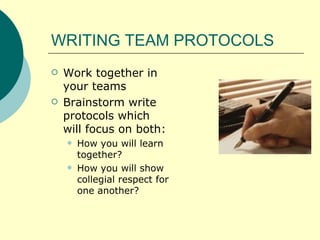
WRITING TEAM PROTOCOLS Work together in your teams Brainstorm write protocols which will focus on both: How you will learn together? How you will show collegial respect for one another?
Resolving Tensions - Problem Solving Strategy PROTOCOLS We will come to meetings prepared. WHAT IT LOOKS LIKE.. We will have read pre-reading material We will complete assigned tasks..
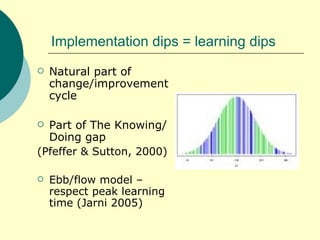
Implementation dips = learning dips Natural part of change/improvement cycle Part of The Knowing/Doing gap (Pfeffer & Sutton, 2000) Ebb/flow model – respect peak learning time (Jarni 2005)
Change will not come if we wait for some other person or some other time. We are the ones we've been waiting for.  We are the change  that we seek.
FINAL THOUGHTS… “ Our schools can be wonderful places of enchantment and creativity, opening doorways to new ways of perceiving, new ways of being; but they are most of all places of exquisite hope in the possibility of people… this means we have to choose what is seen to matter and then go out and collectively begin to move towards achieving it..” (Clarke in Stoll, Fink & Earl 2002)
References National College for School Leadership website:  www.ncsl.org.uk Hattie, J.  Teachers Make a Difference What is the research evidence? Reeves, D.(2008)  Leadership and Learning Monograph Series 43,  ACEL
STEP OUT OF THE BOX (EXAMPLE ONLY!!!) GOAL ONE : PROMOTING CAPACITY FOR DEEP THINKING (STUDENTS AND TEACHERS) To investigate the embedding of Habits of Mind in the curriculum To implement the Thinking domain into all aspects of the curriculum GOAL TWO : ENHANCING PEDAGOGY (STUDENT FOCUS) To develop inquiry-based units of work (rich assessment tasks/essential questions/open-ended) To develop strategies that extend high achieving students To continue to integrate ICT into curriculum GOAL THREE:  EMBEDDING RICH PRACTICE To continue to improve literacy To continue to improve numeracy To explore ESL in the mainstream To use Principles of Learning and Teaching as a reflection tool

The Professional Learning Community

  • 1.
    The Professional LearningCommunity The engine room for change and sustained school improvement Marian College Wednesday 28 January, 2009
  • 2.
  • 3.
    Read first beforelooking at picture. The attached picture was used in a case study on stress levels at St.Mary's Hospital. Look at both dolphins jumping out of the water. Both dolphins are identical. The researchers concluded that a person is under stress if he/she finds both dolphins look different. If there are many differences found between both dolphins, it means that the person is experiencing a great amount of stress. So, if you see too many differences between the two dolphins, you are advised to pack your bag, Go home immediately and take a rest. Have a nice day. 
  • 4.
  • 5.
    RULES FOR WOMENTEACHERS (1915) You will not marry during the term of contract. You are not to keep company with men. You must be home between the hours of 8p.m. and 6 a.m., unless attending a school function. You may not loiter downtown in Ice-Cream parlours. You may not travel beyond the city limits without the permission of the Chairman of the Board. You may not ride in a carriage or an automobile with any man unless he is your father or your brother. You may not smoke cigarettes. You may not dress in bright colours. You may under no circumstances dye your hair. 10.You must wear at least two petticoats and your dresses must not be shorter than 2” above the ankles. 11. To keep the school room clean you must: sweep the floor at least once daily scrub the floor with hot spongy water at least once a week clean the blackboard once a day start the fire at 7am, so that the room will be warm by 8a.m
  • 6.
    Outline A ProfessionalLearning Community What is it? What it is not? Where are we now? Why: what the literature says Morning Tea Getting real – the practical realities Where to next ?
  • 7.
    WHAT IS APROFESSIONAL LEARNING COMMUNITY? What is a professional learning team?
  • 8.
    Misconceptions…Mythconceptions VISION : is it about all of us travelling in the same direction????
  • 9.
    What it isnot….
  • 10.
  • 11.
    Creating and SustainingEffective Professional Learning Communities Project, 2001-2004 An effective professional learning community has the capacity to promote and sustain the learning of all professionals in the school community with the collective purpose of enhancing pupil learning. Co-directors: Ray Bolam, Agnes McMahon, Louise Stoll, Sally Thomas and Mike Wallace
  • 12.
    Going beyond showand tell… Beyond bring and brag… What's the difference between talking to each other to share practice and being part of a learning conversation ?
  • 13.
    Three types ofconversations: Instructional Learning Community (West Burnham and Otero, 2005)
  • 14.
    WHY?????? IF ITAIN’T BROKE, DON’T FIX IT!!!!!
  • 15.
    Futures Possible futures - things which could happen, although many are unlikely Probable futures - things which probably will happen, unless something is done to turn events around Preferable futures - things you prefer to have happen and/or what you would like to plan to happen Beare (2001)
  • 16.
    Three key changeforces influencing schools Powerful industrial sector associated with new technologies views education as a market place Growing awareness of the need for new approaches to learning and realisation that the only genuinely marketable skill is that of learning itself ‘ Child power’: children with increasingly less regard for school as it lags behind the society it serves Papert (1996)
  • 17.
    Role Clarity SupportiveLeadership Excessive Work Demands Teamwork Appraisal & Recognition Empowerment Professional Growth Ownership Individual Morale School Morale School Distress Individual Distress 20 24 40 40 33 29 -41 66 30 40 38 56 33 33 47 72 45 44 59 39 -55 -21 30 -42 22 Best Practice Model of People Management Strength of Relationship turn point ## Team Performance Student Outcomes Discretionary Performance Innovation Parent Satisfaction Engaging Clarity Learning Empathy Leadership and Management Culture
  • 18.
    What do TeachersNeed to Learn? Understanding learning Content knowledge Pedagogical understanding Emotional understanding Fundamentals of change New professionalism Meta-learning Stoll, Fink and Earl (2003)
  • 19.
    No single teacherknows, or could know, the totality of the staff’s professional knowledge. David Hargreaves, 1999
  • 20.
    Major sources ofvariance in student’s achievement Ref: John Hattie
  • 21.
    Sources of influenceon teachers professional practice
  • 22.
    PROFESSIONAL LEARNING COMMUNITYIMPLEMENTATION RUBRIC (NCSL - BOOKLET 8) Complete the rubric - individually Identify one aspect that you think is significant for your team Share this with the group
  • 23.
    Capacity . .. is a complex blend of motivation, skill, positive learning, organisational conditions and culture, and infrastructure of support. Put together, it gives individuals, groups and, ultimately whole school communities the power to get involved in and sustain learning. Stoll, Stobart et al (2003)
  • 24.
    Are You Partof a Professional Learning Community? “… the most promising strategy for substantive school improvement is developing the capacity for school personnel to function as a professional learning community (PLC).” Robert Eaker, Richard DuFour, and Rebecca DuFour, Getting Started: Reculturing Schools to Become Professional Learning Communities
  • 25.
    What causes studentachievement? The data from our studies suggest that where there is a high degree of teacher and leadership efficacy , the gains in student achievement are more than three times greater than when teachers and leaders assume that their impact on achievement is minimal. (Reeves, 2008, p. 5)
  • 26.
    What is expectedgets inspected… Schools with the highest scores on monitoring showed more than five times the gains in achievement compared to schools with the lowest scores on monitoring. The schools with the best scores on monitoring in our study were able to provide frequent feedback to their colleagues in a constructive manner. (Reeves, 2008, p.5)
  • 27.
    Are You Partof a Professional Learning Community? “ Quality teaching requires strong professional learning communities. Collegial interchange, not isolation, must become the norm for teachers. Communities of learners can no longer be considered utopian; they must become the building blocks that establish a new foundation for America’s Schools.” National Commission on Teaching, 2003
  • 28.
    A collaborative venture…“ Isolation is the enemy of learning. Principals who support the learning of adults in their school organize teachers schedules to provide opportunities for teachers to work, plan, and think together.” NAESP, Leading Learning Communities: Standards for What Principals Should Know and Be Able to Do
  • 29.
    Characteristics of professionallearning communities Shared values and vision Collective responsibility for pupil’s learning Reflective enquiry Collaboration focused on learning Group as well as individual professional learning Openness, networks and partnerships Inclusive membership Mutual trust, respect and support
  • 30.
  • 31.
    GETTING REAL: MAKINGIT HAPPEN GOAL SETTING BUILDING RELATIONSHIPS -PROTOCOLS The Professional Learning Team The Professional Learning Community
  • 32.
    Three ways ofresponding to change (Modified Tye, 2000) COPING Limit selves to managing Survival mode Directive leadership Directives outside the school 2. REACTIVE –CHRISTMAS TREE SCHOOLS (Bryk et al, 1998) Aware of trends Indiscriminate goals set (Bryk et al, 1998)
  • 33.
    GOAL FOCUSED !!!!!!!Select a few reasonable goals Establish priorities Ignore or manage other pressures
  • 34.
    Marian College LEARNING AND TEACHING ACTIONS - 2009 To continue to work at implementing a curriculum underpinned by Habits of Mind as Thinking, Personal Learning and Interpersonal strategies. (Years 8 – 10) To investigate the embedding of the Habits of Mind into the curriculum. (Year 7 Focus – implementation 2010) To showcase approaches to Habits of Mind at Curriculum and staff meetings. To showcase student work at team and staff meetings. To develop and implement Student achievement and Consolidation policy To introduce the Student of the Term and Semester Academic Excellence Award To review the current curriculum structure and design proposed new Curriculum Program structure (Years 7 -10) To integrate ICT across the curriculum To investigate the National Curriculum’s impact on Marian College.
  • 35.
    Developing effective goals= understanding priorities How do you know what matters ? What is high leverage? What could be collapsed ? What could be rested ? Characteristics of a secondary school A passion for teaching intellectual stimulation Creative combustion
  • 36.
    Goal setting –advice from the literature THREE WHOLE SCHOOL INITIATIVES One goal which: sustains/ reinforces existing practice deepens learning and teaching capacity builds opportunity for risk-taking and innovation builds pool of expertise creates refined performance benchmarks (qualitative and quantitative Two new goals which: are new challenge shift the goal posts What are the implications of this for the Brigidine nature of Marian College?
  • 37.
    Structuring team goals?Respecting the role of the adult learner means using time wisely (you have been allocated 12 sessions) Are goals long term or short term? Are goals realistic? Are goals specific ? Are goals achievable in the next 12 months ? Are the goals too ambitious?
  • 38.
    TEAM GOAL SETTINGWork together in your ‘Area Team’ Write a team goal that is specific and descriptive Consider: Is it achievable? Can you do this in the next twelve months? THE BIG CHALLENGE – HOW WILL YOU KNOW YOU HAVE ACHIEVED THESE? HOW WILL YOU KNOW IF IT’S MADE A DIFFERENCE TO STUDENT LEARNING ?
  • 39.
    Establishing Protocols =Building “credit in the bank” The altruistic nature of teaching – we all believe we are doing the “right thing and we are all working hard!!!” Teachers invest “emotional labour.” (Liz Freeman, 2003) “ credit in the trust bank” (Covey, 1995)
  • 40.
    The most challengingfeature – team work “ The one area that was the most difficult to carry out for business and education leaders was developing and sustaining teamwork.” (Hay Management 2000) FIVE CONDITIONS FOR EFFECTIVE TEAM WORK : Real team Compelling direction for work Enabling structure Supportive organizational context Expert coaching (Hackman 2002 )
  • 41.
    Two important categoriesto consider 1. PROTOCOLS RELATED TO OUR LEARNING We will come to meetings prepared. We will complete tasks between meetings. 2. PROTOCOLS RELATED TO PROFESSIONAL REGARD FOR OTHERS.. We will begin each meeting on time. We will make these 12 meetings a priority and commit to them in our calendars. We will engage respectfully but honestly with colleagues We will set an agenda at the end of each meeting for the following meeting.
  • 42.
    WRITING TEAM PROTOCOLSWork together in your teams Brainstorm write protocols which will focus on both: How you will learn together? How you will show collegial respect for one another?
  • 43.
    Resolving Tensions -Problem Solving Strategy PROTOCOLS We will come to meetings prepared. WHAT IT LOOKS LIKE.. We will have read pre-reading material We will complete assigned tasks..
  • 44.
    Implementation dips =learning dips Natural part of change/improvement cycle Part of The Knowing/Doing gap (Pfeffer & Sutton, 2000) Ebb/flow model – respect peak learning time (Jarni 2005)
  • 45.
    Change will notcome if we wait for some other person or some other time. We are the ones we've been waiting for. We are the change that we seek.
  • 46.
    FINAL THOUGHTS… “Our schools can be wonderful places of enchantment and creativity, opening doorways to new ways of perceiving, new ways of being; but they are most of all places of exquisite hope in the possibility of people… this means we have to choose what is seen to matter and then go out and collectively begin to move towards achieving it..” (Clarke in Stoll, Fink & Earl 2002)
  • 47.
    References National Collegefor School Leadership website: www.ncsl.org.uk Hattie, J. Teachers Make a Difference What is the research evidence? Reeves, D.(2008) Leadership and Learning Monograph Series 43, ACEL
  • 48.
    STEP OUT OFTHE BOX (EXAMPLE ONLY!!!) GOAL ONE : PROMOTING CAPACITY FOR DEEP THINKING (STUDENTS AND TEACHERS) To investigate the embedding of Habits of Mind in the curriculum To implement the Thinking domain into all aspects of the curriculum GOAL TWO : ENHANCING PEDAGOGY (STUDENT FOCUS) To develop inquiry-based units of work (rich assessment tasks/essential questions/open-ended) To develop strategies that extend high achieving students To continue to integrate ICT into curriculum GOAL THREE: EMBEDDING RICH PRACTICE To continue to improve literacy To continue to improve numeracy To explore ESL in the mainstream To use Principles of Learning and Teaching as a reflection tool