

How do you select
                   funds?

   The most simple approach would be peformance i.e. returns,
    right?!


   But is it sufficient to track only returns?
There is something more…
   The reliability of the scheme too is a critical aspect. Reliability is nothing but
    volatility.


   A scheme giving good returns but is extremely volatile or unreliable may not find
    favor with a larger number of investors.


   This calls for a measure of performance which takes into account both returns as
    well as volatility / reliability.
Understanding Sharpe & Sortino Ratios

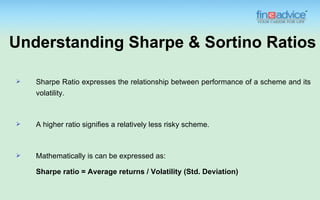
   Sharpe Ratio expresses the relationship between performance of a scheme and its
    volatility.


   A higher ratio signifies a relatively less risky scheme.


   Mathematically is can be expressed as:

    Sharpe ratio = Average returns / Volatility (Std. Deviation)
What does it mean?
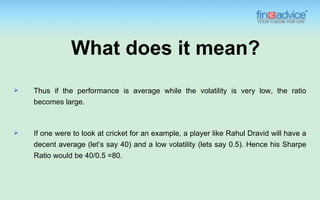
   Thus if the performance is average while the volatility is very low, the ratio
    becomes large.


   If one were to look at cricket for an example, a player like Rahul Dravid will have a
    decent average (let’s say 40) and a low volatility (lets say 0.5). Hence his Sharpe
    Ratio would be 40/0.5 =80.
On the other hand…

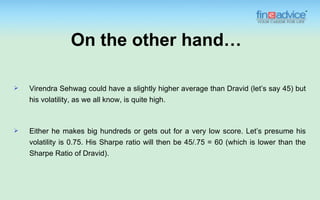
   Virendra Sehwag could have a slightly higher average than Dravid (let’s say 45) but
    his volatility, as we all know, is quite high.


   Either he makes big hundreds or gets out for a very low score. Let’s presume his
    volatility is 0.75. His Sharpe ratio will then be 45/.75 = 60 (which is lower than the
    Sharpe Ratio of Dravid).
So what does this suggest?
   Despite a higher average, Sehwag’s Sharpe ratio is lower than that of Dravid.


   This indicates that simply looking at performance from the average point of view is not
    enough to judge a player.


   One needs to take a look at different dimensions as well.
Hence…
   It may be wiser to pick up Dravid for the longer version of the game, say Test
    Matches and Sehwag might be a better pick for the shortest version of the game,
    say T-20.


   Also, the ratio will become large if either the numerator increases or the
    denominator decreases.
The Sharpe Ratio of Tata
Infrastructure Fund is 0.0899 for
the period of three years from
1st June, ’06 to 31st May, ’09,
wherein Risk Free Rate is
assumed at 6%.
So what is the
                        Sortino Ratio?
   The Sortino ratio is similar to the Sharpe ratio, except while Sharpe ratio uses
    Standard Deviation in the denominator, Sortino ratio uses downside deviation.


   It is important to note that while standard deviation does not discriminate between
    upward and downward volatility, downward deviation does so.
Thus…
   Standard deviation can be high in the case of excessive upward movement of price
    and it may result into a lower Sharpe Ratio.


   Sharpe ratio will be low because the high standard deviation is the denominator.


   Now we may believe that the scheme is unsuitable and therefore misrepresent the
    real picture (since upward movement is desirable from an investor’s perspective!).
   Hence it was necessary to find another ratio which differentiates harmful volatility
    from volatility in general by replacing standard deviation with downside deviation in
    the denominator.


   Thus, the Sortino Ratio was calculated by subtracting the risk free rate from the
    return of the portfolio and then dividing it by the downside deviation.
Conceptually speaking…
   Sortino Ratio = Performance/ Downside deviation. The Sortino ratio measures
    the return to ‘bad’ volatility.


   This ratio allows investors to assess risk in a better manner than simply looking at
    excess returns to total volatility.


   A large Sortino Ratio indicates a low risk of large losses occurring.
   To give an example, assume investment A has a return of +10% in year one
    and -10% in year two. Investment B has a 0% return in year one and a 20%
    return in year two.


   The total variance in these investments is the same, i.e. 20%. However,
    investment B is obviously more favorable. Why??


   As the Sharpe ratio measures risk using standard deviation only, it does not
    differentiate between positive and negative volatility.
The Sortino ratio, on the other hand,
measures     performance    against   the
downward deviation… so it is able to spot
the negative volatility associated with
investment A immediately and help us
classify investment B as a more favorable
investment!
The Sortino Ratio of Tata Infrastructure
Fund is 12.796 for the period of three
years from 1st June, ’06 to 31st May, ’09,
wherein Risk Free Rate is assumed at 6%.
To Sum Up

   Sharpe Ratio: Sharpe Ratio expresses the relationship between performance of a
    scheme and its volatility. A higher ratio signifies a relatively less risky scheme.


   Sortino Ratio: The Sortino Ratio is calculated by subtracting the risk free rate from
    the return of the portfolio and then dividing it by the downside deviation.

Sharpe & Sortino Ratios

  • 2.
    How do youselect funds?  The most simple approach would be peformance i.e. returns, right?!  But is it sufficient to track only returns?
  • 3.
    There is somethingmore…  The reliability of the scheme too is a critical aspect. Reliability is nothing but volatility.  A scheme giving good returns but is extremely volatile or unreliable may not find favor with a larger number of investors.  This calls for a measure of performance which takes into account both returns as well as volatility / reliability.
  • 4.
    Understanding Sharpe &Sortino Ratios  Sharpe Ratio expresses the relationship between performance of a scheme and its volatility.  A higher ratio signifies a relatively less risky scheme.  Mathematically is can be expressed as: Sharpe ratio = Average returns / Volatility (Std. Deviation)
  • 5.
    What does itmean?  Thus if the performance is average while the volatility is very low, the ratio becomes large.  If one were to look at cricket for an example, a player like Rahul Dravid will have a decent average (let’s say 40) and a low volatility (lets say 0.5). Hence his Sharpe Ratio would be 40/0.5 =80.
  • 6.
    On the otherhand…  Virendra Sehwag could have a slightly higher average than Dravid (let’s say 45) but his volatility, as we all know, is quite high.  Either he makes big hundreds or gets out for a very low score. Let’s presume his volatility is 0.75. His Sharpe ratio will then be 45/.75 = 60 (which is lower than the Sharpe Ratio of Dravid).
  • 7.
    So what doesthis suggest?  Despite a higher average, Sehwag’s Sharpe ratio is lower than that of Dravid.  This indicates that simply looking at performance from the average point of view is not enough to judge a player.  One needs to take a look at different dimensions as well.
  • 8.
    Hence…  It may be wiser to pick up Dravid for the longer version of the game, say Test Matches and Sehwag might be a better pick for the shortest version of the game, say T-20.  Also, the ratio will become large if either the numerator increases or the denominator decreases.
  • 9.
    The Sharpe Ratioof Tata Infrastructure Fund is 0.0899 for the period of three years from 1st June, ’06 to 31st May, ’09, wherein Risk Free Rate is assumed at 6%.
  • 10.
    So what isthe Sortino Ratio?  The Sortino ratio is similar to the Sharpe ratio, except while Sharpe ratio uses Standard Deviation in the denominator, Sortino ratio uses downside deviation.  It is important to note that while standard deviation does not discriminate between upward and downward volatility, downward deviation does so.
  • 11.
    Thus…  Standard deviation can be high in the case of excessive upward movement of price and it may result into a lower Sharpe Ratio.  Sharpe ratio will be low because the high standard deviation is the denominator.  Now we may believe that the scheme is unsuitable and therefore misrepresent the real picture (since upward movement is desirable from an investor’s perspective!).
  • 12.
    Hence it was necessary to find another ratio which differentiates harmful volatility from volatility in general by replacing standard deviation with downside deviation in the denominator.  Thus, the Sortino Ratio was calculated by subtracting the risk free rate from the return of the portfolio and then dividing it by the downside deviation.
  • 13.
    Conceptually speaking…  Sortino Ratio = Performance/ Downside deviation. The Sortino ratio measures the return to ‘bad’ volatility.  This ratio allows investors to assess risk in a better manner than simply looking at excess returns to total volatility.  A large Sortino Ratio indicates a low risk of large losses occurring.
  • 14.
    To give an example, assume investment A has a return of +10% in year one and -10% in year two. Investment B has a 0% return in year one and a 20% return in year two.  The total variance in these investments is the same, i.e. 20%. However, investment B is obviously more favorable. Why??  As the Sharpe ratio measures risk using standard deviation only, it does not differentiate between positive and negative volatility.
  • 15.
    The Sortino ratio,on the other hand, measures performance against the downward deviation… so it is able to spot the negative volatility associated with investment A immediately and help us classify investment B as a more favorable investment!
  • 16.
    The Sortino Ratioof Tata Infrastructure Fund is 12.796 for the period of three years from 1st June, ’06 to 31st May, ’09, wherein Risk Free Rate is assumed at 6%.
  • 17.
    To Sum Up  Sharpe Ratio: Sharpe Ratio expresses the relationship between performance of a scheme and its volatility. A higher ratio signifies a relatively less risky scheme.  Sortino Ratio: The Sortino Ratio is calculated by subtracting the risk free rate from the return of the portfolio and then dividing it by the downside deviation.