NAME :BHAKTI KUDNEKAR
ROLL NO : 30-2013
Meaning of portfolio.
Portfolio evaluation meaning.
Portfolio evaluation measures.
MEANING OF PORTFOLIO
Investment and trading in financial assets results
in the holding of a basket of these securities
which is called as portfolio.
A portfolio of an individual or a corporate unit is
the holding of securities and investment in
financial asset.
These holdings are the result of individual
preferences and decisions of the holders
regarding risk and return and host of other
considerations.
Portfolio evaluation
Meaning :-
Portfolio evaluation refers to the
evaluation of the performance of the
portfolio.
It is essentially the process of comparing
the returned earned on a portfolio with
the return earned on one or more other
portfolios.
Portfolio evaluation essentially comprises of two functions.
That is performance measurement and
performance evaluation.
Performance measurement is an accounting
function which measures the returned earned
on portfolio during the holding period or
investment period.
Performance evaluation addresses whether the
performance was superior or inferior ,whether
the performance was due to skill or luck.
Portfolio evaluation
measures are as
follows
Sharpe’s performance
index
Treynor’s
performance index
Jensen’s
performance index
Sharpe’s performance index
Sharpe’s performance index gives a single value to be used
for the performance ranking of various funds or portfolios .
Sharpe index measures the risk premium of the portfolio
relative to the total amount of risk in the portfolio.
This risk premium is the difference between the portfolio’s
average rate of return and the riskless rate of return.
The standard deviation of the portfolio indicates the risk.
The index assigns the highest values that have best risk-
adjusted average rate of return.
𝑆𝑡 =
𝑅𝑝 − 𝑅𝑓
𝜎𝑝
𝑆𝑡 =Sharpe index.
Rp =portfolio average return.
Rf =risk free rate of return.
𝜎𝑝 =standard deviation of portfolio return.
Example the details of two hypothetical funds A and B
Fund Average
annual
return
Riskless rate
of return
Standard
deviation
𝑆𝑡
A 0.0879 0.05 0.0829 0.0879 − 0.05
0.829
=0.475
B 0.1347 0.05 0.1982 0.1347−0.05
0.1982
=0.427
 The larger the 𝑆𝑡, better the fund has performed.
 Thus , A ranked as better fund because its index
0.475>0.427 even though the portfolio B had
greater return of 0.1347 the reason is that the
fund ‘B’s manager took such a great risk to earn
the higher returns and its risk adjusted return was
not the most desirable.
 Sharp index can be used to rank the desirability of
or portfolios, ‘but not the individual assets. the
individual asset contains its diversifiable risk.
Treynor’s performance index
o To understand the Treynor’s index, an investor
should know the concept of characteristic line.
o The relationship between a given market return
and the fund’s return is given by characteristic
line.
o The fund’s performance is measured in relation to
the market performance.
o The ideal fund’s return rises at a faster rate than
the general market performance when the
market is moving upwards and its rate of return
declines slowly and then the market return,in the
decline.
formula
𝑇𝑛 =
𝑅𝑝 − 𝑅𝑓
𝛽𝑝
• 𝑅𝑝=𝛼 + 𝛽𝑅 𝑚 + 𝑒 𝑝
• 𝑅𝑝=portfolio return
• 𝑅 𝑚 =the market return or index return
• 𝑒 𝑝 =the error term or the residual
• 𝛼, 𝛽 =co-efficient to be estimated
Example the details of two hypothetical
funds A and B
Fund Average
return
Beta Risk
premium
𝑅𝑓 𝑇𝑛
A 0.0879 0.499 0.0379 0.05 0.0879 − 0.05
0.499
=0.499
B 0.1347 1.2493 0.0847 0.05 0.1347 − 0.05
1.2493
=0.0678
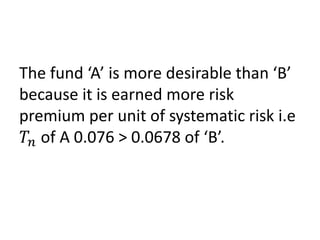
The fund ‘A’ is more desirable than ‘B’
because it is earned more risk
premium per unit of systematic risk i.e
𝑇𝑛 of A 0.076 > 0.0678 of ‘B’.
Jensen’s performance index
• The absolute risk adjusted return measure
was developed by Michael Jensen and
commonly known as jensen’s measure.
• it is mentioned as a measure of absolute
performance because a definite standard is
set and against that the performance is
measured.
• The standard is based on the manager’s
predictive ability.
• Successful prediction of security price would
enable the manger to earn higher returns than
the ordinary investor expects to earn in a given
level of risk.

Sapm

  • 1.
    NAME :BHAKTI KUDNEKAR ROLLNO : 30-2013 Meaning of portfolio. Portfolio evaluation meaning. Portfolio evaluation measures.
  • 2.
    MEANING OF PORTFOLIO Investmentand trading in financial assets results in the holding of a basket of these securities which is called as portfolio. A portfolio of an individual or a corporate unit is the holding of securities and investment in financial asset. These holdings are the result of individual preferences and decisions of the holders regarding risk and return and host of other considerations.
  • 3.
    Portfolio evaluation Meaning :- Portfolioevaluation refers to the evaluation of the performance of the portfolio. It is essentially the process of comparing the returned earned on a portfolio with the return earned on one or more other portfolios.
  • 4.
    Portfolio evaluation essentiallycomprises of two functions. That is performance measurement and performance evaluation. Performance measurement is an accounting function which measures the returned earned on portfolio during the holding period or investment period. Performance evaluation addresses whether the performance was superior or inferior ,whether the performance was due to skill or luck.
  • 5.
    Portfolio evaluation measures areas follows Sharpe’s performance index Treynor’s performance index Jensen’s performance index
  • 6.
    Sharpe’s performance index Sharpe’sperformance index gives a single value to be used for the performance ranking of various funds or portfolios . Sharpe index measures the risk premium of the portfolio relative to the total amount of risk in the portfolio. This risk premium is the difference between the portfolio’s average rate of return and the riskless rate of return. The standard deviation of the portfolio indicates the risk. The index assigns the highest values that have best risk- adjusted average rate of return.
  • 7.
    𝑆𝑡 = 𝑅𝑝 −𝑅𝑓 𝜎𝑝 𝑆𝑡 =Sharpe index. Rp =portfolio average return. Rf =risk free rate of return. 𝜎𝑝 =standard deviation of portfolio return.
  • 8.
    Example the detailsof two hypothetical funds A and B Fund Average annual return Riskless rate of return Standard deviation 𝑆𝑡 A 0.0879 0.05 0.0829 0.0879 − 0.05 0.829 =0.475 B 0.1347 0.05 0.1982 0.1347−0.05 0.1982 =0.427
  • 9.
     The largerthe 𝑆𝑡, better the fund has performed.  Thus , A ranked as better fund because its index 0.475>0.427 even though the portfolio B had greater return of 0.1347 the reason is that the fund ‘B’s manager took such a great risk to earn the higher returns and its risk adjusted return was not the most desirable.  Sharp index can be used to rank the desirability of or portfolios, ‘but not the individual assets. the individual asset contains its diversifiable risk.
  • 10.
    Treynor’s performance index oTo understand the Treynor’s index, an investor should know the concept of characteristic line. o The relationship between a given market return and the fund’s return is given by characteristic line. o The fund’s performance is measured in relation to the market performance. o The ideal fund’s return rises at a faster rate than the general market performance when the market is moving upwards and its rate of return declines slowly and then the market return,in the decline.
  • 11.
    formula 𝑇𝑛 = 𝑅𝑝 −𝑅𝑓 𝛽𝑝 • 𝑅𝑝=𝛼 + 𝛽𝑅 𝑚 + 𝑒 𝑝 • 𝑅𝑝=portfolio return • 𝑅 𝑚 =the market return or index return • 𝑒 𝑝 =the error term or the residual • 𝛼, 𝛽 =co-efficient to be estimated
  • 12.
    Example the detailsof two hypothetical funds A and B Fund Average return Beta Risk premium 𝑅𝑓 𝑇𝑛 A 0.0879 0.499 0.0379 0.05 0.0879 − 0.05 0.499 =0.499 B 0.1347 1.2493 0.0847 0.05 0.1347 − 0.05 1.2493 =0.0678
  • 13.
    The fund ‘A’is more desirable than ‘B’ because it is earned more risk premium per unit of systematic risk i.e 𝑇𝑛 of A 0.076 > 0.0678 of ‘B’.
  • 14.
    Jensen’s performance index •The absolute risk adjusted return measure was developed by Michael Jensen and commonly known as jensen’s measure. • it is mentioned as a measure of absolute performance because a definite standard is set and against that the performance is measured. • The standard is based on the manager’s predictive ability.
  • 15.
    • Successful predictionof security price would enable the manger to earn higher returns than the ordinary investor expects to earn in a given level of risk.