Mastering the Sharpe Ratio: Meaning,
Formula & Simple Calculation Guide
Investing isn’t just about making the most returns — it’s about how
much risk you’re taking to earn those returns. This is where
the Sharpe Ratio comes into play. Whether you’re a beginner
investor, a financial analyst, or a portfolio manager, understanding
and using the Sharpe Ratio can help you make better, risk-adjusted
investment decisions.
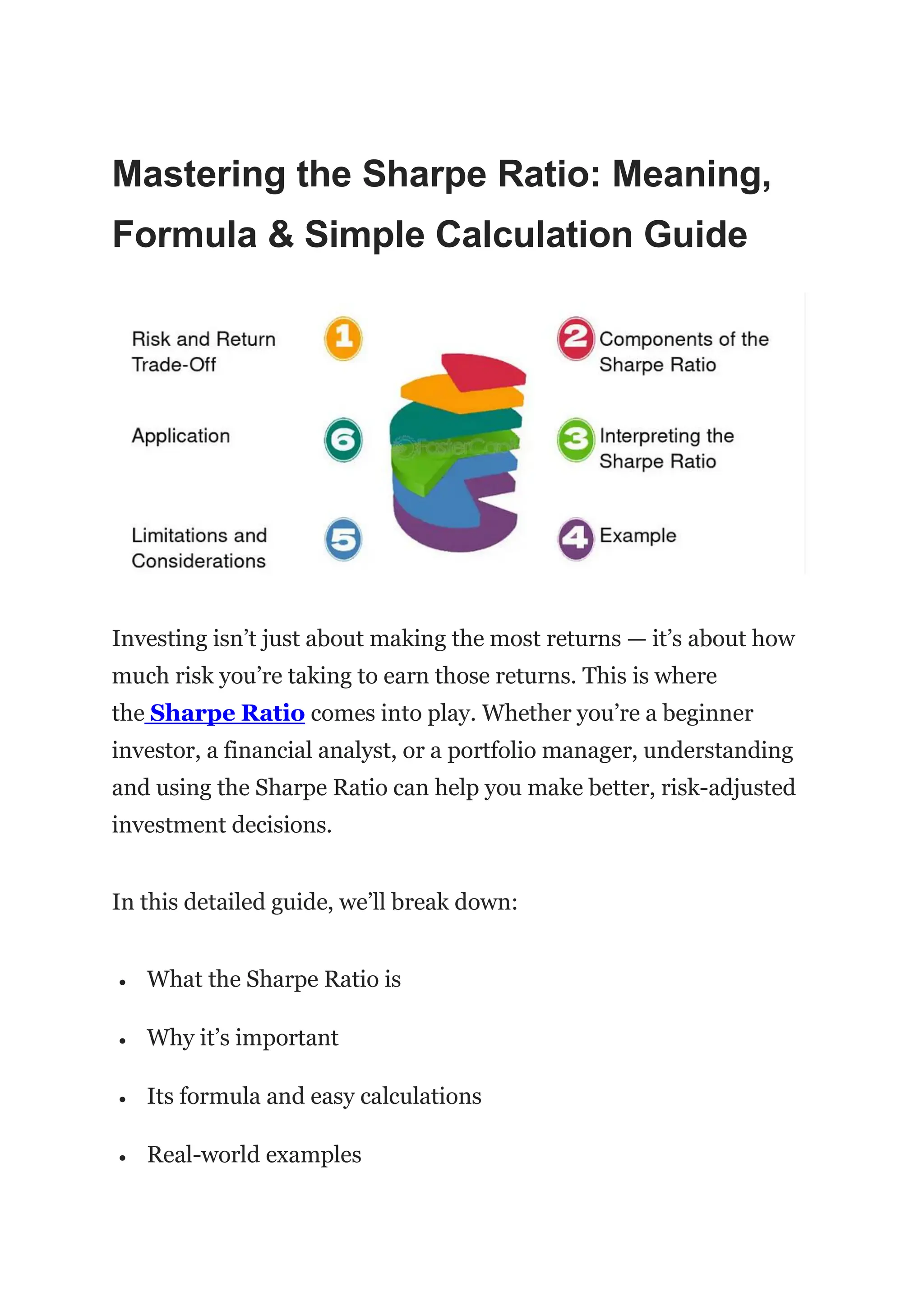
In this detailed guide, we’ll break down:
 What the Sharpe Ratio is
 Why it’s important
 Its formula and easy calculations
 Real-world examples
 Limitations to be aware of
 How it compares with other performance metrics
Let’s dive into the world of smart, risk-conscious investing.
What is the Sharpe Ratio?
The Sharpe Ratio is a measure of risk-adjusted return. It
tells you how much excess return you are receiving for the extra
volatility that you endure for holding a riskier asset.
In simple words, it helps answer this question:
Am I being properly compensated for the risk I’m taking with this
investment?
Developed by Nobel laureate William F. Sharpe in 1966, this ratio
has become one of the most widely used tools in modern portfolio
theory.
Why is the Sharpe Ratio Important?
Let’s say you have two investment portfolios:
 Portfolio A returned 12%
 Portfolio B returned 10%
At first glance, Portfolio A looks better. But what if Portfolio A was
twice as volatile as Portfolio B?
GET MORE INFO: wwwswipeloan.in
The Sharpe Ratio helps compare these two by factoring in the
risk taken to achieve those returns. A higher Sharpe
Ratio means better risk-adjusted performance.
Key Benefits of Using the Sharpe Ratio:
 Compares investments on a level playing field
 Helps evaluate mutual funds, stocks, ETFs, or entire portfolios
 Assists in selecting funds that align with your risk appetite
 Encourages disciplined, risk-aware investment decisions
The Sharpe Ratio Formula
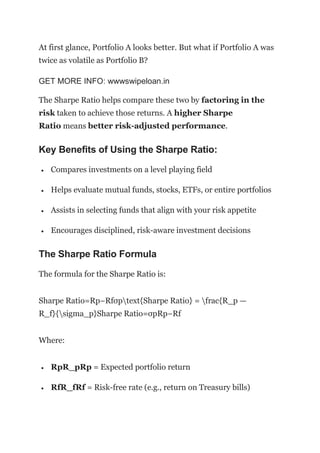
The formula for the Sharpe Ratio is:
Sharpe Ratio=Rp−Rfσptext{Sharpe Ratio} = frac{R_p —
R_f}{sigma_p}Sharpe Ratio=σpRp−Rf
Where:
 RpR_pRp = Expected portfolio return
 RfR_fRf = Risk-free rate (e.g., return on Treasury bills)
 σpsigma_pσp = Standard deviation of portfolio return (i.e.,
risk or volatility)
What It Means:
 Rp−RfR_p — R_fRp−Rf is the excess return (returns over the
risk-free rate)
 σpsigma_pσp is how “bumpy” or volatile the returns are
 The higher the ratio, the more return you’re getting per unit of
risk
Step-by-Step Sharpe Ratio Calculation (with Example)
Let’s calculate the Sharpe Ratio with an example.
Scenario:
You’re analyzing Mutual Fund X. Over the past year:
 Average return RpR_pRp = 14%
 Risk-free rate RfR_fRf = 4%
 Standard deviation σpsigma_pσp = 10%
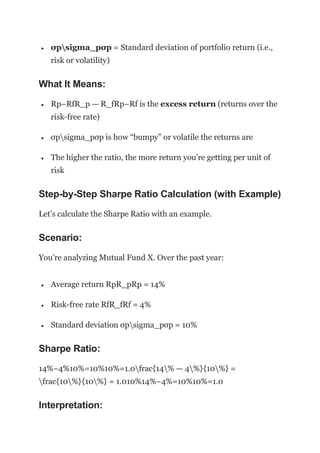
Sharpe Ratio:
14%−4%10%=10%10%=1.0frac{14% — 4%}{10%} =
frac{10%}{10%} = 1.010%14%−4%=10%10%=1.0
Interpretation:
A Sharpe Ratio of 1.0 means the fund generated 1 unit of excess
return for every 1 unit of risk. This is considered a decent ratio.
How to Interpret the Sharpe Ratio
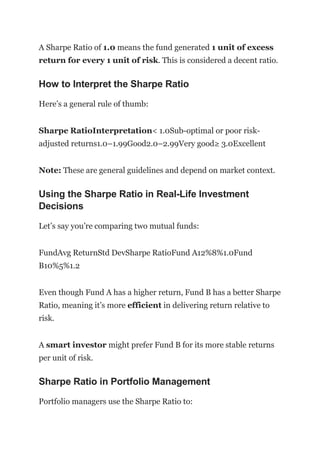
Here’s a general rule of thumb:
Sharpe RatioInterpretation< 1.0Sub-optimal or poor risk-
adjusted returns1.0–1.99Good2.0–2.99Very good≥ 3.0Excellent
Note: These are general guidelines and depend on market context.
Using the Sharpe Ratio in Real-Life Investment
Decisions
Let’s say you’re comparing two mutual funds:
FundAvg ReturnStd DevSharpe RatioFund A12%8%1.0Fund
B10%5%1.2
Even though Fund A has a higher return, Fund B has a better Sharpe
Ratio, meaning it’s more efficient in delivering return relative to
risk.
A smart investor might prefer Fund B for its more stable returns
per unit of risk.
Sharpe Ratio in Portfolio Management
Portfolio managers use the Sharpe Ratio to:
 Optimize asset allocation
 Compare different portfolio strategies
 Evaluate the performance of fund managers
 Justify the inclusion of new risky assets
For example, adding a volatile asset like cryptocurrency may
increase portfolio return, but if it lowers the Sharpe Ratio, it might
not be worth the extra risk.
Sharpe Ratio vs Other Performance Metrics
Let’s compare the Sharpe Ratio with other similar measures:
Treynor Ratio
 Focuses on systematic risk (beta) rather than total risk
 Good for well-diversified portfolios
Sortino Ratio
 Uses downside deviation instead of standard deviation
 Only considers bad volatility, not good volatility
Information Ratio
 Measures excess return relative to a benchmark
 Good for evaluating active managers
Key Difference:
 Sharpe Ratio considers total volatility
 Sortino Ratio may be better if returns are not symmetrically
distributed
How to Calculate Sharpe Ratio in Excel or Google
Sheets
Get data for your investment:
 Daily/monthly/annual returns
 Risk-free rate
 Standard deviation of returns
Limitations of the Sharpe Ratio
While powerful, the Sharpe Ratio isn’t perfect. Here’s what to watch
out for:
1. Assumes Returns are Normally Distributed
 Real-world returns (especially for stocks and crypto) can be
skewed or have fat tails
 Can give misleading results in such cases
2. Penalizes Upside Volatility
 Standard deviation treats all volatility as bad, even if the returns
are high
 This can unfairly penalize high-return investments
3. Sensitive to Time Period
 A Sharpe Ratio over 1 year can differ drastically from a 5-year
view
 Always compare apples to apples
Assumes Constant Risk-Free Rate
 Risk-free rate can fluctuate, impacting Sharpe calculations
 Especially relevant in rising interest rate environments
How to Improve Sharpe Ratio of a Portfolio
Here are ways to boost your portfolio’s Sharpe Ratio:
 Diversify assets to reduce overall volatility
 Add non-correlated investments like gold or real estate
 Rebalance periodically to maintain optimal risk-return
balance
 Cut underperforming, high-volatility assets
A portfolio with 8% return and 6% volatility (Sharpe Ratio 0.67) can
be improved to 8% return and 4% volatility (Sharpe Ratio 1.0) with
smart diversification.
Sharpe Ratio Benchmarks: What’s Considered
Good?
Here’s a quick reference guide for Sharpe Ratio expectations:
Investment TypeTypical Sharpe RatioLarge-cap equity
funds0.8–1.5Balanced funds1.0–2.0Fixed-income funds0.5–
1.2Hedge funds1.0–3.0+
Always compare Sharpe Ratios within the same asset class.
Conclusion: Make Sharpe Ratio Your Risk Compass
The Sharpe Ratio is more than just a math formula — it’s
a strategic compass that guides investors toward more balanced,
risk-aware choices.
By using the Sharpe Ratio:
 You go beyond chasing high returns
 You reward consistency and efficiency
 You develop a resilient investment strategy
So the next time you’re comparing two mutual funds, stock
portfolios, or ETFs, don’t just ask “Which made more money?”
Ask:
“Which one made more money per unit of risk?”
That’s how professionals think. And now, you can too.
FAQs — Quick Answers on Sharpe Ratio
Q1: Can Sharpe Ratio be negative?
Yes. A negative Sharpe Ratio means the investment
performed worse than the risk-free rate — a clear red flag.
Q2: What is a good Sharpe Ratio for mutual funds?
Anything above 1.0 is considered acceptable. Above 2.0 is
excellent.
Q3: Should I only invest based on Sharpe Ratio?
No. Use it alongside other metrics like Sortino Ratio, alpha,
beta, and your risk profile.
Q4: What’s the best frequency for Sharpe
calculation?
Use annualized returns for a broad view or monthly
returns for short-term analysis.

Mastering the Sharpe Ratio: Meaning, Formula & Simple Calculation Guide

  • 1.
    Mastering the SharpeRatio: Meaning, Formula & Simple Calculation Guide Investing isn’t just about making the most returns — it’s about how much risk you’re taking to earn those returns. This is where the Sharpe Ratio comes into play. Whether you’re a beginner investor, a financial analyst, or a portfolio manager, understanding and using the Sharpe Ratio can help you make better, risk-adjusted investment decisions. In this detailed guide, we’ll break down:  What the Sharpe Ratio is  Why it’s important  Its formula and easy calculations  Real-world examples
  • 2.
     Limitations tobe aware of  How it compares with other performance metrics Let’s dive into the world of smart, risk-conscious investing. What is the Sharpe Ratio? The Sharpe Ratio is a measure of risk-adjusted return. It tells you how much excess return you are receiving for the extra volatility that you endure for holding a riskier asset. In simple words, it helps answer this question: Am I being properly compensated for the risk I’m taking with this investment? Developed by Nobel laureate William F. Sharpe in 1966, this ratio has become one of the most widely used tools in modern portfolio theory. Why is the Sharpe Ratio Important? Let’s say you have two investment portfolios:  Portfolio A returned 12%  Portfolio B returned 10%
  • 3.
    At first glance,Portfolio A looks better. But what if Portfolio A was twice as volatile as Portfolio B? GET MORE INFO: wwwswipeloan.in The Sharpe Ratio helps compare these two by factoring in the risk taken to achieve those returns. A higher Sharpe Ratio means better risk-adjusted performance. Key Benefits of Using the Sharpe Ratio:  Compares investments on a level playing field  Helps evaluate mutual funds, stocks, ETFs, or entire portfolios  Assists in selecting funds that align with your risk appetite  Encourages disciplined, risk-aware investment decisions The Sharpe Ratio Formula The formula for the Sharpe Ratio is: Sharpe Ratio=Rp−Rfσptext{Sharpe Ratio} = frac{R_p — R_f}{sigma_p}Sharpe Ratio=σpRp−Rf Where:  RpR_pRp = Expected portfolio return  RfR_fRf = Risk-free rate (e.g., return on Treasury bills)
  • 4.
     σpsigma_pσp =Standard deviation of portfolio return (i.e., risk or volatility) What It Means:  Rp−RfR_p — R_fRp−Rf is the excess return (returns over the risk-free rate)  σpsigma_pσp is how “bumpy” or volatile the returns are  The higher the ratio, the more return you’re getting per unit of risk Step-by-Step Sharpe Ratio Calculation (with Example) Let’s calculate the Sharpe Ratio with an example. Scenario: You’re analyzing Mutual Fund X. Over the past year:  Average return RpR_pRp = 14%  Risk-free rate RfR_fRf = 4%  Standard deviation σpsigma_pσp = 10% Sharpe Ratio: 14%−4%10%=10%10%=1.0frac{14% — 4%}{10%} = frac{10%}{10%} = 1.010%14%−4%=10%10%=1.0 Interpretation:
  • 5.
    A Sharpe Ratioof 1.0 means the fund generated 1 unit of excess return for every 1 unit of risk. This is considered a decent ratio. How to Interpret the Sharpe Ratio Here’s a general rule of thumb: Sharpe RatioInterpretation< 1.0Sub-optimal or poor risk- adjusted returns1.0–1.99Good2.0–2.99Very good≥ 3.0Excellent Note: These are general guidelines and depend on market context. Using the Sharpe Ratio in Real-Life Investment Decisions Let’s say you’re comparing two mutual funds: FundAvg ReturnStd DevSharpe RatioFund A12%8%1.0Fund B10%5%1.2 Even though Fund A has a higher return, Fund B has a better Sharpe Ratio, meaning it’s more efficient in delivering return relative to risk. A smart investor might prefer Fund B for its more stable returns per unit of risk. Sharpe Ratio in Portfolio Management Portfolio managers use the Sharpe Ratio to:
  • 6.
     Optimize assetallocation  Compare different portfolio strategies  Evaluate the performance of fund managers  Justify the inclusion of new risky assets For example, adding a volatile asset like cryptocurrency may increase portfolio return, but if it lowers the Sharpe Ratio, it might not be worth the extra risk. Sharpe Ratio vs Other Performance Metrics Let’s compare the Sharpe Ratio with other similar measures: Treynor Ratio  Focuses on systematic risk (beta) rather than total risk  Good for well-diversified portfolios Sortino Ratio  Uses downside deviation instead of standard deviation  Only considers bad volatility, not good volatility Information Ratio  Measures excess return relative to a benchmark  Good for evaluating active managers
  • 7.
    Key Difference:  SharpeRatio considers total volatility  Sortino Ratio may be better if returns are not symmetrically distributed How to Calculate Sharpe Ratio in Excel or Google Sheets Get data for your investment:  Daily/monthly/annual returns  Risk-free rate  Standard deviation of returns Limitations of the Sharpe Ratio While powerful, the Sharpe Ratio isn’t perfect. Here’s what to watch out for: 1. Assumes Returns are Normally Distributed  Real-world returns (especially for stocks and crypto) can be skewed or have fat tails  Can give misleading results in such cases 2. Penalizes Upside Volatility
  • 8.
     Standard deviationtreats all volatility as bad, even if the returns are high  This can unfairly penalize high-return investments 3. Sensitive to Time Period  A Sharpe Ratio over 1 year can differ drastically from a 5-year view  Always compare apples to apples Assumes Constant Risk-Free Rate  Risk-free rate can fluctuate, impacting Sharpe calculations  Especially relevant in rising interest rate environments How to Improve Sharpe Ratio of a Portfolio Here are ways to boost your portfolio’s Sharpe Ratio:  Diversify assets to reduce overall volatility  Add non-correlated investments like gold or real estate  Rebalance periodically to maintain optimal risk-return balance  Cut underperforming, high-volatility assets
  • 9.
    A portfolio with8% return and 6% volatility (Sharpe Ratio 0.67) can be improved to 8% return and 4% volatility (Sharpe Ratio 1.0) with smart diversification. Sharpe Ratio Benchmarks: What’s Considered Good? Here’s a quick reference guide for Sharpe Ratio expectations: Investment TypeTypical Sharpe RatioLarge-cap equity funds0.8–1.5Balanced funds1.0–2.0Fixed-income funds0.5– 1.2Hedge funds1.0–3.0+ Always compare Sharpe Ratios within the same asset class. Conclusion: Make Sharpe Ratio Your Risk Compass The Sharpe Ratio is more than just a math formula — it’s a strategic compass that guides investors toward more balanced, risk-aware choices. By using the Sharpe Ratio:  You go beyond chasing high returns  You reward consistency and efficiency  You develop a resilient investment strategy
  • 10.
    So the nexttime you’re comparing two mutual funds, stock portfolios, or ETFs, don’t just ask “Which made more money?” Ask: “Which one made more money per unit of risk?” That’s how professionals think. And now, you can too. FAQs — Quick Answers on Sharpe Ratio Q1: Can Sharpe Ratio be negative? Yes. A negative Sharpe Ratio means the investment performed worse than the risk-free rate — a clear red flag. Q2: What is a good Sharpe Ratio for mutual funds? Anything above 1.0 is considered acceptable. Above 2.0 is excellent. Q3: Should I only invest based on Sharpe Ratio? No. Use it alongside other metrics like Sortino Ratio, alpha, beta, and your risk profile. Q4: What’s the best frequency for Sharpe calculation? Use annualized returns for a broad view or monthly returns for short-term analysis.