Experiments
Ellie Warmingham
Process
• Colour palettes
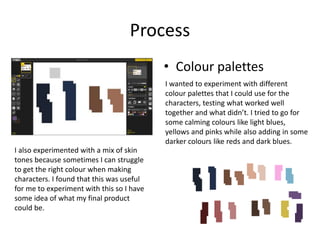
I wanted to experiment with different
colour palettes that I could use for the
characters, testing what worked well
together and what didn’t. I tried to go for
some calming colours like light blues,
yellows and pinks while also adding in some
darker colours like reds and dark blues.
I also experimented with a mix of skin
tones because sometimes I can struggle
to get the right colour when making
characters. I found that this was useful
for me to experiment with this so I have
some idea of what my final product
could be.
Process
• Walking cycle
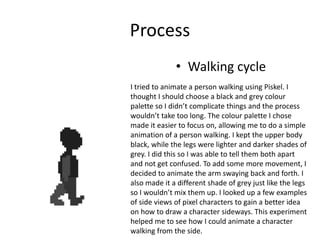
I tried to animate a person walking using Piskel. I
thought I should choose a black and grey colour
palette so I didn’t complicate things and the process
wouldn’t take too long. The colour palette I chose
made it easier to focus on, allowing me to do a simple
animation of a person walking. I kept the upper body
black, while the legs were lighter and darker shades of
grey. I did this so I was able to tell them both apart
and not get confused. To add some more movement, I
decided to animate the arm swaying back and forth. I
also made it a different shade of grey just like the legs
so I wouldn’t mix them up. I looked up a few examples
of side views of pixel characters to gain a better idea
on how to draw a character sideways. This experiment
helped me to see how I could animate a character
walking from the side.
Process
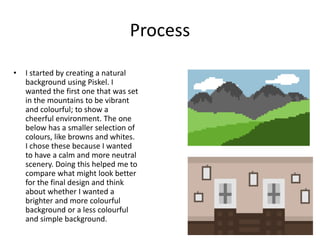
• I started by creating a natural
background using Piskel. I
wanted the first one that was set
in the mountains to be vibrant
and colourful; to show a
cheerful environment. The one
below has a smaller selection of
colours, like browns and whites.
I chose these because I wanted
to have a calm and more neutral
scenery. Doing this helped me to
compare what might look better
for the final design and think
about whether I wanted a
brighter and more colourful
background or a less colourful
and simple background.
Process
• Character designs
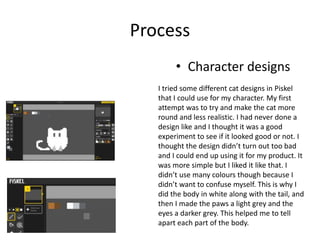
I tried some different cat designs in Piskel
that I could use for my character. My first
attempt was to try and make the cat more
round and less realistic. I had never done a
design like and I thought it was a good
experiment to see if it looked good or not. I
thought the design didn’t turn out too bad
and I could end up using it for my product. It
was more simple but I liked it like that. I
didn’t use many colours though because I
didn’t want to confuse myself. This is why I
did the body in white along with the tail, and
then I made the paws a light grey and the
eyes a darker grey. This helped me to tell
apart each part of the body.
Process
• Character designs
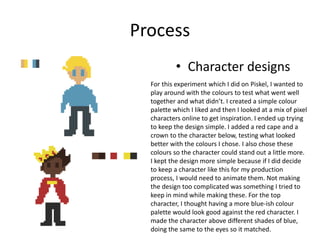
For this experiment which I did on Piskel, I wanted to
play around with the colours to test what went well
together and what didn’t. I created a simple colour
palette which I liked and then I looked at a mix of pixel
characters online to get inspiration. I ended up trying
to keep the design simple. I added a red cape and a
crown to the character below, testing what looked
better with the colours I chose. I also chose these
colours so the character could stand out a little more.
I kept the design more simple because if I did decide
to keep a character like this for my production
process, I would need to animate them. Not making
the design too complicated was something I tried to
keep in mind while making these. For the top
character, I thought having a more blue-ish colour
palette would look good against the red character. I
made the character above different shades of blue,
doing the same to the eyes so it matched.
Reflection
• What elements of your experiments will you
include in your final product?
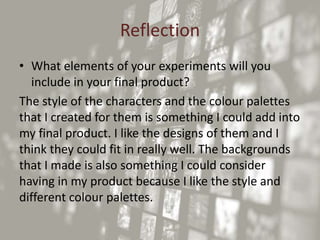
The style of the characters and the colour palettes
that I created for them is something I could add into
my final product. I like the designs of them and I
think they could fit in really well. The backgrounds
that I made is also something I could consider
having in my product because I like the style and
different colour palettes.

Production Experiments (FMP)

  • 1.
  • 2.
    Process • Colour palettes Iwanted to experiment with different colour palettes that I could use for the characters, testing what worked well together and what didn’t. I tried to go for some calming colours like light blues, yellows and pinks while also adding in some darker colours like reds and dark blues. I also experimented with a mix of skin tones because sometimes I can struggle to get the right colour when making characters. I found that this was useful for me to experiment with this so I have some idea of what my final product could be.
  • 3.
    Process • Walking cycle Itried to animate a person walking using Piskel. I thought I should choose a black and grey colour palette so I didn’t complicate things and the process wouldn’t take too long. The colour palette I chose made it easier to focus on, allowing me to do a simple animation of a person walking. I kept the upper body black, while the legs were lighter and darker shades of grey. I did this so I was able to tell them both apart and not get confused. To add some more movement, I decided to animate the arm swaying back and forth. I also made it a different shade of grey just like the legs so I wouldn’t mix them up. I looked up a few examples of side views of pixel characters to gain a better idea on how to draw a character sideways. This experiment helped me to see how I could animate a character walking from the side.
  • 4.
    Process • I startedby creating a natural background using Piskel. I wanted the first one that was set in the mountains to be vibrant and colourful; to show a cheerful environment. The one below has a smaller selection of colours, like browns and whites. I chose these because I wanted to have a calm and more neutral scenery. Doing this helped me to compare what might look better for the final design and think about whether I wanted a brighter and more colourful background or a less colourful and simple background.
  • 5.
    Process • Character designs Itried some different cat designs in Piskel that I could use for my character. My first attempt was to try and make the cat more round and less realistic. I had never done a design like and I thought it was a good experiment to see if it looked good or not. I thought the design didn’t turn out too bad and I could end up using it for my product. It was more simple but I liked it like that. I didn’t use many colours though because I didn’t want to confuse myself. This is why I did the body in white along with the tail, and then I made the paws a light grey and the eyes a darker grey. This helped me to tell apart each part of the body.
  • 6.
    Process • Character designs Forthis experiment which I did on Piskel, I wanted to play around with the colours to test what went well together and what didn’t. I created a simple colour palette which I liked and then I looked at a mix of pixel characters online to get inspiration. I ended up trying to keep the design simple. I added a red cape and a crown to the character below, testing what looked better with the colours I chose. I also chose these colours so the character could stand out a little more. I kept the design more simple because if I did decide to keep a character like this for my production process, I would need to animate them. Not making the design too complicated was something I tried to keep in mind while making these. For the top character, I thought having a more blue-ish colour palette would look good against the red character. I made the character above different shades of blue, doing the same to the eyes so it matched.
  • 7.
    Reflection • What elementsof your experiments will you include in your final product? The style of the characters and the colour palettes that I created for them is something I could add into my final product. I like the designs of them and I think they could fit in really well. The backgrounds that I made is also something I could consider having in my product because I like the style and different colour palettes.

Editor's Notes

  • #3 Discuss the tools and processes used in your experiments
  • #4 Discuss the tools and processes used in your experiments
  • #5 Discuss the tools and processes used in your experiments
  • #6 Discuss the tools and processes used in your experiments
  • #7 Discuss the tools and processes used in your experiments