

Procter & Gamble
Case Study
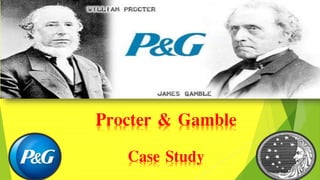
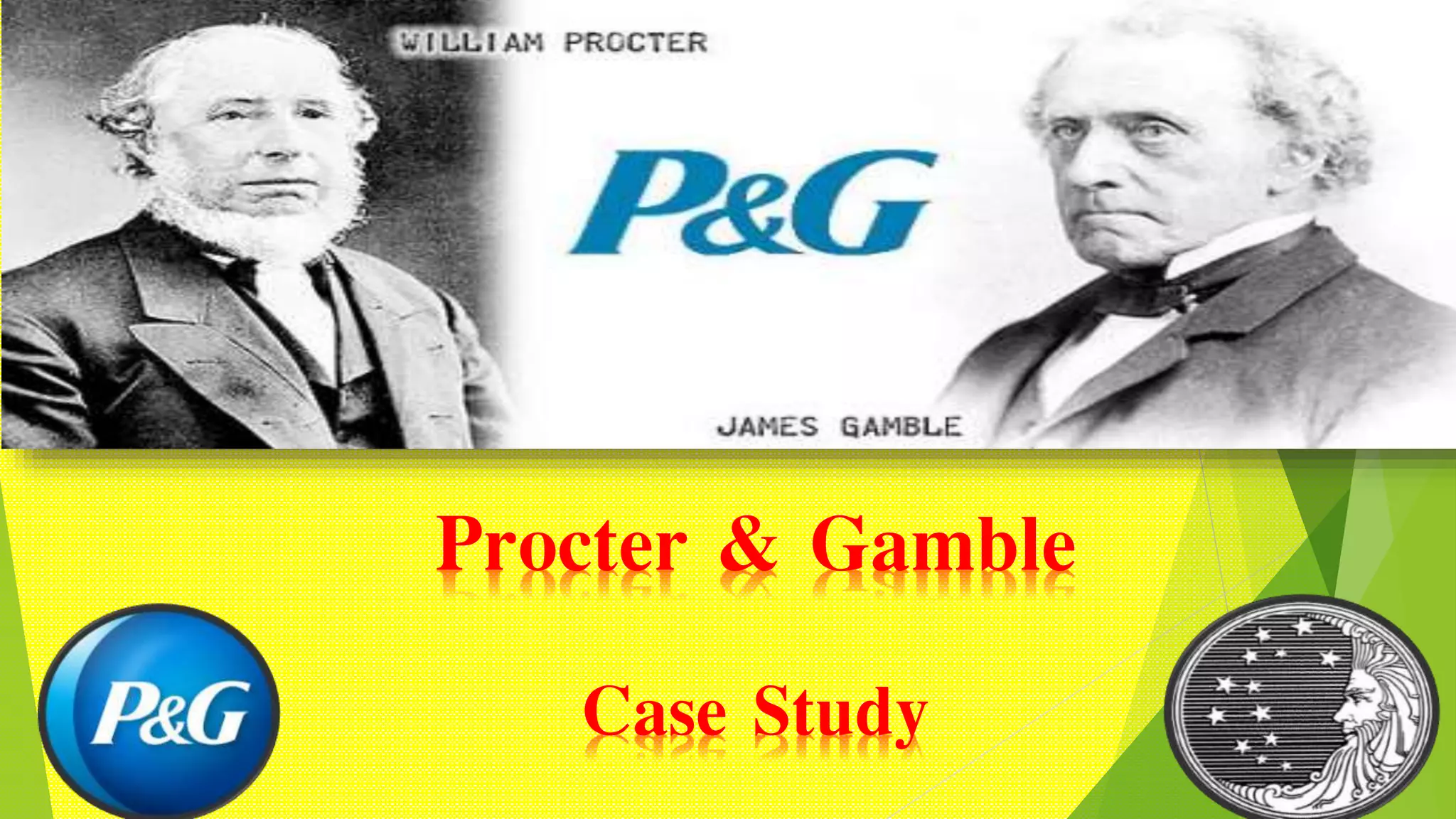
Procter & Gamble is an
American multinational
consumer goods founded by
William Procter and James
Gamble.
Its products include cleaning
agents and personal care
Who are the
players•CEO A.G. Lafley
• CEO Bob McDonald
• CEO Durk Jager
• CEO Jim Stengel
• Claudia Kotchka,
o Vice-president, Design unit
• Marc Pritchard,
o Global Brand Building Officer
OBJECTIVES
Know about the design , implementation & interpretation
of product development & marketing strategies
Evaluate primary and unique communication
strategies and money spending
Innovation , R&D and acquisition
SITUATION
ANALYSIS
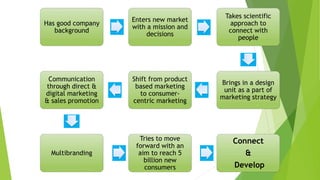
Has good company
background
Enters new market
with a mission and
decisions
Takes scientific
approach to
connect with
people
Brings in a design
unit as a part of
marketing strategy
Shift from product
based marketing
to consumer-
centric marketing
Communication
through direct &
digital marketing
& sales promotion
Multibranding
Tries to move
forward with an
aim to reach 5
billion new
consumers
Connect
&
Develop
MAJOR ISSUES
1. Growth of P&G’s core brands & categories with an unrelenting
focus on innovation & design.
2. Building business with unserved & underserved consumers through
consumer-centric , digital & direct and neuromarketing ,
multibranding and interactive community promotion.
3. Continue to grow & develop faster-growing higher margin
businesses with global leadership potential.
MARKETING
STRATEGY
•Historically, P&G had pursued a multibrand strategy, and it
managed brands across a category carefully, with each getting
individual support and satisfying a segment of the market.
• A new design unit was created for design innovation &
strategy. A culture of design was introduced in P&G which
complemented function-driven process.
• A consumer-centric marketing approach was followed which
allowed customization on the basis of needs of people.
• The firm leveraged its products through multibranding ,
focused on “Return On Marketing Investment” and shopper
marketing experience.
CONSUUMER
RELATIONSHIPS
• A lot of innovative approaches were introduced in product
and market research that gained qualitative and
quantitative information from the consumers , in-turn
resulting in better products and positive buying behaviour.
• Word-of-mouth advertising was followed , especially in
relation with females through campaigns like “Thank you
Mom” & “Loads of Hope” which acted as a means of
emotional branding.
• The pre and post purchase behavior towards products
were measured by online grocer sites & Neuromarketing
which helped in building one-to-one relationship with
customers.
ADVERTISING
•It was the first company to sell its
products directly to consumers through
dramas , T.V commercials and operas
instead of including wholesalers and
retailers in the chain.
• To compete in less familiar markets , it
developed “Media neutral” idea that
could be advertised in different and
relevant local languages.
• Lafley , Stengel and Kotchka aimed
towards design and emotion driven-
advertising along with benefits and
function driven one.
SPONSORSHIP
• It sponsored the U.S. Olympic team in
2010 and raised its visibility as a
worldwide sponsor for 2012 winter
games in Russia and 2016 summer
games summer games in Brazil.
• It engaged its consumers in fitness
campaign through NFL sponsorship
whereas the major campaign “Thank
you Mom” still remained the best in
touching everyone’s heart.
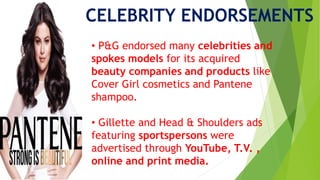
CELEBRITY ENDORSEMENTS
• P&G endorsed many celebrities and
spokes models for its acquired
beauty companies and products like
Cover Girl cosmetics and Pantene
shampoo.
• Gillette and Head & Shoulders ads
featuring sportspersons were
advertised through YouTube, T.V. ,
online and print media.
DIGITAL MARKETING
• P&G launched its first mobile marketing ad
campaign in 2006 . The campaign also released TV
commercials and print advertisements, and had an
online presence.
• P&G’s line of “My Black is Beautiful” products,
introduced two web series in 2010 to showcase its
products. This attracted a lot of views online .
Collection sales and market share increased.
• P&G’s Old Spice television commercial and
YouTube sensation, “The Man Your Man Could Smell
Like,” gave P&G its greatest exposure in the online
community and bridged the power of digital and
social media.
SOCIAL MEDIA
•In 2007, P&G launched two social media sites:
Capessa for women on Yahoo! Health and the
People’s Choice Community, associated with the
People’s Choice awards.
• P&G used Facebook as a marketing supplement,
not a replacement. It identified 2010 as the year to
acquire Facebook friends, but the years beyond
that were for figuring out how to use them.
• In 2011, when research showed that men were
interested in work generally done by women in
houses , P&G rounded out its earlier social media
efforts with Manofthehouse.com, which featured
household advice for men .
WHAT’S NEXT
• Digital marketing with campaigns
campaigns
• Emotional, design and function driven
driven marketing
• R&D
• Consumer research & product
performance.
SUMMARY
• Introduction
• CEO
• Objectives
• Situation Analysis
• Major Issues
• Consumer Relationship
• Marketing Strategies
Advertising
Sponsorship
Digital Marketing
Social Media
• What’s Next
DISCLAIMER
Created By Vikash Kumar,NIT RAIPUR during
A marketing internship by Prof Sameer Mathur
IIM LUCKNOW
See (http://www.IIMLinternship.com)

Procter & Gamble Case Study

  • 1.
  • 2.
    Procter & Gambleis an American multinational consumer goods founded by William Procter and James Gamble. Its products include cleaning agents and personal care
  • 3.
    Who are the players•CEOA.G. Lafley • CEO Bob McDonald • CEO Durk Jager • CEO Jim Stengel • Claudia Kotchka, o Vice-president, Design unit • Marc Pritchard, o Global Brand Building Officer
  • 4.
  • 5.
    Know about thedesign , implementation & interpretation of product development & marketing strategies Evaluate primary and unique communication strategies and money spending Innovation , R&D and acquisition
  • 6.
  • 7.
    Has good company background Entersnew market with a mission and decisions Takes scientific approach to connect with people Brings in a design unit as a part of marketing strategy Shift from product based marketing to consumer- centric marketing Communication through direct & digital marketing & sales promotion Multibranding Tries to move forward with an aim to reach 5 billion new consumers Connect & Develop
  • 8.
  • 9.
    1. Growth ofP&G’s core brands & categories with an unrelenting focus on innovation & design. 2. Building business with unserved & underserved consumers through consumer-centric , digital & direct and neuromarketing , multibranding and interactive community promotion. 3. Continue to grow & develop faster-growing higher margin businesses with global leadership potential.
  • 10.
  • 11.
    •Historically, P&G hadpursued a multibrand strategy, and it managed brands across a category carefully, with each getting individual support and satisfying a segment of the market. • A new design unit was created for design innovation & strategy. A culture of design was introduced in P&G which complemented function-driven process. • A consumer-centric marketing approach was followed which allowed customization on the basis of needs of people. • The firm leveraged its products through multibranding , focused on “Return On Marketing Investment” and shopper marketing experience.
  • 12.
  • 13.
    • A lotof innovative approaches were introduced in product and market research that gained qualitative and quantitative information from the consumers , in-turn resulting in better products and positive buying behaviour. • Word-of-mouth advertising was followed , especially in relation with females through campaigns like “Thank you Mom” & “Loads of Hope” which acted as a means of emotional branding. • The pre and post purchase behavior towards products were measured by online grocer sites & Neuromarketing which helped in building one-to-one relationship with customers.
  • 14.
    ADVERTISING •It was thefirst company to sell its products directly to consumers through dramas , T.V commercials and operas instead of including wholesalers and retailers in the chain. • To compete in less familiar markets , it developed “Media neutral” idea that could be advertised in different and relevant local languages. • Lafley , Stengel and Kotchka aimed towards design and emotion driven- advertising along with benefits and function driven one.
  • 15.
    SPONSORSHIP • It sponsoredthe U.S. Olympic team in 2010 and raised its visibility as a worldwide sponsor for 2012 winter games in Russia and 2016 summer games summer games in Brazil. • It engaged its consumers in fitness campaign through NFL sponsorship whereas the major campaign “Thank you Mom” still remained the best in touching everyone’s heart.
  • 16.
    CELEBRITY ENDORSEMENTS • P&Gendorsed many celebrities and spokes models for its acquired beauty companies and products like Cover Girl cosmetics and Pantene shampoo. • Gillette and Head & Shoulders ads featuring sportspersons were advertised through YouTube, T.V. , online and print media.
  • 17.
    DIGITAL MARKETING • P&Glaunched its first mobile marketing ad campaign in 2006 . The campaign also released TV commercials and print advertisements, and had an online presence. • P&G’s line of “My Black is Beautiful” products, introduced two web series in 2010 to showcase its products. This attracted a lot of views online . Collection sales and market share increased. • P&G’s Old Spice television commercial and YouTube sensation, “The Man Your Man Could Smell Like,” gave P&G its greatest exposure in the online community and bridged the power of digital and social media.
  • 18.
    SOCIAL MEDIA •In 2007,P&G launched two social media sites: Capessa for women on Yahoo! Health and the People’s Choice Community, associated with the People’s Choice awards. • P&G used Facebook as a marketing supplement, not a replacement. It identified 2010 as the year to acquire Facebook friends, but the years beyond that were for figuring out how to use them. • In 2011, when research showed that men were interested in work generally done by women in houses , P&G rounded out its earlier social media efforts with Manofthehouse.com, which featured household advice for men .
  • 19.
    WHAT’S NEXT • Digitalmarketing with campaigns campaigns • Emotional, design and function driven driven marketing • R&D • Consumer research & product performance.
  • 20.
    SUMMARY • Introduction • CEO •Objectives • Situation Analysis • Major Issues • Consumer Relationship • Marketing Strategies Advertising Sponsorship Digital Marketing Social Media • What’s Next
  • 21.
    DISCLAIMER Created By VikashKumar,NIT RAIPUR during A marketing internship by Prof Sameer Mathur IIM LUCKNOW See (http://www.IIMLinternship.com)