Harvard Business School Case
P G&
What
is
?
Procter & Gamble Co. , also known as P&G , is
an American multinational consumer goods
company headquartered in downtown
Cincinnati , Ohio , the U.S. , founded by
William Procter and James Gamble.
It holds one of the most powerful portfolios of
trusted brands.
Who are the players ?
• CEO A.G. Lafley
• CEO Bob McDonald
• CEO Durk Jager
• CEO Jim Stengel
• Claudia Kotchka,
o Vice-president, Design unit
• Marc Pritchard,
o Global Brand Building Officer
SITUATION
ANALYSIS
Has good company
background
Enters new market
with a mission and
decisions
Takes scientific
approach to connect
with people
Brings in a design
unit as a part of
marketing strategy
Shift from product
based marketing to
consumer-centric
marketing
Communication
through direct &
digital marketing &
sales promotion
Multibranding
Tries to move
forward with an aim
to reach 5 billion
new consumers
Connect
&
Develop
Know about the design , implementation &
interpretation of product development &
marketing strategies
Evaluate primary and unique communication
strategies and money spending
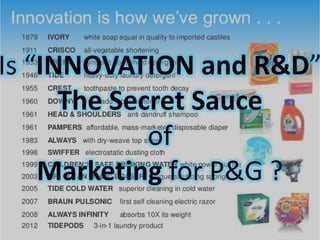
Innovation , R&D and acquisition
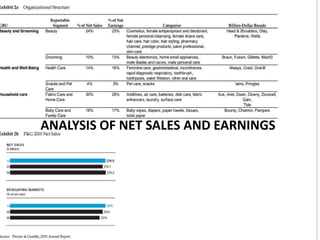
ANALYSIS OF NET SALES AND EARNINGS
1. Growth of P&G’s core brands & categories with an
unrelenting focus on innovation & design.
2. Building business with unserved & underserved
consumers through consumer-centric , digital &
direct and neuromarketing , multibranding and
interactive community promotion.
3. Continue to grow & develop faster-growing higher
margin businesses with global leadership potential.
ONE
MAJOR QUESTION
Growth of P&G’s core brands & categories with
an unrelenting focus on innovation & design.
1st ISSUE
• P&G pursued international expansion as early as the 1930s,
and from 1945 to 1980 it began to enter markets in Latin
America, Western Europe, and Japan.
• P&G’s approach to entering new markets was via
“acquisition or joint venture on a small scale, and through
trial and error, learn the formula for success before making a
major commitment.”
• In 2010, P&G’s stated corporate mission was to build on its
company purpose to improve the lives of its customers
through continued innovation to reach “More Consumers, In
More Parts of the World, More Completely.”
• Connect and Develop : A step towards innovation ,
research and development of products
Building business with unserved & underserved
consumers through consumer-centric , digital
& direct and neuromarketing , multibranding
and interactive community promotion.
2nd ISSUE
MARKETING
STRATEGY
• Historically, P&G had pursued a multibrand strategy, and it
managed brands across a category carefully, with each getting
individual support and satisfying a segment of the market.
• A new design unit was created for design innovation &
strategy. A culture of design was introduced in P&G which
complemented function-driven process.
• A consumer-centric marketing approach was followed
which allowed customization on the basis of needs of people.
• The firm leveraged its products through multibranding ,
focused on “Return On Marketing Investment” and shopper
marketing experience.
COMMITMENT
TO THE
CONSUMER
• A lot of innovative approaches were introduced in
product and market research that gained qualitative and
quantitative information from the consumers , in-turn
resulting in better products and positive buying behaviour.
• Word-of-mouth advertising was followed , especially in
relation with females through campaigns like “Thank you
Mom” & “Loads of Hope” which acted as a means of
emotional branding.
• The pre and post purchase behavior towards products
were measured by online grocer sites & Neuromarketing
which helped in building one-to-one relationship with
customers.
ADVERTISING
• It was the first company to sell its products directly
to consumers through dramas , T.V commercials and
operas instead of including wholesalers and retailers
in the chain.
• To compete in less familiar markets , it developed
“Media neutral” idea that could be advertised in
different and relevant local languages.
• Lafley , Stengel and Kotchka aimed towards design
and emotion driven-advertising along with benefits
and function driven one.
SPONSORSHIP
• It sponsored the U.S. Olympic team in
2010 and raised its visibility as a worldwide
sponsor for 2012 winter games in Russia
and 2016 summer games summer games
in Brazil.
• It engaged its consumers in fitness
campaign through NFL sponsorship
whereas the major campaign “Thank you
Mom” still remained the best in touching
everyone’s heart.
CELEBRITY
ENDORSEMENTS
• P&G endorsed many celebrities and spokesmodels
for its acquired beauty companies and products like
CoverGirl cosmetics and Pantene shampoo.
• Gillette and Head & Shoulders ads featuring
sportspersons were advertised through YouTube, T.V.
, online and print media.
• P&G also pursued a host of promotion, sponsorship,
and endorsement relationships as well as other
nontraditional outlets, such as product placement in
television and film.
MEDIA
SPENDING
• During recession in 2009 , P&G shifted to coupons
and in-store promotional activities to maintain its
media presence while shifting ad costs.
• In 2010, P&G increased ad spending by $1 billion,
with a 20% increase in media impressions; higher
revenues led to an increase in dollars spent.
McDonald, who became CEO in 2010, stated that
P&G would maintain the same level of spending,
while shifting dollars to digital advertising and
other new media to broaden the audience.
DIGITAL
MARKETING
• Digital media enabled niche experimentation targeted to specific
customers, including online serials , video games, and YouTube
channels for specific products.
• P&G launched its first mobile marketing ad campaign in 2006 . The
campaign also released TV commercials and print advertisements, and
had an online presence.
• P&G’s line of “My Black is Beautiful” products, introduced two web
series in 2010 to showcase its products. This attracted a lot of views
online . Collection sales and market share increased.
• P&G’s Old Spice television commercial and YouTube sensation, “The
Man Your Man Could Smell Like,” gave P&G its greatest exposure in the
online community and bridged the power of digital and social media.
• From mass marketer , P&G became one-to-one digitized marketer.
SOCIAL MEDIA
• In 2007, P&G launched two social media sites: Capessa for
women on Yahoo! Health and the People’s Choice
Community, associated with the People’s Choice awards.
• P&G used Facebook as a marketing supplement, not a
replacement. It identified 2010 as the year to acquire
Facebook friends, but the years beyond that were for figuring
out how to use them.
• In 2011, when research showed that men were interested in
work generally done by women in houses , P&G rounded out
its earlier social media efforts with Manofthehouse.com,
which featured household advice for men .
• Social media was a way to speak to its audience virtually.
INTERACTIVE
COMMUNITY
PROMOTION
• P&G used T-shirts having slogans and endorsed
celebrities like Katrina Kaif to promote sale of products
like Tide. The T-shirts were worn by celebrities and were
sold online and proceeds went to hurricane affected
families.
• A similar mass promotional activity was held in Times
Square in 2006 , targeting holiday shoppers. It generated
YouTube ads and attracted a lot of viewers , mainly youth.
• A large blue neon sign in the middle of a Broadway block
read “Restrooms” and led people up an escalator into a
lounge with flat-screen TVs, leather couches, a fireplace,
and 20 shiny, spotless toilets. The ad was used to promote
Charmin toilet paper, and tourists loved it.
Continue to grow & develop faster-growing
higher margin businesses with global
leadership potential
3rd ISSUE
MOVING FORWARD
Digital marketing with campaigns,
Emotional, design and function driven marketing ,
R&D , consumer research & product performance.

Procter & gamble.pptx

  • 1.
  • 3.
  • 4.
    Procter & GambleCo. , also known as P&G , is an American multinational consumer goods company headquartered in downtown Cincinnati , Ohio , the U.S. , founded by William Procter and James Gamble. It holds one of the most powerful portfolios of trusted brands.
  • 7.
    Who are theplayers ? • CEO A.G. Lafley • CEO Bob McDonald • CEO Durk Jager • CEO Jim Stengel • Claudia Kotchka, o Vice-president, Design unit • Marc Pritchard, o Global Brand Building Officer
  • 8.
  • 9.
    Has good company background Entersnew market with a mission and decisions Takes scientific approach to connect with people Brings in a design unit as a part of marketing strategy Shift from product based marketing to consumer-centric marketing Communication through direct & digital marketing & sales promotion Multibranding Tries to move forward with an aim to reach 5 billion new consumers Connect & Develop
  • 11.
    Know about thedesign , implementation & interpretation of product development & marketing strategies Evaluate primary and unique communication strategies and money spending Innovation , R&D and acquisition
  • 12.
    ANALYSIS OF NETSALES AND EARNINGS
  • 14.
    1. Growth ofP&G’s core brands & categories with an unrelenting focus on innovation & design. 2. Building business with unserved & underserved consumers through consumer-centric , digital & direct and neuromarketing , multibranding and interactive community promotion. 3. Continue to grow & develop faster-growing higher margin businesses with global leadership potential.
  • 15.
  • 17.
    Growth of P&G’score brands & categories with an unrelenting focus on innovation & design. 1st ISSUE
  • 18.
    • P&G pursuedinternational expansion as early as the 1930s, and from 1945 to 1980 it began to enter markets in Latin America, Western Europe, and Japan. • P&G’s approach to entering new markets was via “acquisition or joint venture on a small scale, and through trial and error, learn the formula for success before making a major commitment.” • In 2010, P&G’s stated corporate mission was to build on its company purpose to improve the lives of its customers through continued innovation to reach “More Consumers, In More Parts of the World, More Completely.” • Connect and Develop : A step towards innovation , research and development of products
  • 20.
    Building business withunserved & underserved consumers through consumer-centric , digital & direct and neuromarketing , multibranding and interactive community promotion. 2nd ISSUE
  • 21.
  • 22.
    • Historically, P&Ghad pursued a multibrand strategy, and it managed brands across a category carefully, with each getting individual support and satisfying a segment of the market. • A new design unit was created for design innovation & strategy. A culture of design was introduced in P&G which complemented function-driven process. • A consumer-centric marketing approach was followed which allowed customization on the basis of needs of people. • The firm leveraged its products through multibranding , focused on “Return On Marketing Investment” and shopper marketing experience.
  • 23.
  • 24.
    • A lotof innovative approaches were introduced in product and market research that gained qualitative and quantitative information from the consumers , in-turn resulting in better products and positive buying behaviour. • Word-of-mouth advertising was followed , especially in relation with females through campaigns like “Thank you Mom” & “Loads of Hope” which acted as a means of emotional branding. • The pre and post purchase behavior towards products were measured by online grocer sites & Neuromarketing which helped in building one-to-one relationship with customers.
  • 25.
  • 26.
    • It wasthe first company to sell its products directly to consumers through dramas , T.V commercials and operas instead of including wholesalers and retailers in the chain. • To compete in less familiar markets , it developed “Media neutral” idea that could be advertised in different and relevant local languages. • Lafley , Stengel and Kotchka aimed towards design and emotion driven-advertising along with benefits and function driven one.
  • 27.
  • 28.
    • It sponsoredthe U.S. Olympic team in 2010 and raised its visibility as a worldwide sponsor for 2012 winter games in Russia and 2016 summer games summer games in Brazil. • It engaged its consumers in fitness campaign through NFL sponsorship whereas the major campaign “Thank you Mom” still remained the best in touching everyone’s heart.
  • 29.
  • 30.
    • P&G endorsedmany celebrities and spokesmodels for its acquired beauty companies and products like CoverGirl cosmetics and Pantene shampoo. • Gillette and Head & Shoulders ads featuring sportspersons were advertised through YouTube, T.V. , online and print media. • P&G also pursued a host of promotion, sponsorship, and endorsement relationships as well as other nontraditional outlets, such as product placement in television and film.
  • 31.
  • 32.
    • During recessionin 2009 , P&G shifted to coupons and in-store promotional activities to maintain its media presence while shifting ad costs. • In 2010, P&G increased ad spending by $1 billion, with a 20% increase in media impressions; higher revenues led to an increase in dollars spent. McDonald, who became CEO in 2010, stated that P&G would maintain the same level of spending, while shifting dollars to digital advertising and other new media to broaden the audience.
  • 33.
  • 34.
    • Digital mediaenabled niche experimentation targeted to specific customers, including online serials , video games, and YouTube channels for specific products. • P&G launched its first mobile marketing ad campaign in 2006 . The campaign also released TV commercials and print advertisements, and had an online presence. • P&G’s line of “My Black is Beautiful” products, introduced two web series in 2010 to showcase its products. This attracted a lot of views online . Collection sales and market share increased. • P&G’s Old Spice television commercial and YouTube sensation, “The Man Your Man Could Smell Like,” gave P&G its greatest exposure in the online community and bridged the power of digital and social media. • From mass marketer , P&G became one-to-one digitized marketer.
  • 35.
  • 36.
    • In 2007,P&G launched two social media sites: Capessa for women on Yahoo! Health and the People’s Choice Community, associated with the People’s Choice awards. • P&G used Facebook as a marketing supplement, not a replacement. It identified 2010 as the year to acquire Facebook friends, but the years beyond that were for figuring out how to use them. • In 2011, when research showed that men were interested in work generally done by women in houses , P&G rounded out its earlier social media efforts with Manofthehouse.com, which featured household advice for men . • Social media was a way to speak to its audience virtually.
  • 37.
  • 38.
    • P&G usedT-shirts having slogans and endorsed celebrities like Katrina Kaif to promote sale of products like Tide. The T-shirts were worn by celebrities and were sold online and proceeds went to hurricane affected families. • A similar mass promotional activity was held in Times Square in 2006 , targeting holiday shoppers. It generated YouTube ads and attracted a lot of viewers , mainly youth. • A large blue neon sign in the middle of a Broadway block read “Restrooms” and led people up an escalator into a lounge with flat-screen TVs, leather couches, a fireplace, and 20 shiny, spotless toilets. The ad was used to promote Charmin toilet paper, and tourists loved it.
  • 39.
    Continue to grow& develop faster-growing higher margin businesses with global leadership potential 3rd ISSUE
  • 40.
    MOVING FORWARD Digital marketingwith campaigns, Emotional, design and function driven marketing , R&D , consumer research & product performance.