Developing a Brand Strategy for Your Institution


                                        Defining Branding


                                                  February 20, 2008


© Lipman Hearne 2008. This material cannot be copied or reproduced without permission
Defining Branding


   Agenda:
       Defining brand

       Branding in the higher education context

       The role of identity in branding

       Brand Claims

       Steps to brand development

       Brand Positioning

       A Case Study
Brand: YOU
AT BIRTH
IN COLLEGE
CAREER CHANGE
OUTSIDE OF WORK
AT RETIREMENT
Brand is
NOT:
Defining Branding


   Brand is not:
       The next project after the website

       Your mission statement

       Cooked up in the cabinet meeting

       “Category” attributes
Defining Branding


   Brand is not:
       A logo

       Color scheme/look and feel

       A rule book

       Advertising
Brand
IS:
Defining Branding


   Brand is:
       Every association and experience

       Functional and emotional

       Intrinsic and original

       Contextual and positional

       Active and intentional
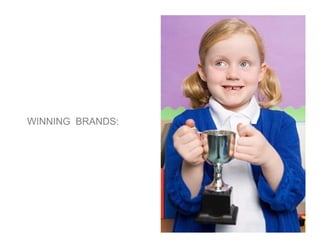
WINNING BRANDS:
Are championed by everyone

                  Pay attention

WINNING BRANDS:   Are responsive

                  Change with the times
                  Move to meet goals
Meet a compelling need
                  (beyond “a degree”)

                  Inspire loyalty

WINNING BRANDS:   Create a premium

                  Facilitate choice

                  Insulate against competition

                  Are ‘money in the bank’
The Challenges of Brand-building
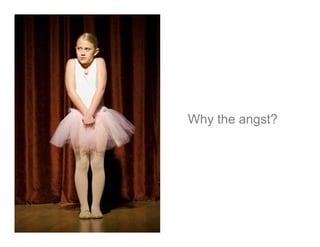
Why the angst?
Defining Branding


       Brands are abstract and metaphysical

       Perceived as a ‘Zero-Sum-Game’

       Perceptions affect brand—the ‘truth’ is vulnerable

       ‘Consumers’ are not rational

       Come from commercial models

       Requires collaboration and collusion
The role of identity in branding
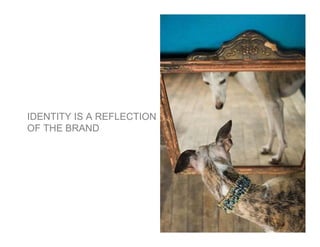
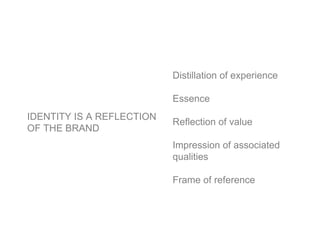
IDENTITY IS A REFLECTION
OF THE BRAND
Distillation of experience

                           Essence
IDENTITY IS A REFLECTION
                           Reflection of value
OF THE BRAND
                           Impression of associated
                           qualities

                           Frame of reference
Defining Branding


   What identity can’t do:

       Can’t tell a story

       Can’t fix a brand

       Doesn’t drive the brand
Defining Branding


   What identity does best:

       Reflects a personality

       Expresses an abstract notion

       Establishes an organizing architecture

       Provides the ‘brand collateral’ for product extensions

       Establishes benchmarks and standards for consistent
       visual expression and naming conventions
Positioning the Brand


     Checklist for brand claim:
     Can we really make this promise?

             Distinctive in market

             Relevant to constituents

             Credible and supportable with evidence

             Consistent with brand heritage

             Feasible and executable
Reverse-engineering Some
      Brand Claims
6
STEPS TO BRAND
 DEVELOPMENT
Understand presenting
     1.            concerns

Define the need.   Use evidence

                   Consider the past
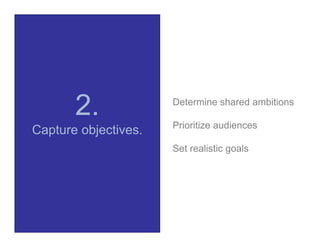
2.             Determine shared ambitions

                      Prioritize audiences
Capture objectives.
                      Set realistic goals
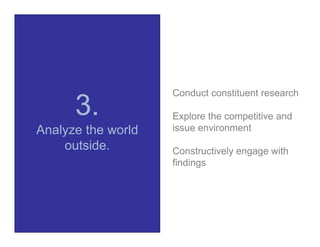
Conduct constituent research
      3.            Explore the competitive and
Analyze the world   issue environment
    outside.        Constructively engage with
                    findings
Capture brand characteristics
        4.               Formulate a competitive
   Draft beta brand      brand claim
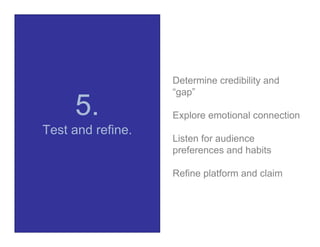
platform and strategy.   Consider how to best deliver
Determine credibility and
                   “gap”

     5.            Explore emotional connection
Test and refine.
                   Listen for audience
                   preferences and habits

                   Refine platform and claim
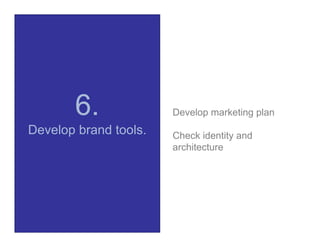
6.              Develop marketing plan
Develop brand tools.   Check identity and
                       architecture
Brand Positioning
Staking Your Claim
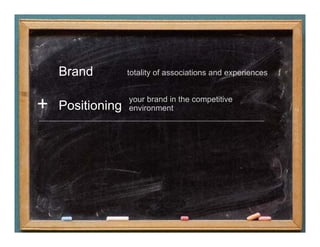
Brand   totality of associations and experiences
Brand         totality of associations and experiences


                  your brand in the competitive
+   Positioning   environment
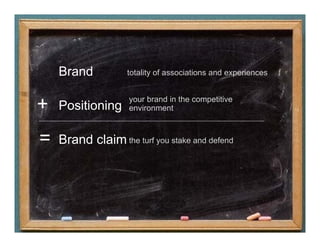
Brand           totality of associations and experiences


                    your brand in the competitive
+   Positioning     environment


=   Brand claim the turf you stake and defend
Positioning the Brand


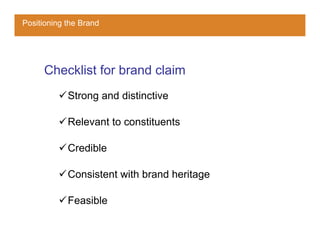
     Checklist for brand claim
            Strong and distinctive

            Relevant to constituents

            Credible

            Consistent with brand heritage

            Feasible
Positioning the Brand


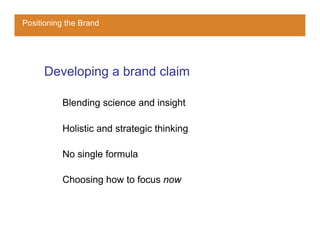
     Developing a brand claim

          Blending science and insight

          Holistic and strategic thinking

          No single formula

          Choosing how to focus now
Positioning Challenge #1


Getting beyond             Distinguish between
“category”                 “points of parity” and
                           unique attributes
Positioning Challenge #2


Strength v.                Balancing what you
Relevance                  are best known for
                           against what you learn
                           to be the most
                           important
                           “decision-drivers.”
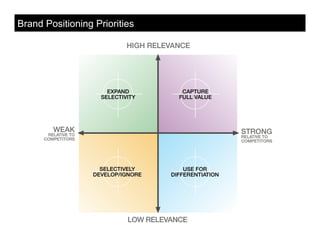
Brand Positioning Priorities
Positioning Challenge #3


Motivating                 Understanding what
Desire                     audiences want from
                           your brand beyond a
                           degree or other
                           functional benefit
Positioning the Brand


     Motivating desire

          Asking the right questions

          Ethnographic research

          Cultural understanding
A CASE STUDY

         Case Study:
Fielding Graduate University
 Fielding Graduate University
Positioning the Brand


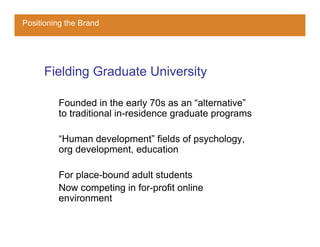
     Fielding Graduate University

         Founded in the early 70s as an “alternative”
         to traditional in-residence graduate programs

         “Human development” fields of psychology,
         org development, education

         For place-bound adult students
         Now competing in for-profit online
         environment
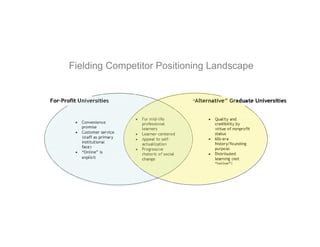
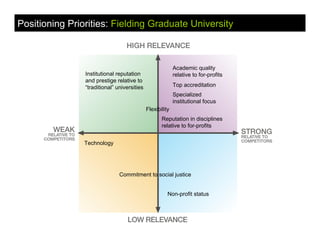
Fielding Competitor Positioning Landscape
Positioning Priorities: Fielding Graduate University


                                                           Academic quality
                Institutional reputation                   relative to for-profits
                and prestige relative to
                “traditional” universities                 Top accreditation
                                                           Specialized
                                                           institutional focus
                                             Flexibility
                                                    Reputation in disciplines
                                                    relative to for-profits


                Technology


                               Commitment to social justice


                                                       Non-profit status
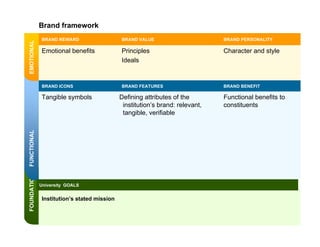
Brand framework
             BRAND REWARD                   BRAND VALUE                       BRAND PERSONALITY
EMOTIONAL


             Emotional benefits             Principles                        Character and style
                                            Ideals


             BRAND ICONS                    BRAND FEATURES                    BRAND BENEFIT

             Tangible symbols               Defining attributes of the        Functional benefits to
                                             institution’s brand: relevant,   constituents
                                             tangible, verifiable
FUNCTIONAL
FOUNDATION


             University GOALS


             Institution’s stated mission
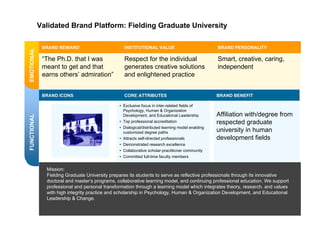
Validated Brand Platform: Fielding Graduate University

              BRAND REWARD                        INSTITUTIONAL VALUE                              BRAND PERSONALITY
EMOTIONAL


              “The Ph.D. that I was               Respect for the individual                       Smart, creative, caring,
              meant to get and that               generates creative solutions                     independent
              earns others’ admiration”           and enlightened practice


              BRAND ICONS                         CORE ATTRIBUTES                                  BRAND BENEFIT

                                                • Exclusive focus in inter-related fields of
                                                  Psychology, Human & Organization
                                                                                                   Affiliation with/degree from
FUNCTIONAL


                                                  Development, and Educational Leadership
                                                • Top professional accreditation                   respected graduate
                                                • Dialogical/distributed learning model enabling
                                                  customized degree paths                          university in human
                                                • Attracts self-directed professionals             development fields
                                                • Demonstrated research excellence
                                                • Collaborative scholar-practitioner community
                                                • Committed full-time faculty members


               Mission:
               Fielding Graduate University prepares its students to serve as reflective professionals through its innovative
               doctoral and master’s programs, collaborative learning model, and continuing professional education. We support
               professional and personal transformation through a learning model which integrates theory, research, and values
               with high integrity practice and scholarship in Psychology, Human & Organization Development, and Educational
               Leadership & Change.
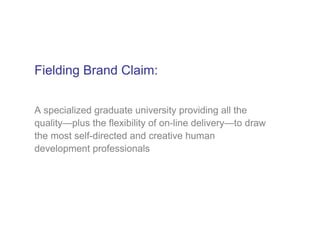
Fielding Brand Claim:


A specialized graduate university providing all the
quality—plus the flexibility of on-line delivery—to draw
the most self-directed and creative human
development professionals
Positioning the Brand


     Fielding strategy:
     Play on ground competitors can’t

         Specialized nature

         Institutional solidity

         Quality guarantors (APA accreditation)

         Third-party endorsement
Positioning the Brand


     Fielding strategy:
     Show students as agents

         Independent ways of thinking

         Students as colleagues

         Breakthrough solutions in disciplines
Positioning the Brand


     Fielding strategy:
     Don’t dwell in self-actualization space

         Emotional appeals

         Supportive culture (reads as remedial)

         Soft imagery
Developing a Brand Strategy

Developing a Brand Strategy

  • 1.
    Developing a BrandStrategy for Your Institution Defining Branding February 20, 2008 © Lipman Hearne 2008. This material cannot be copied or reproduced without permission
  • 2.
    Defining Branding Agenda: Defining brand Branding in the higher education context The role of identity in branding Brand Claims Steps to brand development Brand Positioning A Case Study
  • 3.
  • 4.
  • 5.
  • 6.
  • 7.
  • 8.
  • 9.
  • 10.
    Defining Branding Brand is not: The next project after the website Your mission statement Cooked up in the cabinet meeting “Category” attributes
  • 11.
    Defining Branding Brand is not: A logo Color scheme/look and feel A rule book Advertising
  • 12.
  • 13.
    Defining Branding Brand is: Every association and experience Functional and emotional Intrinsic and original Contextual and positional Active and intentional
  • 14.
  • 15.
    Are championed byeveryone Pay attention WINNING BRANDS: Are responsive Change with the times Move to meet goals
  • 16.
    Meet a compellingneed (beyond “a degree”) Inspire loyalty WINNING BRANDS: Create a premium Facilitate choice Insulate against competition Are ‘money in the bank’
  • 17.
    The Challenges ofBrand-building

  • 18.
  • 19.
    Defining Branding Brands are abstract and metaphysical Perceived as a ‘Zero-Sum-Game’ Perceptions affect brand—the ‘truth’ is vulnerable ‘Consumers’ are not rational Come from commercial models Requires collaboration and collusion
  • 20.
    The role ofidentity in branding
  • 21.
    IDENTITY IS AREFLECTION OF THE BRAND
  • 22.
    Distillation of experience Essence IDENTITY IS A REFLECTION Reflection of value OF THE BRAND Impression of associated qualities Frame of reference
  • 23.
    Defining Branding What identity can’t do: Can’t tell a story Can’t fix a brand Doesn’t drive the brand
  • 24.
    Defining Branding What identity does best: Reflects a personality Expresses an abstract notion Establishes an organizing architecture Provides the ‘brand collateral’ for product extensions Establishes benchmarks and standards for consistent visual expression and naming conventions
  • 25.
    Positioning the Brand Checklist for brand claim: Can we really make this promise? Distinctive in market Relevant to constituents Credible and supportable with evidence Consistent with brand heritage Feasible and executable
  • 26.
  • 30.
    6 STEPS TO BRAND DEVELOPMENT
  • 31.
    Understand presenting 1. concerns Define the need. Use evidence Consider the past
  • 32.
    2. Determine shared ambitions Prioritize audiences Capture objectives. Set realistic goals
  • 33.
    Conduct constituent research 3. Explore the competitive and Analyze the world issue environment outside. Constructively engage with findings
  • 34.
    Capture brand characteristics 4. Formulate a competitive Draft beta brand brand claim platform and strategy. Consider how to best deliver
  • 35.
    Determine credibility and “gap” 5. Explore emotional connection Test and refine. Listen for audience preferences and habits Refine platform and claim
  • 36.
    6. Develop marketing plan Develop brand tools. Check identity and architecture
  • 37.
  • 38.
  • 39.
    Brand totality of associations and experiences
  • 40.
    Brand totality of associations and experiences your brand in the competitive + Positioning environment
  • 41.
    Brand totality of associations and experiences your brand in the competitive + Positioning environment = Brand claim the turf you stake and defend
  • 42.
    Positioning the Brand Checklist for brand claim Strong and distinctive Relevant to constituents Credible Consistent with brand heritage Feasible
  • 43.
    Positioning the Brand Developing a brand claim Blending science and insight Holistic and strategic thinking No single formula Choosing how to focus now
  • 44.
    Positioning Challenge #1 Gettingbeyond Distinguish between “category” “points of parity” and unique attributes
  • 45.
    Positioning Challenge #2 Strengthv. Balancing what you Relevance are best known for against what you learn to be the most important “decision-drivers.”
  • 46.
  • 47.
    Positioning Challenge #3 Motivating Understanding what Desire audiences want from your brand beyond a degree or other functional benefit
  • 48.
    Positioning the Brand Motivating desire Asking the right questions Ethnographic research Cultural understanding
  • 49.
    A CASE STUDY Case Study: Fielding Graduate University Fielding Graduate University
  • 50.
    Positioning the Brand Fielding Graduate University Founded in the early 70s as an “alternative” to traditional in-residence graduate programs “Human development” fields of psychology, org development, education For place-bound adult students Now competing in for-profit online environment
  • 51.
  • 53.
    Positioning Priorities: FieldingGraduate University Academic quality Institutional reputation relative to for-profits and prestige relative to “traditional” universities Top accreditation Specialized institutional focus Flexibility Reputation in disciplines relative to for-profits Technology Commitment to social justice Non-profit status
  • 54.
    Brand framework BRAND REWARD BRAND VALUE BRAND PERSONALITY EMOTIONAL Emotional benefits Principles Character and style Ideals BRAND ICONS BRAND FEATURES BRAND BENEFIT Tangible symbols Defining attributes of the Functional benefits to institution’s brand: relevant, constituents tangible, verifiable FUNCTIONAL FOUNDATION University GOALS Institution’s stated mission
  • 55.
    Validated Brand Platform:Fielding Graduate University BRAND REWARD INSTITUTIONAL VALUE BRAND PERSONALITY EMOTIONAL “The Ph.D. that I was Respect for the individual Smart, creative, caring, meant to get and that generates creative solutions independent earns others’ admiration” and enlightened practice BRAND ICONS CORE ATTRIBUTES BRAND BENEFIT • Exclusive focus in inter-related fields of Psychology, Human & Organization Affiliation with/degree from FUNCTIONAL Development, and Educational Leadership • Top professional accreditation respected graduate • Dialogical/distributed learning model enabling customized degree paths university in human • Attracts self-directed professionals development fields • Demonstrated research excellence • Collaborative scholar-practitioner community • Committed full-time faculty members Mission: Fielding Graduate University prepares its students to serve as reflective professionals through its innovative doctoral and master’s programs, collaborative learning model, and continuing professional education. We support professional and personal transformation through a learning model which integrates theory, research, and values with high integrity practice and scholarship in Psychology, Human & Organization Development, and Educational Leadership & Change.
  • 56.
    Fielding Brand Claim: Aspecialized graduate university providing all the quality—plus the flexibility of on-line delivery—to draw the most self-directed and creative human development professionals
  • 57.
    Positioning the Brand Fielding strategy: Play on ground competitors can’t Specialized nature Institutional solidity Quality guarantors (APA accreditation) Third-party endorsement
  • 58.
    Positioning the Brand Fielding strategy: Show students as agents Independent ways of thinking Students as colleagues Breakthrough solutions in disciplines
  • 59.
    Positioning the Brand Fielding strategy: Don’t dwell in self-actualization space Emotional appeals Supportive culture (reads as remedial) Soft imagery