Procter & Gamble :
Marketing Capabilities
Harvard Business Case
An Evaluation
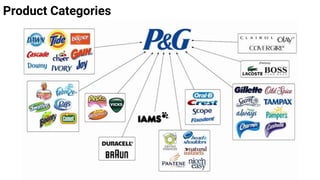
Product Categories
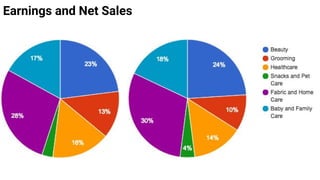
Earnings and Net Sales
● Evaluation of P&G’s marketing strategy
● Is their heavy financial investment in advertising and marketing campaigns
working for them? Or is capital better invested elsewhere?
● P&G has been the largest spender in market research. Is it effective?
What we’re asking
R&D replaces Trial and Error (1887)
● Chemistry lab set up
● Sales and Marketing connected to R&D department
● Ahead of their time and competition
● Have been relentlessly innovative ever since
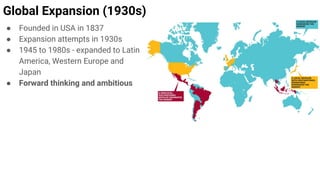
Global Expansion (1930s)
● Founded in USA in 1837
● Expansion attempts in 1930s
● 1945 to 1980s - expanded to Latin
America, Western Europe and
Japan
● Forward thinking and ambitious
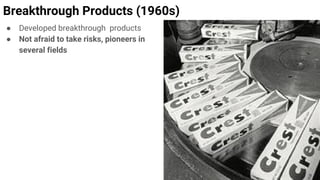
Breakthrough Products (1960s)
● Developed breakthrough products
● Not afraid to take risks, pioneers in
several fields
Acquisitions (1950s)
● Acquired many companies
that served as gateways into
new markets
● Many successful acquisitions
in short span of time
● Good at predicting trends and
demands
● Not afraid to take risks
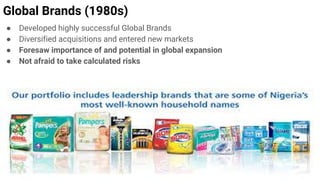
Global Brands (1980s)
● Developed highly successful Global Brands
● Diversified acquisitions and entered new markets
● Foresaw importance of and potential in global expansion
● Not afraid to take calculated risks
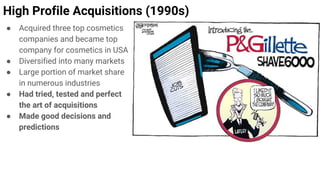
High Profile Acquisitions (1990s)
● Acquired three top cosmetics
companies and became top
company for cosmetics in USA
● Diversified into many markets
● Large portion of market share
in numerous industries
● Had tried, tested and perfect
the art of acquisitions
● Made good decisions and
predictions
Decline in Growth (1999)
● Cut down on staff
● Greater emphasis on innovation
● More number of Global Expansion Units - Risky step
● Greater emphasis on research
● Greater emphasis on acquisition
● Did not let go of tried and tested company strategy during testing times despite
huge risks
● Cut down on expenses
● Doubled down on proven methods
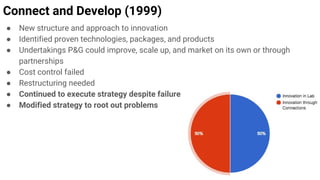
Connect and Develop (1999)
● New structure and approach to innovation
● Identified proven technologies, packages, and products
● Undertakings P&G could improve, scale up, and market on its own or through
partnerships
● Cost control failed
● Restructuring needed
● Continued to execute strategy despite failure
● Modified strategy to root out problems
● Great emphasis on design across industries in 1990s
● Focus on product design following years of focusing on function, performance and
price
● Indicative of capability to recognize emerging trends
● Design at front end of innovation process
● In depth focus on product, purchasing and user experience
● P&G Design Board set up
● Design informed innovation and lead to success
● Unique and inventive sources of market research
● Consumer marketing developed
Emphasis on Product Design (post 2000)
Focus on Return on Market Investment (post 2000)
● In depth studies tracking customer behaviour conducted - focus on customer for
product development is a valuable practice
● Focus on customers offering potential for growth - expansion into new markets
● Measured brand loyalty and customer relationships - retain and adapt values
company is built on
● Shift to digital marketing - capitalised on emerging trend, more effective
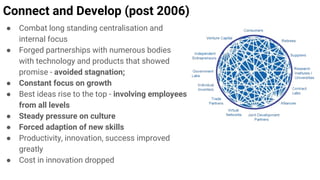
Connect and Develop (post 2006)
● Combat long standing centralisation and
internal focus
● Forged partnerships with numerous bodies
with technology and products that showed
promise - avoided stagnation;
● Constant focus on growth
● Best ideas rise to the top - involving employees
from all levels
● Steady pressure on culture
● Forced adaption of new skills
● Productivity, innovation, success improved
greatly
● Cost in innovation dropped
Recession (2008)
● Marketing Investment Maintained
● Took appropriate measure to compensate and mitigate losses
● Did not face too much damage
● Focus on shopping experience - exploring innovative concepts to avoid stagnation
of brand equity
● Final product kept in mind in early stages - focus on more wholesome view of
marketing
● Sophistication and refinement of processes
● Multibranding - Leveraging P&G brand for sales
● Held off on digital marketing when dot com bubble burst - took calculated steps,
avoided failure
● Acquired Gillette in 2005
● Great degree of sustained success expected
● 150% returns initially
● Sales died down a brought down the brand in 2010
● Performed damage control
● Sales went back up by 2012 with 80% market share in USA and India
Potential Failure - Gillette (2005 - 2012)
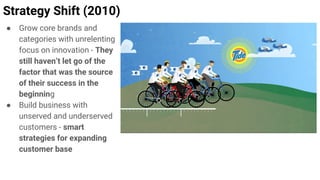
Strategy Shift (2010)
● Grow core brands and
categories with unrelenting
focus on innovation - They
still haven’t let go of the
factor that was the source
of their success in the
beginning
● Build business with
unserved and underserved
customers - smart
strategies for expanding
customer base
● Focus on fast growth - coping
with swiftly increasing
competition
● High margin businesses with
global leadership potential
● Neuromarketing - constant
incorporation of latest
technology
● Strong shift to digital marketing
- focus on greater ROMI
● Olympic Sponsorship - built
upon developing markets;
thought long term
More Customers, More Parts of the World, More
Completely (2010)
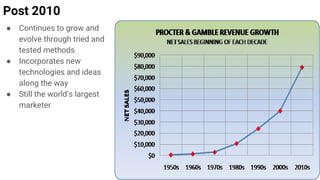
Post 2010
● Continues to grow and
evolve through tried and
tested methods
● Incorporates new
technologies and ideas
along the way
● Still the world’s largest
marketer
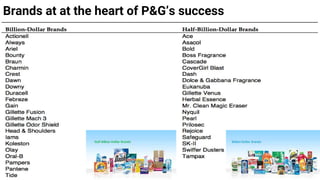
Brands at at the heart of P&G’s success
● Acquire on a small scale
● Trial and error
● Learn formula for success before scaling
● Scale if successful and viable
Acquisition Process
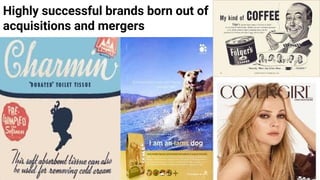
Highly successful brands born out of
acquisitions and mergers
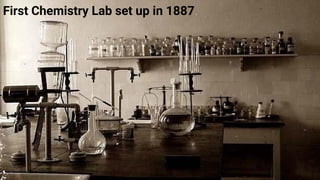
First Chemistry Lab set up in 1887
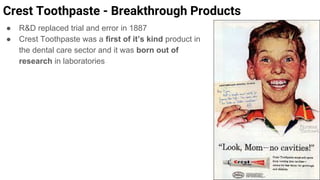
● R&D replaced trial and error in 1887
● Crest Toothpaste was a first of it’s kind product in
the dental care sector and it was born out of
research in laboratories
Crest Toothpaste - Breakthrough Products
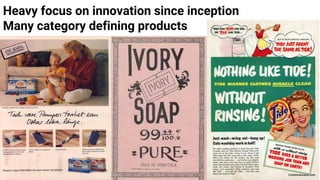
Heavy focus on innovation since inception
Many category defining products
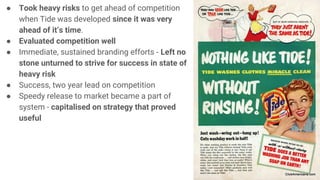
● Took heavy risks to get ahead of competition
when Tide was developed since it was very
ahead of it’s time.
● Evaluated competition well
● Immediate, sustained branding efforts - Left no
stone unturned to strive for success in state of
heavy risk
● Success, two year lead on competition
● Speedy release to market became a part of
system - capitalised on strategy that proved
useful
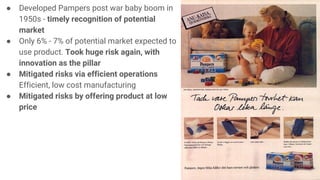
● Developed Pampers post war baby boom in
1950s - timely recognition of potential
market
● Only 6% - 7% of potential market expected to
use product. Took huge risk again, with
innovation as the pillar
● Mitigated risks via efficient operations
Efficient, low cost manufacturing
● Mitigated risks by offering product at low
price
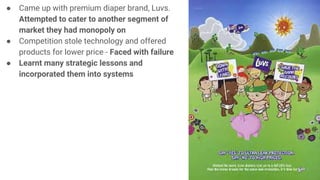
● Came up with premium diaper brand, Luvs.

Attempted to cater to another segment of
market they had monopoly on
● Competition stole technology and offered
products for lower price - Faced with failure
● Learnt many strategic lessons and
incorporated them into systems
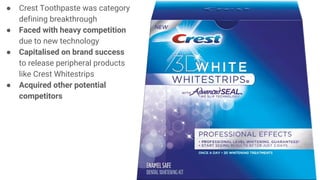
● Crest Toothpaste was category
defining breakthrough
● Faced with heavy competition
due to new technology
● Capitalised on brand success
to release peripheral products
like Crest Whitestrips
● Acquired other potential
competitors
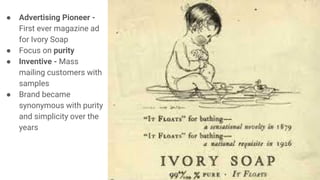
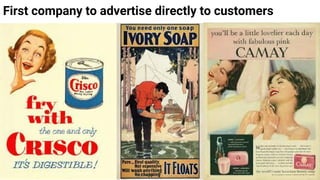
First company to advertise directly to customers
● Advertising Pioneer -
First ever magazine ad
for Ivory Soap
● Focus on purity
● Inventive - Mass
mailing customers with
samples
● Brand became
synonymous with purity
and simplicity over the
years
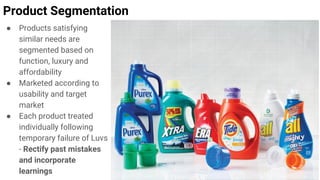
Product Segmentation
● Products satisfying
similar needs are
segmented based on
function, luxury and
affordability
● Marketed according to
usability and target
market
● Each product treated
individually following
temporary failure of Luvs
- Rectify past mistakes
and incorporate
learnings
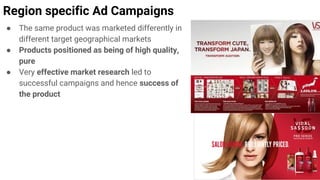
Region specific Ad Campaigns
● The same product was marketed differently in
different target geographical markets
● Products positioned as being of high quality,
pure
● Very effective market research led to
successful campaigns and hence success of
the product
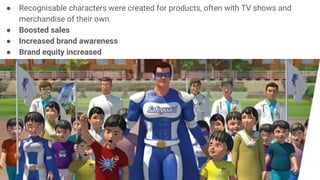
● Recognisable characters were created for products, often with TV shows and
merchandise of their own.
● Boosted sales
● Increased brand awareness
● Brand equity increased
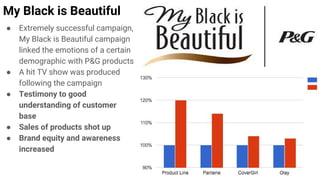
My Black is Beautiful
● Extremely successful campaign,
My Black is Beautiful campaign
linked the emotions of a certain
demographic with P&G products
● A hit TV show was produced
following the campaign
● Testimony to good
understanding of customer
base
● Sales of products shot up
● Brand equity and awareness
increased
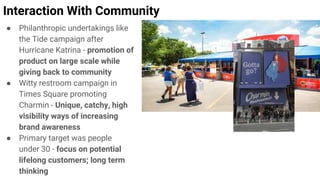
Interaction With Community
● Philanthropic undertakings like
the Tide campaign after
Hurricane Katrina - promotion of
product on large scale while
giving back to community
● Witty restroom campaign in
Times Square promoting
Charmin - Unique, catchy, high
visibility ways of increasing
brand awareness
● Primary target was people
under 30 - focus on potential
lifelong customers; long term
thinking
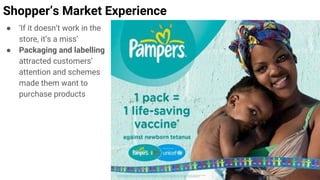
Shopper’s Market Experience
● ‘If it doesn’t work in the
store, it’s a miss’
● Packaging and labelling
attracted customers’
attention and schemes
made them want to
purchase products
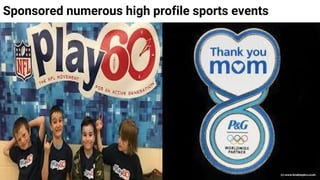
Sponsored numerous high profile sports events
Sponsored daytime dramas, giving rise to Soap Operas
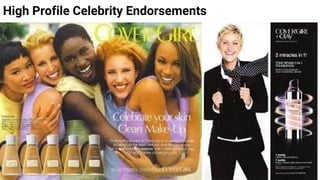
High Profile Celebrity Endorsements
● Long standing partnerships with broadcast and advertising agencies from the early
days of advertising
● Have been sponsors for The Olympic Games multiple times
● Celebrity endorsements generate product awareness
● Increased Brand Awareness and Equity
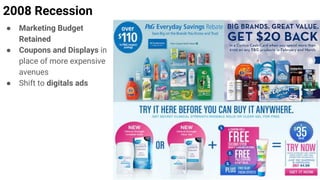
2008 Recession
● Marketing Budget
Retained
● Coupons and Displays in
place of more expensive
avenues
● Shift to digitals ads
Consumer Centric Marketing (post 2000)
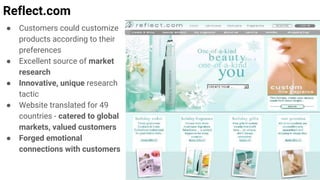
Reflect.com
● Customers could customize
products according to their
preferences
● Excellent source of market
research
● Innovative, unique research
tactic
● Website translated for 49
countries - catered to global
markets, valued customers
● Forged emotional
connections with customers
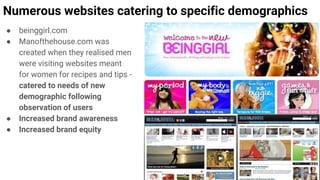
Numerous websites catering to specific demographics
● beinggirl.com
● Manofthehouse.com was
created when they realised men
were visiting websites meant
for women for recipes and tips -
catered to needs of new
demographic following
observation of users
● Increased brand awareness
● Increased brand equity
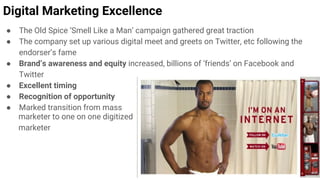
Digital Marketing Excellence
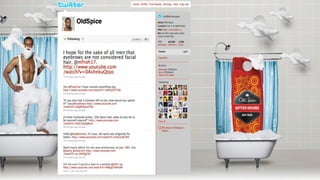
● The Old Spice ‘Smell Like a Man’ campaign gathered great traction
● The company set up various digital meet and greets on Twitter, etc following the
endorser’s fame
● Brand’s awareness and equity increased, billions of ‘friends’ on Facebook and
Twitter
● Excellent timing
● Recognition of opportunity
● Marked transition from mass
marketer to one on one digitized
marketer
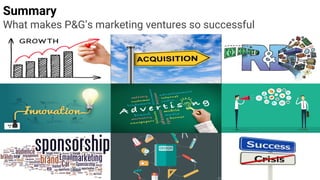
Summary
What makes P&G’s marketing ventures so successful
● P&G have been pioneers in the field of marketing
● Have developed a unique, ever evolving formula for marketing success
● They have coped with failures well in the past by adapting to changing
environments and thinking long term
● The company tends to think out of the box
● Their marketing tactics are effective to a great extent (5 billion strong customer
base)
● P&G’s investment and heavy focus on marketing activities is justified
● The company should invest more in environmental and humanitarian causes
DISCLAIMER
This presentation was made by Aarzoo Sharma, BITS Pilani during an internship under
Prof Sameer Mathur, IIM Lucknow.

Procter & Gamble : Marketing Capabilities

  • 2.
    Procter & Gamble: Marketing Capabilities Harvard Business Case An Evaluation
  • 3.
  • 4.
  • 5.
    ● Evaluation ofP&G’s marketing strategy ● Is their heavy financial investment in advertising and marketing campaigns working for them? Or is capital better invested elsewhere? ● P&G has been the largest spender in market research. Is it effective? What we’re asking
  • 7.
    R&D replaces Trialand Error (1887) ● Chemistry lab set up ● Sales and Marketing connected to R&D department ● Ahead of their time and competition ● Have been relentlessly innovative ever since
  • 8.
    Global Expansion (1930s) ●Founded in USA in 1837 ● Expansion attempts in 1930s ● 1945 to 1980s - expanded to Latin America, Western Europe and Japan ● Forward thinking and ambitious
  • 9.
    Breakthrough Products (1960s) ●Developed breakthrough products ● Not afraid to take risks, pioneers in several fields
  • 10.
    Acquisitions (1950s) ● Acquiredmany companies that served as gateways into new markets ● Many successful acquisitions in short span of time ● Good at predicting trends and demands ● Not afraid to take risks
  • 11.
    Global Brands (1980s) ●Developed highly successful Global Brands ● Diversified acquisitions and entered new markets ● Foresaw importance of and potential in global expansion ● Not afraid to take calculated risks
  • 12.
    High Profile Acquisitions(1990s) ● Acquired three top cosmetics companies and became top company for cosmetics in USA ● Diversified into many markets ● Large portion of market share in numerous industries ● Had tried, tested and perfect the art of acquisitions ● Made good decisions and predictions
  • 13.
    Decline in Growth(1999) ● Cut down on staff ● Greater emphasis on innovation ● More number of Global Expansion Units - Risky step ● Greater emphasis on research ● Greater emphasis on acquisition ● Did not let go of tried and tested company strategy during testing times despite huge risks ● Cut down on expenses ● Doubled down on proven methods
  • 14.
    Connect and Develop(1999) ● New structure and approach to innovation ● Identified proven technologies, packages, and products ● Undertakings P&G could improve, scale up, and market on its own or through partnerships ● Cost control failed ● Restructuring needed ● Continued to execute strategy despite failure ● Modified strategy to root out problems
  • 15.
    ● Great emphasison design across industries in 1990s ● Focus on product design following years of focusing on function, performance and price ● Indicative of capability to recognize emerging trends ● Design at front end of innovation process ● In depth focus on product, purchasing and user experience ● P&G Design Board set up ● Design informed innovation and lead to success ● Unique and inventive sources of market research ● Consumer marketing developed Emphasis on Product Design (post 2000)
  • 16.
    Focus on Returnon Market Investment (post 2000) ● In depth studies tracking customer behaviour conducted - focus on customer for product development is a valuable practice ● Focus on customers offering potential for growth - expansion into new markets ● Measured brand loyalty and customer relationships - retain and adapt values company is built on ● Shift to digital marketing - capitalised on emerging trend, more effective
  • 17.
    Connect and Develop(post 2006) ● Combat long standing centralisation and internal focus ● Forged partnerships with numerous bodies with technology and products that showed promise - avoided stagnation; ● Constant focus on growth ● Best ideas rise to the top - involving employees from all levels ● Steady pressure on culture ● Forced adaption of new skills ● Productivity, innovation, success improved greatly ● Cost in innovation dropped
  • 18.
    Recession (2008) ● MarketingInvestment Maintained ● Took appropriate measure to compensate and mitigate losses ● Did not face too much damage ● Focus on shopping experience - exploring innovative concepts to avoid stagnation of brand equity ● Final product kept in mind in early stages - focus on more wholesome view of marketing ● Sophistication and refinement of processes ● Multibranding - Leveraging P&G brand for sales ● Held off on digital marketing when dot com bubble burst - took calculated steps, avoided failure
  • 19.
    ● Acquired Gillettein 2005 ● Great degree of sustained success expected ● 150% returns initially ● Sales died down a brought down the brand in 2010 ● Performed damage control ● Sales went back up by 2012 with 80% market share in USA and India Potential Failure - Gillette (2005 - 2012)
  • 20.
    Strategy Shift (2010) ●Grow core brands and categories with unrelenting focus on innovation - They still haven’t let go of the factor that was the source of their success in the beginning ● Build business with unserved and underserved customers - smart strategies for expanding customer base
  • 21.
    ● Focus onfast growth - coping with swiftly increasing competition ● High margin businesses with global leadership potential ● Neuromarketing - constant incorporation of latest technology ● Strong shift to digital marketing - focus on greater ROMI ● Olympic Sponsorship - built upon developing markets; thought long term
  • 22.
    More Customers, MoreParts of the World, More Completely (2010)
  • 23.
    Post 2010 ● Continuesto grow and evolve through tried and tested methods ● Incorporates new technologies and ideas along the way ● Still the world’s largest marketer
  • 24.
    Brands at atthe heart of P&G’s success
  • 26.
    ● Acquire ona small scale ● Trial and error ● Learn formula for success before scaling ● Scale if successful and viable Acquisition Process
  • 27.
    Highly successful brandsborn out of acquisitions and mergers
  • 29.
    First Chemistry Labset up in 1887
  • 30.
    ● R&D replacedtrial and error in 1887 ● Crest Toothpaste was a first of it’s kind product in the dental care sector and it was born out of research in laboratories Crest Toothpaste - Breakthrough Products
  • 32.
    Heavy focus oninnovation since inception Many category defining products
  • 33.
    ● Took heavyrisks to get ahead of competition when Tide was developed since it was very ahead of it’s time. ● Evaluated competition well ● Immediate, sustained branding efforts - Left no stone unturned to strive for success in state of heavy risk ● Success, two year lead on competition ● Speedy release to market became a part of system - capitalised on strategy that proved useful
  • 34.
    ● Developed Pamperspost war baby boom in 1950s - timely recognition of potential market ● Only 6% - 7% of potential market expected to use product. Took huge risk again, with innovation as the pillar ● Mitigated risks via efficient operations Efficient, low cost manufacturing ● Mitigated risks by offering product at low price
  • 35.
    ● Came upwith premium diaper brand, Luvs. Attempted to cater to another segment of market they had monopoly on ● Competition stole technology and offered products for lower price - Faced with failure ● Learnt many strategic lessons and incorporated them into systems
  • 36.
    ● Crest Toothpastewas category defining breakthrough ● Faced with heavy competition due to new technology ● Capitalised on brand success to release peripheral products like Crest Whitestrips ● Acquired other potential competitors
  • 38.
    First company toadvertise directly to customers
  • 39.
    ● Advertising Pioneer- First ever magazine ad for Ivory Soap ● Focus on purity ● Inventive - Mass mailing customers with samples ● Brand became synonymous with purity and simplicity over the years
  • 40.
    Product Segmentation ● Productssatisfying similar needs are segmented based on function, luxury and affordability ● Marketed according to usability and target market ● Each product treated individually following temporary failure of Luvs - Rectify past mistakes and incorporate learnings
  • 42.
    Region specific AdCampaigns ● The same product was marketed differently in different target geographical markets ● Products positioned as being of high quality, pure ● Very effective market research led to successful campaigns and hence success of the product
  • 43.
    ● Recognisable characterswere created for products, often with TV shows and merchandise of their own. ● Boosted sales ● Increased brand awareness ● Brand equity increased
  • 44.
    My Black isBeautiful ● Extremely successful campaign, My Black is Beautiful campaign linked the emotions of a certain demographic with P&G products ● A hit TV show was produced following the campaign ● Testimony to good understanding of customer base ● Sales of products shot up ● Brand equity and awareness increased
  • 45.
    Interaction With Community ●Philanthropic undertakings like the Tide campaign after Hurricane Katrina - promotion of product on large scale while giving back to community ● Witty restroom campaign in Times Square promoting Charmin - Unique, catchy, high visibility ways of increasing brand awareness ● Primary target was people under 30 - focus on potential lifelong customers; long term thinking
  • 46.
    Shopper’s Market Experience ●‘If it doesn’t work in the store, it’s a miss’ ● Packaging and labelling attracted customers’ attention and schemes made them want to purchase products
  • 48.
    Sponsored numerous highprofile sports events
  • 49.
    Sponsored daytime dramas,giving rise to Soap Operas
  • 50.
  • 51.
    ● Long standingpartnerships with broadcast and advertising agencies from the early days of advertising ● Have been sponsors for The Olympic Games multiple times ● Celebrity endorsements generate product awareness ● Increased Brand Awareness and Equity
  • 53.
    2008 Recession ● MarketingBudget Retained ● Coupons and Displays in place of more expensive avenues ● Shift to digitals ads
  • 55.
  • 56.
    Reflect.com ● Customers couldcustomize products according to their preferences ● Excellent source of market research ● Innovative, unique research tactic ● Website translated for 49 countries - catered to global markets, valued customers ● Forged emotional connections with customers
  • 58.
    Numerous websites cateringto specific demographics ● beinggirl.com ● Manofthehouse.com was created when they realised men were visiting websites meant for women for recipes and tips - catered to needs of new demographic following observation of users ● Increased brand awareness ● Increased brand equity
  • 59.
    Digital Marketing Excellence ●The Old Spice ‘Smell Like a Man’ campaign gathered great traction ● The company set up various digital meet and greets on Twitter, etc following the endorser’s fame ● Brand’s awareness and equity increased, billions of ‘friends’ on Facebook and Twitter ● Excellent timing ● Recognition of opportunity ● Marked transition from mass marketer to one on one digitized marketer
  • 61.
    Summary What makes P&G’smarketing ventures so successful
  • 62.
    ● P&G havebeen pioneers in the field of marketing ● Have developed a unique, ever evolving formula for marketing success ● They have coped with failures well in the past by adapting to changing environments and thinking long term ● The company tends to think out of the box ● Their marketing tactics are effective to a great extent (5 billion strong customer base) ● P&G’s investment and heavy focus on marketing activities is justified ● The company should invest more in environmental and humanitarian causes
  • 63.
    DISCLAIMER This presentation wasmade by Aarzoo Sharma, BITS Pilani during an internship under Prof Sameer Mathur, IIM Lucknow.