Language for Teaching a Language
Babylen Arit-Soner
MA Applied Linguistics
We will be learning about…
How is language used in teaching
Techniques for teaching using the language
Socio-cultural perspective on classroom
interaction
How is language used in teaching?
 In organizing activities for the learners who
vary in their aims, abilities and motivations.
 In controlling unruly behavior
 In teaching the content of a specific
curriculum, a body of knowledge and skills
to the students.
 In monitoring and assessing the educational
progress the students make
Language and Teaching
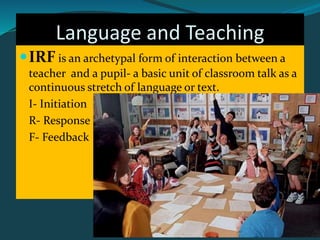
IRF is an archetypal form of interaction between a
teacher and a pupil- a basic unit of classroom talk as a
continuous stretch of language or text.
I- Initiation
R- Response
F- Feedback
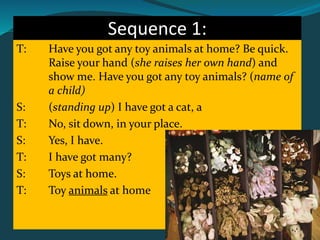
Sequence 1:
T: Have you got any toy animals at home? Be quick.
Raise your hand (she raises her own hand) and
show me. Have you got any toy animals? (name of
a child)
S: (standing up) I have got a cat, a
T: No, sit down, in your place.
S: Yes, I have.
T: I have got many?
S: Toys at home.
T: Toy animals at home
Observations:
 The teacher took longer turns at speaking than any
students.
 She asked all the questions to elicit some kind of
participatory response from the students.
 She then evaluates the replies they give
 She also uses questions to direct the topic or
content of the talk towards issues that she wishes
to focus attention on.
 There is a structural pattern to the talk: a teacher’s
question is followed by a student’s response,
followed in turn by some teacher’s feedback or
evaluation.
 The sequence also shows how feedback of the teacher
may be used to control student’s behavior.
 In this sequence, IRF exchanges are being used to
perform a common function in classrooms- the teacher
is eliciting from the learners their knowledge of the
relevant curriculum subject
 This particular kind of use of question-answer by a
teacher- asking questions to which the teacher knows
exactly what answers she seeks- is the most common IRF.
 The students get little opportunity for using the
language in more creative ways.
 The teacher is asking her students to answer in a
sentence which conform to the models she has in mind.
The children respond by trying to provide these “right
answers”
According to Edwards and Westgate:
“Most classroom talk displays a clear boundary
between knowledge and ignorance…to be asked a
question by someone who wants to know is to be given
the initiative in deciding the amount of information to
be offered and the manner of telling. But to be asked
by someone who already knows, and wants to know if
you know, is to have your answer accepted, rejected, or
otherwise evaluated according to the questioner’s
beliefs about what is relevant and true”.
Sequence 2
T: Who would like to tell the class about their personal
qualities? Dalia?
D: I am polite, friendly, organized, trustworthy, responsible but
sometimes I am impatient and unpunctual. Sometimes (laughs)
T: Good, Isn’t it? (addressing the class) Thank you, Dalia. That was
good. Now, can you tell me the positive qualities you just have
said?
D: yeah?
T: That is, friendly, um, organized.
D: Right.
T: How is it helping you…
D: yeah?
T: …with your friends /in the class?
D: /It help me to get along with people and to understand them and
help them.
T: That’s good. And what about the, the not very
positive ones like /punctual…
D: /Sometimes?
T: What happens then?
D: Sometimes I lose my friend basically of that
because I lose my temper very quickly.
T: and what happens with me? I don’t smile at you
that much, do I?
Observations:
 There is an IRF exchange but is slightly more complex,
linked structures, in which the students interjects
during the teacher’s elicitations, perhaps seeking
clarification which the teacher provides.
 The teacher is asking questions to encourage the
students to elaborate, in this way, the teacher is not
trying to elicit particular forms or structures of English
but rather encouraging the students to use English in a
practical, communicative manner.
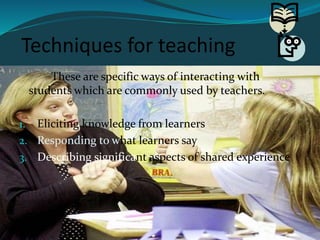
Techniques for teaching
These are specific ways of interacting with
students which are commonly used by teachers.
1. Eliciting knowledge from learners
2. Responding to what learners say
3. Describing significant aspects of shared experience
Techniques for teaching
1. Eliciting knowledge from learners:
a. Direct elicitation- if it is a straightforward
request for an information
b. Cued Elicitation- drawing out from learners the
information they are seeking by
providing visual clues and verbal
hints as to what answer is
required.
T: (to child) Say the sound.
C: b-b-b
T: b-b-b is for?
(child does not answer. Teacher waves her hand over the
nearest objects, one of which is a book)
C: b-b-b is for book
T: Well done!
2. Responding to what learners say:
a. Confirmation- e.g. saying yes, that’s right to a
pupil’s answer.
b. Repetition- the teacher repeats the answer of the
pupil to draw the attention of a
whole class to an answer or
other remarks which is
judged by the teacher to be of
significance.
c. Reformulations- the teacher revises a student’s
answer to fit in better with the point
that the teacher wishes to make or
the form of response being sought.
d. elaborations- when a teacher picks up on a cryptic
statement made by a pupil and expands
and/or explains its significance to the rest
of the class.
e. Rejections- wrong answers or unsuitable
contributions may be explicitly
rejected by a teacher . In dealing
with such, we should make use of the
most popular technique, simply
ignore them.
3. Describing shared experience
Teachers should be using the “We statements”
(last week, we learned how to transform singular
nouns to plural), to represent past experience as
relevant to present activity. They show how learners
see they have significant past experience in common
and so have gained shared knowledge and collective
understanding which can be drawn upon to progress
further.
A Socio-Cultural Perspective on
Classroom Interaction
1. Language is our most important pedagogic tool.
Language is a tool for carrying out teaching-
learning and also that which is meant to be learnt
and taught.
2. Education is a dialogical, cultural process
The development of students’ knowledge and
understanding is shaped by their relationships with
teachers and other students, and by the culture in
which those relationships are located.
An effective teacher provides the kind of intellectual
support which enables learners to make intellectual
achievements they would never accomplish alone;
and one way they do so is using dialogue to guide
and support the development of understanding.
3. Language carries the history of classroom activity
into its future
Language is a tool for building the future out of
the past: the meaningfulness of current and future
joint activities of teachers and learners depends on the
foundations of their common knowledge.
4. Classroom interaction follows implicit “ground
rules”
The ground rules or conventions will make sure
that speakers, and listeners, writers and readers are
operating within the same genres of language.
Thank you!

Language for teaching a language

  • 1.
    Language for Teachinga Language Babylen Arit-Soner MA Applied Linguistics
  • 2.
    We will belearning about… How is language used in teaching Techniques for teaching using the language Socio-cultural perspective on classroom interaction
  • 3.
    How is languageused in teaching?  In organizing activities for the learners who vary in their aims, abilities and motivations.  In controlling unruly behavior  In teaching the content of a specific curriculum, a body of knowledge and skills to the students.  In monitoring and assessing the educational progress the students make
  • 4.
    Language and Teaching IRFis an archetypal form of interaction between a teacher and a pupil- a basic unit of classroom talk as a continuous stretch of language or text. I- Initiation R- Response F- Feedback
  • 5.
    Sequence 1: T: Haveyou got any toy animals at home? Be quick. Raise your hand (she raises her own hand) and show me. Have you got any toy animals? (name of a child) S: (standing up) I have got a cat, a T: No, sit down, in your place. S: Yes, I have. T: I have got many? S: Toys at home. T: Toy animals at home
  • 6.
    Observations:  The teachertook longer turns at speaking than any students.  She asked all the questions to elicit some kind of participatory response from the students.  She then evaluates the replies they give  She also uses questions to direct the topic or content of the talk towards issues that she wishes to focus attention on.  There is a structural pattern to the talk: a teacher’s question is followed by a student’s response, followed in turn by some teacher’s feedback or evaluation.
  • 7.
     The sequencealso shows how feedback of the teacher may be used to control student’s behavior.  In this sequence, IRF exchanges are being used to perform a common function in classrooms- the teacher is eliciting from the learners their knowledge of the relevant curriculum subject  This particular kind of use of question-answer by a teacher- asking questions to which the teacher knows exactly what answers she seeks- is the most common IRF.  The students get little opportunity for using the language in more creative ways.  The teacher is asking her students to answer in a sentence which conform to the models she has in mind. The children respond by trying to provide these “right answers”
  • 8.
    According to Edwardsand Westgate: “Most classroom talk displays a clear boundary between knowledge and ignorance…to be asked a question by someone who wants to know is to be given the initiative in deciding the amount of information to be offered and the manner of telling. But to be asked by someone who already knows, and wants to know if you know, is to have your answer accepted, rejected, or otherwise evaluated according to the questioner’s beliefs about what is relevant and true”.
  • 9.
    Sequence 2 T: Whowould like to tell the class about their personal qualities? Dalia? D: I am polite, friendly, organized, trustworthy, responsible but sometimes I am impatient and unpunctual. Sometimes (laughs) T: Good, Isn’t it? (addressing the class) Thank you, Dalia. That was good. Now, can you tell me the positive qualities you just have said? D: yeah? T: That is, friendly, um, organized. D: Right. T: How is it helping you… D: yeah? T: …with your friends /in the class? D: /It help me to get along with people and to understand them and help them.
  • 10.
    T: That’s good.And what about the, the not very positive ones like /punctual… D: /Sometimes? T: What happens then? D: Sometimes I lose my friend basically of that because I lose my temper very quickly. T: and what happens with me? I don’t smile at you that much, do I?
  • 11.
    Observations:  There isan IRF exchange but is slightly more complex, linked structures, in which the students interjects during the teacher’s elicitations, perhaps seeking clarification which the teacher provides.  The teacher is asking questions to encourage the students to elaborate, in this way, the teacher is not trying to elicit particular forms or structures of English but rather encouraging the students to use English in a practical, communicative manner.
  • 12.
    Techniques for teaching Theseare specific ways of interacting with students which are commonly used by teachers. 1. Eliciting knowledge from learners 2. Responding to what learners say 3. Describing significant aspects of shared experience
  • 13.
    Techniques for teaching 1.Eliciting knowledge from learners: a. Direct elicitation- if it is a straightforward request for an information b. Cued Elicitation- drawing out from learners the information they are seeking by providing visual clues and verbal hints as to what answer is required.
  • 14.
    T: (to child)Say the sound. C: b-b-b T: b-b-b is for? (child does not answer. Teacher waves her hand over the nearest objects, one of which is a book) C: b-b-b is for book T: Well done!
  • 15.
    2. Responding towhat learners say: a. Confirmation- e.g. saying yes, that’s right to a pupil’s answer. b. Repetition- the teacher repeats the answer of the pupil to draw the attention of a whole class to an answer or other remarks which is judged by the teacher to be of significance. c. Reformulations- the teacher revises a student’s answer to fit in better with the point that the teacher wishes to make or the form of response being sought.
  • 16.
    d. elaborations- whena teacher picks up on a cryptic statement made by a pupil and expands and/or explains its significance to the rest of the class. e. Rejections- wrong answers or unsuitable contributions may be explicitly rejected by a teacher . In dealing with such, we should make use of the most popular technique, simply ignore them.
  • 17.
    3. Describing sharedexperience Teachers should be using the “We statements” (last week, we learned how to transform singular nouns to plural), to represent past experience as relevant to present activity. They show how learners see they have significant past experience in common and so have gained shared knowledge and collective understanding which can be drawn upon to progress further.
  • 18.
    A Socio-Cultural Perspectiveon Classroom Interaction 1. Language is our most important pedagogic tool. Language is a tool for carrying out teaching- learning and also that which is meant to be learnt and taught.
  • 19.
    2. Education isa dialogical, cultural process The development of students’ knowledge and understanding is shaped by their relationships with teachers and other students, and by the culture in which those relationships are located. An effective teacher provides the kind of intellectual support which enables learners to make intellectual achievements they would never accomplish alone; and one way they do so is using dialogue to guide and support the development of understanding.
  • 20.
    3. Language carriesthe history of classroom activity into its future Language is a tool for building the future out of the past: the meaningfulness of current and future joint activities of teachers and learners depends on the foundations of their common knowledge.
  • 21.
    4. Classroom interactionfollows implicit “ground rules” The ground rules or conventions will make sure that speakers, and listeners, writers and readers are operating within the same genres of language.
  • 22.