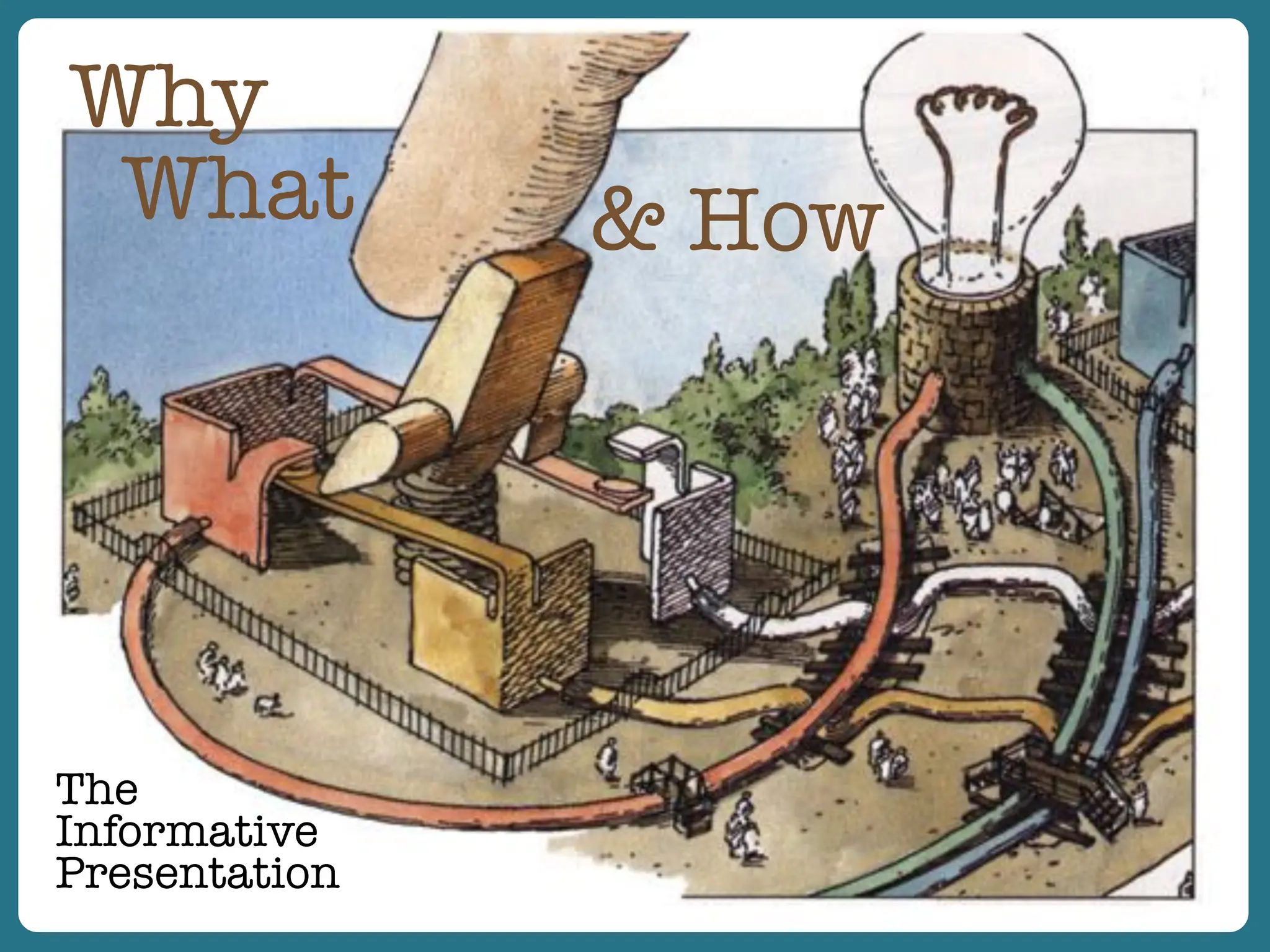




Why
What & How
The
Informative
Presentation
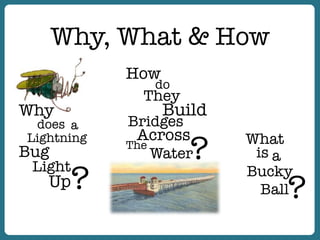
Why, What & How
How
do
They
Build
Bridges
Across
The
Water
?
Why
does a
Lightning
Bug
Light
Up?
What
is a
Bucky
Ball?
Basic Requirements
1. Falls within the 5-7 minute time limit
2. Explores an approved topic
3. Utilizes extemporaneous and enthusiastic delivery
4. Incorporates 4 high quality sources
5. Citation of all of your sources during your speech
6. Submission of a typed full sentence outline (2-4 p.)
7. Contains a clear introduction, body, & conclusion
8. Follows APA or MLA guidelines
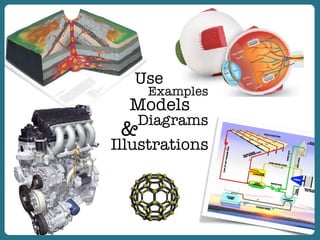
Use
Examples
Diagrams
Models
Illustrations
&
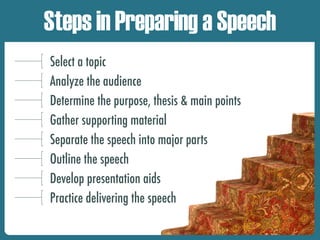
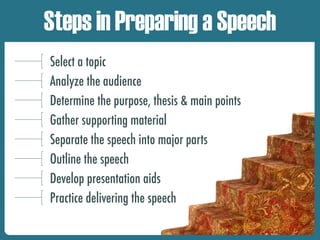
Steps in Preparing a Speech
Select a topic
Analyze the audience
Determine the purpose, thesis & main points
Gather supporting material
Separate the speech into major parts
Outline the speech
Develop presentation aids
Practice delivering the speech
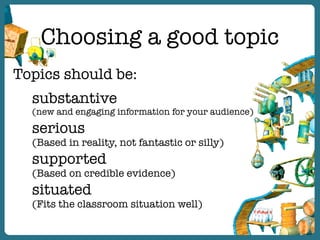
Choosing a good topic
Topics should be:
substantive
(new and engaging information for your audience)
serious
(Based in reality, not fantastic or silly)
supported
(Based on credible evidence)
situated
(Fits the classroom situation well)
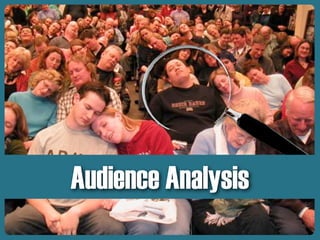
Audience Analysis
“To make a successful speech, you too must function like an advertiser.”
good
Audience
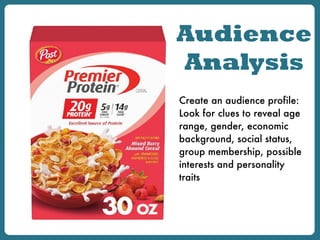
Analysis
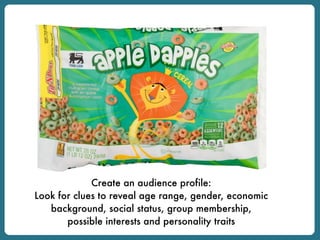
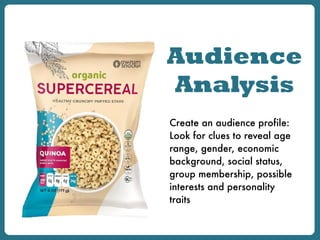
Create an audience profile:
Look for clues to reveal age
range, gender, economic
background, social status,
group membership, possible
interests and personality
traits
Audience
Analysis
Create an audience profile:
Look for clues to reveal age
range, gender, economic
background, social status,
group membership, possible
interests and personality
traits
Audience
Analysis
Create an audience profile:
Look for clues to reveal age
range, gender, economic
background, social status,
group membership, possible
interests and personality
traits
Create an audience profile:
Look for clues to reveal age range, gender, economic
background, social status, group membership,
possible interests and personality traits
Audience
Analysis
Create an audience profile:
Look for clues to reveal age
range, gender, economic
background, social status,
group membership, possible
interests and personality
traits
Analyzing your Audience
Situational information
Demographic information
Psychological information
Speech context/Rhetorical situation
- Orientation toward speaker, occasion, topic
Size of audience
Physical setting
Time and length of speech
Situational: The Setting
Characteristic of the Audience
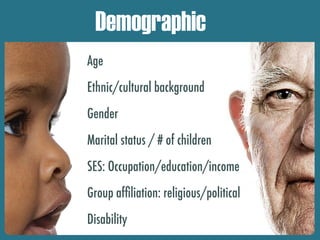
Demographic
Age
Ethnic/cultural background
Gender
Marital status / # of children
SES: Occupation/education/income
Group affiliation: religious/political
Disability
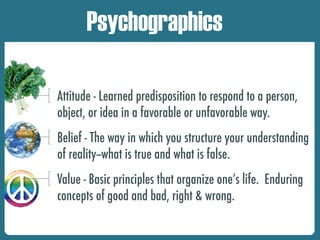
Attitude - Learned predisposition to respond to a person,
object, or idea in a favorable or unfavorable way.
Belief - The way in which you structure your understanding
of reality--what is true and what is false.
Value - Basic principles that organize one’s life. Enduring
concepts of good and bad, right & wrong.
Psychographics
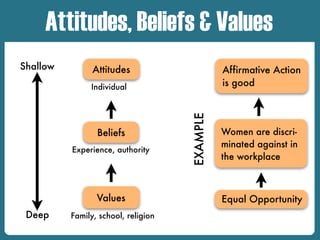
Relationship between Attitudes,
Beliefs and Values
Shallow
Deep
Experience, authority
Individual
Family, school, religion
Equal Opportunity
EXAMPLE
Affirmative Action
is good
Women are discri-
minated against in
the workplace
Attitudes
Values
Beliefs
Attitudes, Beliefs & Values
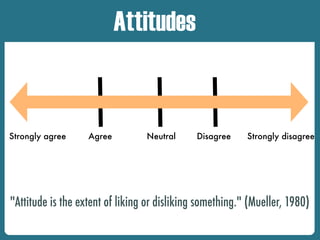
Attitudes
Evaluations made about specific problems/issues
"Attitude is the extent of liking or disliking something." (Mueller, 1980)
Strongly agree Agree Neutral Disagree Strongly disagree
Attitudes
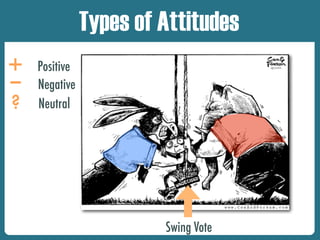
Types of Attitudes
N
+ Positive
-- Negative
Neutral
?
Swing Vote
Types of Attitudes
Needs and wants motivate people to act
Speakers can motivate audiences by:
playing on audience needs
showing that their needs are currently unsatisfied
showing how their needs will be satisfied
Audience Needs
Need: State in which some sort of unsatisfied condition exists
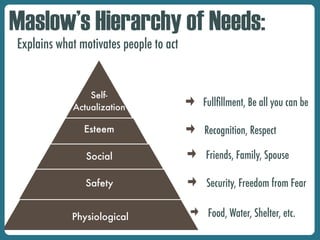
Physiological Food, Water, Shelter, etc.
Safety Security, Freedom from Fear
Friends, Family, Spouse
Social
Esteem Recognition, Respect
Self-
Actualization Fullfillment, Be all you can be
Maslow’s Hierarchy of Needs:
Explains what motivates people to act
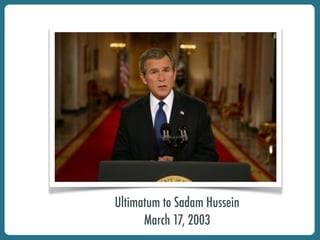
Ultimatum to Sadam Hussein
March 17, 2003
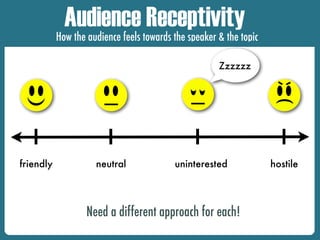
Audience
How the audience feels towards the speaker & the topic
friendly hostile
neutral uninterested
Zzzzzz
Need a different approach for each!
Audience Receptivity
How the audience feels towards the speaker & the topic
Steps in Preparing a Speech
Select a topic
Analyze the audience
Determine the purpose, thesis & main points
Gather supporting material
Separate the speech into major parts
Outline the speech
Develop presentation aids
Practice delivering the speech

Process for Informative Speech & Audience Analysis

  • 1.
  • 2.
    Why, What &How How do They Build Bridges Across The Water ? Why does a Lightning Bug Light Up? What is a Bucky Ball?
  • 3.
    Basic Requirements 1. Fallswithin the 5-7 minute time limit 2. Explores an approved topic 3. Utilizes extemporaneous and enthusiastic delivery 4. Incorporates 4 high quality sources 5. Citation of all of your sources during your speech 6. Submission of a typed full sentence outline (2-4 p.) 7. Contains a clear introduction, body, & conclusion 8. Follows APA or MLA guidelines
  • 4.
  • 5.
    Steps in Preparinga Speech Select a topic Analyze the audience Determine the purpose, thesis & main points Gather supporting material Separate the speech into major parts Outline the speech Develop presentation aids Practice delivering the speech
  • 6.
    Choosing a goodtopic Topics should be: substantive (new and engaging information for your audience) serious (Based in reality, not fantastic or silly) supported (Based on credible evidence) situated (Fits the classroom situation well)
  • 7.
  • 8.
    “To make asuccessful speech, you too must function like an advertiser.” good
  • 9.
    Audience Analysis Create an audienceprofile: Look for clues to reveal age range, gender, economic background, social status, group membership, possible interests and personality traits
  • 10.
    Audience Analysis Create an audienceprofile: Look for clues to reveal age range, gender, economic background, social status, group membership, possible interests and personality traits
  • 11.
    Audience Analysis Create an audienceprofile: Look for clues to reveal age range, gender, economic background, social status, group membership, possible interests and personality traits
  • 12.
    Create an audienceprofile: Look for clues to reveal age range, gender, economic background, social status, group membership, possible interests and personality traits
  • 13.
    Audience Analysis Create an audienceprofile: Look for clues to reveal age range, gender, economic background, social status, group membership, possible interests and personality traits
  • 14.
    Analyzing your Audience Situationalinformation Demographic information Psychological information
  • 15.
    Speech context/Rhetorical situation -Orientation toward speaker, occasion, topic Size of audience Physical setting Time and length of speech Situational: The Setting
  • 16.
    Characteristic of theAudience Demographic Age Ethnic/cultural background Gender Marital status / # of children SES: Occupation/education/income Group affiliation: religious/political Disability
  • 17.
    Attitude - Learnedpredisposition to respond to a person, object, or idea in a favorable or unfavorable way. Belief - The way in which you structure your understanding of reality--what is true and what is false. Value - Basic principles that organize one’s life. Enduring concepts of good and bad, right & wrong. Psychographics
  • 18.
    Relationship between Attitudes, Beliefsand Values Shallow Deep Experience, authority Individual Family, school, religion Equal Opportunity EXAMPLE Affirmative Action is good Women are discri- minated against in the workplace Attitudes Values Beliefs Attitudes, Beliefs & Values
  • 19.
    Attitudes Evaluations made aboutspecific problems/issues "Attitude is the extent of liking or disliking something." (Mueller, 1980) Strongly agree Agree Neutral Disagree Strongly disagree Attitudes
  • 20.
    Types of Attitudes N +Positive -- Negative Neutral ? Swing Vote Types of Attitudes
  • 21.
    Needs and wantsmotivate people to act Speakers can motivate audiences by: playing on audience needs showing that their needs are currently unsatisfied showing how their needs will be satisfied Audience Needs Need: State in which some sort of unsatisfied condition exists
  • 22.
    Physiological Food, Water,Shelter, etc. Safety Security, Freedom from Fear Friends, Family, Spouse Social Esteem Recognition, Respect Self- Actualization Fullfillment, Be all you can be Maslow’s Hierarchy of Needs: Explains what motivates people to act
  • 23.
    Ultimatum to SadamHussein March 17, 2003
  • 25.
    Audience How the audiencefeels towards the speaker & the topic friendly hostile neutral uninterested Zzzzzz Need a different approach for each! Audience Receptivity How the audience feels towards the speaker & the topic
  • 26.
    Steps in Preparinga Speech Select a topic Analyze the audience Determine the purpose, thesis & main points Gather supporting material Separate the speech into major parts Outline the speech Develop presentation aids Practice delivering the speech