These methods provide maximum security
to operation of the information system.
Standard procedures are developed and
maintained manually and built in software
help display so that every one knows what to
do.
It promotes uniformity and
minimize the chance of error
and fraud.
It should be kept up-to-date so
that correct processing of each
activity is made possible.
Standard
procedures and
documentation
Authorization
requirements
Disaster recovery
Controls for
end-user
computing
refer to mandatory
activities, actions, rules, or
regulations.
 can give a policy its support and
reinforcement in direction.
could be internal, or externally
mandated (government laws
and regulations).
detailed step-by-step tasks that should
be performed to achieve a certain goal.
Example: procedures on how to
install operating systems
spell out how the policy,
standards, and guidelines will
actually be implemented in an
operating environment.
If a policy states that all
individuals who access
confidential information must be
properly authenticated.
ISO 9001 Documented Information
the terms “documents” and “records”
were formally used to refer to the
important information and data that
exists within a company.
DOCUMENT - information
that is discussed in ISO 9001
is also defined as the vital
information that must be
kept and evaluated
periodically.
RECORDS are usually retained for
long periods of time, while
DOCUMENTS hold data that is
maintained and frequently updated
or added to.
an access policy.
function of specifying access
rights/privileges to resources, which
is related to information
security and computer security in
general and to access control in
particular
security mechanism used to
determine user/client privileges
or access levels related to system
resources,including computer programs,
files, services, data and application
features.
normally preceded by
authentication for user
identity verification. System
administrators (SA) are typically
assigned permission levels
covering all system and user
resources.
involves a set of policies, tools and
procedures to enable the recovery or
continuation of vital technology
infrastructure and systems following a
natural or human-induced disaster.
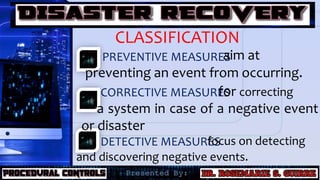
CLASSIFICATION
PREVENTIVE MEASURES
CORRECTIVE MEASURES
DETECTIVE MEASURES
aim at
preventing an event from occurring.
for correcting
a system in case of a negative event
or disaster
focus on detecting
and discovering negative events.
EUC refers to computer
systems and platforms that
are meant to allow non-
programmers to create
working
computer applications.
EUC compilation of approaches meant
to better involve and
integrate end users and other non-
programmers into the world
of computing systems development.
Procedural Controls

Procedural Controls

  • 4.
    These methods providemaximum security to operation of the information system. Standard procedures are developed and maintained manually and built in software help display so that every one knows what to do.
  • 5.
    It promotes uniformityand minimize the chance of error and fraud. It should be kept up-to-date so that correct processing of each activity is made possible.
  • 6.
  • 7.
    refer to mandatory activities,actions, rules, or regulations.  can give a policy its support and reinforcement in direction. could be internal, or externally mandated (government laws and regulations).
  • 8.
    detailed step-by-step tasksthat should be performed to achieve a certain goal. Example: procedures on how to install operating systems
  • 9.
    spell out howthe policy, standards, and guidelines will actually be implemented in an operating environment. If a policy states that all individuals who access confidential information must be properly authenticated.
  • 10.
    ISO 9001 DocumentedInformation the terms “documents” and “records” were formally used to refer to the important information and data that exists within a company.
  • 11.
    DOCUMENT - information thatis discussed in ISO 9001 is also defined as the vital information that must be kept and evaluated periodically.
  • 12.
    RECORDS are usuallyretained for long periods of time, while DOCUMENTS hold data that is maintained and frequently updated or added to.
  • 13.
    an access policy. functionof specifying access rights/privileges to resources, which is related to information security and computer security in general and to access control in particular
  • 14.
    security mechanism usedto determine user/client privileges or access levels related to system resources,including computer programs, files, services, data and application features.
  • 15.
    normally preceded by authenticationfor user identity verification. System administrators (SA) are typically assigned permission levels covering all system and user resources.
  • 16.
    involves a setof policies, tools and procedures to enable the recovery or continuation of vital technology infrastructure and systems following a natural or human-induced disaster.
  • 17.
    CLASSIFICATION PREVENTIVE MEASURES CORRECTIVE MEASURES DETECTIVEMEASURES aim at preventing an event from occurring. for correcting a system in case of a negative event or disaster focus on detecting and discovering negative events.
  • 18.
    EUC refers tocomputer systems and platforms that are meant to allow non- programmers to create working computer applications.
  • 19.
    EUC compilation ofapproaches meant to better involve and integrate end users and other non- programmers into the world of computing systems development.

Editor's Notes

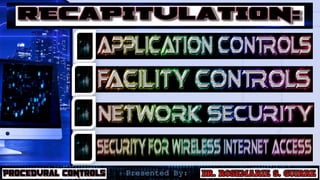
  • #4 APPLICATION CONTROLS IPOS FACILITY CONTROL 1. Network Security 2. Physical Protection Controls 3. Biometric Controls 4. Computer-Failure Controls NETWORK SECURITY Encryption Authentication Message integrity Digital signatures Digital certificates Public key infrastructure (PKI) Security for wireless internet access 1. Service set identifiers (SSID) 2. Wired Equivalent Privacy (WEP): 3. Wi-Fi Protected Access (WPA)