ERP Life Cycle
ERP Implementation Life Cycle is the process of
implementation of the enterprise resource planning
in any organization. It involves many steps and
stages right from the start, planning for project
implementation, analysis, design, implementation,
transition and operations. ERP implementation
lifecycle highlights the different phases of
implementing an ERP system. It starts from the
projection of the ideal ERP package that is suitable
for the company. The steps involved in the life cycle
of the ERP implementation are:
ERP Life Cycle
ERP Life Cycle
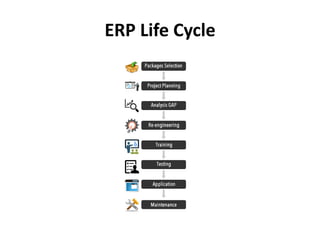
• Selection of packages: This is the first step of the life cycle where the
perfect ERP package has to be selected in agreement that fits your
business environment. In the selection process, ERP packages that are not
suitable they are eliminated. The package has to be carefully selected and
testified. The right choice will determine the success of the ERP
implementation. A proper study and research should be done before the
selection.
• Project Planning: Proper planning of the implementation process of the
project shall be made and designed. Resources should be allocated and
the team members have to be selected.
• Analysis GAP: GAP analysis is an important step in the life cycle of ERP
implementation step. GAP analysis is performed to analyze the current
situation of the organization and its future position as needed.
• Re-engineering is needed to make the implementation process involves
many changes and alterations. The job responsibilities of employees and
the number of employees can be altered as well. This step is done to make
the business process more efficient.
ERP Life Cycle
• Training: Training of employees starts with the implementation process in
the life cycle of the ERP implementation. Employees of getting used to the
new system in order to run the system smoothly later. Get the time at this
stage to learn the software and its features and become self-sufficient in
order to be able to operate later, when consultants and suppliers to end
and go.
• Testing: Testing is an important step and is carried out so that the errors
can be found and resolved before the actual application process.
• Application: This step is performed when data conversion is done and the
work of the database is over. After setup and testing is completed, the
actual implementation is done. Once the new system is implemented, the
old system is removed. The end user is trained on how to use the new
system.
• Maintenance: Maintenance is carried out in the post-implementation life
cycle of ERP implementation phase. The problems are identified and
employees learn how to deal with it. Maintenance is also an important
stage in the life cycle.
ERP Life Cycle
• These are the stages of ERP project goes
through a cycle of life of
the ERP implementation. It is important to
complete these steps with attention to detail
in order to run the ERP project successfully.
After the application is done, maintenance is
also important and the system must be
regular updates to keep up with changes in
technology.

Unit 6 erp life cycle

  • 1.
    ERP Life Cycle ERPImplementation Life Cycle is the process of implementation of the enterprise resource planning in any organization. It involves many steps and stages right from the start, planning for project implementation, analysis, design, implementation, transition and operations. ERP implementation lifecycle highlights the different phases of implementing an ERP system. It starts from the projection of the ideal ERP package that is suitable for the company. The steps involved in the life cycle of the ERP implementation are:
  • 2.
  • 3.
    ERP Life Cycle •Selection of packages: This is the first step of the life cycle where the perfect ERP package has to be selected in agreement that fits your business environment. In the selection process, ERP packages that are not suitable they are eliminated. The package has to be carefully selected and testified. The right choice will determine the success of the ERP implementation. A proper study and research should be done before the selection. • Project Planning: Proper planning of the implementation process of the project shall be made and designed. Resources should be allocated and the team members have to be selected. • Analysis GAP: GAP analysis is an important step in the life cycle of ERP implementation step. GAP analysis is performed to analyze the current situation of the organization and its future position as needed. • Re-engineering is needed to make the implementation process involves many changes and alterations. The job responsibilities of employees and the number of employees can be altered as well. This step is done to make the business process more efficient.
  • 4.
    ERP Life Cycle •Training: Training of employees starts with the implementation process in the life cycle of the ERP implementation. Employees of getting used to the new system in order to run the system smoothly later. Get the time at this stage to learn the software and its features and become self-sufficient in order to be able to operate later, when consultants and suppliers to end and go. • Testing: Testing is an important step and is carried out so that the errors can be found and resolved before the actual application process. • Application: This step is performed when data conversion is done and the work of the database is over. After setup and testing is completed, the actual implementation is done. Once the new system is implemented, the old system is removed. The end user is trained on how to use the new system. • Maintenance: Maintenance is carried out in the post-implementation life cycle of ERP implementation phase. The problems are identified and employees learn how to deal with it. Maintenance is also an important stage in the life cycle.
  • 5.
    ERP Life Cycle •These are the stages of ERP project goes through a cycle of life of the ERP implementation. It is important to complete these steps with attention to detail in order to run the ERP project successfully. After the application is done, maintenance is also important and the system must be regular updates to keep up with changes in technology.