Management
Information
System
in
Manufacturing
Sector
Raghav
Grover
2014215
Pritam
Pandey
2014205
Rachna
Verma
2014214
Rashi
Srivastava
2014222
Group 6
Members
“According to some economists,
manufacturing is a wealth-producing
sector of an economy, whereas
a service sector tends to be wealth-
consuming sector.”
Agglomeration of industries engaged in
chemical, mechanical, or
physical transformation of materials,
substances,
or components into consumer or industri
al goods.
Definition of Manufacturing Sector
Introduction
Source:www.businessdictionary.com/definition/manufacturing-sector.html
Global Manufacturing Sector
World manufacturing
industry and type of
economy:
Capitalist economy
Collectivist economy
Modern economy
• China ranked most competitive
manufacturing nation in the world
• China exports toys, apparel &
electronic products
• Germany is the 2nd & US is 3rd most
competitive in this sector
• India & Brazil moving up to capture
2nd & 3rd slot
• The market in this sector demands
Talent-driven Innovation
• Japan has fallen down to the 10th
position in this field once a leader.
Source: http://www.cimaglobal.com/The-global-manufacturing-sector-current-issues
Indian Manufacturing Sector
• According to India Brand
Equity Foundation, India’s
manufacturing sector
contributes about 16% to GDP
• India was ranked the 4th most
competitive manufacturing
nation in Deloitte’s Global
Index for 38 nations
• India`s manufacturing sector
can reach US$ 1 trillion by
2025, as predicted by McKinsey
& Co.
Source: http://www.financialexpress.com/article/fe-columnist/data-drive-global-lessons-for-
indias-manufacturing/13782/
Transaction Process System
A transaction process system (TPS) is an information processing
system for business transactions involving the collection, modification
and retrieval of all transaction data. Characteristics of a TPS include
performance, reliability and consistency.
Functional aspects of TPS in Toyota as
• Import management system
• Stores management system
• Sales system
Source: http://www.theguardian.com/business/manufacturing-sector
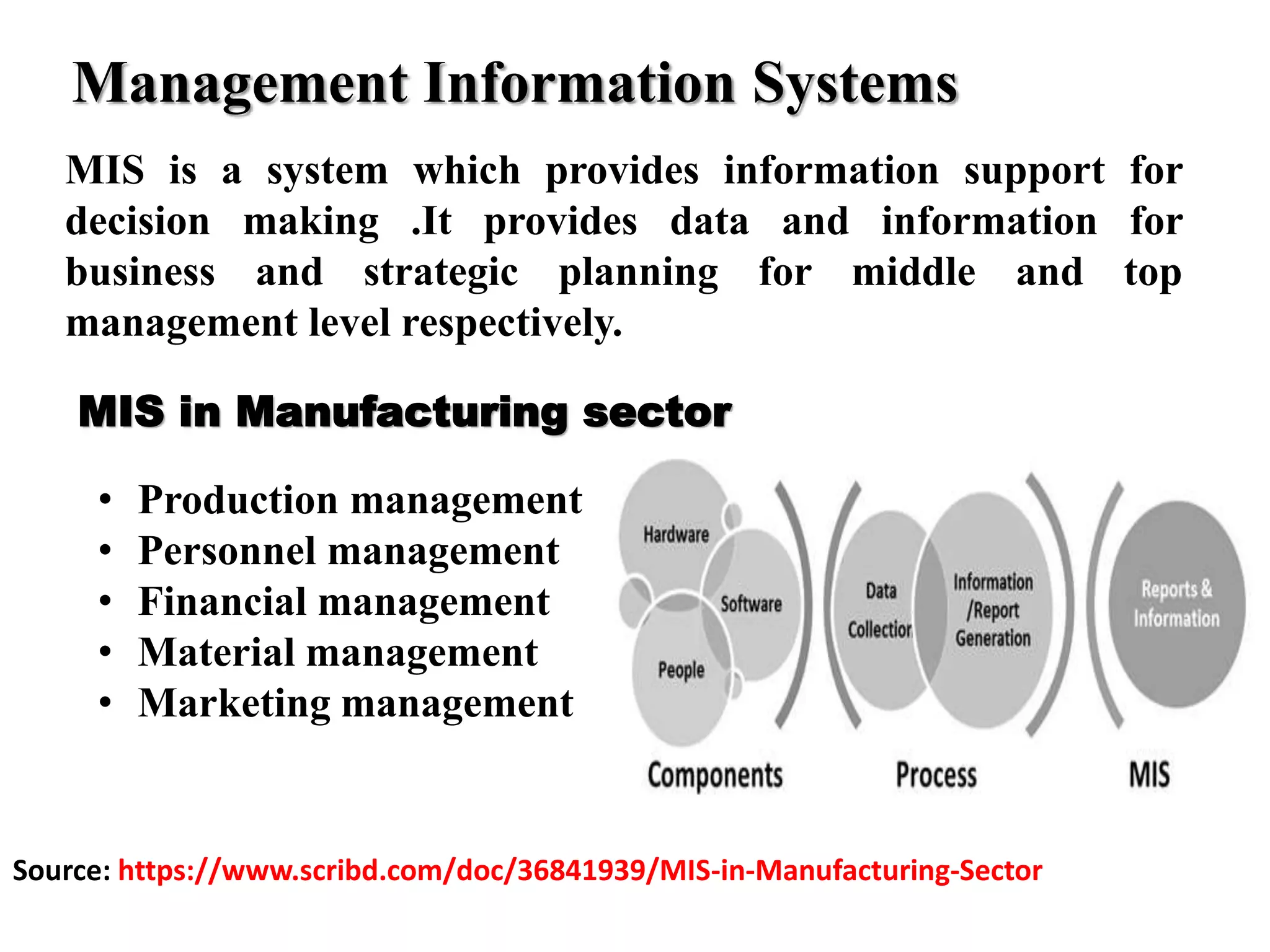
Management Information Systems
MIS is a system which provides information support for
decision making .It provides data and information for
business and strategic planning for middle and top
management level respectively.
MIS in Manufacturing sector
• Production management
• Personnel management
• Financial management
• Material management
• Marketing management
Source: https://www.scribd.com/doc/36841939/MIS-in-Manufacturing-Sector
Decision Support System
• A DSS is a computer-
based information
system that supports
business or
organizational decision-
making activities.
• A DSS is a collection of
integrated software
applications and
hardware that form the
backbone of an
organization’s decision
making process and
help to make decisions,
which may be rapidly
changing and not easily
specified in advance.
Source: http://toyotaprojectteam.blogspot.in/p/information-system-used.html
Toyota uses Warehouse Management
System as its Decision Support System.
It is used due to the fact that knowledge
generated of it is used in decision
making process.
It primarily aims to:
• Control the movement and storage of
materials within a warehouse.
• Process the associated transactions , including
shipping, receiving, put away and picking.
Toyota Warehouse System combined with the
logistics equipment of Toyota Material Handling
Company, they are able to provide customers
with optimized logistics solutions at their
worksite.
Decision Support System in Toyota
Source: http://toyotaprojectteam.blogspot.in/p/information-system-used.html
Knowledge Management System
The knowledge management cycle describes the way in which
knowledge is captured , processed and distributed in an
organization.
Source: http://www.wisegeek.com/what-is-a-knowledge-management-cycle.htm
KMS at Boeing
Boeing defines knowledge management as- Disciplined, holistic
approach to use expertise effectively for competitive advantage.
Different knowledge management systems used at Boeing:
• Integrated defense system
• Internal wiki service
• Your Encore
• Initiatives Database
Source: http://blog.jackvinson.com/archives/2007/10/29/boeing_on_knowledge_management.html
• Integrated Defense System
• Integrated defense system engineering defines the pilot program
where an organization can use assessment tools to identify needs.
• They take results and use elf help translator to review likely scenarios
they’re facing and suggest solutions
• Internal Wiki Service
• For use by employees only on the
Boeing intranet
• Wikis are online collection of
information input by users
• Easy way to share knowledge and
is readily accessible to all users
• The information can be modified
by any user using their web
browser
Source: http://www.boeing.com/news/frontiers/archive/2007/october/cover.pdf
• Your Encore
• Helps to accelerate innovation by leveraging the expertise of retired
engineers and scientists
• They act as consultants to Boeing
• Provide expertise like: key technical support, guidance and independent
analysis, strategic and high level consultations
• Helps Boeing mitigate the potential “brain drain”
• Initiatives Database
• Provides a repository of information
for programs and functions to locate
and replicate best practices
• Senior leaders use to track and
measure their team’s progress
Source: http://www.boeing.com/news/frontiers/archive/2007/october/cover.pdf
STRATEGIC INFORMATION SYSTEM
SIS is an information systems used to prepare strategies that
changes the goals, processes or products to help organization
gain competitive advantage.
Two competitive strategies adopted by Dell:
Differentiation as competitive
advantage for DELL
• Dell computers best known
for distribution
• No middle men
• Customers can log on to the
site from anywhere and
provide specifications for
computer hardware they
require.
Wireless Application Protocol
Wireless Application protocol
(WAP) provides speed as a
competitive advantage for
DELL, allows people to react
immediately from virtually any
place in the world
Source: http://www.umsl.edu/~joshik/msis480/chapt09.htm
Major Threats faced by Toyota:
• Basic Perimeter Protection
• Scheming Malware & Spam
• Monitoring Website Access
• VPN Connectivity
Solutions:
Toyota looked into a number of security products including Checkpoint in
order to address their business challenges. However, after seeing a trial
demo of Cyberoam by Gladstone Technologies Limited, they felt that
Cyberoam was the apparent choice.
The Business benefits of using Cyberoam are as follows: -
• Access and Application Control
• Malware and Spam Free Internet
• Filtering Solution
• Uninterrupted Business Connectivity.
Source: http://www.cyberoam.com/downloads/CaseStudies/ToyotaCaseStudy.pdf
Thank You !

MIS in Manufacturing Sector

  • 1.
  • 2.
    “According to someeconomists, manufacturing is a wealth-producing sector of an economy, whereas a service sector tends to be wealth- consuming sector.” Agglomeration of industries engaged in chemical, mechanical, or physical transformation of materials, substances, or components into consumer or industri al goods. Definition of Manufacturing Sector Introduction Source:www.businessdictionary.com/definition/manufacturing-sector.html
  • 3.
    Global Manufacturing Sector Worldmanufacturing industry and type of economy: Capitalist economy Collectivist economy Modern economy • China ranked most competitive manufacturing nation in the world • China exports toys, apparel & electronic products • Germany is the 2nd & US is 3rd most competitive in this sector • India & Brazil moving up to capture 2nd & 3rd slot • The market in this sector demands Talent-driven Innovation • Japan has fallen down to the 10th position in this field once a leader. Source: http://www.cimaglobal.com/The-global-manufacturing-sector-current-issues
  • 4.
    Indian Manufacturing Sector •According to India Brand Equity Foundation, India’s manufacturing sector contributes about 16% to GDP • India was ranked the 4th most competitive manufacturing nation in Deloitte’s Global Index for 38 nations • India`s manufacturing sector can reach US$ 1 trillion by 2025, as predicted by McKinsey & Co. Source: http://www.financialexpress.com/article/fe-columnist/data-drive-global-lessons-for- indias-manufacturing/13782/
  • 5.
    Transaction Process System Atransaction process system (TPS) is an information processing system for business transactions involving the collection, modification and retrieval of all transaction data. Characteristics of a TPS include performance, reliability and consistency. Functional aspects of TPS in Toyota as • Import management system • Stores management system • Sales system Source: http://www.theguardian.com/business/manufacturing-sector
  • 6.
    Management Information Systems MISis a system which provides information support for decision making .It provides data and information for business and strategic planning for middle and top management level respectively. MIS in Manufacturing sector • Production management • Personnel management • Financial management • Material management • Marketing management Source: https://www.scribd.com/doc/36841939/MIS-in-Manufacturing-Sector
  • 7.
    Decision Support System •A DSS is a computer- based information system that supports business or organizational decision- making activities. • A DSS is a collection of integrated software applications and hardware that form the backbone of an organization’s decision making process and help to make decisions, which may be rapidly changing and not easily specified in advance. Source: http://toyotaprojectteam.blogspot.in/p/information-system-used.html
  • 8.
    Toyota uses WarehouseManagement System as its Decision Support System. It is used due to the fact that knowledge generated of it is used in decision making process. It primarily aims to: • Control the movement and storage of materials within a warehouse. • Process the associated transactions , including shipping, receiving, put away and picking. Toyota Warehouse System combined with the logistics equipment of Toyota Material Handling Company, they are able to provide customers with optimized logistics solutions at their worksite. Decision Support System in Toyota Source: http://toyotaprojectteam.blogspot.in/p/information-system-used.html
  • 9.
    Knowledge Management System Theknowledge management cycle describes the way in which knowledge is captured , processed and distributed in an organization. Source: http://www.wisegeek.com/what-is-a-knowledge-management-cycle.htm
  • 10.
    KMS at Boeing Boeingdefines knowledge management as- Disciplined, holistic approach to use expertise effectively for competitive advantage. Different knowledge management systems used at Boeing: • Integrated defense system • Internal wiki service • Your Encore • Initiatives Database Source: http://blog.jackvinson.com/archives/2007/10/29/boeing_on_knowledge_management.html
  • 11.
    • Integrated DefenseSystem • Integrated defense system engineering defines the pilot program where an organization can use assessment tools to identify needs. • They take results and use elf help translator to review likely scenarios they’re facing and suggest solutions • Internal Wiki Service • For use by employees only on the Boeing intranet • Wikis are online collection of information input by users • Easy way to share knowledge and is readily accessible to all users • The information can be modified by any user using their web browser Source: http://www.boeing.com/news/frontiers/archive/2007/october/cover.pdf
  • 12.
    • Your Encore •Helps to accelerate innovation by leveraging the expertise of retired engineers and scientists • They act as consultants to Boeing • Provide expertise like: key technical support, guidance and independent analysis, strategic and high level consultations • Helps Boeing mitigate the potential “brain drain” • Initiatives Database • Provides a repository of information for programs and functions to locate and replicate best practices • Senior leaders use to track and measure their team’s progress Source: http://www.boeing.com/news/frontiers/archive/2007/october/cover.pdf
  • 13.
    STRATEGIC INFORMATION SYSTEM SISis an information systems used to prepare strategies that changes the goals, processes or products to help organization gain competitive advantage. Two competitive strategies adopted by Dell: Differentiation as competitive advantage for DELL • Dell computers best known for distribution • No middle men • Customers can log on to the site from anywhere and provide specifications for computer hardware they require. Wireless Application Protocol Wireless Application protocol (WAP) provides speed as a competitive advantage for DELL, allows people to react immediately from virtually any place in the world Source: http://www.umsl.edu/~joshik/msis480/chapt09.htm
  • 14.
    Major Threats facedby Toyota: • Basic Perimeter Protection • Scheming Malware & Spam • Monitoring Website Access • VPN Connectivity Solutions: Toyota looked into a number of security products including Checkpoint in order to address their business challenges. However, after seeing a trial demo of Cyberoam by Gladstone Technologies Limited, they felt that Cyberoam was the apparent choice. The Business benefits of using Cyberoam are as follows: - • Access and Application Control • Malware and Spam Free Internet • Filtering Solution • Uninterrupted Business Connectivity. Source: http://www.cyberoam.com/downloads/CaseStudies/ToyotaCaseStudy.pdf
  • 15.

Editor's Notes

  • #14 Competitive Advantage: . The system provides them with the cost and once the order the client accepted the order, it is sent to production where it is assembled. Normally wthin two weeks the machine is delivered to the client. WAP: Speed or rapid response as a competitive advantage includes providing current products quicker, accelerating new product development or improvement, quickly adjusting production processes and making decisions quickly. The growing telecommunications infrastructure and technology, like Wireless Application Protocol (WAP), which allows access to the Internet, email and faxing through the use of a cellular phone, allows business people to react immediately from virtually any place in the world.