Karen Gazith Ph.D. 
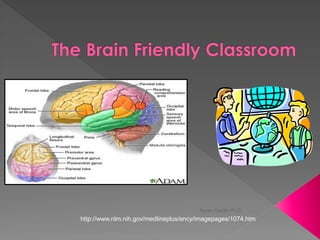
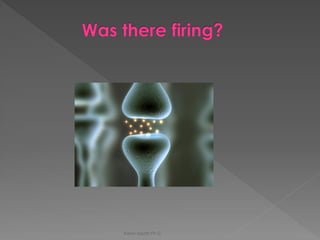
http://www.nlm.nih.gov/medlineplus/ency/imagepages/1074.htm
Karen Gazith Ph.D. 
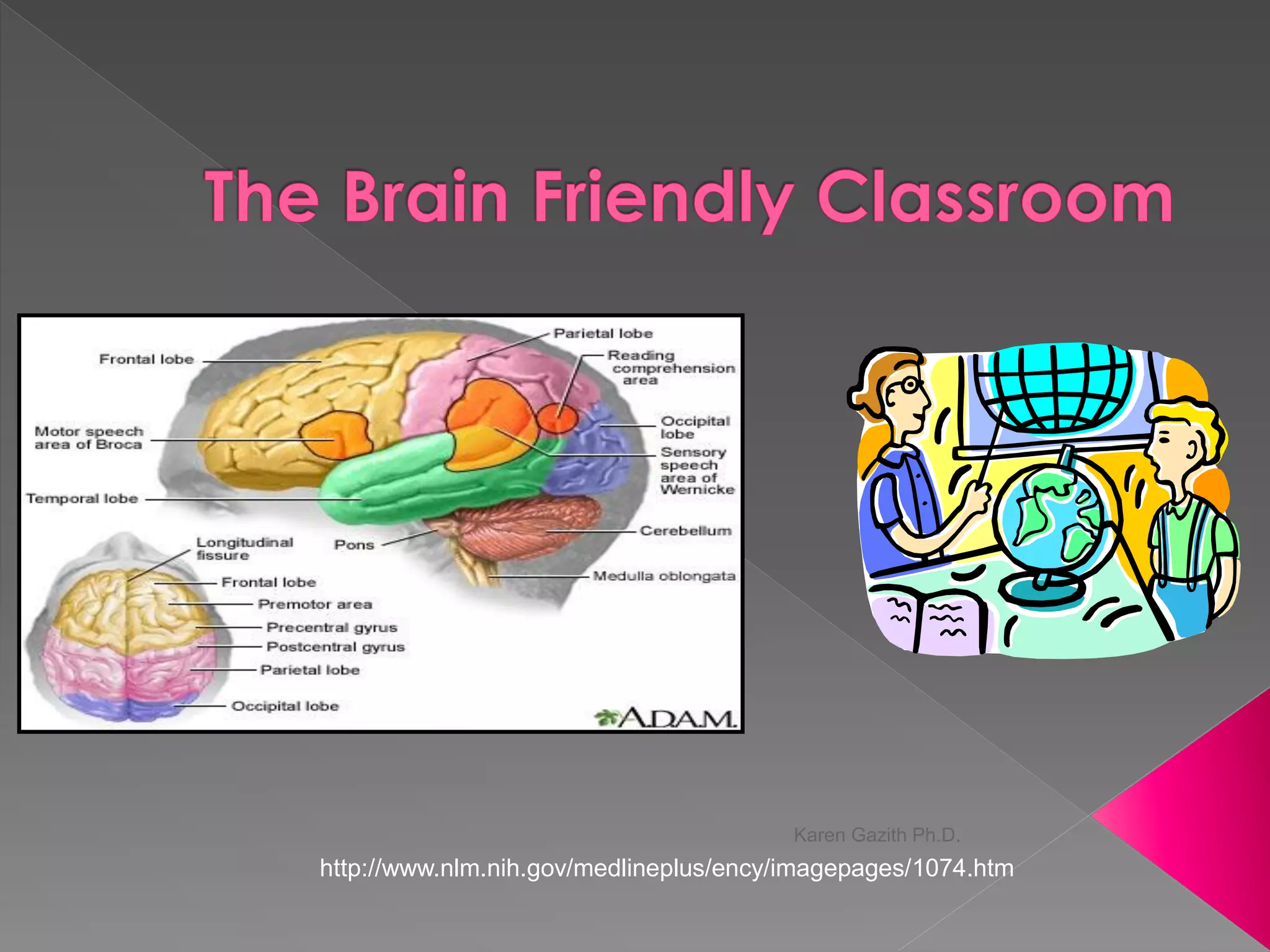
•Work in partners 
•Each partner must think of one piece of challenging information (something you can teach your partner) that you know well but your partner probably doesn’t 
•In passing information to your partner use the following techniques 
http://www.hcc.uce.ac.uk/physiology/pharmacology01.htm
Karen Gazith Ph.D. 
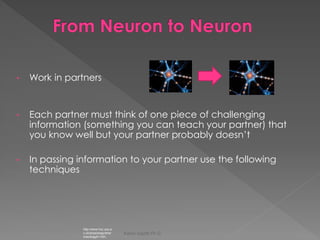
1. Visual Images 
2. Connect to life of your partner 
3. Ensure they are active – doing something not just listening 
4. Assess his/her understanding 
Our Entry Point
Karen Gazith Ph.D.
1.The brain can rewire itself 
2.Emotions are highly connected to learning 
3.Intrinsic rewards create a dopamine effect 
4.Learning is all about building neural networks 
5.Specific functions in the brain are localized in specific regions 
6.http://www.youtube.com/watch?v=gI1BT7E58WU 
Karen Gazith Ph.D.
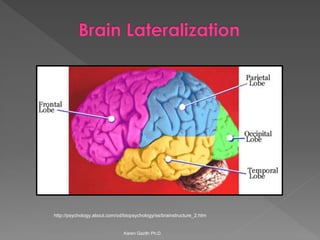
http://psychology.about.com/od/biopsychology/ss/brainstructure_2.htm 
Karen Gazith Ph.D.
•X-Rays – radiation from electromagnetic waves 
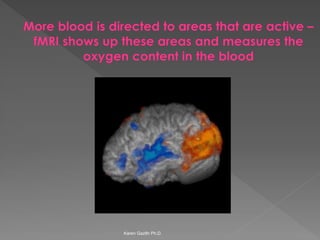
•MRI – magnetic field measuring blood flow 
•PET SCAN – radioactive glucose injected into the subject allowing for observation of tasks 
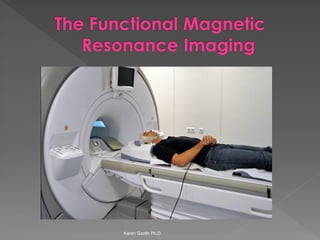
•fMRI – why is this so exciting? 
•Why all the buzz - The field of cognitive science, neuroscience and pedagogy coming together informing teaching and learning 
Karen Gazith Ph.D.
Karen Gazith Ph.D.
Karen Gazith Ph.D.
Karen Gazith Ph.D.
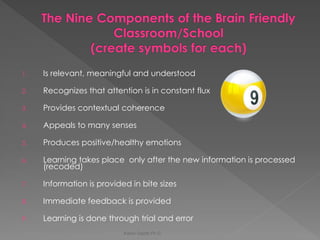
1.Is relevant, meaningful and understood 
2.Recognizes that attention is in constant flux 
3.Provides contextual coherence 
4.Appeals to many senses 
5.Produces positive/healthy emotions 
6.Learning takes place only after the new information is processed (recoded) 
7.Information is provided in bite sizes 
8.Immediate feedback is provided 
9.Learning is done through trial and error 
Karen Gazith Ph.D.
Karen Gazith Ph.D. 
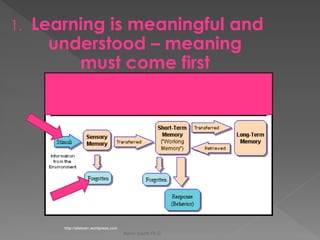
1. Learning is meaningful and understood – meaning must come first 
http://atiekwin.wordpress.com
Explain it before you name it!! 
Karen Gazith Ph.D.
First the gist, then the details 
Organize knowledge around core concepts 
Karen Gazith Ph.D.
Don’t give it a name before you explain what it is. 
Capitalism: Explain it – then name it. 
Karen Gazith Ph.D.
Karen Gazith Ph.D.
Karen Gazith Ph.D.
WHY??????? 
Words, grammar must be put in context 
We communicate for a purpose 
Karen Gazith Ph.D.
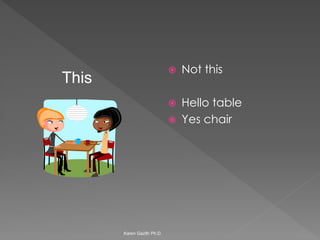
 Not this 
 Hello table 
 Yes chair 
Karen Gazith Ph.D. 
This
Brain is wired for survival 
Our brains have a surveillance and alerting system 
Make it worth it or lose the attention 
Saying pay attention is antagonistic – the brain is wired to attend to its surroundings 
Karen Gazith Ph.D. 
http://www.cartoonstock.com/directory/p/paying_attention.asp
Emotions get our attention!!!! 
Called ECS: Emotionally charged Stimulus 
Karen Gazith Ph.D.
Novelty 
Music 
Laughter – oxygen to the brain 
Movement – neurotropic factors (proteins) that act as miracle grow in the brain. Enhance the growth of new connections (neurogenesis) 
 Remember – the brain attends to whatever calls attention to it. It’s wired that way 
Karen Gazith Ph.D.
What could you do to capture your students’ attention? 
Karen Gazith Ph.D.
The brain is a pattern seeker 
The more information is isolated – the more the brain depends on the rote system of learning 
Make a connection/Tell a story 
Karen Gazith Ph.D. 
3. Learning includes contextual coherence
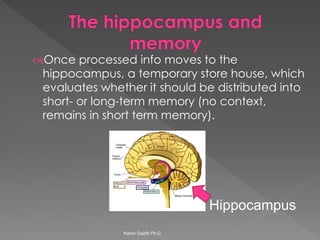
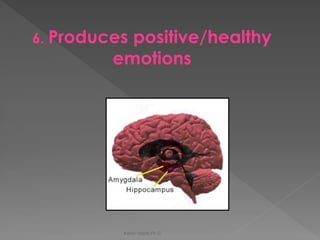
Once processed info moves to the hippocampus, a temporary store house, which evaluates whether it should be distributed into short- or long-term memory (no context, remains in short term memory). 
Hippocampus 
Karen Gazith Ph.D.
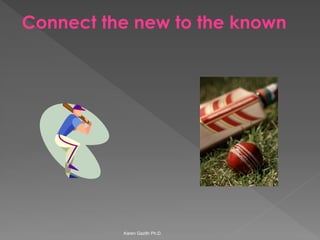
Connect the new to the known 
Karen Gazith Ph.D.
Karen Gazith Ph.D.
The brain seeks patterns making the multiplication tables challenging 
The brain looks for patterns 
›7x8 activates 48, 56, 54…. 
The challenge of learning the times tables - pattern seeking vs correct response 
Karen Gazith Ph.D.
Pattern interference causes problems 
2x3=5 (student sees that is ok) 
2x3=7 (we have no pattern for this) 
Karen Gazith Ph.D.
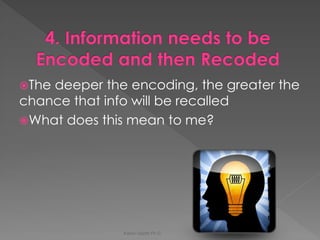
The deeper the encoding, the greater the chance that info will be recalled 
What does this mean to me? 
Karen Gazith Ph.D.
Teacher owns it 
Karen Gazith Ph.D. 
Student owns it
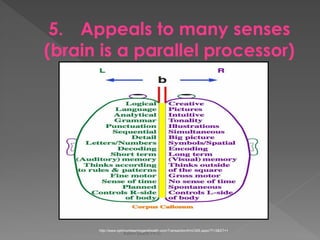
5. Appeals to many senses (brain is a parallel processor) 
Karen Gazith Ph.D. 
http://www.optimumlearningandhealth.com/Transaction/frmCMS.aspx?T=3&ST=1
Karen Gazith Ph.D. 
6. Produces positive/healthy emotions
Karen Gazith Ph.D. 
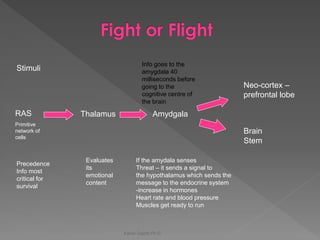
Stimuli 
Thalamus 
Amydgala 
Neo-cortex – prefrontal lobe 
Evaluates its emotional content 
If the amydala senses 
Threat – it sends a signal to 
the hypothalamus which sends the 
message to the endocrine system 
-increase in hormones 
Heart rate and blood pressure 
Muscles get ready to run 
Info goes to the amygdala 40 milliseconds before going to the cognitive centre of the brain 
RAS 
Primitive network of cells 
Precedence Info most critical for survival 
Brain Stem
Karen Gazith Ph.D. 
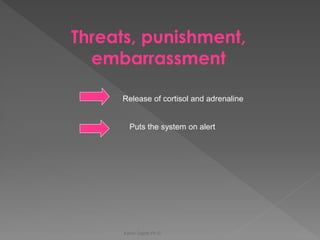
Threats, punishment, embarrassment 
Release of cortisol and adrenaline 
Puts the system on alert
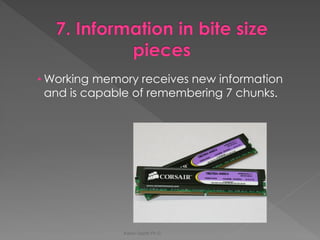
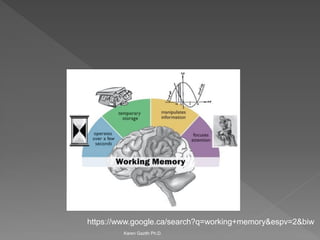
•Working memory receives new information and is capable of remembering 7 chunks. 
Karen Gazith Ph.D.
Karen Gazith Ph.D. 
https://www.google.ca/search?q=working+memory&espv=2&biw
Karen Gazith Ph.D. 
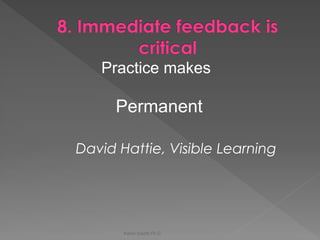
David Hattie, Visible Learning 
Practice makes 
Permanent
Very effective because the brain learns how to make good choices based on data – what worked and what didn’t! 
Karen Gazith Ph.D.
The key points I am taking from this are 
›1. 
›2. 
›3. 
Karen Gazith Ph.D.
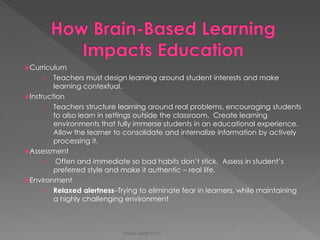
Curriculum 
›Teachers must design learning around student interests and make learning contextual. 
Instruction 
›Teachers structure learning around real problems, encouraging students to also learn in settings outside the classroom. Create learning environments that fully immerse students in an educational experience. Allow the learner to consolidate and internalize information by actively processing it. 
Assessment 
› Often and immediate so bad habits don’t stick. Assess in student’s preferred style and make it authentic – real life. 
Environment 
›Relaxed alertness–Trying to eliminate fear in learners, while maintaining a highly challenging environment 
Karen Gazith Ph.D.
Karen Gazith Ph.D. 
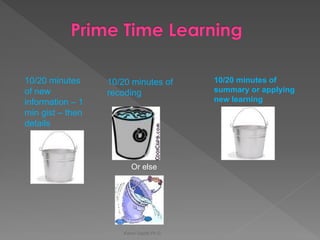
Or else 
10/20 minutes of new information – 1 min gist – then details 
10/20 minutes of recoding 
10/20 minutes of summary or applying new learning
Karen Gazith Ph.D.
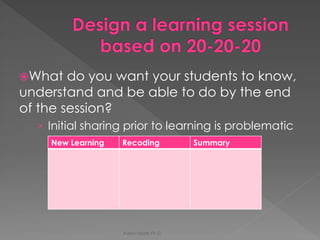
What do you want your students to know, understand and be able to do by the end of the session? 
›Initial sharing prior to learning is problematic 
Karen Gazith Ph.D. 
New Learning 
Recoding 
Summary

Procede-The Brain Friendly Classroom

  • 1.
    Karen Gazith Ph.D. http://www.nlm.nih.gov/medlineplus/ency/imagepages/1074.htm
  • 2.
    Karen Gazith Ph.D. •Work in partners •Each partner must think of one piece of challenging information (something you can teach your partner) that you know well but your partner probably doesn’t •In passing information to your partner use the following techniques http://www.hcc.uce.ac.uk/physiology/pharmacology01.htm
  • 3.
    Karen Gazith Ph.D. 1. Visual Images 2. Connect to life of your partner 3. Ensure they are active – doing something not just listening 4. Assess his/her understanding Our Entry Point
  • 4.
  • 5.
    1.The brain canrewire itself 2.Emotions are highly connected to learning 3.Intrinsic rewards create a dopamine effect 4.Learning is all about building neural networks 5.Specific functions in the brain are localized in specific regions 6.http://www.youtube.com/watch?v=gI1BT7E58WU Karen Gazith Ph.D.
  • 6.
  • 7.
    •X-Rays – radiationfrom electromagnetic waves •MRI – magnetic field measuring blood flow •PET SCAN – radioactive glucose injected into the subject allowing for observation of tasks •fMRI – why is this so exciting? •Why all the buzz - The field of cognitive science, neuroscience and pedagogy coming together informing teaching and learning Karen Gazith Ph.D.
  • 8.
  • 9.
  • 10.
  • 11.
    1.Is relevant, meaningfuland understood 2.Recognizes that attention is in constant flux 3.Provides contextual coherence 4.Appeals to many senses 5.Produces positive/healthy emotions 6.Learning takes place only after the new information is processed (recoded) 7.Information is provided in bite sizes 8.Immediate feedback is provided 9.Learning is done through trial and error Karen Gazith Ph.D.
  • 12.
    Karen Gazith Ph.D. 1. Learning is meaningful and understood – meaning must come first http://atiekwin.wordpress.com
  • 13.
    Explain it beforeyou name it!! Karen Gazith Ph.D.
  • 14.
    First the gist,then the details Organize knowledge around core concepts Karen Gazith Ph.D.
  • 15.
    Don’t give ita name before you explain what it is. Capitalism: Explain it – then name it. Karen Gazith Ph.D.
  • 16.
  • 17.
  • 18.
    WHY??????? Words, grammarmust be put in context We communicate for a purpose Karen Gazith Ph.D.
  • 19.
     Not this  Hello table  Yes chair Karen Gazith Ph.D. This
  • 20.
    Brain is wiredfor survival Our brains have a surveillance and alerting system Make it worth it or lose the attention Saying pay attention is antagonistic – the brain is wired to attend to its surroundings Karen Gazith Ph.D. http://www.cartoonstock.com/directory/p/paying_attention.asp
  • 21.
    Emotions get ourattention!!!! Called ECS: Emotionally charged Stimulus Karen Gazith Ph.D.
  • 22.
    Novelty Music Laughter– oxygen to the brain Movement – neurotropic factors (proteins) that act as miracle grow in the brain. Enhance the growth of new connections (neurogenesis)  Remember – the brain attends to whatever calls attention to it. It’s wired that way Karen Gazith Ph.D.
  • 23.
    What could youdo to capture your students’ attention? Karen Gazith Ph.D.
  • 24.
    The brain isa pattern seeker The more information is isolated – the more the brain depends on the rote system of learning Make a connection/Tell a story Karen Gazith Ph.D. 3. Learning includes contextual coherence
  • 25.
    Once processed infomoves to the hippocampus, a temporary store house, which evaluates whether it should be distributed into short- or long-term memory (no context, remains in short term memory). Hippocampus Karen Gazith Ph.D.
  • 26.
    Connect the newto the known Karen Gazith Ph.D.
  • 27.
  • 28.
    The brain seekspatterns making the multiplication tables challenging The brain looks for patterns ›7x8 activates 48, 56, 54…. The challenge of learning the times tables - pattern seeking vs correct response Karen Gazith Ph.D.
  • 29.
    Pattern interference causesproblems 2x3=5 (student sees that is ok) 2x3=7 (we have no pattern for this) Karen Gazith Ph.D.
  • 30.
    The deeper theencoding, the greater the chance that info will be recalled What does this mean to me? Karen Gazith Ph.D.
  • 31.
    Teacher owns it Karen Gazith Ph.D. Student owns it
  • 32.
    5. Appeals tomany senses (brain is a parallel processor) Karen Gazith Ph.D. http://www.optimumlearningandhealth.com/Transaction/frmCMS.aspx?T=3&ST=1
  • 33.
    Karen Gazith Ph.D. 6. Produces positive/healthy emotions
  • 34.
    Karen Gazith Ph.D. Stimuli Thalamus Amydgala Neo-cortex – prefrontal lobe Evaluates its emotional content If the amydala senses Threat – it sends a signal to the hypothalamus which sends the message to the endocrine system -increase in hormones Heart rate and blood pressure Muscles get ready to run Info goes to the amygdala 40 milliseconds before going to the cognitive centre of the brain RAS Primitive network of cells Precedence Info most critical for survival Brain Stem
  • 35.
    Karen Gazith Ph.D. Threats, punishment, embarrassment Release of cortisol and adrenaline Puts the system on alert
  • 36.
    •Working memory receivesnew information and is capable of remembering 7 chunks. Karen Gazith Ph.D.
  • 37.
    Karen Gazith Ph.D. https://www.google.ca/search?q=working+memory&espv=2&biw
  • 38.
    Karen Gazith Ph.D. David Hattie, Visible Learning Practice makes Permanent
  • 39.
    Very effective becausethe brain learns how to make good choices based on data – what worked and what didn’t! Karen Gazith Ph.D.
  • 40.
    The key pointsI am taking from this are ›1. ›2. ›3. Karen Gazith Ph.D.
  • 41.
    Curriculum ›Teachers mustdesign learning around student interests and make learning contextual. Instruction ›Teachers structure learning around real problems, encouraging students to also learn in settings outside the classroom. Create learning environments that fully immerse students in an educational experience. Allow the learner to consolidate and internalize information by actively processing it. Assessment › Often and immediate so bad habits don’t stick. Assess in student’s preferred style and make it authentic – real life. Environment ›Relaxed alertness–Trying to eliminate fear in learners, while maintaining a highly challenging environment Karen Gazith Ph.D.
  • 42.
    Karen Gazith Ph.D. Or else 10/20 minutes of new information – 1 min gist – then details 10/20 minutes of recoding 10/20 minutes of summary or applying new learning
  • 43.
  • 44.
    What do youwant your students to know, understand and be able to do by the end of the session? ›Initial sharing prior to learning is problematic Karen Gazith Ph.D. New Learning Recoding Summary