The Learning Process
How can understanding our brain influence the way we teach
and learn?
Presentation by Bridget Foy
Produced in Springfield, MA
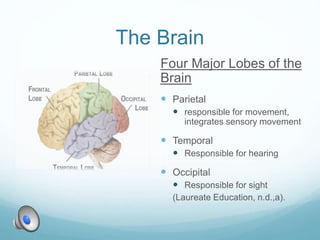
The Brain
Four Major Lobes of the
Brain
 Parietal
 responsible for movement,
integrates sensory movement
 Temporal
 Responsible for hearing
 Occipital
 Responsible for sight
(Laureate Education, n.d.,a).
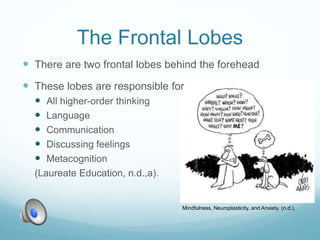
The Frontal Lobes
Mindfulness, Neuroplasticity, and Anxiety. (n.d.).
 There are two frontal lobes behind the forehead
 These lobes are responsible for
 All higher-order thinking
 Language
 Communication
 Discussing feelings
 Metacognition
(Laureate Education, n.d.,a).
Making Connections
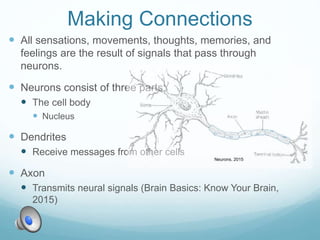
 All sensations, movements, thoughts, memories, and
feelings are the result of signals that pass through
neurons.
 Neurons consist of three parts:
 The cell body
 Nucleus
 Dendrites
 Receive messages from other cells
 Axon
 Transmits neural signals (Brain Basics: Know Your Brain,
2015)
Neurons, 2015
Synapses
 Connection between two neurons in a synapse
 Electrical connection/impulse
 Received by the axon and transmitted by the dendrite
 “The more you activate a connection, the more you increase
the potential of that connection to fire again” (Laureate
Education, n.d.,a).
 The more students practice , the stronger their synapses
become
 Memory improves (Laureate Education, n.d.,a).
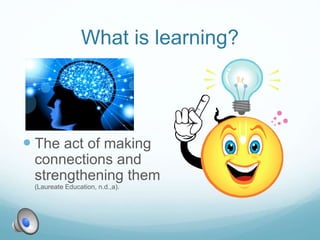
What is learning?
 The act of making
connections and
strengthening them
(Laureate Education, n.d.,a).
How do we apply this information
in the classroom?
 Brain-Based Approaches to Learning
 Helps students become critical thinkers and problem
solvers with the ability to reason
 Cognition
 Metacognition and Feedback
 Individual and Social Factors
(Best Allied Health Programs, 2013)
Emotions
 Emotions
 Play a large part in a student’s ability
and desire to learn
 Joy, pleasure, fear, surprise, disgust,
anger and sadness
 Affect memory
 Increases chemicals in brain leading to
retention (Beers, 2006).
 Can be accomplished by:
 Reading a moving story
 Asking students to write personal
narratives or responses to the stories of
others
 Addressing controversial topics in the
classroom
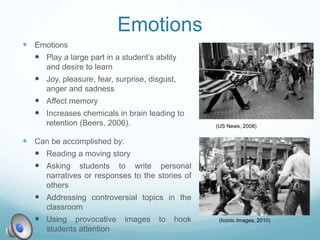
 Using provocative images to hook
students attention
(US News, 2008)
(Iconic Images, 2010)
Meaning and Relevance
 The brain:
 seeks meaningful patterns
 only retains what is relevant
 Teachers must create the network that enables
students to retain pertinent information.
 Two ways of doing this:
 Analogy-hook new information to what students already
know
 Create the experience with a hands on activity
Meaning and Relevance
 Analogies/Metaphors
 Teachers can create metaphors to help students link new
knowledge to prior knowledge (Laureate Education,
n.d.,b).
 Ex. Comparing a Confederation to the relationship between
administrators and classroom teachers
 Ex. Asking students to list their “grievances” against the
administration when studying the Declaration of
Independence
 If students have no prior knowledge, teachers can create
an experience through a hands-on activity (Laureate
Education, n.d.,b).
 Ex. creating a skit using slang from the 1920s
 Ex. Taking a field trip to a historical site or museum
In Conclusion
 New technology is allowing researchers to study the
brain
 Provides insight into how learning occurs.
 This is valuable information as students today need to
think critically by processing and evaluating information
(Beers, 2006).
 Through various teaching strategies, teachers have the
ability to positively shape their students’ brains.
 All brains can change.
References
 Brain Basics: Know Your Brain. (2015, April 17). Retrieved July 8, 2015.
 Iconic Photos. (n.d.). Retrieved July 8, 2015.
 Kingsbury, A. (2008, April 4). A Flag, a Busing Fight, and a Famous
Photograph. Retrieved July 8, 2015.
 Laureate Education (Producer). (n.d.,b). Brain research and learning
[Video file]. Retrieved from https://class.waldenu.edu
 Laureate Education (Producer). (n.d.a). Understanding the brain [Video
file]. Retrieved from https://class.waldenu.edu
 Mindfulness, Neuroplasticity, and Anxiety. (n.d.). Retrieved July 8, 2015.
 Neurons. (n.d.). Retrieved July 8, 2015.

Learning process

  • 1.
    The Learning Process Howcan understanding our brain influence the way we teach and learn? Presentation by Bridget Foy Produced in Springfield, MA
  • 2.
    The Brain Four MajorLobes of the Brain  Parietal  responsible for movement, integrates sensory movement  Temporal  Responsible for hearing  Occipital  Responsible for sight (Laureate Education, n.d.,a).
  • 3.
    The Frontal Lobes Mindfulness,Neuroplasticity, and Anxiety. (n.d.).  There are two frontal lobes behind the forehead  These lobes are responsible for  All higher-order thinking  Language  Communication  Discussing feelings  Metacognition (Laureate Education, n.d.,a).
  • 4.
    Making Connections  Allsensations, movements, thoughts, memories, and feelings are the result of signals that pass through neurons.  Neurons consist of three parts:  The cell body  Nucleus  Dendrites  Receive messages from other cells  Axon  Transmits neural signals (Brain Basics: Know Your Brain, 2015) Neurons, 2015
  • 5.
    Synapses  Connection betweentwo neurons in a synapse  Electrical connection/impulse  Received by the axon and transmitted by the dendrite  “The more you activate a connection, the more you increase the potential of that connection to fire again” (Laureate Education, n.d.,a).  The more students practice , the stronger their synapses become  Memory improves (Laureate Education, n.d.,a).
  • 6.
    What is learning? The act of making connections and strengthening them (Laureate Education, n.d.,a).
  • 7.
    How do weapply this information in the classroom?  Brain-Based Approaches to Learning  Helps students become critical thinkers and problem solvers with the ability to reason  Cognition  Metacognition and Feedback  Individual and Social Factors (Best Allied Health Programs, 2013)
  • 8.
    Emotions  Emotions  Playa large part in a student’s ability and desire to learn  Joy, pleasure, fear, surprise, disgust, anger and sadness  Affect memory  Increases chemicals in brain leading to retention (Beers, 2006).  Can be accomplished by:  Reading a moving story  Asking students to write personal narratives or responses to the stories of others  Addressing controversial topics in the classroom  Using provocative images to hook students attention (US News, 2008) (Iconic Images, 2010)
  • 9.
    Meaning and Relevance The brain:  seeks meaningful patterns  only retains what is relevant  Teachers must create the network that enables students to retain pertinent information.  Two ways of doing this:  Analogy-hook new information to what students already know  Create the experience with a hands on activity
  • 10.
    Meaning and Relevance Analogies/Metaphors  Teachers can create metaphors to help students link new knowledge to prior knowledge (Laureate Education, n.d.,b).  Ex. Comparing a Confederation to the relationship between administrators and classroom teachers  Ex. Asking students to list their “grievances” against the administration when studying the Declaration of Independence  If students have no prior knowledge, teachers can create an experience through a hands-on activity (Laureate Education, n.d.,b).  Ex. creating a skit using slang from the 1920s  Ex. Taking a field trip to a historical site or museum
  • 11.
    In Conclusion  Newtechnology is allowing researchers to study the brain  Provides insight into how learning occurs.  This is valuable information as students today need to think critically by processing and evaluating information (Beers, 2006).  Through various teaching strategies, teachers have the ability to positively shape their students’ brains.  All brains can change.
  • 12.
    References  Brain Basics:Know Your Brain. (2015, April 17). Retrieved July 8, 2015.  Iconic Photos. (n.d.). Retrieved July 8, 2015.  Kingsbury, A. (2008, April 4). A Flag, a Busing Fight, and a Famous Photograph. Retrieved July 8, 2015.  Laureate Education (Producer). (n.d.,b). Brain research and learning [Video file]. Retrieved from https://class.waldenu.edu  Laureate Education (Producer). (n.d.a). Understanding the brain [Video file]. Retrieved from https://class.waldenu.edu  Mindfulness, Neuroplasticity, and Anxiety. (n.d.). Retrieved July 8, 2015.  Neurons. (n.d.). Retrieved July 8, 2015.