
This is why we entered the profession. The opportunity to be up
in front of children and young adults imparting wisdom is the
vision we’ve all had when we chose to be a teacher. Like any
other profession, there are those skilled in it, as well as, those
whose talents leave a bit to be desired. Just like in those
professions, there are techniques and practices which can assist
you in excelling and providing your student with a rewarding
school year.
In the immortal words of Gunnery Sergeant Thomas Highway, you
must learn how to improvise, adapt and overcome.
You will make mistakes. You will have the wrong answer key, the wrong
word will be used, technology will malfunction. So many outside factors will occur
that will interfere with your lesson. Acknowledge it and let it go!
*Teachers who try to hide behind their mistake end up having more problems and lose
respect of their students.
Remember
 Ask yourself what do you teach?
Avoid saying you teach math or
science or music, but rather you
teacher 7th graders
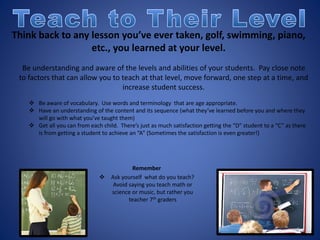
Think back to any lesson you’ve ever taken, golf, swimming, piano,
etc., you learned at your level.
Be understanding and aware of the levels and abilities of your students. Pay close note
to factors that can allow you to teach at that level, move forward, one step at a time, and
increase student success.
 Be aware of vocabulary. Use words and terminology that are age appropriate.
 Have an understanding of the content and its sequence (what they’ve learned before you and where they
will go with what you’ve taught them)
 Get all you can from each child. There’s just as much satisfaction getting the “D” student to a “C” as there
is from getting a student to achieve an “A” (Sometimes the satisfaction is even greater!)
“In reality, there was probably only one good teacher ever created. The rest of
us have stolen ideas from him or her and one another.”
-E Bates
 Teaching can be a very isolated profession.
Collaboration though can be very beneficial,
rejuvenating, and enlightening .
 Teachers can be very generous and happy to
share their successes with others/
So…….STEAL, LISTEN, and LEARN
 Attend conferences, workshops, forums and web sites which chronicle successful practices/
 Find the good teachers in your building and pick their brains. Good mentors will allow their mentee
to view and observe other teachers besides themselves/
*You’ll be amazed at how much you will learn by observing
others. And how much others can learn from you!
*The one who does the doing does the learning!
Lecturing is the least
effective method of
teaching, yet the most
often used.
How did you learn to drive a car? Did
your instructor read from a manual?
We learn by doing!
*Are you “covering” material or teaching it!
There aren’t many adults who owe their successes to that of a textbook, but many who
owe their successes to the influence of a teacher.
 Avoid teaching from the textbook, especially at the lower levels, as it may not follow
the content in a proper sequence. Teachers make the mistake of seeing the textbook
as the definitive curriculum for their district.
 Take the curriculum and determine the best resources to teach that curriculum.
A textbook should be used as a teaching tool, one of several sources.
Ask yourself – if all the textbooks were removed from your classroom ,
would you be able to continue your teaching.
Be a good role model!
 Make it a part of your class rules.
Be courteous, raise your hand, do not yell out answers,
etc.
 Model it yourself.
 Speak in a proper tone, use positive body language,
say “please” and “thank you”.
 Utilize group activities to promote positive social skills
*Weave proper social skills into everything you teach!
Assume nothing! Don’t expect your students to come in with
perfect manners. Don’t assume they know right from wrong.
Don’t assume they’ll work cooperatively and get along with
each other. “Educate” the whole person.
Questioning techniques – use these to determine strengths
Ask all kids questions – ask a colleague to observe and record
questioning patterns.
 “Softballs” – use these with the student who may have difficulty with a particular
topic.
 “Rock Stars” – these are the kids who’ll leave the easy questions for others. They’ll
answer the more challenging questions.
Every single students possesses lots of strengths. Sometimes it’s harder to find in some,
but they are there.
Focus on strengths that may be non educationally related if necessary (i.e. good
manners, effort, etc.)
When implementing classroom management activities in your classroom, REMEMBER…
 Assign groups that have varying ability levels (assign each student a different job).
 Monitor behaviors to see that they are appropriate.
 Keep noise level under control by circulating throughout room.
This requires a lot of work and effort on the teachers part. Teachers need to have a solid classroom
management plan in place BEFORE implementing cooperative learning activities
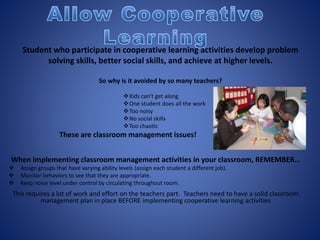
Student who participate in cooperative learning activities develop problem
solving skills, better social skills, and achieve at higher levels.
So why is it avoided by so many teachers?
Kids can’t get along
One student does all the work
Too noisy
No social skills
Too chaotic
These are classroom management issues!
“When are we ever gonna
have to use this?”
“All knowledge is relational.”
Aristotle
 In order for us to learn, we must have something we already
“know” with which to connect the new skill.
 When work “makes sense”, students have a purpose of
doing it. If it doesn’t seem meaningful, we close our minds
to it.
Find the application
Examples : Middle school math students can see the relevance of coordinate geometry when it’s
applied to the job an air traffic controller performs. Students can see applications of % when it’s
applied to how they shop.
Tell stories – students will relate to a topic when it’s connected to a story that may have been important to you.
*If you cannot come up with a real-life application to a particular topic, get rid of that
topic!
In most classes it’s a necessary evil, but assign
in moderation. It should NOT be meant as a
punishment!
Homework should be reflective of that days lesson
and should be meaningful and doable.
It should be assigned so that you as a teacher can
assess mastery of that particular topic.
It on average should not take the child more than
20 minutes to complete (If it exceeds that, build
time into the end of your class to begin the
assignment.)
Communicate with your colleagues to see what else is being assigned. If you
team teach, create a “team calendar,” so that both students and colleagues can see
important items throughout the month. You can then plan your assessments and
assignments accordingly so as to not overwhelm students or create conflicts with
others assessments.
Helpful hint: When creating an assignment, set aside 2-3 additional questions related to
that topic. Do this for each assignment and you’ll have a bank of questions to use on tests
and quizzes.
Students need to “see” what the process looks like and listen as the teacher “thinks aloud”
and models the thought process that goes into completing a task.
Use guided notes and examples
Conduct “reviews” of the concept in a basic sense via discussion
*Imagine teaching someone how to ride a bike without ever showing them what riding a bike “looks” like.
Model your skills as well
Use proper grammar and spelling.
Avoid saying “I was never any good at….”
Provide clear and legible notes (If you have poor handwriting, then TYPE them out!)
*Teaching of any manner, requires modeling. So model, model, model! Create a “light
of understanding” in your students minds.
Find your niche.
 Let kids know what
they’ll expect of you
during their time in
your class. With
clear rules and
expectations, you
can allow yourself to
have fun with the
kids.
Let kids see the
lighter side of
you. The human
side.
 You don’t “plug” a
cord into your head
and go into your
cabinet at days
end.
*Lighten up. Don’t take yourself so seriously and add some fun to your school day.
“I hear and I forget. I see and I remember. I do and I understand.”
Chinese Proverb
 Get kids up and involved
 Simulations
 Problems on board
 Reading instructions/passages
*What students hear in the classroom will go in one ear and out the other. What they’ll see
they’ll tend to remember, but what they actually have to do, they’ll learn, and that learning
will stick with them.
 Create an environment in your teaching that increases active
student participation, higher interest levels , the opportunity for
meaningful learning, and last but not least, decreases boredom
Often times we as teachers assume too much. Just because a student knows an answer or
can memorize a piece of information, we assume they understand. Know and applying
information are 2 different things.
Critical thinking involves problem
solving, which creates
understanding of a topic.
Ex: Remembering “dates” or
the historical reference
behind them.
Regurgitating a formula or
having a true understanding
as to how it’s derived.
Don’t be afraid to go off topic
if it stimulates
discussion….but bring them
back.
 Make an effort in your teaching to switch from stating fact after fact and instead encourage students to think
critically.
 Once they understand the concept, the facts become meaningful. Students delve deeper into concepts and
remain in a questioning mode throughout the lesson
*You want to create a class of students that will question you, that will ask the “what if” question.
“Authentic” means “real” or “valid.” So assess kids in a way of knowing whether or not
your students have attained a particular skill.
 On a vocabulary test, reciting definitions mean nothing. Have the students “use the
words.
 A test on the scientific method should not just require students to list the steps, but
also apply the method in an experiment.
 In a lesson involving laws of exponents, students should not just be able to recite the
laws, but use them to prove why anything to the zero power = 1.
*Would a written exam in
swimming determine
whether or not you’re a good
swimmer?
*If you want to know if a
person can cook, have them
cook something for you.
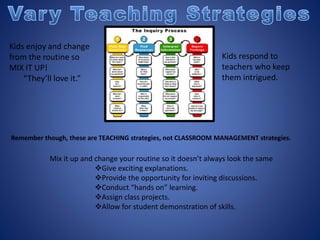
Kids enjoy and change
from the routine so
MIX IT UP!
“They’ll love it.”
Kids respond to
teachers who keep
them intrigued.
Remember though, these are TEACHING strategies, not CLASSROOM MANAGEMENT strategies.
Mix it up and change your routine so it doesn’t always look the same
Give exciting explanations.
Provide the opportunity for inviting discussions.
Conduct “hands on” learning.
Assign class projects.
Allow for student demonstration of skills.
Sometimes the right decision isn’t the easiest. There will be days when you’re
exhausted and will be tempted to take the easy way out, showing a video, giving a
multiple choice test using a scantron. It’s human nature. DON’T GIVE IN to the
temptation.
Always ask yourself: “Is what I’m doing in the best interests of my students?”

Teaching and instruction

  • 1.
    This is whywe entered the profession. The opportunity to be up in front of children and young adults imparting wisdom is the vision we’ve all had when we chose to be a teacher. Like any other profession, there are those skilled in it, as well as, those whose talents leave a bit to be desired. Just like in those professions, there are techniques and practices which can assist you in excelling and providing your student with a rewarding school year.
  • 2.
    In the immortalwords of Gunnery Sergeant Thomas Highway, you must learn how to improvise, adapt and overcome. You will make mistakes. You will have the wrong answer key, the wrong word will be used, technology will malfunction. So many outside factors will occur that will interfere with your lesson. Acknowledge it and let it go! *Teachers who try to hide behind their mistake end up having more problems and lose respect of their students.
  • 3.
    Remember  Ask yourselfwhat do you teach? Avoid saying you teach math or science or music, but rather you teacher 7th graders Think back to any lesson you’ve ever taken, golf, swimming, piano, etc., you learned at your level. Be understanding and aware of the levels and abilities of your students. Pay close note to factors that can allow you to teach at that level, move forward, one step at a time, and increase student success.  Be aware of vocabulary. Use words and terminology that are age appropriate.  Have an understanding of the content and its sequence (what they’ve learned before you and where they will go with what you’ve taught them)  Get all you can from each child. There’s just as much satisfaction getting the “D” student to a “C” as there is from getting a student to achieve an “A” (Sometimes the satisfaction is even greater!)
  • 4.
    “In reality, therewas probably only one good teacher ever created. The rest of us have stolen ideas from him or her and one another.” -E Bates  Teaching can be a very isolated profession. Collaboration though can be very beneficial, rejuvenating, and enlightening .  Teachers can be very generous and happy to share their successes with others/ So…….STEAL, LISTEN, and LEARN  Attend conferences, workshops, forums and web sites which chronicle successful practices/  Find the good teachers in your building and pick their brains. Good mentors will allow their mentee to view and observe other teachers besides themselves/ *You’ll be amazed at how much you will learn by observing others. And how much others can learn from you!
  • 5.
    *The one whodoes the doing does the learning! Lecturing is the least effective method of teaching, yet the most often used. How did you learn to drive a car? Did your instructor read from a manual? We learn by doing!
  • 6.
    *Are you “covering”material or teaching it! There aren’t many adults who owe their successes to that of a textbook, but many who owe their successes to the influence of a teacher.  Avoid teaching from the textbook, especially at the lower levels, as it may not follow the content in a proper sequence. Teachers make the mistake of seeing the textbook as the definitive curriculum for their district.  Take the curriculum and determine the best resources to teach that curriculum. A textbook should be used as a teaching tool, one of several sources. Ask yourself – if all the textbooks were removed from your classroom , would you be able to continue your teaching.
  • 7.
    Be a goodrole model!  Make it a part of your class rules. Be courteous, raise your hand, do not yell out answers, etc.  Model it yourself.  Speak in a proper tone, use positive body language, say “please” and “thank you”.  Utilize group activities to promote positive social skills *Weave proper social skills into everything you teach! Assume nothing! Don’t expect your students to come in with perfect manners. Don’t assume they know right from wrong. Don’t assume they’ll work cooperatively and get along with each other. “Educate” the whole person.
  • 8.
    Questioning techniques –use these to determine strengths Ask all kids questions – ask a colleague to observe and record questioning patterns.  “Softballs” – use these with the student who may have difficulty with a particular topic.  “Rock Stars” – these are the kids who’ll leave the easy questions for others. They’ll answer the more challenging questions. Every single students possesses lots of strengths. Sometimes it’s harder to find in some, but they are there. Focus on strengths that may be non educationally related if necessary (i.e. good manners, effort, etc.)
  • 9.
    When implementing classroommanagement activities in your classroom, REMEMBER…  Assign groups that have varying ability levels (assign each student a different job).  Monitor behaviors to see that they are appropriate.  Keep noise level under control by circulating throughout room. This requires a lot of work and effort on the teachers part. Teachers need to have a solid classroom management plan in place BEFORE implementing cooperative learning activities Student who participate in cooperative learning activities develop problem solving skills, better social skills, and achieve at higher levels. So why is it avoided by so many teachers? Kids can’t get along One student does all the work Too noisy No social skills Too chaotic These are classroom management issues!
  • 11.
    “When are weever gonna have to use this?” “All knowledge is relational.” Aristotle  In order for us to learn, we must have something we already “know” with which to connect the new skill.  When work “makes sense”, students have a purpose of doing it. If it doesn’t seem meaningful, we close our minds to it. Find the application Examples : Middle school math students can see the relevance of coordinate geometry when it’s applied to the job an air traffic controller performs. Students can see applications of % when it’s applied to how they shop. Tell stories – students will relate to a topic when it’s connected to a story that may have been important to you. *If you cannot come up with a real-life application to a particular topic, get rid of that topic!
  • 12.
    In most classesit’s a necessary evil, but assign in moderation. It should NOT be meant as a punishment! Homework should be reflective of that days lesson and should be meaningful and doable. It should be assigned so that you as a teacher can assess mastery of that particular topic. It on average should not take the child more than 20 minutes to complete (If it exceeds that, build time into the end of your class to begin the assignment.) Communicate with your colleagues to see what else is being assigned. If you team teach, create a “team calendar,” so that both students and colleagues can see important items throughout the month. You can then plan your assessments and assignments accordingly so as to not overwhelm students or create conflicts with others assessments. Helpful hint: When creating an assignment, set aside 2-3 additional questions related to that topic. Do this for each assignment and you’ll have a bank of questions to use on tests and quizzes.
  • 13.
    Students need to“see” what the process looks like and listen as the teacher “thinks aloud” and models the thought process that goes into completing a task. Use guided notes and examples Conduct “reviews” of the concept in a basic sense via discussion *Imagine teaching someone how to ride a bike without ever showing them what riding a bike “looks” like. Model your skills as well Use proper grammar and spelling. Avoid saying “I was never any good at….” Provide clear and legible notes (If you have poor handwriting, then TYPE them out!) *Teaching of any manner, requires modeling. So model, model, model! Create a “light of understanding” in your students minds.
  • 14.
    Find your niche. Let kids know what they’ll expect of you during their time in your class. With clear rules and expectations, you can allow yourself to have fun with the kids. Let kids see the lighter side of you. The human side.  You don’t “plug” a cord into your head and go into your cabinet at days end. *Lighten up. Don’t take yourself so seriously and add some fun to your school day.
  • 15.
    “I hear andI forget. I see and I remember. I do and I understand.” Chinese Proverb  Get kids up and involved  Simulations  Problems on board  Reading instructions/passages *What students hear in the classroom will go in one ear and out the other. What they’ll see they’ll tend to remember, but what they actually have to do, they’ll learn, and that learning will stick with them.  Create an environment in your teaching that increases active student participation, higher interest levels , the opportunity for meaningful learning, and last but not least, decreases boredom
  • 16.
    Often times weas teachers assume too much. Just because a student knows an answer or can memorize a piece of information, we assume they understand. Know and applying information are 2 different things. Critical thinking involves problem solving, which creates understanding of a topic. Ex: Remembering “dates” or the historical reference behind them. Regurgitating a formula or having a true understanding as to how it’s derived. Don’t be afraid to go off topic if it stimulates discussion….but bring them back.  Make an effort in your teaching to switch from stating fact after fact and instead encourage students to think critically.  Once they understand the concept, the facts become meaningful. Students delve deeper into concepts and remain in a questioning mode throughout the lesson *You want to create a class of students that will question you, that will ask the “what if” question.
  • 17.
    “Authentic” means “real”or “valid.” So assess kids in a way of knowing whether or not your students have attained a particular skill.  On a vocabulary test, reciting definitions mean nothing. Have the students “use the words.  A test on the scientific method should not just require students to list the steps, but also apply the method in an experiment.  In a lesson involving laws of exponents, students should not just be able to recite the laws, but use them to prove why anything to the zero power = 1. *Would a written exam in swimming determine whether or not you’re a good swimmer? *If you want to know if a person can cook, have them cook something for you.
  • 18.
    Kids enjoy andchange from the routine so MIX IT UP! “They’ll love it.” Kids respond to teachers who keep them intrigued. Remember though, these are TEACHING strategies, not CLASSROOM MANAGEMENT strategies. Mix it up and change your routine so it doesn’t always look the same Give exciting explanations. Provide the opportunity for inviting discussions. Conduct “hands on” learning. Assign class projects. Allow for student demonstration of skills.
  • 19.
    Sometimes the rightdecision isn’t the easiest. There will be days when you’re exhausted and will be tempted to take the easy way out, showing a video, giving a multiple choice test using a scantron. It’s human nature. DON’T GIVE IN to the temptation. Always ask yourself: “Is what I’m doing in the best interests of my students?”