Making Feedback Count
producing good useful feedback
What, Why, How?
Teaching Essentials: https://blogs.shu.ac.uk/teaching/
Course-focused Practice: https://blogs.shu.ac.uk/cfp
Feedback is a key opportunity for
motivating and guiding students
- Black and Wiliam 1998; Sadler 2010
Making Feedback Count: Key ideas
Integrated
 explicitly integrated into curriculum design
and an outcome of all formative and
summative assessments;
 consistent in terms of the student's
experience of their course.
Sheffield Hallam University’s Feedback Protocols
Good feedback is
Making Feedback Count: Key ideas
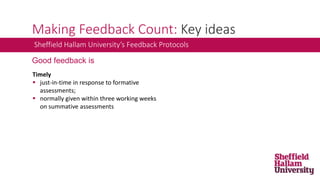
Timely
 just-in-time in response to formative
assessments;
 normally given within three working weeks
on summative assessments
Sheffield Hallam University’s Feedback Protocols
Good feedback is
Making Feedback Count: Key ideas
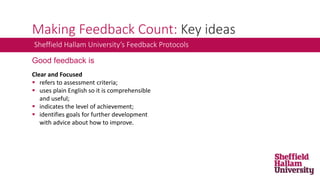
Clear and Focused
 refers to assessment criteria;
 uses plain English so it is comprehensible
and useful;
 indicates the level of achievement;
 identifies goals for further development
with advice about how to improve.
Sheffield Hallam University’s Feedback Protocols
Good feedback is
Making Feedback Count: Key ideas
Sheffield Hallam University’s Feedback Protocols
Good feedback is
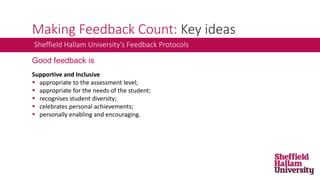
Supportive and Inclusive
 appropriate to the assessment level;
 appropriate for the needs of the student;
 recognises student diversity;
 celebrates personal achievements;
 personally enabling and encouraging.
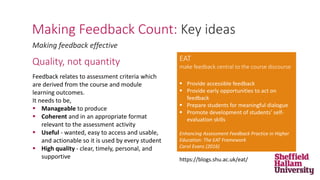
Making feedback effective
Making Feedback Count: Key ideas
Feedback relates to assessment criteria which
are derived from the course and module
learning outcomes.
It needs to be,
 Manageable to produce
 Coherent and in an appropriate format
relevant to the assessment activity
 Useful - wanted, easy to access and usable,
and actionable so it is used by every student
 High quality - clear, timely, personal, and
supportive
EAT
make feedback central to the course discourse
 Provide accessible feedback
 Provide early opportunities to act on
feedback
 Prepare students for meaningful dialogue
 Promote development of students’ self-
evaluation skills
Enhancing Assessment Feedback Practice in Higher
Education: The EAT Framework
Carol Evans (2016)
https://blogs.shu.ac.uk/eat/
Quality, not quantity
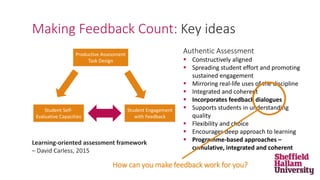
Learning-oriented assessment framework
– David Carless, 2015
Making Feedback Count: Key ideas
Productive Assessment
Task Design
Student Self-
Evaluative Capacities
Student Engagement
with Feedback
Authentic Assessment
 Constructively aligned
 Spreading student effort and promoting
sustained engagement
 Mirroring real-life uses of the discipline
 Integrated and coherent
 Incorporates feedback dialogues
 Supports students in understanding
quality
 Flexibility and choice
 Encourages deep approach to learning
 Programme-based approaches –
cumulative, integrated and coherent
How can you make feedback work for you?
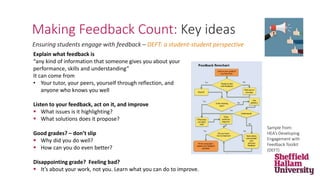
Ensuring students engage with feedback – DEFT: a student-student perspective
Making Feedback Count: Key ideas
Explain what feedback is
“any kind of information that someone gives you about your
performance, skills and understanding”
It can come from
• Your tutor, your peers, yourself through reflection, and
anyone who knows you well
Listen to your feedback, act on it, and improve
 What issues is it highlighting?
 What solutions does it propose?
Good grades? – don’t slip
 Why did you do well?
 How can you do even better?
Disappointing grade? Feeling bad?
 It’s about your work, not you. Learn what you can do to improve.
Sample from:
HEA’s Developing
Engagement with
Feedback Toolkit
(DEFT)
Making Feedback Count: Key ideas
Feedback creates an opportunity to
develop student self-regulation and
a sense of agency over their learning
Beyond just providing
feedback
“get students to clarify their
understandings of feedback e.g. lack
of knowledge; lack of preparation;
misunderstanding of the process and
/or requirements”
“Students’ understanding of feedback and their
capacity to act on it depends on their beliefs,
motives, and established schema”
Feedback as a locus of learning
Feedback needs to have a dual function:
 meeting students’ immediate assessment needs
 developing the knowledge skills and dispositions they
require beyond the module/ programme as part of
lifelong learning
(see Boud, 2000; Hounsell, 2007).
Evans, C. (2016). Evans Assessment Tool (EAT). University of Southampton
We tend to see feedback in isolation, but it can be so much more
Making Feedback Count: Key ideas
Our students told the University’s CAFÉ project feedback should be…
 Consistent in quality across their course…
 …No contradictions or mixed messages in how
assessment and feedback are introduced and
delivered
 Clear… with opportunities for further clarification
 Generally, they want succinct feedback they can take
on board and use
 Generally, they say they want feedforward more than
feedback
 Feedforward needs to be actionable by them.
Is our feedback
practice of a
consistent
quality?
Review these questions – over to you
 Do you agree what you mean by 'good quality feedback’?
 Do you all share a sense of what students perceive 'good quality feedback' to
mean? Do you regularly discuss this and refresh your shared understanding?
 How do I get the balance between feedback and feedforward right?
 How do I know what will be useful to a student later?
 How much feedback is enough?
 How do we and can we produce feedback that is both manageable and of a high
quality?
 How can we ensure the feedback we produce is wanted, easy to access and usable,
and used by every student?
Discussion
We’ve begun the conversation…
Personally
 What do you take from the discussion and what more would you like to find out or
think about?
Collectively
 How can your course team or subject group make use of these ideas
 What further development would be useful for you?
Your Action Plan

Making feedback count

  • 1.
    Making Feedback Count producinggood useful feedback What, Why, How? Teaching Essentials: https://blogs.shu.ac.uk/teaching/ Course-focused Practice: https://blogs.shu.ac.uk/cfp
  • 2.
    Feedback is akey opportunity for motivating and guiding students - Black and Wiliam 1998; Sadler 2010 Making Feedback Count: Key ideas
  • 3.
    Making Feedback Count:Key ideas Integrated  explicitly integrated into curriculum design and an outcome of all formative and summative assessments;  consistent in terms of the student's experience of their course. Sheffield Hallam University’s Feedback Protocols Good feedback is
  • 4.
    Making Feedback Count:Key ideas Timely  just-in-time in response to formative assessments;  normally given within three working weeks on summative assessments Sheffield Hallam University’s Feedback Protocols Good feedback is
  • 5.
    Making Feedback Count:Key ideas Clear and Focused  refers to assessment criteria;  uses plain English so it is comprehensible and useful;  indicates the level of achievement;  identifies goals for further development with advice about how to improve. Sheffield Hallam University’s Feedback Protocols Good feedback is
  • 6.
    Making Feedback Count:Key ideas Sheffield Hallam University’s Feedback Protocols Good feedback is Supportive and Inclusive  appropriate to the assessment level;  appropriate for the needs of the student;  recognises student diversity;  celebrates personal achievements;  personally enabling and encouraging.
  • 7.
    Making feedback effective MakingFeedback Count: Key ideas Feedback relates to assessment criteria which are derived from the course and module learning outcomes. It needs to be,  Manageable to produce  Coherent and in an appropriate format relevant to the assessment activity  Useful - wanted, easy to access and usable, and actionable so it is used by every student  High quality - clear, timely, personal, and supportive EAT make feedback central to the course discourse  Provide accessible feedback  Provide early opportunities to act on feedback  Prepare students for meaningful dialogue  Promote development of students’ self- evaluation skills Enhancing Assessment Feedback Practice in Higher Education: The EAT Framework Carol Evans (2016) https://blogs.shu.ac.uk/eat/ Quality, not quantity
  • 8.
    Learning-oriented assessment framework –David Carless, 2015 Making Feedback Count: Key ideas Productive Assessment Task Design Student Self- Evaluative Capacities Student Engagement with Feedback Authentic Assessment  Constructively aligned  Spreading student effort and promoting sustained engagement  Mirroring real-life uses of the discipline  Integrated and coherent  Incorporates feedback dialogues  Supports students in understanding quality  Flexibility and choice  Encourages deep approach to learning  Programme-based approaches – cumulative, integrated and coherent How can you make feedback work for you?
  • 9.
    Ensuring students engagewith feedback – DEFT: a student-student perspective Making Feedback Count: Key ideas Explain what feedback is “any kind of information that someone gives you about your performance, skills and understanding” It can come from • Your tutor, your peers, yourself through reflection, and anyone who knows you well Listen to your feedback, act on it, and improve  What issues is it highlighting?  What solutions does it propose? Good grades? – don’t slip  Why did you do well?  How can you do even better? Disappointing grade? Feeling bad?  It’s about your work, not you. Learn what you can do to improve. Sample from: HEA’s Developing Engagement with Feedback Toolkit (DEFT)
  • 10.
    Making Feedback Count:Key ideas Feedback creates an opportunity to develop student self-regulation and a sense of agency over their learning Beyond just providing feedback “get students to clarify their understandings of feedback e.g. lack of knowledge; lack of preparation; misunderstanding of the process and /or requirements” “Students’ understanding of feedback and their capacity to act on it depends on their beliefs, motives, and established schema” Feedback as a locus of learning Feedback needs to have a dual function:  meeting students’ immediate assessment needs  developing the knowledge skills and dispositions they require beyond the module/ programme as part of lifelong learning (see Boud, 2000; Hounsell, 2007). Evans, C. (2016). Evans Assessment Tool (EAT). University of Southampton We tend to see feedback in isolation, but it can be so much more
  • 11.
    Making Feedback Count:Key ideas Our students told the University’s CAFÉ project feedback should be…  Consistent in quality across their course…  …No contradictions or mixed messages in how assessment and feedback are introduced and delivered  Clear… with opportunities for further clarification  Generally, they want succinct feedback they can take on board and use  Generally, they say they want feedforward more than feedback  Feedforward needs to be actionable by them. Is our feedback practice of a consistent quality?
  • 12.
    Review these questions– over to you  Do you agree what you mean by 'good quality feedback’?  Do you all share a sense of what students perceive 'good quality feedback' to mean? Do you regularly discuss this and refresh your shared understanding?  How do I get the balance between feedback and feedforward right?  How do I know what will be useful to a student later?  How much feedback is enough?  How do we and can we produce feedback that is both manageable and of a high quality?  How can we ensure the feedback we produce is wanted, easy to access and usable, and used by every student? Discussion
  • 13.
    We’ve begun theconversation… Personally  What do you take from the discussion and what more would you like to find out or think about? Collectively  How can your course team or subject group make use of these ideas  What further development would be useful for you? Your Action Plan

Editor's Notes

  • #2 Feedback is often identified as a problematic area of academic practice. There are a couple of reasons for this: it is an area singled out in the NSS and this means students, across the sector, may have a tendency to focus on memorable aspects of their experience, whether these are good or bad. Secondly, feedback is often understood as a reaction to an event that has been and gone: for the tutor and the student the world has moved on and the opportunity for making feedback count seems to have passed. So when it comes to thinking about feedback it is worth thinking about how feedback can be designed so that it is useful, helpful and memorable.
  • #3 This quote from Black and Wiliam actually identifies the opportunity we are missing if we are not getting it right – we should think of feedback as a key learning opportunity. Let’s begin by considering Sheffield Hallam’s four Feedback Protocols which are based on a wealth of evidence and literature… Sheffield Hallam University’s Feedback Protocols: https://staff.shu.ac.uk/sls/qess/Documents/Good%20Practice%20Feedback%20briefing%20paper.pdf
  • #4 The first protocol is about Integrated feedback. Simply, this means feedback that is designed into the teaching and learning experience – it is not an after thought or an ‘add on’ – it has been designed to help the student learn based on what they have already done, either through formative activities or summative tasks. The second point here, highlights the need for consistency across the course for high quality feedback. This necessitates, therefore, that course teams talk about what good quality feedback looks like, including what is reasonable. On some courses students will receive abundant, detailed feedback from some tutors and much more selective feedback from others. This can create tensions amongst teaching teams as there is no wrong or right about this – other than what actually is going to work best for the course team and the students as a whole. This requires discussion. Sheffield Hallam University’s Feedback Protocols: https://staff.shu.ac.uk/sls/qess/Documents/Good%20Practice%20Feedback%20briefing%20paper.pdf
  • #5 Timeliness is key. This is a sensitive matter because many academics read this as having to turn around copious amounts of feedback within three weeks of a summative assessment. Actually, that perception is usually wrong. Good feedback on summative assessment is often highly selective. But it is timely. The detailed work of giving feedforward on formative activities through normal teaching ahead of summative assessments is probably where the spade work is really needed and potentially most impactful. Feedback is best when it is ‘just-in-time’, but the question then is about when is the best time for feedback or feed forward? There is much practical guidance and support available to help you think through effective strategies. Sheffield Hallam University’s Feedback Protocols: https://staff.shu.ac.uk/sls/qess/Documents/Good%20Practice%20Feedback%20briefing%20paper.pdf
  • #6 Good feedback is clear and focused. It refers to the assessment criteria. Good feedback must be easy to understand. On summative assessment, it should be clear how well the student has done. In terms of ‘making feedback count’, the final point is critical – the feedback needs to be useful. The student needs to know how they can improve. Now is the opportunity to be clear about what the student should pay attention to if they are to be more successful as they progress. Sheffield Hallam University’s Feedback Protocols: https://staff.shu.ac.uk/sls/qess/Documents/Good%20Practice%20Feedback%20briefing%20paper.pdf
  • #7 Sometimes the feedback message may feel like ‘tough love’ – you know if you don’t take the opportunity now to tell them something they should address, then the moment will have passed. However, whatever the message, the tone must be highly supportive – many students know they have not done well and feel anxious about receiving feedback. Your challenge then it to make sure that they want the feedback – they understand that it provides an opportunity to do better by building on the current experience. You should not hide difficult messages, but your tone needs to be reassuring and focussed on how they can improve. Sheffield Hallam University’s Feedback Protocols: https://staff.shu.ac.uk/sls/qess/Documents/Good%20Practice%20Feedback%20briefing%20paper.pdf
  • #8 There have been many national studies about how to improve feedback. They tend to conclude similar things. For example, the Enhancing Assessment Feedback Practice project focused on manageability and coherence. Don’t overwhelm students, keep feedback focussed and manageable for all concerned. In this way students are likely to value it. If you have more to say, communicate this, assuming you are prepared to talk further to students. But don’t overwhelm them. Enhancing Assessment Feedback Practice in Higher Education: The EAT Framework © Carol Evans (2016) https://blogs.shu.ac.uk/eat/
  • #9 David Carless’s work concludes that the most useful and empowering feedback focuses on how the student learns and how they can develop by applying feedback through course-wide opportunities. It’s important that the feedback works for you too, and your module. How can you maximise success on your module? ***Often this is by creating a dialogic culture – for example, using formative activities as an opportunity to clarify misconceptions. Carless, D. (2015). Excellence in university assessment : Learning from award-winning practice. Abingdon: Routledge. Rhetorical question: How can you make feedback work for you?
  • #10 Students have also produced research on what makes good feedback. It is consistent with other research and is obviously worth looking at. They have produced practical guidance. But have you asked your own students what works? This is an obvious step you can take as a course team. Good advice for students from students and staff can be found in the HEA’s Developing Engagement with Feedback Toolkit (DEFT) AUTHORS Dr Naomi E. Winstone - University of Surrey Dr Robert A. Nash - Aston University PUBLISH DATE Tuesday, 6th September, 2016 How to Use Feedback Effectively https://www.heacademy.ac.uk/knowledge-hub/developing-engagement-feedback-toolkit-deft
  • #11 Research on feedback is full of good ideas. Because this is such a hot issue for course success, a focus on feedback practice is likely to lead to far reaching improvement in all aspects of practice.
  • #12 The University continues to work with course teams and their students and we continue to learn a lot about what works. Again the messages are loud and clear. They want feedback… Consistency Clarity, and ‘Feed forward’ feedback they can use to improve their learning *** As a course team, a key question must be “Is our feedback practice of a consistent quality?”